Kakurin-ji
Crane Grove Temple — climb counted in stones
Understand sacred places, explore living traditions, and learn how to engage respectfully with Pilgrim Map.
Access has not been verified. Check current local guidance before planning a visit.
Katsuura, Tokushima Prefecture, Japan
Read the sources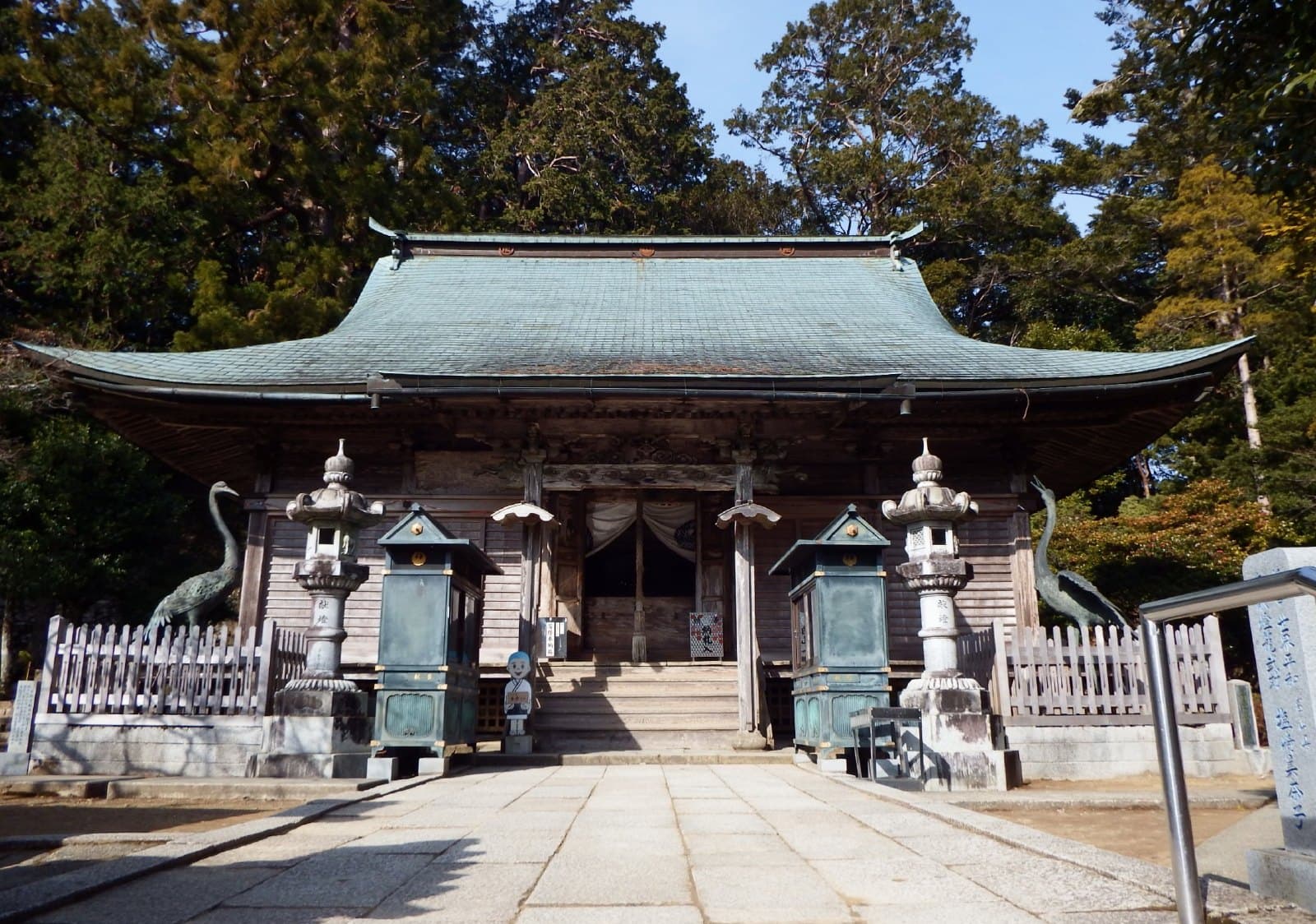
Image of Kakurin-ji (鶴林寺). Image source · CC-BY-SA-4.0
Station 20 of 88
Shikoku 88 Temple PilgrimageVisit essentials
A quick read before you go
- Duration
- Walkers: 4-5 hours one way from the valley; 30-45 minutes in the precinct itself.
- Access
- Address: 14 Hyō, Ikuna, Katsuura-chō, Katsuura-gun, Tokushima 771-4303.
Overview
The trail to Kakurin-ji begins down in the Naka River valley and rises sharply. Twenty-one chō-ishi — Muromachi-period stone pillars, each marking a chō (about 109 metres) of ritual approach — count the climb upward. Pilgrim accounts describe Kakurin-ji as the second-hardest ascent in Tokushima after Temple 12 Shōzan-ji, and the trail has earned the affectionate name pilgrim killer among walkers.
At the top, on a cleared shoulder of Mount Washinō (Vulture Peak, named for the Indian peak where the Buddha is said to have preached the Lotus Sutra), the precinct opens. The Hondō, designated an Important Cultural Property of Japan, sits flanked by two bronze cranes.
The temple's name — Kakurin-ji, Crane Grove Temple — comes from a vision attributed to Kūkai in 798: while practising on the mountain, he is said to have seen a pair of cranes circling and protecting a tiny golden Jizō image. He carved a larger wooden Jizō to enshrine the original within and built the hall on the spot. Cranes recur throughout the precinct: bronze guardians at the Hondō, a stylised circular crane as the temple crest.
The chō-ishi-marked path makes the approach itself part of the practice. Each pillar is a station of progressive interior approach, a kind of mountain rosary. Walkers commonly report a moment of recognition at marker 21 — the body has carried the question this far. The view from the precinct, when clear, reaches to the Pacific and Awaji Island.
For walking pilgrims, Kakurin-ji is often described as the crucible temple of the Awa segment — the place where physical struggle and Jizō's compassion become one reflection. For drivers, who arrive via a paved mountain road, the precinct shifts the henro from urban-edge culture to mountain wildness in a single afternoon. There is no ropeway here — that serves the neighbouring Tairyū-ji at Temple 21.
Why this place is sacred
Where most of the Shikoku 88 are reached quickly, Kakurin-ji refuses that pace. The mountain takes hours to climb, and the chō-ishi count hardship one stone at a time, turning distance into ritual. By the upper markers, cedars are old and the air thinner; bronze cranes at the Hondō, sometimes emerging through mist, hold the eye at the summit.
In Shingon symbolism, the paired cranes embody dharmic guardianship as compassion and wisdom, while the Jizō within the Jizō figures buddha-nature within ordinary form. The mountain does most of the teaching: elevation, isolation, and the long approach create an arrival distinct within the Awa segment. When weather allows, the Pacific view becomes a vista of crossings—the eastern horizon, next leg, and long path ahead.
Founded in 798 CE by Kūkai during his return from Tang China, on Mount Washinō (the Japanese reading of Vulture Peak, where in Indian Buddhist tradition the Buddha preached the Lotus Sutra). Imperial support under Emperor Kanmu followed. The temple's original orientation was toward Jizō Bosatsu's protection of travellers, children, and the dying — fitting for a remote mountain temple where pilgrim hardship is most acute.
The Hondō, preserved across centuries, is now a designated Important Cultural Property of Japan. The pagoda and other structures have been preserved alongside it. The 21 chō-ishi pillars along the trail were added in the Muromachi period, ritualising the approach as a graduated mandala. Today Kakurin-ji is an active Kōyasan Shingon mountain temple receiving pilgrims year-round; the temple office issues nōkyōchō stamps daily.
Experience and orientation
Walkers begin at the foot of the mountain, often from the village of Sakauchi or Ikuna, and follow the marked trail upward. The first chō-ishi appears early; the climb steepens through cedars. The path is steady but demanding — most walkers stop several times. By marker 14 or 15, the cedars are tall and quiet enough that the only sound is footfall and breath, sometimes wind, sometimes cicadas.
At the upper markers, the trail opens onto a cleared shoulder of the mountain. The precinct sits ahead: the Hondō, the Daishidō, the bronze cranes, the small temple office. Pilgrims complete the formal worship — bow, hand-purification, offerings at the Hondō to Jizō Bosatsu, offerings at the Daishidō to Kōbō Daishi, the Heart Sutra, the Kōbō Daishi mantra. Many circumambulate the Hondō and offer additional prayers before the bronze cranes.
A small precinct teahouse, when open, serves tea to weary walkers. Drivers arriving from the paved mountain road skip most of the climb, but a 10-minute uphill walk from the parking lot still introduces the precinct slowly. The summit's atmosphere — often misty in early morning, often clear by midday in autumn — is most of the temple's teaching.
If walking, allow 4-5 hours from the valley to the precinct one way. Carry water and food. Bow at the Niōmon. Purify hands and mouth at the stone basin. Offer at the Hondō first to Jizō Bosatsu, then at the Daishidō to Kōbō Daishi. Drop your osamefuda, light incense, chant or read the Heart Sutra and the Kōbō Daishi mantra.
Walk past the bronze cranes that flank the Hondō and give them an additional small bow if your practice includes that gesture. Receive your nōkyōchō stamp at the temple office. Plan your descent in daylight — the trail is rough underfoot.
Context and lineage
Tradition holds that in 798, returning from Tang China, the young Kūkai climbed Mount Washinō (Vulture Peak namesake of the Indian Ryōjusen) and saw a pair of cranes circling and protecting a tiny golden Jizō image. He carved a larger wooden Jizō to enshrine the original within and built a hall on the spot. The temple thus took its name Kakurin-ji — Crane Grove Temple. Imperial sponsorship followed under Emperor Kanmu.
Across centuries the major halls were rebuilt, but the line of practice continued. The 21 chō-ishi pillars marking the approach were added in the Muromachi period.
Kōyasan Shingon. Kakurin-ji is the 20th of the Shikoku 88 in standard order, on Mount Washinō in Katsuura. Together with Temple 21 Tairyū-ji on the far side of the Naka River valley, it forms one of the most evocative double-mountain segments on the henro.
Kūkai (Kōbō Daishi)
Founder, carver of the principal Jizō
Emperor Kanmu
Imperial patron
Traditions and practice
Goma fire ceremonies on key Shingon dates. Jizō-related memorial services. New Year hatsu-mōde. The temple's elevation and isolation make its liturgical rhythm steadier than the busier valley temples — quiet most of the year, with peaks at New Year and during pilgrim season.
Pilgrim worship at the Hondō and Daishidō. Circumambulation and additional prayers before the bronze cranes that flank the Hondō. Rest and tea at the small precinct teahouse when open. Walkers commonly leave small osamefuda at the chō-ishi markers along the trail — a folk gesture, not formal liturgy.
If you can walk the chō-ishi trail rather than driving, do. The marked stages turn the climb into practice. At the precinct, complete the formal worship at both halls before approaching the bronze cranes. Read the Heart Sutra at each hall; if you know the Kōbō Daishi mantra ('Namu Daishi Henjō Kongō'), include it. Allow time at the bronze cranes — they are an integral part of the temple, not decoration.
Shingon Buddhism (Kōyasan branch)
ActiveKakurin-ji's Jizō devotion threads through Shikoku's broader concern with the protection of travellers, children, and the dying — fitting for a remote mountain temple where pilgrim hardship is most acute.
Standard henro twin-hall worship; veneration of the small (encased) golden Jizō and the larger wooden Jizō; offerings before the paired bronze cranes that flank the Hondō. The chō-ishi-marked approach functions as graduated mountain practice.
Perspectives and open questions
Kakurin-ji's crane legend is a classic Heian/medieval engi (origin tale) pattern — animal protectors revealing a hidden image — but the mountain itself anchors the temple's reception across very different readings.
Scholarly perspective
Religious historians read the crane legend as a typical narrative device by which an existing local cult site was legitimated through a Kūkai-linked story. The chō-ishi pillars confirm the trail's medieval ritualisation; whatever the historical accuracy of the 798 founding, by the Muromachi period the mountain was a fully ritualised pilgrimage approach.
Living and traditional perspectives
Local Katsuura tradition treats the cranes literally — as guardian spirits still tied to the mountain — and the Hondō's bronze cranes as their visible representatives. The crest's stylised round crane is sometimes worn as a charm by pilgrims after their visit, marking that they made the climb.
Alternative interpretations
In esoteric Shingon reading, the paired cranes are dual aspects of dharmic guardianship — compassion and wisdom — and the small Jizō within the larger Jizō figures the buddha-nature within ordinary form. The kakure butsu (hidden buddha) device at the heart of the principal image is a direct Shingon teaching, not just an iconographic curiosity.
Open questions
The exact age and original carving lineage of the principal Jizō are unconfirmed by external scholarship. Whether the small enclosed image still exists is treated as a matter of faith rather than verified fact. The temple's elevation is cited variously as 470 m or 550 m in different mainstream pilgrim resources.
Plan your visit
Access and arrival
Address: 14 Hyō, Ikuna, Katsuura-chō, Katsuura-gun, Tokushima 771-4303. Parking lot near the summit accessed via a paved mountain road (some toll segments); from the parking lot, ~10-minute walk uphill to the Hondō. Walking pilgrims typically come up the chō-ishi trail from the Naka River valley. Phone: 0885-42-3020 (verify). There is no ropeway here — the ropeway serves the neighbouring Tairyū-ji at Temple 21.
No shukubo at Kakurin-ji. Walkers typically stay in Katsuura town, in valley minshuku at the foot of the mountain, or at Tatsue-ji's shukubo (Temple 19) the night before. Some walkers arrange a two-day plan that crosses both Kakurin-ji and Tairyū-ji with a valley overnight in between.
Respectful visit
Hiking-appropriate clothing for walkers. Modest casual for those arriving by car. Pilgrim attire welcomed.
Permitted in the precinct. Interior altar photography typically prohibited. Drone use restricted on the mountain.
Coin, three sticks of incense, one candle, an osamefuda dropped in the wooden box at each hall. Walkers often leave small osamefuda at chō-ishi markers along the trail — a folk gesture rather than formal liturgy.
No camping in the precinct. No fires. Respect the chō-ishi markers — do not lean on or move them (they are prefectural cultural assets). No drones.
The trail is rough underfoot and the descent in late afternoon, particularly in autumn or winter, can become dangerous in fading light. Plan to be off the upper trail before dusk. In summer, carry adequate water; in winter, check for ice. Do not lean on or move the chō-ishi markers — they are prefectural cultural assets.
Current practical details
Address
Washigao-14 Ikuna, Katsuura, Katsuura District, Tokushima 771-4303, Japan
Phone
Hours
Hours, fees, and access can change — verify on the official source before you travel. Practical details last checked Jun 2026.
Location
Map loads as you approach this section.
Pilgrim reflections
A portrait of encounter, not a score
Pilgrims describe what they felt, how present they could become, and whether the place would shape a journey. There are no stars and no ranking of traditions.
No reviewed reflections yet
The first pilgrims can help describe the character of being here.
Share a reflection
Available after an account-backed “Been there.” Every reflection is reviewed before publication.
Watch deeper
Films, episodes, and recorded talks for visitors who want more context before or after a visit. Speculative and alternative-history entries are labelled as perspectives, not as sources for established claims.
Nearby sacred places
Explore other sacred places in the region. Proximity does not establish access or travel time; check each place’s guidance.


References
Sources consulted for this page. Source categories describe the publication, not a guarantee that every claim is verified. Traditional accounts and outside interpretations may differ.
- 01Ryoujyusan Houjyuin Kakurinji – Shikoku 88 Temple Pilgrimage — Shikoku 88 ReijokaiofficialOfficial temple page.
- 02Kakurinji – Katsuura, Tokushima Prefecture, Shikoku — Henro.orgguideCrane legend, chō-ishi markers, founding date 798.
- 03Kakurinji: The 20th Temple on the Shikoku 88 Temple Pilgrimage — East Tokushima TourismguideCultural and trail context.
- 04Temple 20, Kakurin-ji — Shikoku ToursguidePilgrim-killer trail rating, views.
- 05Day 20.1 of the Shikoku Pilgrimage: T20 Kakurinji — Mountain PenguinblogPersonal walking-pilgrim trail report; chō-ishi markers.
- 0620th temple of the Shikoku Pilgrimage, Kakurinji Temple — Shikoku Pilgrimage NewsguideCrane legend variants.
Pilgrim glossary
- Bodhisattva
- An enlightened being who postpones full nirvana to help others toward awakening.
- Mandala
- A symbolic diagram of the cosmos used in meditation and ritual.
- Sutra
- A canonical Buddhist scripture, often chanted as part of practice.
- Mantra
- A sound, word, or phrase repeated as part of meditation or ritual.
- Shingon
- An esoteric Japanese Buddhist school emphasizing ritual, mantra, and mandala practice.
Share a photo
Help visitors recognize Kakurin-ji. Every submission is reviewed before publication.