Fujii-dera
Where Kūkai performed his own yakudoshi rite, Temple 11 of the Shikoku 88
Understand sacred places, explore living traditions, and learn how to engage respectfully with Pilgrim Map.
Access has not been verified. Check current local guidance before planning a visit.
Yoshinogawa, Tokushima Prefecture, Japan
Read the sources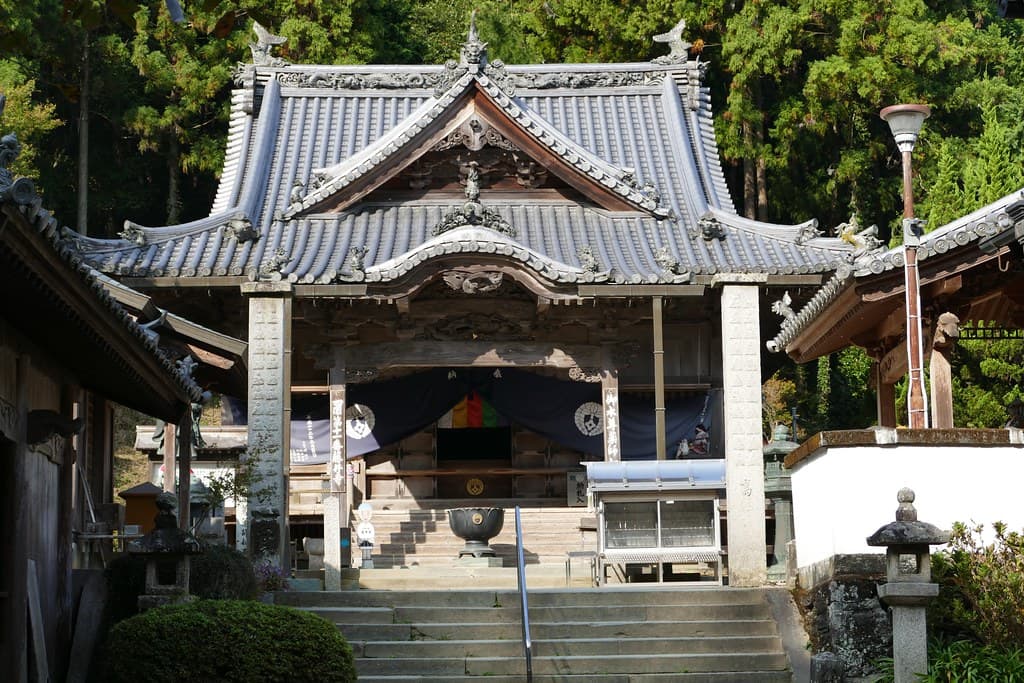
Image of Fujii-dera (藤井寺). Image source
Station 11 of 88
Shikoku 88 Temple PilgrimageVisit essentials
A quick read before you go
- Duration
- 30–60 minutes for the temple itself.
- Access
- Located in Yoshinogawa City, Tokushima Prefecture, in a mountain valley near the Yoshino River.
Overview
Fujii-dera is one of only three Zen temples among the Shikoku 88, and the layered identity is part of what makes it distinctive. The temple was founded in 815 by Kūkai as a Shingon establishment and revived in 1674 as a Rinzai Zen temple of the Myōshinji branch by Nanzan Kokushi, a Zen master deeply trusted by the Lord of Awa.
Both traditions remain visible on the site: the resident community follows Rinzai Zen ritual, while pilgrims continue the standard Shikoku henro chants—Heart Sutra, the Yakushi Nyorai mantra, the Kōbō Daishi mantra. The Yakushi Nyorai principal image, an Important Cultural Property of Japan, carries a Heian-period inscription that makes it the oldest Buddhist statue on the entire pilgrimage route.
The place is shaped by mountains. Three peaks close it in on three sides, and clear streams come down through the valley. Above the temple stands Yatsutatami Rock, where Kūkai is said to have built a goma altar at age 42—the yakudoshi or 'unlucky age' for men in Japanese folk reckoning—and undertaken seventeen days of fire ritual for the elimination of misfortune and the peace of all beings.
He is said to have planted five-coloured wisteria vines in front of the temple, giving the place its name: Fujii-dera, the Wisteria Temple. In late April the wisteria still blooms.
Fujii-dera is also a threshold. The 12-kilometre, 5–8 hour mountain trail from this temple to Shōsan-ji is the route's first true nansho—'difficult place'—and pilgrims often arrive at Fujii-dera the evening before the climb, sleep nearby, and begin the trail at dawn. The temple's quiet halls offer the last rest and prayer before the ascent.
Pilgrims who treat the visit as preparation rather than as a quick stamp-collection often describe Fujii-dera as one of the most inwardly turning temples of the early henro.
Why this place is sacred
Fujii-dera's quality of place comes from convergence rather than from any single dramatic feature. The geography is enclosing—peaks on three sides, streams down the valleys—and the precinct itself is unusually quiet for a temple visited by every walking pilgrim of the Shikoku 88.
Above the precinct lies Yatsutatami Rock, a place of austere ritual memory; the Yakushi Nyorai principal image, dated by inscription to the Heian period, is the oldest Buddhist statue on the route; and the temple's identity bridges two major Buddhist traditions, neither of which has displaced the other.
The wisteria adds a seasonal layer. In late April and early May the vines drop their long racemes of purple flowers in cascading verticals that, in esoteric reading, evoke the bodhisattva ideal of compassion descending into the world. For walking pilgrims, the temple's deepest tonality is its threshold position: a place to set down weight before taking it up again differently on the trail to Shōsan-ji.
Many henro report a subtle interior turning here that persists through the days that follow.
Founded in 815 by Kūkai as a Shingon Buddhist temple, with the principal Yakushi Nyorai (Medicine Buddha) carved by Kūkai during his own 42nd-year yakudoshi (unlucky-age) ritual. The original purpose combined personal austerity (Kūkai's seventeen-day goma fire offering on Yatsutatami Rock) with a public function as a healing-Buddha temple for the surrounding mountain communities.
The temple was destroyed during the Tenshō era (1573–1592) Chōsokabe campaigns and revived in 1674 as a Rinzai Zen temple of the Myōshinji branch by Nanzan Kokushi, under the patronage of the Lord of Awa. This sectarian shift—rare on a Shingon-rooted pilgrimage—did not displace the temple's founding identity; the Yakushi Nyorai principal image and the Shingon pilgrim chant sequence remained. Fire struck again in 1832, and the current buildings were completed in 1860.
The Yakushi Nyorai principal image was designated an Important Cultural Property of Japan based on its Heian-period inscription, which makes it the oldest Buddhist statue on the Shikoku Pilgrimage.
Experience and orientation
Driving pilgrims arrive through Yoshinogawa City and turn off into a narrowing valley. Walking pilgrims come about nine kilometres southeast from Kirihata-ji, crossing the Yoshino River and following the henro path into the foothills. The Niōmon is set against the closing geography of the ridge; behind the gate the precinct opens into a small, dignified compound with old trees, a temizuya, and the standard Hondō and Daishi-dō facing each other.
The atmosphere is noticeably quieter than at the more populated lowland temples. Many pilgrims comment on a particular hush here, especially in the morning.
The ritual sequence is unhurried. Pilgrims chant the Heart Sutra and the Yakushi Nyorai mantra at the Hondō, then move to the Daishi-dō for the Kōbō Daishi mantra. Some climb a short path above the temple to Yatsutatami Rock, where Kūkai's seventeen-day goma fire is said to have taken place. The wisteria, when in bloom, hangs in long curtains in front of the precinct.
For pilgrims preparing to walk to Shōsan-ji, the visit blends with logistics: water bottles refilled, food and snacks checked, weather assessed. Half an hour to an hour is the typical duration for the temple itself; those staying overnight nearby usually visit twice—on arrival, and again at dawn before beginning the trail.
The temple sits at the mouth of a valley with three peaks visible from the precinct. The Niōmon faces the road; the courtyard opens toward the Hondō and Daishi-dō, with the goshuin office near the precinct edge. Behind the temple, a footpath climbs to Yatsutatami Rock and continues into the henro mountain trail toward Shōsan-ji. Wisteria trellises stand near the gate; the principal Yakushi Nyorai is enshrined in the Hondō and is typically not directly visible.
Free parking is available at the temple.
Context and lineage
In 815, Kūkai was drawn to this site for its sacred mountain setting—three peaks closing the valley, clear streams running down the slopes—and chose it for a personal ritual. He was 42 years old, the yakudoshi or 'unlucky age' for men in Japanese folk belief, when misfortune is held to be especially likely.
He carved a Yakushi Nyorai (Medicine Buddha) image and built a goma altar atop Yatsutatami Rock above the temple, where he undertook seventeen days of fire ritual for the elimination of misfortune and for the peace of all beings. He is said to have planted five-coloured wisteria vines in front of the temple, giving it the name Fujii-dera (Wisteria Temple).
Two layers run together at Fujii-dera. The resident sect is Rinzai Zen (Myōshinji branch), one of the major Zen lineages in Japan, descended from the Linji school of Chinese Chan and emphasizing kōan practice and seated meditation. The pilgrimage layer is Shingon: the temple's founding by Kūkai, its Yakushi Nyorai principal image, and its Shingon-rooted chant sequence remain integral to its identity as Temple 11 of the Shikoku 88.
Both traditions are maintained on site and neither has displaced the other.
Kūkai (Kōbō Daishi)
Founder; carver of the Yakushi Nyorai principal image; performer of the 17-day goma rite
Nanzan Kokushi
Rinzai Zen master; reviver of Fujii-dera as a Zen temple in 1674
Traditions and practice
The henro sequence at Fujii-dera follows the standard Shikoku 88 pattern. Pilgrims bow at the Niōmon, purify hands and mouth at the temizuya, and sound the bell once on entry. At the Hondō: osamefuda, candle, three sticks of incense, a small coin in the saisen-bako, the Heart Sutra, and the Yakushi Nyorai mantra: On Korokoro Sendari Matōgi Sowaka. At the Daishi-dō: the same offerings and the Kōbō Daishi mantra: Namu Daishi Henjō Kongō.
Many pilgrims preparing for the trail to Shōsan-ji light additional incense or make further offerings, and some leave a paper slip dedicating the upcoming ascent to a particular intention.
The nōkyō office is open 7:00–17:00 daily. Resident Rinzai Zen practice is maintained by the temple community alongside the pilgrim ritual. The temple supports henro information services, including current trail conditions to Shōsan-ji during the spring and autumn walking seasons. Foreign pilgrims and first-time henro are welcomed; the resident community is accustomed to walkers preparing for the trail.
For pilgrims continuing on foot to Shōsan-ji: this is the place to settle. Fill water bottles, check food, confirm daylight remaining, and—if possible—begin the trail at dawn the next day. For all visitors, climbing the short path above the precinct to Yatsutatami Rock is a worthwhile pause; the rock is associated with Kūkai's seventeen-day goma fire and offers a quiet view back over the valley.
Those uncertain about the chants may simply offer incense and a coin at each hall and read the Heart Sutra silently.
Rinzai Zen Buddhism (Myōshinji branch)
ActiveFujii-dera is one of only three Zen temples among the Shikoku 88. Although founded by Kūkai as a Shingon site, it was revived as Rinzai Zen by Nanzan Kokushi in 1674 under the patronage of the Awa domain lord. The site carries a layered identity bridging Shingon esoteric devotion and Zen meditation.
Rinzai Zen ritual structure governs the resident community, including kōan practice and zazen. Pilgrims continue the Shikoku henro chants (Heart Sutra, Yakushi Nyorai mantra, Kōbō Daishi mantra) at the same halls.
Shingon Buddhism (historical / pilgrimage layer)
ActiveThe temple's founding by Kūkai, the goma altar tradition on Yatsutatami Rock, and its ongoing role as Temple 11 of the Shingon-rooted Shikoku 88 keep the Shingon layer of practice alive even though the resident sect is Rinzai. The Yakushi Nyorai principal image, the oldest Buddhist statue on the entire pilgrimage, retains its Shingon devotional context.
Pilgrims chant Shingon mantras at both halls and follow the standard henro ritual sequence. The Yakushi Nyorai mantra (On Korokoro Sendari Matōgi Sowaka) is offered at the Hondō and the Kōbō Daishi mantra at the Daishi-dō.
Perspectives and open questions
Fujii-dera invites multiple readings: as Shingon founding-place, as Rinzai Zen residence, as the home of the route's oldest Buddhist statue, and as the threshold to the route's first real test of pilgrim resolve.
Scholarly perspective
Historians accept Fujii-dera as an old foundation, though the 815 date and Kūkai attribution remain traditional. The Heian-period inscription on the Yakushi Nyorai gives the image documentary antiquity—the oldest among the Shikoku 88 principal images—and is the strongest historical anchor available. The 1674 sectarian shift to Rinzai Zen under Nanzan Kokushi is well documented through Awa domain records.
Living and traditional perspectives
Within both the Shingon pilgrimage layer and the resident Rinzai Zen community, Fujii-dera is venerated as the place where Kūkai personally enacted yakudoshi exorcism through his seventeen-day goma fire. The act is held up as a model of austere practice undertaken not for personal protection alone but for the salvation of all beings.
Alternative interpretations
Esoteric readings see the temple's three-mountain enclosure as a natural mandala; the goma altar on Yatsutatami Rock as an axis mundi connecting earth and the unmanifest; and the wisteria—blossoming downward in cascading purple racemes—as an image of the bodhisattva ideal of compassion descending into the world. The threshold position before the Shōsan-ji trail is sometimes read as a body-scale enactment of preparation before initiation.
Open questions
The exact location of Kūkai's original goma altar on Yatsutatami Rock is uncertain; subsequent fires (Tenshō era and 1832) destroyed most material evidence. The relationship between the surviving Heian-period Yakushi Nyorai and Kūkai's purported original carving cannot be definitively established. The year of Rinzai revival is given as 1674 by most sources but as 1683 in a few; the discrepancy may reflect distinct stages of the same revival project.
Plan your visit
Access and arrival
Located in Yoshinogawa City, Tokushima Prefecture, in a mountain valley near the Yoshino River. By car: free parking at the temple. On foot: about 9 kilometres southeast from Temple 10 Kirihata-ji along the henro route, crossing the Yoshino River. Nearest train station: JR Kamojima on the Tokushima Line, then taxi or roughly a 30-minute walk.
Pilgrim minshuku (family-run inns) and small ryokan operate in Yoshinogawa City and along the henro route near Fujii-dera. Walking pilgrims typically stay near the temple the night before the Shōsan-ji trail, allowing a dawn start. Direct contact details and current availability should be confirmed in advance through the Shikoku Henro Reijōkai or local pilgrim guides.
Respectful visit
Comfortable walking attire; pilgrim white hakui jackets, sedge hats, and kongō-zue staffs are common but optional. Pilgrims continuing to Shōsan-ji should arrive in proper hiking gear with adequate water and food. Layered clothing is wise—the valley is noticeably cooler than the plain.
Exterior photography of the precinct, gates, and wisteria is welcomed. Avoid flash and direct images of enshrined statues inside the halls. The Yakushi Nyorai principal image is an Important Cultural Property and is typically not photographed even when visible.
Standard pilgrim offerings of osamefuda, candle, incense, and coin at each hall. Many pilgrims also leave a paper slip near the Daishi-dō dedicating the upcoming Shōsan-ji ascent to a particular intention, person, or aspiration.
Ring the bell only on entry. Stay on marked paths to Yatsutatami Rock—the slope is steep and the rock itself is venerated. Do not begin the henro mountain path to Temple 12 late in the day. Do not photograph the Yakushi Nyorai principal image.
Do not begin the henro mountain path to Temple 12 late in the day; the trail is 12 kilometres of demanding hiking, takes 5–8 hours, and arriving after dark is dangerous. The trail is genuinely strenuous in places (the henro-gorogashi sections are steep) and requires proper footwear, water, food, and weather awareness. The Yakushi Nyorai principal image is an Important Cultural Property and is typically not photographed.
Current practical details
Address
1525 Kamojimachō Inoo, Yoshinogawa, Tokushima 776-0033, Japan
Phone
Hours
Hours, fees, and access can change — verify on the official source before you travel. Practical details last checked Jun 2026.
Location
Map loads as you approach this section.
Pilgrim reflections
A portrait of encounter, not a score
Pilgrims describe what they felt, how present they could become, and whether the place would shape a journey. There are no stars and no ranking of traditions.
No reviewed reflections yet
The first pilgrims can help describe the character of being here.
Share a reflection
Available after an account-backed “Been there.” Every reflection is reviewed before publication.
Watch deeper
Films, episodes, and recorded talks for visitors who want more context before or after a visit. Speculative and alternative-history entries are labelled as perspectives, not as sources for established claims.
Nearby sacred places
Explore other sacred places in the region. Proximity does not establish access or travel time; check each place’s guidance.


References
Sources consulted for this page. Source categories describe the publication, not a guarantee that every claim is verified. Traditional accounts and outside interpretations may differ.
- 01Fujii-dera (Yoshinogawa) - Wikipedia — Wikipedia contributorsencyclopediaSect change to Rinzai Zen, Important Cultural Property status of Yakushi Nyorai, history of fires and reconstructions.
- 02Temple 11, Fujiidera|What to See & Do — Shikoku Tourism Promotion OrganizationofficialFounding legend, yakudoshi goma ritual, wisteria etymology.
- 03Fujiidera – Yoshinogawa, Tokushima Prefecture, Shikoku • Henro.org — Henro.orgguidePilgrim guide; access; gateway to the Shōsan-ji henro-gorogashi mountain trail.
- 04Customs and Etiquette of the Shikoku Pilgrimage - Henro.org — Henro.orgguideStandard henro etiquette.
- 05A challenging day hike from Fujii-dera to Shōsan-ji – Henro — Henro.coguide12 km mountain henro path between Temples 11 and 12; 5–8 hour duration.
- 06Fujiidera Temple, the 11th temple of the Shikoku Pilgrimage | Shikoku Pilgrimage News — Shikoku Pilgrimage NewsguideGoma altar on Yatsutatami Rock; 17 days of austerities.
Pilgrim glossary
- Bodhisattva
- An enlightened being who postpones full nirvana to help others toward awakening.
- Mandala
- A symbolic diagram of the cosmos used in meditation and ritual.
- Sutra
- A canonical Buddhist scripture, often chanted as part of practice.
- Mantra
- A sound, word, or phrase repeated as part of meditation or ritual.
- Shingon
- An esoteric Japanese Buddhist school emphasizing ritual, mantra, and mandala practice.
- Zen
- A Japanese Buddhist school emphasizing seated meditation and direct insight.
- Koan
- A paradoxical question used in Zen training to break conceptual thinking.
Share a photo
Help visitors recognize Fujii-dera. Every submission is reviewed before publication.