Hōrin-ji
A reclining Buddha at rest on the Yoshino plain, Temple 9 of the Shikoku 88
Understand sacred places, explore living traditions, and learn how to engage respectfully with Pilgrim Map.
Access has not been verified. Check current local guidance before planning a visit.
Awa, Tokushima Prefecture, Japan
Read the sources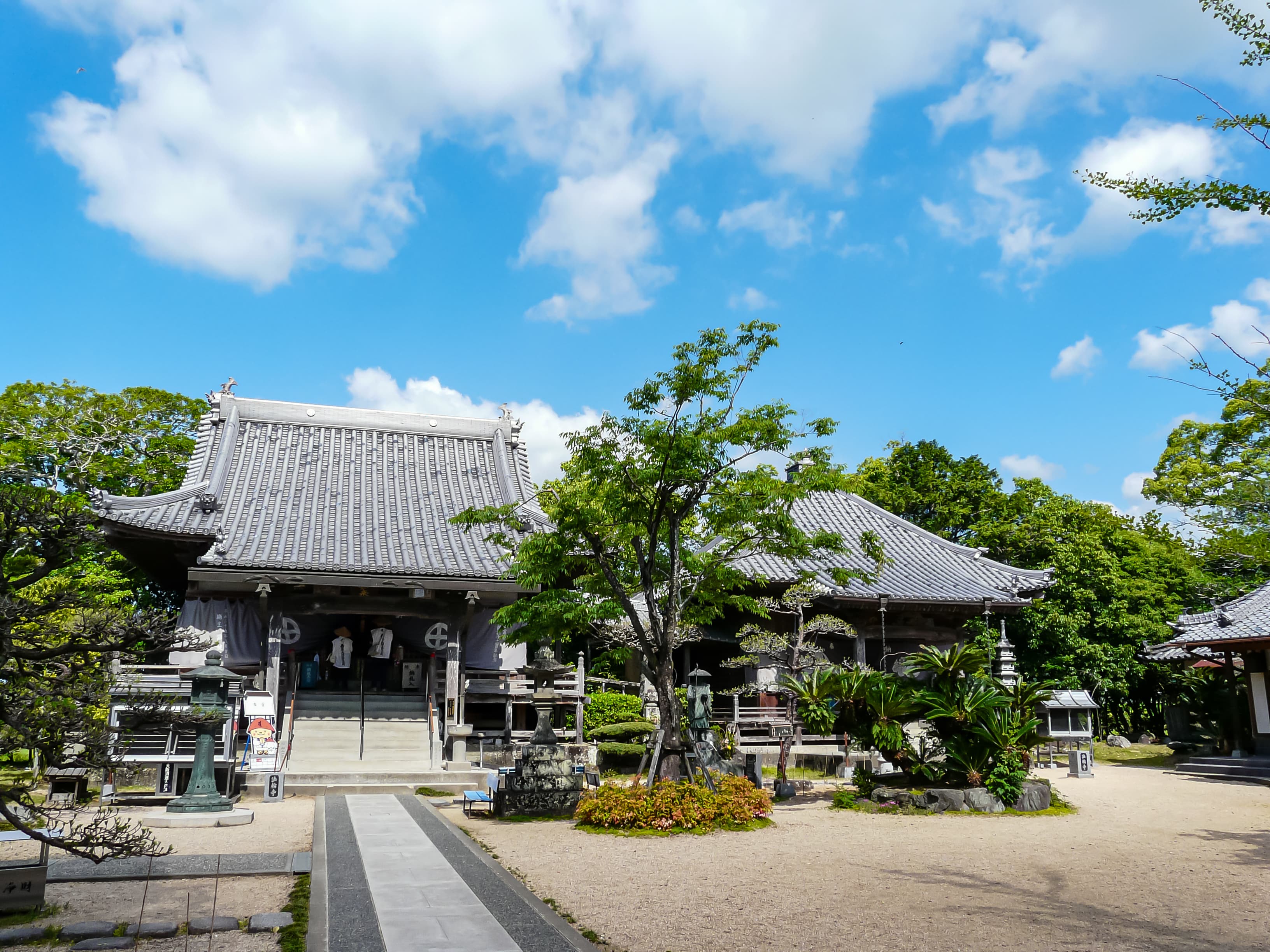
Image of Hōrin-ji (法輪寺). Image source · CC-BY-SA-4.0
Station 9 of 88
Shikoku 88 Temple PilgrimageVisit essentials
A quick read before you go
- Duration
- 30–45 minutes for a thorough visit including chanting at both halls, viewing the cedar grove,…
- Access
- Located in Awa City, Tokushima Prefecture, on flat terrain along the Yoshino River plain.
Overview
Hōrin-ji, Temple 9 of the Shikoku 88, sits low on the Yoshino River plain in Awa. This working Kōya-san Shingon temple has the route's only principal image of Parinirvana Shaka Nyorai: the Buddha entering final liberation, lying on his right side with one hand beneath his head. Where most of the eighty-eight temples show Buddhas standing or seated in active mudra, this one rests, making stillness a marked contrast after neighboring Kumadani-ji's steep approach.
Tradition says Kūkai encountered a white snake here in 815, understood it as a Buddha's messenger, carved the reclining Shaka Nyorai, and founded Hakubazan Hōrin-ji—White Horse Mountain Dharma Wheel Temple—four kilometers north in the Hochigakei mountains. The complex moved to the plain sometime in the seventeenth century. Fires struck in 1582 and 1859, and today's buildings date mainly to the Meiji period.
The reclining Buddha invites contemplation of letting go rather than teaching or awakening. Pilgrims chant the Heart Sutra, Shaka Nyorai's mantra, and the Kōbō Daishi mantra at the Daishi-dō; many feel the pilgrimage's rhythm settle between Temple 9 and Temple 10. The small grounds include the long-remembered Awaji shop near the gate, selling grass mochi and udon. Emperor Meiji presented Kūkai's robe to the temple in 1882, and this relic remains a tangible thread to the founder.
Why this place is sacred
Thinness here is not dramatic. There is no cliff, no climb, no thunderous waterfall. The temple holds its quality through what it does not assert: a low compound, a cedar grove, and at the heart of the Hondō a Buddha who is not standing or teaching but lying down, entering nirvana. Many pilgrims arrive directly from Temple 8 Kumadani-ji, where the approach climbs steeply, and feel the tonal shift.
The Yoshino plain opens around the temple on three sides, mountains visible in the distance, and the long horizontal of the reclining figure inside the Hondō echoes the long horizontal of the land outside.
The rare iconography invites a contemplation specific to this temple. Most Buddhist images are bodies in upright posture—seated meditation, standing welcome, raised mudra. To meet a Buddha in his last lying-down is to meet, gently, the question of how one will set things down at the end.
The white-snake legend layers a second register over this: a kami of the place, manifesting in the form of a serpent, recognized by Kūkai as a messenger and folded into the Buddhist iconography of the site. Shinbutsu-shūgō—the long Japanese practice of weaving native and Buddhist sanctity—lives quietly here, in a temple too small to insist on it.
Founded in 815 by Kūkai as a Buddhist temple of the emerging Shingon esoteric school, dedicated to Shaka Nyorai (Shakyamuni Buddha) in the rare reclining Parinirvana form. The original mountain site (Hakubazan Hōrin-ji, four kilometers north) was a remote Buddhist establishment whose precise function within the early ninth-century religious landscape is not clearly documented but appears to have combined mountain austerity with the veneration of Kūkai's carved image.
The original mountain temple was relocated to the Yoshino plain during the Shōhō era (1644–1648), bringing the principal image into the agricultural landscape where most pilgrims encountered it. Fires in 1582 (during the Tenshō-era Chōsokabe campaigns) and again in 1859 destroyed buildings and likely required replacement of subsidiary images. The current Hondō and Daishi-dō are Meiji-period reconstructions.
In 1882, Emperor Meiji presented a robe of Kūkai to the temple, an imperial gesture that reaffirmed the site's role as a working pilgrim destination during the post-Restoration reorganization of Buddhist institutions. The temple has functioned continuously since then as Temple 9 of the Shikoku 88.
Experience and orientation
Walking pilgrims arriving from Kumadani-ji come along about three and a half kilometers of mostly flat path through rice fields and quiet roads. The transition from temple to temple here is gentle. The Niōmon at Hōrin-ji is a modest gate; the bow at the threshold is the standard one, and the courtyard immediately beyond holds a temizuya for the rinsing of mouth and hands. Cedars give the courtyard its shade.
The Hondō and Daishi-dō face each other in the usual henro arrangement, close enough that a pilgrim can complete the full sequence of chants at both halls without walking far.
What changes the experience is the Hondō's interior. The Parinirvana Shaka Nyorai inside is sometimes a hibutsu—a hidden image—visible only in certain periods, but the orientation of the hall and the iconography it serves shape the room even when the image cannot be directly seen. Pilgrims chant the Heart Sutra and the Shaka mantra here. Some pause longer than they planned.
The shop called Awaji near the gate has been part of the pilgrim's experience of Hōrin-ji for decades; grass mochi and udon are part of how the temple is remembered. The visit takes thirty to forty-five minutes for those completing both halls properly. Drivers and walkers continue west toward Kirihata-ji, about four kilometers further, where the day's work changes character with a long stone staircase up the hill.
The temple sits on flat land in the agricultural plain south of the Yoshino River. The Niōmon faces roughly east; the courtyard opens to the Hondō (north) and the Daishi-dō (typically opposite or adjacent), with the goshuin office near the precinct edge. The shop Awaji and small pilgrim supply stalls cluster near the gate. Paths are level and accessible; there are no steep stairs within the precinct itself.
The cedar grove encircles the precinct on the temple's side away from the road.
Context and lineage
In 815, while traveling through the agricultural country of Awa, Kūkai is said to have encountered a white snake. The snake was understood as a messenger of the Buddha—a recognition that wove the local kami of the place into the new Buddhist cosmology Kūkai was establishing across Shikoku. He carved a reclining Shaka Nyorai by his own hand, depicting the Buddha at parinirvana, and founded a temple to enshrine it.
The original site was named Hakubazan Hōrin-ji, White Horse Mountain Dharma Wheel Temple, and stood four kilometers north of the present location, in the Hochigakei mountains. The relocation to the Yoshino plain came during the Shōhō era (1644–1648), and it is at the present site that pilgrims have approached the temple for the past four centuries.
Kōya-san Shingon: a major branch of Shingon Buddhism descended directly from Kūkai's monastic establishment on Mt. Kōya in Wakayama Prefecture. The school transmits the esoteric teachings of the Mahāvairocana and Vajraśekhara sutras through ritual, mantra, and the lineage of master-to-disciple authorization (kanjō). Hōrin-ji is administratively part of this branch; the resident community maintains the standard Shingon liturgy alongside the pilgrim-specific Shikoku henro chant sequence.
Kūkai (Kōbō Daishi)
Founder and putative carver of the reclining Shaka Nyorai principal image
Emperor Meiji
Imperial patron
Traditions and practice
The henro sequence is the same here as at every Shikoku 88 temple, but the chants take on the particular coloration of the Parinirvana iconography. At the Niōmon, pilgrims bow once toward the temple before crossing the threshold (taking care not to step on the threshold itself). Hands and mouth are rinsed at the temizuya. The bell, if available, is sounded once on entry only—not on departure, which is considered inauspicious.
At the Hondō, pilgrims offer an osamefuda (name slip), light a candle and three sticks of incense, drop a small coin into the saisen-bako, and chant the Heart Sutra followed by the honzon mantra of Shaka Nyorai: Nōmaku Sanmanda Bodanan Baku. They then move to the Daishi-dō and repeat the sequence with the Kōbō Daishi mantra: Namu Daishi Henjō Kongō. The goshuin (red seal) for the pilgrim's nōkyōchō is collected at the stamping office before leaving.
The daily nōkyō office is open from 7:00 to 17:00, the standard hours for all Shikoku 88 temples. Solo and group henro arrive year-round, with notable concentration in spring and autumn. The temple maintains periodic Buddhist memorial services for parishioners. Many contemporary pilgrims—including the steadily growing number of foreign henro—approach the practices without prior Buddhist training, and the temple welcomes silent presence as a valid form of participation.
Pilgrims new to the henro sequence are welcome to follow at their own pace. Those uncertain about the chants may simply offer incense, a coin, and a moment of silence at each hall. Reading the Heart Sutra slowly in English is a contemplative alternative. For those drawn to the reclining iconography, a few minutes seated quietly facing the Hondō—rather than rushing the ritual—often opens the temple's particular tone.
Shingon Buddhism (Kōya-san branch)
ActiveHōrin-ji is a working Kōya-san Shingon temple, the school founded by Kūkai and the institutional home of the Shikoku 88 pilgrimage. The principal image—a reclining Shaka Nyorai attributed to Kūkai's own hand—anchors the temple firmly within Shingon esoteric devotion.
Pilgrims chant the Heart Sutra, the honzon mantra of Shaka Nyorai (Nōmaku Sanmanda Bodanan Baku), and the Kōmyō Shingon (Mantra of Light) at both the Main Hall and Daishi-dō. Name slips and incense are offered at each hall.
Perspectives and open questions
Hōrin-ji is read differently by historians, by the Shingon tradition that holds it, by esoteric interpreters, and by pilgrims who simply walk through. Each reading adds something the others omit.
Scholarly perspective
Modern historians treat the 815 founding date and the attribution to Kūkai as traditional rather than strictly documented. The Shikoku 88 route as a formal pilgrimage was consolidated during the medieval and early Edo periods, with the seventeenth-century monk Yūben Shinnen often credited with codifying the modern circuit. The temple's pre-relocation history in the Hochigakei mountains is poorly documented, and whether the surviving Parinirvana image dates to Kūkai's time or to a post-fire replacement cannot be definitively established.
Living and traditional perspectives
Within the Kōya-san Shingon tradition, the reclining Shaka Nyorai at Hōrin-ji is venerated as a direct work of Kūkai's hand, carved after his recognition of the white snake as a Buddha-messenger. The image is held to embody the Buddha's parinirvana not as ending but as the perfect completion of his teaching, and the temple is regarded as an authentic touchstone for meditation on impermanence within the henro sequence.
Alternative interpretations
Esoteric Shingon interpretation reads the reclining Buddha not as death but as the dharmakāya at rest—the unmanifest, absolute body of the Buddha prior to and beyond all phenomena. The white snake is read as a manifestation of the kami of the place merging with Buddhist cosmology, a typical shinbutsu-shūgō motif in which native sanctity and imported teaching recognize one another rather than competing.
Open questions
The pre-relocation history of the original mountain site is largely opaque. Whether the surviving Parinirvana statue is the same image associated with Kūkai or a later replacement after the 1582 and 1859 fires cannot be determined from available evidence. The extent to which the white-snake legend reflects historical encounter, hagiographic projection, or a long-standing local kami narrative absorbed into the temple's founding story is open to interpretation.
Plan your visit
Access and arrival
Located in Awa City, Tokushima Prefecture, on flat terrain along the Yoshino River plain. By car: about five minutes from Temple 8 Kumadani-ji along the henro route; free parking available. On foot: about 3.4 kilometers (one hour) from Kumadani-ji along the traditional henro path. Nearest train station: JR Kamoinosho on the Tokushima Line, then taxi or walk.
Pilgrim minshuku (family-run inns) and small ryokan are available along the Yoshino plain between Temples 8 and 11; Awa City and the larger town of Kamojima offer additional options. Many pilgrims stay near Fujii-dera (Temple 11) the night before the demanding mountain trail to Shōsan-ji. Direct contact details and current availability should be confirmed in advance through the Shikoku Henro Reijōkai or local pilgrim guides.
Respectful visit
White hakui jacket, sedge hat, wagesa stole, and kongō-zue staff for traditional pilgrims; modest casual clothing covering shoulders and knees for all visitors. Comfortable walking shoes; the precinct is level but the henro route between temples involves walking.
Permitted on grounds, gates, and exteriors. Avoid flash and direct photography of enshrined statues inside the Hondō and Daishi-dō. The reclining Buddha is sometimes a hibutsu and may be photographed only with specific permission, if at all. Posted signs override general guidance.
Osamefuda (name slip) deposited in the box at each hall; one candle and three incense sticks; a small coin in the saisen-bako. Many pilgrims also accept osettai—small gifts of welcome from local people or shopkeepers—and offer thanks rather than payment in return.
Bell rung only on entry. Do not step on the threshold of the Niōmon. Maintain quiet during others' chanting. Photography of enshrined images may be prohibited; defer to signage.
The reclining Buddha is sometimes a hibutsu (hidden image), shown only on specific occasions. Pilgrims hoping for darshan (direct visual encounter) should not assume the image will be open. Photography of enshrined images inside the halls is generally restricted; check posted signage and ask if uncertain. The bell may only be rung on entry, never on departure.
Current practical details
Address
Tanaka-198-2 Donarichō Donari, Awa, Tokushima 771-1506, Japan
Phone
Hours
Hours, fees, and access can change — verify on the official source before you travel. Practical details last checked Jun 2026.
Location
Map loads as you approach this section.
Pilgrim reflections
A portrait of encounter, not a score
Pilgrims describe what they felt, how present they could become, and whether the place would shape a journey. There are no stars and no ranking of traditions.
No reviewed reflections yet
The first pilgrims can help describe the character of being here.
Share a reflection
Available after an account-backed “Been there.” Every reflection is reviewed before publication.
Watch deeper
Films, episodes, and recorded talks for visitors who want more context before or after a visit. Speculative and alternative-history entries are labelled as perspectives, not as sources for established claims.
Nearby sacred places
Explore other sacred places in the region. Proximity does not establish access or travel time; check each place’s guidance.



References
Sources consulted for this page. Source categories describe the publication, not a guarantee that every claim is verified. Traditional accounts and outside interpretations may differ.
- 01Hōrin-ji (Awa) - Wikipedia — Wikipedia contributorsencyclopediaConfirms Kōya-san Shingon affiliation, principal image as Parinirvana Shaka Nyorai (reclining Buddha), and pilgrimage role.
- 02Shoukakuzan Botaiin Horinji – Shikoku 88 Temple Pilgrimage — Shikoku 88 Henro Reijokai (Official Pilgrimage Association)officialOfficial temple association entry covering founding legend, fires, and reconstructions.
- 03Horinji – Awa, Tokushima Prefecture, Shikoku • Henro.org — Henro.orgguideDetailed pilgrim guide; includes practical access notes.
- 04Temple 9, Horinji|What to See & Do|Tourism SHIKOKU — Shikoku Tourism Promotion OrganizationofficialTourism agency overview confirming 815 founding and white snake legend.
- 05Customs and Etiquette of the Shikoku Pilgrimage - Henro.org — Henro.orgguideStandard pilgrim etiquette: temple offices 7am–5pm, gate bow, water purification, name slip, sutra chanting.
- 06Horinji Temple Shikoku | Japan Experience — Japan ExperienceguideTravel-oriented overview repeating standard temple history.
Pilgrim glossary
- Honzon
- The principal Buddhist deity enshrined as a temple's central object of worship.
- Sutra
- A canonical Buddhist scripture, often chanted as part of practice.
- Mantra
- A sound, word, or phrase repeated as part of meditation or ritual.
- Mudra
- A symbolic hand gesture used in Buddhist iconography and practice.
- Dharma
- The teachings of the Buddha; also the universal law underlying them.
- Shingon
- An esoteric Japanese Buddhist school emphasizing ritual, mantra, and mandala practice.
Share a photo
Help visitors recognize Hōrin-ji. Every submission is reviewed before publication.