Kirihata-ji
333 stone steps, a weaving girl who became Kannon, Temple 10 of the Shikoku 88
Understand sacred places, explore living traditions, and learn how to engage respectfully with Pilgrim Map.
Access has not been verified. Check current local guidance before planning a visit.
Awa, Tokushima Prefecture, Japan
Read the sources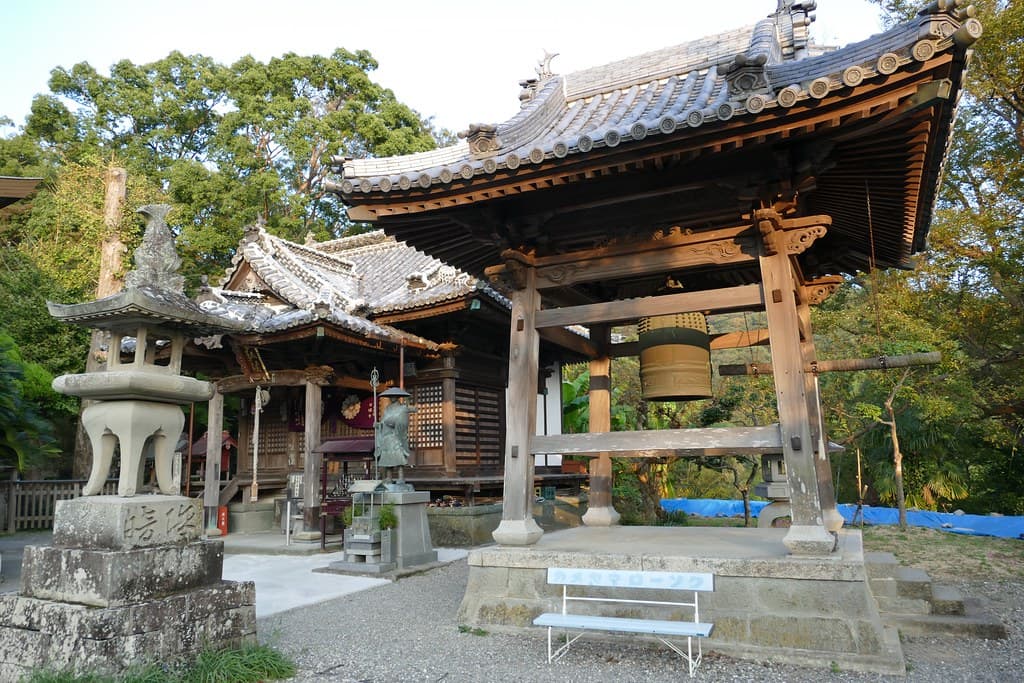
Image of Kirihata-ji (切幡寺). Image source
Station 10 of 88
Shikoku 88 Temple PilgrimageVisit essentials
A quick read before you go
- Duration
- 60–90 minutes for a thorough visit, including the staircase climb up and down, ritual at both…
- Access
- Located on the middle slope of Mt.
Overview
Kirihata-ji is the tenth temple of the Shikoku 88, and the first one where the legs notice the pilgrimage. The climb is 333 stone steps to the upper precinct, ascending through a small market street of pilgrim shops and then steepening into a long stone staircase that often leaves walkers breathing hard at the top.
The reward is a hilltop compound 155 metres above the Yoshino River plain, with the rare two-storey Daitō pagoda visible above the forest canopy and a long view back across the rice fields toward Hōrin-ji.
The temple's name—Kirihata, 'cut cloth'—comes from the founding legend that has shaped the precinct's three names: Tokudosan ('Mountain of Ordination'), Kanjō-in ('Hall of Consecration'), and Kirihata-ji itself. In 815, Kūkai stopped at the foot of Mt. Kirihata and asked a young weaver girl for cloth to mend his torn robes. Without hesitation she cut a piece from the fabric on her loom and gave it to him.
She told him her father had been exiled in the Kusuko Incident of 810, and her mother had prayed for a daughter to spare her child the same fate. Moved by her devotion, Kūkai carved a Senjū Kannon in a single night, performed the kanjō consecration ritual on her head, and received her vow of refuge. The girl is said to have transformed into Senjū Kannon, radiating seven-coloured light.
The story is the temple's enduring meditation on sokushin jōbutsu—Buddhahood attained in this very body.
What makes the legend matter is its particular shape: a single act of giving, without calculation, opened a path to awakening that did not require lifetimes. The 333 steps are read by many pilgrims as the slow physical version of that same opening—offered breath by breath, no hesitation. The rare two-storey Daitō pagoda is an Important Cultural Property of Japan.
Why this place is sacred
Thinness here is built into the climb. The pilgrim leaves the road, passes through a brief market lane of shops selling pilgrim staffs and snacks, and meets the stone staircase. Each step is shallow, worn, and uneven; the count is conventionally 333, though some sources include the additional steps to the pagoda and arrive at 380. By the upper precinct the body is heavier and the breath has slowed. The air is cooler.
The view back across the plain is suddenly available, and the Hondō, the Daishi-dō, the Hatakiri Kannon-dō, and the Daitō pagoda hold the small upper terrace together.
The density of the place comes from a convergence. Three founding-myth elements—cut cloth, ordination, consecration—are bound here in the temple's own three names. The Daitō pagoda's square second storey is unique in Japan; the building has crossed prefectures and centuries to stand on this hilltop. The Hatakiri Kannon-dō marks the spot where, in legend, the weaver girl became Senjū Kannon.
The story models a kind of generosity that does not measure itself, and the staircase models the long, embodied version of the same.
Founded in 815 by Kūkai as a Shingon Buddhist temple dedicated to Senjū Kannon, with the temple's institutional structure (Tokudosan, Kanjō-in, Kirihata-ji) commemorating the founding legend of the weaving girl's instantaneous Buddhahood. The hilltop position situated the temple within the Shingon mountain-temple tradition while keeping it close enough to the agricultural valley below to receive ordinary lay devotion.
The temple was destroyed during the Tenshō era (1573–1592) by Chōsokabe Motochika's forces and rebuilt afterward. The Daitō pagoda's history is unusual: originally donated by the second Tokugawa shōgun Tokugawa Hidetada to Sumiyoshi Shrine in Sakai, Osaka, in 1618, it was purchased and reconstructed at Kirihata-ji in 1873 by the temple's 45th head priest. This reuse of an Edo-period structure preserves a rare two-storey form with a square second storey not found elsewhere in Japanese pagoda architecture.
The principal Senjū Kannon image dates from the post-Tenshō reconstruction. The temple has continued in active service as Temple 10 of the Shikoku 88 since the medieval consolidation of the route.
Experience and orientation
Walking pilgrims arriving from Hōrin-ji come about 3.8 kilometres along level paths through Awa City's southern fields, and the change of register at Kirihata-ji is the climb. The lane of shops at the foot of the mountain is short but characteristically pilgrim—white hakui jackets and bamboo staffs in the windows, grilled mochi and udon at the small counters, and the conversation of returning henro coming back down. The staircase begins where the lane ends.
Stone steps rise through the trees in long flights, with rest landings every fifty steps or so. The conventional count is 333; the body usually loses count somewhere in the middle.
The upper precinct is a compact terrace. The Hondō is reached first; pilgrims pause for breath, then begin the standard sequence. The Daitō pagoda stands a little further up another short flight of steps; from below it is dramatic against the sky, and from the pagoda's level the view back across the Yoshino plain opens completely. The Hatakiri Kannon-dō, where the weaving girl is said to have become Kannon, is on the upper level.
Many pilgrims describe the hilltop quiet as unexpectedly intense after the staircase. Sixty to ninety minutes is realistic for a thorough visit including the climb up, ritual at both halls, the pagoda visit, and the descent.
The temple sits on the middle slope of Mt. Kirihata at 155 metres elevation. From the parking area at the base, a brief shop-lined lane leads to the staircase. There is also an upper parking lot accessible by car, which reduces the climb to about 100 steps for those with mobility limits. The Hondō, Daishi-dō, Hatakiri Kannon-dō, and Daitō pagoda cluster on the small upper terrace; the goshuin office is near the Hondō.
Trees enclose the precinct on three sides; the fourth opens to the view of the plain.
Context and lineage
In 815, Kūkai stopped at the foot of Mt. Kirihata. His robes were torn from travel, and he asked a young weaver girl working at her loom whether she could spare any cloth. She cut a piece from the fabric on her loom and gave it to him without hesitation.
When she told him her circumstances—her father exiled in connection with the Kusuko Incident of 810, her mother having prayed to Kannon for a daughter to spare her child the same fate—Kūkai was moved. He carved an image of Senjū Kannon (Thousand-Armed Kannon) in a single night, performed the kanjō consecration ritual on her head, and accepted her vow of refuge. According to the legend, she transformed instantly into Senjū Kannon, radiating seven-coloured light.
The temple's name (Kirihata, 'cut cloth'), mountain name (Tokudosan, 'Mountain of Ordination'), and institutional name (Kanjō-in, 'Hall of Consecration') all derive from this story.
Kōya-san Shingon: the major branch of Shingon Buddhism descended from Kūkai's monastic establishment on Mt. Kōya. Kirihata-ji is administratively part of this branch and maintains both the standard Shingon liturgy and the pilgrim-specific Shikoku 88 chant sequence. Senjū Kannon, the temple's principal image, is one of the major esoteric Bodhisattvas of the Shingon pantheon, depicted with a thousand arms reaching simultaneously to all sentient beings.
Kūkai (Kōbō Daishi)
Founder; carver of the original Senjū Kannon image
The weaving girl (anonymous)
Recipient of consecration; legendary embodiment of Senjū Kannon
Tokugawa Hidetada
Patron of the original Daitō pagoda
Traditions and practice
The henro sequence is performed at gate, Hondō, Daishi-dō, and—optionally—Hatakiri Kannon-dō. At the bottom of the staircase, before beginning the climb, many pilgrims pause briefly and form an intention; the steps are then walked at a steady, breath-paced rhythm.
At the top, the standard sequence proceeds: bow at the Hondō threshold, deposit an osamefuda, light a candle and three sticks of incense, drop a small coin into the saisen-bako, chant the Heart Sutra, and chant the Senjū Kannon mantra: On Bazara Tarama Kiriku. Pilgrims then move to the Daishi-dō and repeat the sequence with the Kōbō Daishi mantra: Namu Daishi Henjō Kongō.
Many also visit the Hatakiri Kannon-dō and offer a brief prayer at the site of the weaver girl's transformation. The goshuin is collected at the stamping office before descent.
The nōkyō office is open 7:00–17:00 daily. Pilgrim traffic concentrates in the cooler months and on weekends; during midsummer the staircase is hot and physically demanding. Many older pilgrims use the upper parking lot, reducing the climb to roughly 100 steps. The temple receives the standard mix of solo henro, organized bus pilgrimages, and increasing numbers of foreign walkers.
For pilgrims newer to the henro sequence: the staircase is itself a practice. Walking it slowly, attentive to the breath and the placement of each foot, is more in keeping with the tradition than rushing to the top. Pilgrims who find the chants unfamiliar may simply offer incense and a coin at each hall and read the Heart Sutra silently. Spending a few minutes facing the Hatakiri Kannon-dō—with the founding legend in mind—often opens the temple's particular quality.
Shingon Buddhism (Kōya-san branch)
ActiveKirihata-ji is dedicated to Senjū (Thousand-Armed) Kannon, a major Shingon esoteric Bodhisattva of compassion. The temple's founding legend embodies the core Shingon teaching of sokushin jōbutsu—Buddhahood attained in this very body—through the weaver girl's instantaneous transformation.
Pilgrims chant the Heart Sutra and the Senjū Kannon mantra (On Bazara Tarama Kiriku) at the Hondō, and the Kōbō Daishi mantra at the Daishi-dō. The 333-step approach itself functions as a meditative ascent.
Perspectives and open questions
Kirihata-ji's legend is read in multiple registers: as hagiography, as Shingon doctrine, as Pure Land allusion, and as the working myth of a hilltop temple that has survived destruction and reassembly.
Scholarly perspective
Historians treat the weaving girl legend as a hagiographic narrative shaped during the medieval consolidation of the Shikoku 88 route, not as documented history. The Daitō pagoda, by contrast, is firmly dated to 1618 with Tokugawa documentary provenance and was reassembled at Kirihata-ji in 1873. The original founding-era image, if any, did not survive the Tenshō destruction; the present principal Senjū Kannon image is a post-1573 reconstruction.
Living and traditional perspectives
Within the Kōya-san Shingon tradition, the Kirihata legend is a paradigmatic illustration of sokushin jōbutsu—Buddhahood attained in this very body—and of the salvific power of selfless offering combined with proper ritual consecration (kanjō). The temple is regarded as a place where, through Kūkai's hand, the path of immediate awakening was opened to a single human life and remains accessible to those who follow.
Alternative interpretations
Esoteric readings interpret the weaving girl as an emanation of Kannon herself, choosing to manifest in human form to model the path of compassion. The act of cutting cloth (kirihata) is read as the cutting of attachment (klesha) that frees one to enter the Pure Land in this very life. The 333-step ascent is sometimes read as a body-scale invocation of the thousand-armed Bodhisattva—each step a hand reaching forward.
Open questions
The Kusuko Incident reference gives the legend a chronological anchor in 810, but the historicity of the girl's family circumstances cannot be verified. The original founding-era Senjū Kannon image did not survive the Tenshō era. Whether the weaver girl is a wholly literary figure, a memory of a real local woman, or a pre-existing local kami absorbed into the Buddhist legend is open to interpretation.
Plan your visit
Access and arrival
Located on the middle slope of Mt. Kirihata in Awa City, Tokushima Prefecture, at 155 metres elevation. By car: small parking near the temple shops at the base, and an upper parking lot reachable by a narrow road that reduces the climb to about 100 steps. On foot: about 3.8 kilometres from Temple 9 Hōrin-ji along the henro route; the final approach is the 333-step stone staircase. Nearest train station: JR Awa-Kawashima on the Tokushima Line, then taxi.
Pilgrim minshuku and ryokan are available in Awa City and along the Yoshino plain between Temples 9 and 11. Many walking pilgrims stay near Fujii-dera (Temple 11) the night before the demanding mountain trail to Shōsan-ji. Direct contact details and current availability should be confirmed in advance through the Shikoku Henro Reijōkai or local pilgrim guides.
Respectful visit
Comfortable walking shoes are essential for the 333 steps; modest clothing covering shoulders and knees. Pilgrim white hakui jackets, sedge hats, and kongō-zue staffs are common but optional. Layered clothing is wise—the upper precinct is noticeably cooler in shoulder seasons.
Exterior photography of the staircase, gates, courtyard, and Daitō pagoda is welcomed and widespread; the pagoda is one of the route's most photographed structures. Avoid flash and direct images of enshrined statues inside the Hondō, Daishi-dō, and Hatakiri Kannon-dō. Posted signs override general guidance.
Osamefuda, three incense sticks, one candle, and a small coin at each hall. The shops along the approach lane sell pilgrim supplies and sometimes offer osettai (gifts of welcome) to pilgrims; offering thanks is the appropriate response.
Ring the bell only on entry. Do not step on door thresholds. Stay on marked paths around the Daitō pagoda. Be cautious on stone steps when wet. Do not begin the climb in heavy rain or thunderstorms.
The stone steps are uneven and become slippery when wet; sturdy walking shoes are essential. Pilgrims with knee or heart conditions should consider the upper parking lot; the climb is genuinely demanding. The Daitō pagoda is an Important Cultural Property—stay on marked paths around it. The principal Senjū Kannon image is sometimes a hibutsu and may not be visible.
Current practical details
Address
Kannon-129 Ichibachō Kirihata, Awa, Tokushima 771-1623, Japan
Phone
Hours
Hours, fees, and access can change — verify on the official source before you travel. Practical details last checked Jun 2026.
Location
Map loads as you approach this section.
Pilgrim reflections
A portrait of encounter, not a score
Pilgrims describe what they felt, how present they could become, and whether the place would shape a journey. There are no stars and no ranking of traditions.
No reviewed reflections yet
The first pilgrims can help describe the character of being here.
Share a reflection
Available after an account-backed “Been there.” Every reflection is reviewed before publication.
Watch deeper
Films, episodes, and recorded talks for visitors who want more context before or after a visit. Speculative and alternative-history entries are labelled as perspectives, not as sources for established claims.
Nearby sacred places
Explore other sacred places in the region. Proximity does not establish access or travel time; check each place’s guidance.


References
Sources consulted for this page. Source categories describe the publication, not a guarantee that every claim is verified. Traditional accounts and outside interpretations may differ.
- 01Kirihata-ji (Awa) - Wikipedia — Wikipedia contributorsencyclopediaConfirms Kōya-san Shingon affiliation, principal image Senjū Kannon, two-storey Daitō pagoda as Important Cultural Property.
- 02Tokudozan Kanjyouin Kirihataji – Shikoku 88 Temple Pilgrimage — Shikoku 88 Henro ReijokaiofficialOfficial temple association entry; weaving girl legend, Kanjō and Tokudo etymology.
- 03Kirihataji – Awa, Tokushima Prefecture, Shikoku • Henro.org — Henro.orgguidePilgrim guide with route, elevation, and access info.
- 04Customs and Etiquette of the Shikoku Pilgrimage - Henro.org — Henro.orgguideGeneral henro etiquette.
- 05Kirihata-ji Temple, the 10th temple of the Shikoku Pilgrimage | Shikoku Pilgrimage News — Shikoku Pilgrimage NewsguideDetailed legend account including Kusuko Incident background of the weaving girl.
- 06More glimpses of unfamiliar Japan: Shikoku 88 Temple 10 Kirihataji — Ojisan JakeblogFirst-hand visit description; pagoda and Tokugawa Hidetada provenance.
Pilgrim glossary
- Kannon
- The bodhisattva of compassion, central to many East Asian pilgrimage routes.
- Bodhisattva
- An enlightened being who postpones full nirvana to help others toward awakening.
- Sutra
- A canonical Buddhist scripture, often chanted as part of practice.
- Mantra
- A sound, word, or phrase repeated as part of meditation or ritual.
- Shingon
- An esoteric Japanese Buddhist school emphasizing ritual, mantra, and mandala practice.
- Pure Land
- A Buddhist tradition focused on rebirth in Amida Buddha's western paradise through devotional practice.
Share a photo
Help visitors recognize Kirihata-ji. Every submission is reviewed before publication.