Shōsan-ji
Burning Mountain Temple, the route's first nansho, Temple 12 of the Shikoku 88
Understand sacred places, explore living traditions, and learn how to engage respectfully with Pilgrim Map.
Access has not been verified. Check current local guidance before planning a visit.
Kamiyama, Tokushima Prefecture, Japan
Read the sources
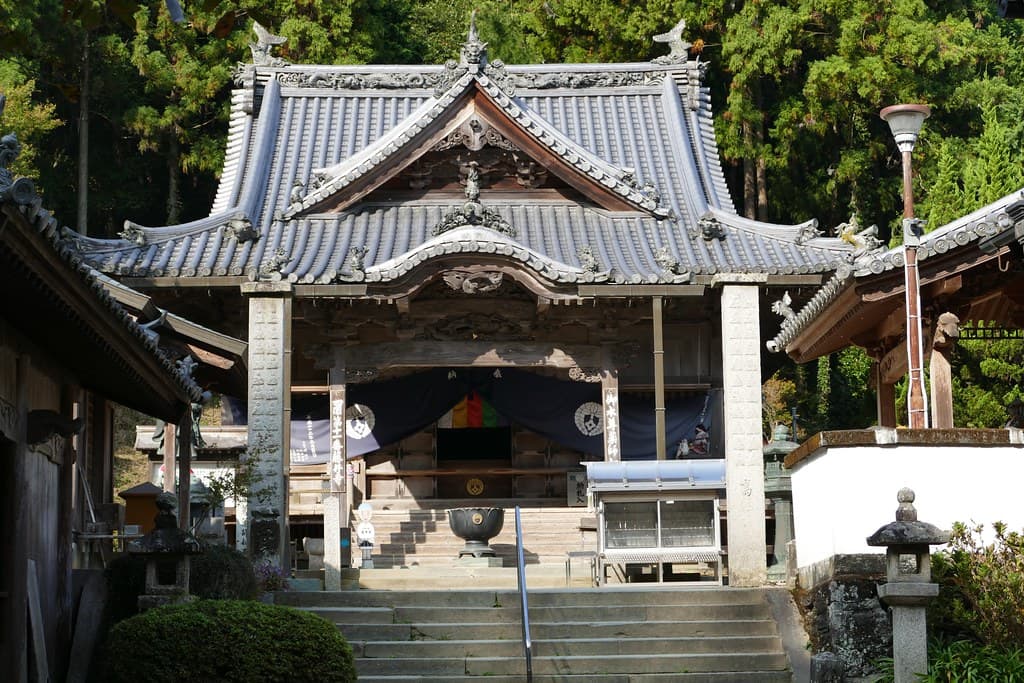
Image of Shōsan-ji (焼山寺). Image source · CC-BY-SA-3.0
Station 12 of 88
Shikoku 88 Temple PilgrimageVisit essentials
A quick read before you go
- Duration
- 60–90 minutes at the temple itself.
- Access
- Located on Mt.
Overview
Shōsan-ji means 'Burning Mountain Temple,' from the tradition of a fire-breathing dragon-snake that devastated the region. When Kūkai climbed here in 815, the creature set the slopes aflame. He prayed to Kokūzō Bosatsu, Bodhisattva of Boundless Space and Memory, whose gumonji-hō mantra had been central to his awakening, and with the Bodhisattva's blessing sealed the snake in a cave. Kūkai then carved a three-faced Daikokuten and prayed for peace and harvest for those harmed.
Both Marozan and Shōsan-ji derive from this story.
An older tradition attributes an Asuka-period shrine to Zaō Gongen here to En no Gyōja, the seventh-century founder of Shugendō. This mountain-ascetic layer remains in the rugged cedar setting, though formal Shugendō practice is no longer active. Emperor Godaigo patronized the temple as an imperial site in the fourteenth century.
For walkers, the 12-kilometre route from Fujii-dera is the Shikoku pilgrimage's first true nansho. Its henro-gorogashi, or 'where pilgrims fall down,' sections pass Ryūsuian at about 6.6 km and 500 m elevation, then Jōrenan and the Ipponsugi giant cedar at about 8.8 km and 745 m. Exhausted arrival in the silent grove is widely described as one of the pilgrimage's most moving moments, where many pilgrims say the henro begins taking interior root.
Why this place is sacred
Altitude, distance, and time shape Shōsan-ji. Cooler air, surrounding ridges visible to the south and east that are themselves mountains, and a centuries-old cedar grove—designated a Tokushima Prefectural Natural Monument—filter the precinct in green light. Kūkai's Buddhist layer joins Kokūzō Bosatsu, the snake-subduing tradition, and a three-faced Daikokuten; an older layer attributes an Asuka-period Zaō Gongen shrine to En no Gyōja.
The henro-gorogashi trail brings pilgrims from Fujii-dera hungry, tired, and physically worked before the grove receives them. Many report this arrival as the point when pilgrimage changes from something they do to something they inhabit.
Kūkai's snake cave is somewhere on the mountain, but sources disagree on its exact location. Legend says he planted the Ipponsugi giant cedar at Jōrenan, about an hour before the temple. Neither claim is verifiable; the silence is.
Two layers of original purpose are visible. The first, attributed to En no Gyōja in the Asuka period (592–710), was a mountain-ascetic shrine to Zaō Gongen, the Shugendō protective deity associated with austerity in remote mountain settings. The second, attributed to Kūkai in 815, established the site as a Shingon Buddhist temple dedicated to Kokūzō Bosatsu following the legendary subjugation of the fire-breathing snake. The two purposes—mountain austerity and Buddhist devotion—were continuous rather than contradictory.
The temple was reconstructed multiple times over the centuries. Emperor Godaigo (reigned 1319–1338) granted it imperial temple status, reinforcing its role as a major mountain site. Tenshō-era destruction during the Chōsokabe campaigns required substantial rebuilding in the early Edo period. The cedar grove has been protected as a Tokushima Prefectural Natural Monument and the temple has remained a working Kōya-san Shingon establishment with a daily nōkyō office.
The mountain access road was paved in modern times, allowing car pilgrimage; the henro foot trail from Fujii-dera remains the traditional approach and the route by which the temple's nansho character is most fully encountered.
Experience and orientation
Walking pilgrims leave Fujii-dera at first light, cross valley settlements, and climb ridges through the steep henro-gorogashi sections. Around halfway, Ryūsuian offers a hut at roughly 500 metres. A few kilometres later, Jōrenan or Ipponsugian stands at 745 metres beside the giant cedar traditionally planted by Kūkai. The trail rises and falls to Shōsan-ji at 706 metres; weather, conditions, and pace make the journey five to eight hours.
Drivers use a steep, narrow paved road from Kamiyama and park near the compact precinct of Niōmon, Hondō, Daishi-dō, cedar grove, and subsidiary halls. Walkers often experience the gate as a threshold: after hours of exertion, cooler air and tall cedars hold the temple in green silence.
At the Hondō and Daishi-dō, pilgrims follow the standard henro sequence, including Kokūzō Bosatsu's mantra at the Hondō. A temple visit usually takes sixty to ninety minutes. Drivers end there; walkers normally need a second day or transport to reach Temple 13 Dainichi-ji, about 25 kilometres onward.
The temple sits on Mt. Shōsan-ji at 706 metres elevation. The Niōmon faces the approach road from below; the courtyard opens to the Hondō and Daishi-dō, with the cedar grove rising on the slopes around the precinct. The henro foot trail from Fujii-dera enters from the south-southwest; the access road for cars climbs from Kamiyama Town to the north. The snake cave associated with Kūkai's victory is somewhere on the mountain but not part of the standard pilgrim circuit.
Free parking is available near the temple.
Context and lineage
Tradition holds that a great fire-breathing dragon-snake lived on Mt. Shōsan-ji, devastating the surrounding region with frequent fires—the source of the mountain's name (shōsan: 'burning mountain'). When Kūkai climbed the mountain in 815, the creature set the slopes aflame to repel him. Kūkai prayed to Kokūzō Bosatsu, the Bodhisattva associated with boundless space and memory whose mantra (the gumonji-hō) had been central to his own enlightenment, and with the Bodhisattva's blessing sealed the snake in a cave on the mountain.
He then carved a three-faced Daikokuten and prayed for peace and harvest for those the snake's fires had harmed. Underlying this Buddhist founding is an older mountain-shrine tradition: the original shrine on the mountain is attributed to En no Gyōja, the seventh-century founder of Shugendō, who is said to have enshrined Zaō Gongen here in the Asuka period.
Kōya-san Shingon: the major branch of Shingon Buddhism descended from Kūkai's monastic establishment on Mt. Kōya. Shōsan-ji is administratively part of this branch. The historical Shugendō layer—mountain ascetic practice associated with En no Gyōja—is no longer actively maintained as a distinct lineage at the temple but remains part of the site's atmosphere and self-understanding. Kokūzō Bosatsu, the principal Bodhisattva, is one of the central esoteric figures of Shingon devotion.
Kūkai (Kōbō Daishi)
Founder of the Buddhist temple; subduer of the snake in legend; carver of the three-faced Daikokuten
En no Gyōja (En no Ozunu)
Founder of the original mountain shrine in the Asuka period
Emperor Godaigo
Imperial patron; granted Shōsan-ji imperial temple status
Traditions and practice
The henro sequence at Shōsan-ji follows the standard Shikoku 88 pattern with the particular emphasis given by the temple's nansho status. At the Niōmon, pilgrims bow once toward the temple before crossing the threshold. Hands and mouth are rinsed at the temizuya. The bell, if available, is sounded once on entry. At the Hondō: osamefuda, candle, three sticks of incense, a small coin, the Heart Sutra, and the Kokūzō Bosatsu mantra: Nōbō Akyasha Kyarabaya On Arikya Mari Bori Sowaka.
At the Daishi-dō: the same offerings and the Kōbō Daishi mantra: Namu Daishi Henjō Kongō. Many pilgrims also pause in the cedar grove for silent presence, and walking pilgrims often offer additional thanks for safe arrival on the henro-gorogashi trail.
The nōkyō office is open 7:00–17:00 daily. Pilgrim reception runs year-round; walking pilgrims arriving via the trail from Fujii-dera concentrate in spring and autumn. The temple maintains periodic Buddhist services with the resident community. The cedar grove is protected as a Prefectural Natural Monument and is part of the contemporary visitor's experience even when not formally part of the ritual sequence.
Walking pilgrims: time the trail to arrive with daylight to spare, allowing time for ritual at both halls and a quiet pause in the cedar grove. Driving pilgrims: park, walk slowly to the gate, and resist the temptation to compress the visit. The cedar grove is itself a practice; ten minutes of silent presence among the trees changes the tone of the visit. Those uncertain about the chants may simply offer incense and a coin at each hall.
Shingon Buddhism (Kōya-san branch)
ActiveShōsan-ji is dedicated to Kokūzō Bosatsu (Akashagarbha), the Bodhisattva of Boundless Space and Memory whom Kūkai famously invoked in the gumonji-hō practice that led to his enlightenment. The temple commemorates Kūkai's encounter with and subjugation of a great snake-dragon, mirroring the inner subjugation of delusion.
Pilgrims chant the Heart Sutra and the Kokūzō Bosatsu mantra (Nōbō Akyasha Kyarabaya On Arikya Mari Bori Sowaka) at the Hondō, and the Kōbō Daishi mantra at the Daishi-dō.
Shugendō / mountain ascetic tradition
HistoricalThe original mountain shrine is attributed to En no Gyōja, founder of Shugendō, who is said to have enshrined Zaō Gongen here in the Asuka period. This pre-Buddhist mountain-ascetic layer underlies the present Buddhist temple and remains visible in the cedar grove and rugged mountain setting.
Historical Shugendō practices on this mountain are not actively maintained today, but the site's ascetic atmosphere—steep approach, ancient cedars, mountain seclusion—preserves the lineage's flavour.
Perspectives and open questions
Shōsan-ji is read in multiple registers—as Shingon legend, as Shugendō survival, as nansho threshold, and as long-protected ecological site. Each reading sees a different dimension of the same precinct.
Scholarly perspective
Modern scholarship treats the En no Gyōja founding as legendary and the 815 Kūkai date as traditional. However, archaeological evidence and the Prefectural Natural Monument cedar grove suggest very long continuous use of the mountain as a sacred site. The temple's role as a key nansho on the Shikoku 88 is documented from at least the medieval period, and the imperial patronage under Emperor Godaigo provides a fourteenth-century anchor.
Living and traditional perspectives
Within Shingon, Shōsan-ji is the dragon-subduing temple par excellence. Kūkai's victory over the burning snake stands as a paradigmatic image of the mind's mastery of klesha (afflictions) through Kokūzō's wisdom. The cedar grove is regarded as a manifestation of the mountain's enduring sanctity, and the snake cave—wherever exactly it lies—as a continuing site of contained delusion held under the Bodhisattva's blessing.
Alternative interpretations
Esoteric readings interpret the snake-dragon as the kundalini-like vital energy of the mountain itself, neither defeated nor destroyed but sealed (contained and integrated) by the practitioner's awakened presence. The three-faced Daikokuten Kūkai is said to have carved represents the integration of three worldly necessities—food, wealth, household—under a single awakened gaze. The henro-gorogashi trail is sometimes read as a body-scale enactment of this same integrative process.
Open questions
The historicity of En no Gyōja's visit cannot be confirmed. The location of the snake-subduing cave varies among sources and pilgrim accounts. Whether the gigantic cedars actually date back to Kūkai's time, as legend at the Ipponsugi cedar claims, cannot be verified by available dendrochronological records. The relationship between the original Shugendō shrine and the present Shingon temple in the centuries between En no Gyōja and Kūkai is not documented.
Plan your visit
Access and arrival
Located on Mt. Shōsan-ji in Kamiyama Town, Tokushima Prefecture, at 706 metres elevation. By car: a steep, narrow, paved mountain road climbs from Kamiyama; small free parking lot near the temple. On foot (henro trail): 12 kilometres, 5–8 hour mountain hike from Temple 11 Fujii-dera, including henro-gorogashi steep sections; intermediate stops at Ryūsuian (~6.6 km, 500 m elevation) and Jōrenan/Ipponsugian (~8.8 km, 745 m elevation, with the Ipponsugi giant cedar).
No nearby train station; bus service from Tokushima City to Kamiyama is limited and should be checked locally.
Limited overnight options on the mountain itself. Pilgrim minshuku and small inns operate in Kamiyama Town; some walking pilgrims stay at Jōrenan or descend partway after the visit. Many henro plan the trail so that they leave Fujii-dera at dawn, complete Shōsan-ji in the afternoon, and continue toward Dainichi-ji on a separate day. Direct contact details and current availability should be confirmed in advance through the Shikoku Henro Reijōkai or local pilgrim guides.
Respectful visit
Proper hiking footwear and weather-appropriate clothing if walking the trail; layered clothing recommended even in summer due to elevation. Modest casual clothing for the temple. Pilgrim white hakui jackets, sedge hats, and kongō-zue staffs are common but optional.
Exterior photography of the precinct, gate, and cedar grove is welcomed; the cedars are widely photographed. Avoid flash and direct images of enshrined statues inside the Hondō and Daishi-dō. Respect the cedar grove—do not climb or carve on protected trees.
Standard pilgrim offerings: osamefuda, candle, incense, and coin at each hall. Walking pilgrims often offer additional incense or a longer chant in thanks for safe arrival on the henro-gorogashi trail.
Stay on marked paths in the cedar grove. Do not begin the trail from Fujii-dera late in the day. Ring the bell only on entry. Mountain weather can change quickly; do not attempt the trail in heavy rain. The snake cave is not a marked pilgrim destination; do not leave the path to look for it.
The mountain trail from Fujii-dera is genuinely strenuous and should not be undertaken late in the day, in heavy rain, or in winter conditions. Mountain weather changes quickly; layered clothing and adequate water and food are essential. The cedar grove is a protected natural monument—do not climb or carve on the trees. The snake cave site is uncertain; do not search for it by leaving marked paths.
The mountain access road for cars is steep and narrow, with limited passing places.
Current practical details
Address
Jichū-318 Shimobun, Kamiyama, Myozai District, Tokushima 771-3421, Japan
Phone
Hours
Hours, fees, and access can change — verify on the official source before you travel. Practical details last checked Jun 2026.
Location
Map loads as you approach this section.
Pilgrim reflections
A portrait of encounter, not a score
Pilgrims describe what they felt, how present they could become, and whether the place would shape a journey. There are no stars and no ranking of traditions.
No reviewed reflections yet
The first pilgrims can help describe the character of being here.
Share a reflection
Available after an account-backed “Been there.” Every reflection is reviewed before publication.
Watch deeper
Films, episodes, and recorded talks for visitors who want more context before or after a visit. Speculative and alternative-history entries are labelled as perspectives, not as sources for established claims.
Nearby sacred places
Explore other sacred places in the region. Proximity does not establish access or travel time; check each place’s guidance.
References
Sources consulted for this page. Source categories describe the publication, not a guarantee that every claim is verified. Traditional accounts and outside interpretations may differ.
- 01Shōsan-ji (Kamiyama) - Wikipedia — Wikipedia contributorsencyclopediaFounding by En no Gyōja, Kūkai's snake-subduing legend, elevation 706 m, Kōya-san Shingon affiliation.
- 02Marozan Shoujyuin Shozanji – Shikoku 88 Temple Pilgrimage — Shikoku 88 Henro ReijokaiofficialOfficial temple association entry; legend of three-faced Daikokuten.
- 03Shosanji – Kamiyama, Tokushima Prefecture, Shikoku • Henro.org — Henro.orgguidePilgrim guide; nansho status; cedar grove.
- 04Customs and Etiquette of the Shikoku Pilgrimage - Henro.org — Henro.orgguideStandard henro etiquette.
- 05A challenging day hike from Fujii-dera to Shōsan-ji – Henro — Henro.coguide12 km, 5–8 hour mountain trail; henro-gorogashi description.
- 06Shosanji Temple - Tokushima Attractions - Japan Travel — Japan TravelguideCedar grove (Prefectural Natural Monument); imperial temple status under Emperor Godaigo.
Pilgrim glossary
- Bodhisattva
- An enlightened being who postpones full nirvana to help others toward awakening.
- Sutra
- A canonical Buddhist scripture, often chanted as part of practice.
- Mantra
- A sound, word, or phrase repeated as part of meditation or ritual.
- Shingon
- An esoteric Japanese Buddhist school emphasizing ritual, mantra, and mandala practice.
Share a photo
Help visitors recognize Shōsan-ji. Every submission is reviewed before publication.