Kumadani-ji
Pass beneath the great Niōmon — Temple 8's nine-meter gate of 1687
Understand sacred places, explore living traditions, and learn how to engage respectfully with Pilgrim Map.
Access has not been verified. Check current local guidance before planning a visit.
Awa, Tokushima Prefecture, Japan
Read the sources
Image of Kumadani-ji (熊谷寺). Image source · CC-BY-SA-3.0
Station 8 of 88
Shikoku 88 Temple PilgrimageVisit essentials
A quick read before you go
- Duration
- 30-45 minutes for a standard visit including the long approach and the formal ritual at both…
- Access
- About 4 km west of Jūraku-ji on the standard henro route; about an hour on foot.
Overview
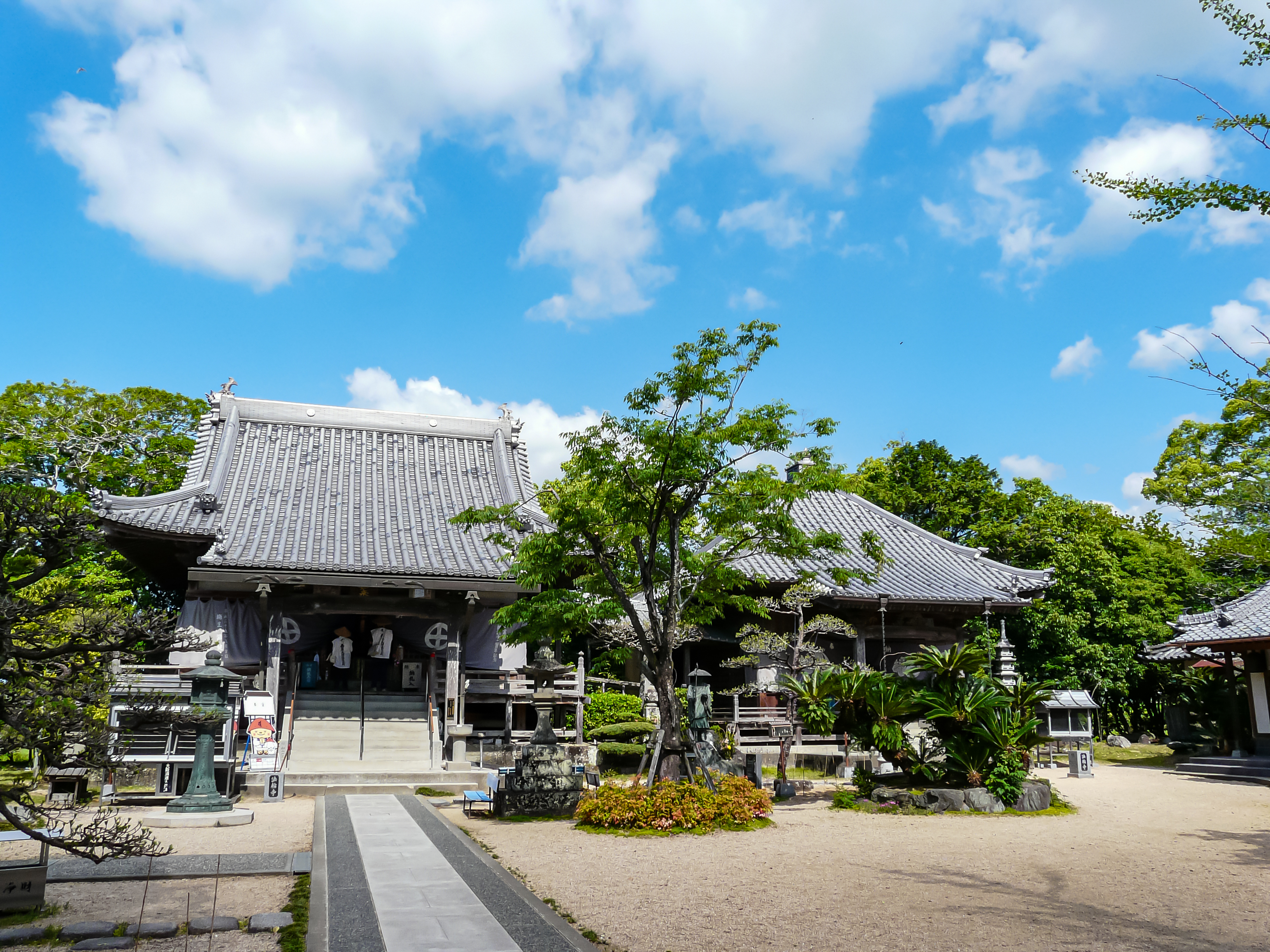
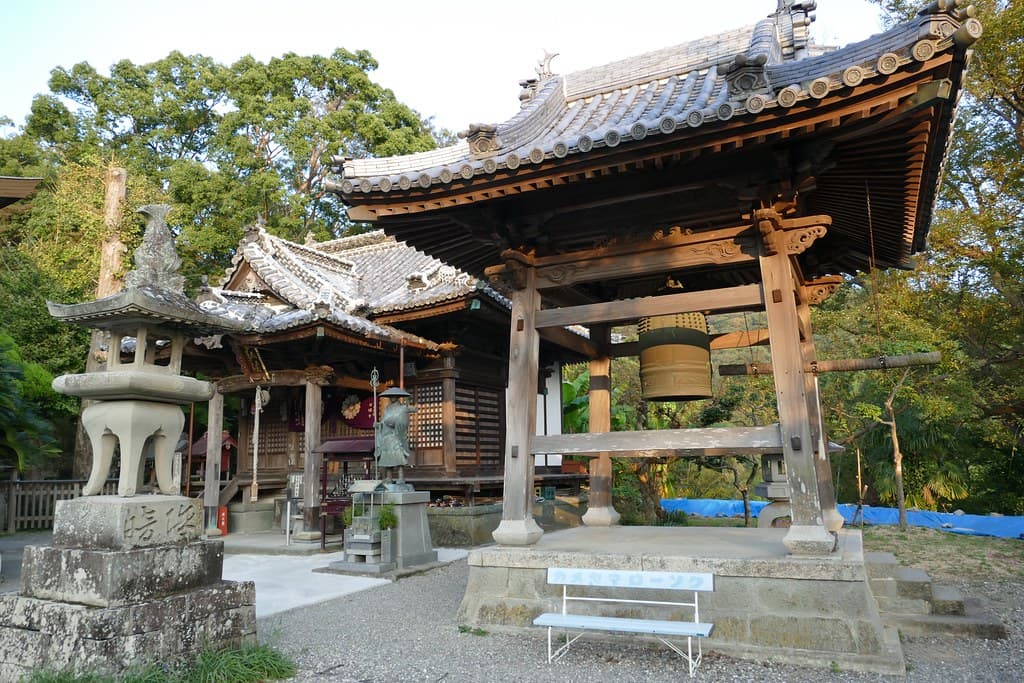
Kumadani-ji's 1687 Niōmon is one of the largest gates among the Shikoku pilgrimage's 88 temples: nine meters across, more than twelve meters high, and designated a Tokushima Prefecture Cultural Property. Beyond it, a long stone approach passes Japanese maples, carved stones, a two-tiered pagoda, and a bell tower ornamented with dragons and koi before reaching the comparatively intimate Hondō.
Tradition holds that Kūkai founded the temple in 815 and carved a life-size Senju Kannon, the Thousand-Armed bodhisattva whose arms reach into every being's situation. He placed a small gold image inside it and worked 126 grains of Buddha relics into its hair, making the temple a literal reliquary in sculptural form.
The original image survived nearly 1,100 years before a catastrophic 1927 fire destroyed it with the Hondō. Reconstruction continued until 1946, when the present principal image was consecrated. The surviving Edo gate, rebuilt hall, postwar image, and early-April cherry blossoms hold impermanence and renewal together.
Why this place is sacred
The image-within-image structure of the original Senju Kannon — small gold figure inside the life-size statue, with 126 grains of relics in the hair — is a classic esoteric Buddhist technique for instantiating the Three Bodies of the Buddha (Trikāya: dharmakāya, sambhogakāya, nirmāṇakāya) in a single sculptural object. The 1927 fire destroyed this material instantiation.
The 1946 reconsecration — without the original image, without the original relics, with a new statue carved during the postwar reconstruction — could be read as loss; in Shingon teaching it is read instead as a doctrinal demonstration of the dharma's continuity through impermanence. The new image carries the same vow as the old one. The current temple holds both readings simultaneously. The 1687 Niōmon, by contrast, has stood through everything — Edo period, Meiji opening, Pacific war, postwar reconstruction.
It is the precinct's anchor, and walking under it on a spring morning when the cherry blossoms are out is a moment many henro mark.
Founded by Kūkai in 815 in this 'bear valley' (kuma-dani), with the explicit purpose of housing a Senju Kannon image holding 126 grains of Buddha relics in its hair. The relic-bearing structure makes the temple a sokusui-butsu — a Buddha containing physical relics — and the Hondō a literal reliquary.
The original Heian-period image survived for nearly 1,100 years. The 1687 Niōmon was added during the Edo period, marking the temple's expansion under sustained patronage. A devastating fire in 1927 destroyed the principal image and the Hondō. Reconstruction completed 1940-1946; new principal image consecrated 1946. The two-tiered pagoda and the carved bell tower with dragon-and-koi ornament are part of the rebuilt architectural complex. The temple is now a Kōyasan Shingon parish temple.
Experience and orientation
The walk from Jūraku-ji takes about an hour on the henro path, partly along quiet roads. The Niōmon is visible from a distance. Up close, the gate is large enough that pilgrims often stop to look up at it before passing under. The Niō figures inside — guardian kings — are themselves more than life-size.
The path beyond the gate is long, lined with carved stones inscribed with sutra fragments and donor names, and in early April with cherry trees in bloom. The pagoda rises on one side, the carved bell tower on the other. The Hondō is at the end of the approach, with the Daishi-dō to the side. The chōzuya is to the right of the path.
At the Hondō the standard ritual unfolds — candle, three incense sticks, osamefuda, coin, the Heart Sutra, and the Senju Kannon mantra ('On bazara tarama kiriku'). The same at the Daishi-dō. Many pilgrims linger at the Niōmon on the way out, looking up. The cherry-lined approach in early April is, by consensus, one of the most photographed scenes on the early route. In autumn the maples turn; in winter the gate stands stark against the sky.
The temple's architectural sequence — gate, path, pagoda, halls — is the visit, more than any single feature.
From Jūraku-ji walk west about 4 km on the henro route. By car, free parking near the gate. Approach the Niōmon directly along the central stone path; bow once before passing under. The sequence is gate, path, Hondō, Daishi-dō, pagoda, bell tower. Photograph the gate from a distance to capture the scale. Allow more time than the standard early-temple visit if you want to walk the approach slowly.
Context and lineage
Kūkai is said to have spent a period of retreat in this 'bear valley' (kuma-dani) in 815. He carved a life-size Senju Kannon Bosatsu and placed a small gold image inside the larger statue, working 126 grains of Buddha relics into the hair before consecrating the temple. The relic-bearing structure makes the Hondō a literal reliquary. The original image survived for nearly 1,100 years until the 1927 fire.
Kumadani-ji is a parish temple of the Kōyasan Shingon-shū. Its dedication to Senju Kannon — Avalokiteśvara in his thousand-armed form — places it within the broader East Asian devotion to Kannon as the bodhisattva of universal compassion. The temple's architectural lineage spans the Edo Niōmon, the lost Heian-period image, and the postwar reconstruction in continuous dharma succession.
Kūkai (Kōbō Daishi)
Founder; traditional carver of the original life-size Senju Kannon containing a smaller gold image and 126 grains of relics
Edo-period Niōmon builders
Builders of the 1687 great gate
20th-century reconstructors and 1946 sculptor
Builders of the present Hondō (1940-1946) and carver of the present Senju Kannon principal image (consecrated 1946)
Traditions and practice
At each main hall, the standard sequence — chōzuya purification, one bell stroke on arrival (the temple's bell hangs in a separate elaborately carved bell tower with dragon-and-koi ornament), candle from the temple flame, three incense sticks, osamefuda, coin, sutra recitation. The Senju Kannon mantra ('On bazara tarama kiriku') is chanted at the Hondō; the Kōbō Daishi mantra at the Daishi-dō. The Heart Sutra precedes both mantras.
Older pilgrim accounts describe slow circumambulation of the pagoda, though this is not universally practiced today.
Daily Shingon liturgy continues. The stamp office issues the eighth inscription. The Niōmon is a popular subject for photography; the pagoda is closed to visitor entry but visible throughout the approach. Cherry blossom season brings a notable increase in non-henro visitors.
Walk the approach slowly. The Niōmon is the temple's announcement; pause at it both on entry and on exit. Complete the standard ritual at both halls. If you visit in late March or early April, time your arrival for morning light through the cherry blossoms — the long stone path is the photographic centerpiece of the early Tokushima leg.
If you are not chanting, the standard non-pilgrim gesture applies: bow at the gate, ring the bell once, light a candle, place a coin in the saisen, stand a moment at each hall.
Shingon Buddhism (Kōyasan branch)
ActiveTemple 8 of the Shikoku Pilgrimage. Mountain name Fumyōzan ('Universal Light Mountain'), hall name Shinkōin. The 1687 Niōmon is one of the largest among the 88 temples and is a designated Cultural Property of Tokushima Prefecture.
Daily Shingon liturgy at Hondō (Senju Kannon) and Daishi-dō. Pilgrim chanting includes the Heart Sutra, the Senju Kannon mantra ('On bazara tarama kiriku'), and the Kōbō Daishi mantra.
Perspectives and open questions
Kumadani-ji's interpretive layers center on impermanence and renewal: the architectural lineage runs continuously across the 1927 fire, but the principal image does not. Different communities weight the loss and the reconstruction differently.
Scholarly perspective
The Kūkai foundation in 815 is traditional. The Niōmon (1687) and the 1927 loss of the original principal image are documented architectural facts. The temple's designation of the Niōmon as a Tokushima Prefecture Cultural Property reflects its significance to Edo-period religious architecture. The 1946 consecration of the new principal image is documented; the relationship of the present statue to Kūkai's tradition rests on devotional continuity rather than material identity.
Living and traditional perspectives
Shingon teaching reads Senju Kannon as the bodhisattva-form most fully expressing universal compassion. The relic-bearing image structure of the original principal image was doctrinally a sokusui-butsu (a Buddha containing physical relics), making the Hondō a literal reliquary. The 1946 reconsecration carries forward the same vow without requiring material identity with the lost image.
Alternative interpretations
The image-within-image structure (small gold figure inside the life-size Senju Kannon, with 126 grains of relics in the hair) is a classic esoteric technique for instantiating the Three Bodies of the Buddha (Trikāya) in a single sculptural object. The 1927 fire and 1946 re-consecration may be read as a doctrinal demonstration of dharma's continuity through impermanence: the form is replaceable, the vow is not.
Open questions
What of the original Heian-period image, if anything, survived the fire is not publicly catalogued. The provenance of the 126 grains of relics traditionally said to be in the hair of the original image is part of tradition rather than documented archaeology. The exact carver of the 1946 principal image is recorded in temple registers but is not widely known outside specialist circles.
Plan your visit
Access and arrival
About 4 km west of Jūraku-ji on the standard henro route; about an hour on foot. Free parking near the gate. Address: Maeda, Hisanori, Awa-chō, Awa-shi, Tokushima Prefecture.
No shukubo at Kumadani-ji. Hotels and minshuku in Awa City. Most walking henro continue along the route and stay either further west or return to a base in Tokushima City.
Respectful visit
Pilgrim whites are encouraged but not required. Modest casual dress is acceptable. The approach is partly outdoors and partly under tree canopy; spring weather can include occasional rain.
Permitted in the precinct. The Niōmon and the cherry-lined approach are popular subjects. Avoid flash inside halls. Do not touch the Niō statues to photograph them. Do not use a tripod in ways that block the path or the inner halls. Photographs of the principal image are typically prohibited; signs in Japanese mark where.
At each hall: coins, candle, three incense sticks, and an osamefuda. No additional offerings are required at the gate, the pagoda, or the bell tower; these are architectural rather than active devotional stations.
Do not climb the pagoda. Do not touch the Niō statues. Do not pluck flowers or branches. Observe photography prohibitions inside the inner halls. Do not enter behind the altars.
Do not light your candle from another pilgrim's flame. Do not touch the Niō statues inside the gate. Do not climb the pagoda — it is off-limits to visitors. Do not pluck cherry blossoms or maple leaves from the precinct's trees, even fallen ones in large quantity. Photograph the gate respectfully; tour-bus pilgrims sometimes congregate beneath it, and patience is welcomed.
Current practical details
Address
Maeda-185 Donarichō Donari, Awa, Tokushima 771-1506, Japan
Phone
Hours
Hours, fees, and access can change — verify on the official source before you travel. Practical details last checked Jun 2026.
Location
Map loads as you approach this section.
Pilgrim reflections
A portrait of encounter, not a score
Pilgrims describe what they felt, how present they could become, and whether the place would shape a journey. There are no stars and no ranking of traditions.
No reviewed reflections yet
The first pilgrims can help describe the character of being here.
Share a reflection
Available after an account-backed “Been there.” Every reflection is reviewed before publication.
Watch deeper
Films, episodes, and recorded talks for visitors who want more context before or after a visit. Speculative and alternative-history entries are labelled as perspectives, not as sources for established claims.
Nearby sacred places
Explore other sacred places in the region. Proximity does not establish access or travel time; check each place’s guidance.


References
Sources consulted for this page. Source categories describe the publication, not a guarantee that every claim is verified. Traditional accounts and outside interpretations may differ.
- 01Temple 8, Kumadaniji — Tourism ShikokuguideOfficial regional tourism portal
- 02Fumyouzan Shinkouin Kumadaniji — Shikoku 88 Temple Pilgrimage AssociationofficialOfficial 88-temple association
- 03Customs and Etiquette of the Shikoku Pilgrimage — Henro.orgguidePilgrim protocol
- 04Kumadani-ji (Awa) — WikipediaencyclopediaArchitectural and fire history
- 05Kumadani-ji in Awa-shi — Japan TravelguideArchitectural and seasonal detail
Pilgrim glossary
- Kannon
- The bodhisattva of compassion, central to many East Asian pilgrimage routes.
- Bodhisattva
- An enlightened being who postpones full nirvana to help others toward awakening.
- Sutra
- A canonical Buddhist scripture, often chanted as part of practice.
- Mantra
- A sound, word, or phrase repeated as part of meditation or ritual.
- Dharma
- The teachings of the Buddha; also the universal law underlying them.
- Shingon
- An esoteric Japanese Buddhist school emphasizing ritual, mantra, and mandala practice.
Share a photo
Help visitors recognize Kumadani-ji. Every submission is reviewed before publication.