Kannon-ji
A pilgrim temple tucked into a Tokushima neighbourhood, Temple 16 of the Shikoku 88
Understand sacred places, explore living traditions, and learn how to engage respectfully with Pilgrim Map.
Access has not been verified. Check current local guidance before planning a visit.
Tokushima, Tokushima Prefecture, Japan
Read the sources
Image of Kannon-ji (観音寺). Image source · CC-BY-SA-3.0
Station 16 of 88
Shikoku 88 Temple PilgrimageVisit essentials
A quick read before you go
- Duration
- 30–45 minutes for a thorough visit including ritual at both halls and a pause at the Yonaki…
- Access
- Located in a residential area of Tokushima City (Kokufu-chō / Awacho area), Tokushima…
Overview
Kannon-ji sits within a residential neighbourhood of Tokushima City, and the contrast is part of how the temple is encountered. Pilgrims who have just walked from Awa Kokubun-ji come along ordinary streets between modern houses, pass a school or a small shop, and arrive at a bell tower gate that opens directly into the temple precinct.
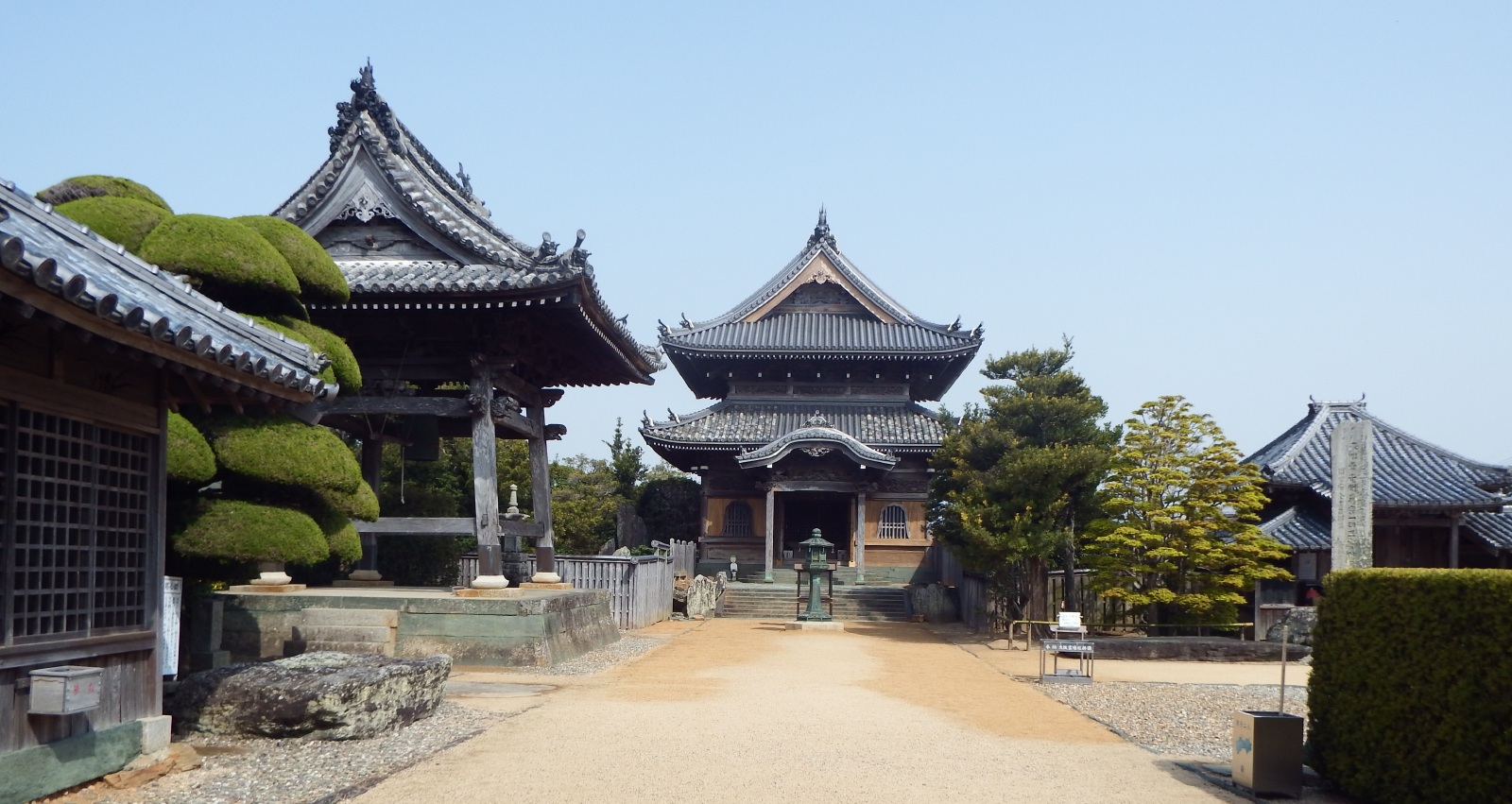
The shift from neighbourhood to sacred space is sharp; the bell tower gate (shōrōmon) is imposing in its Edo-era proportions and creates a sudden interior. Many henro comment on the surprise of finding a Shikoku 88 temple tucked into a quiet street rather than set apart by mountains or fields.
The temple's history runs in two layers. An imperial pilgrimage place was reportedly established at this site during Emperor Shōmu's reign (724–749), making the location part of the Nara-period sacred network that included nearby Awa Kokubun-ji. When Kūkai visited in 816, he is said to have carved the central Senjū Kannon and the attendant Fudō Myō-ō and Bishamonten, formally founding the temple as it is known today.
Burnt down during the Tenshō era (1573–1592) by Chōsokabe Motochika's forces, the temple was rebuilt in 1659 by Hachisuka Mitsutaka, lord of Awa, who funded the imposing bell tower gate that still marks the precinct's entrance.
What distinguishes the temple beyond its setting is the unusual number of folk-religious practices associated with it. Pilgrim sources note Kannon-ji's reputation for many spiritual legends, of which the most enduring is the Yonaki Jizō—a small stone Jizō statue petitioned to soothe sleepless babies who cry through the night. Parents and grandparents come specifically for this prayer, sometimes leaving small offerings or written wishes.
The temple's protective triad—Senjū Kannon (compassion), Fudō Myō-ō (transformative wrath), Bishamonten (protective sovereignty)—forms a complete Shingon configuration around the central image, and Kannon-ji is widely held within the cluster of Tokushima City temples to model the integration of dharma into everyday neighbourhood life.
Why this place is sacred
Thinness at Kannon-ji is built through threshold rather than through seclusion. The neighbourhood approach is unremarkable—houses, narrow streets, a small parking area—and the bell tower gate that opens into the precinct is the place where the change happens. The shōrōmon was funded by Hachisuka Mitsutaka in the 1659 reconstruction and retains the imposing Edo-era proportions of a major temple gate. Stepping under it from the street is the temple's central spatial gesture.
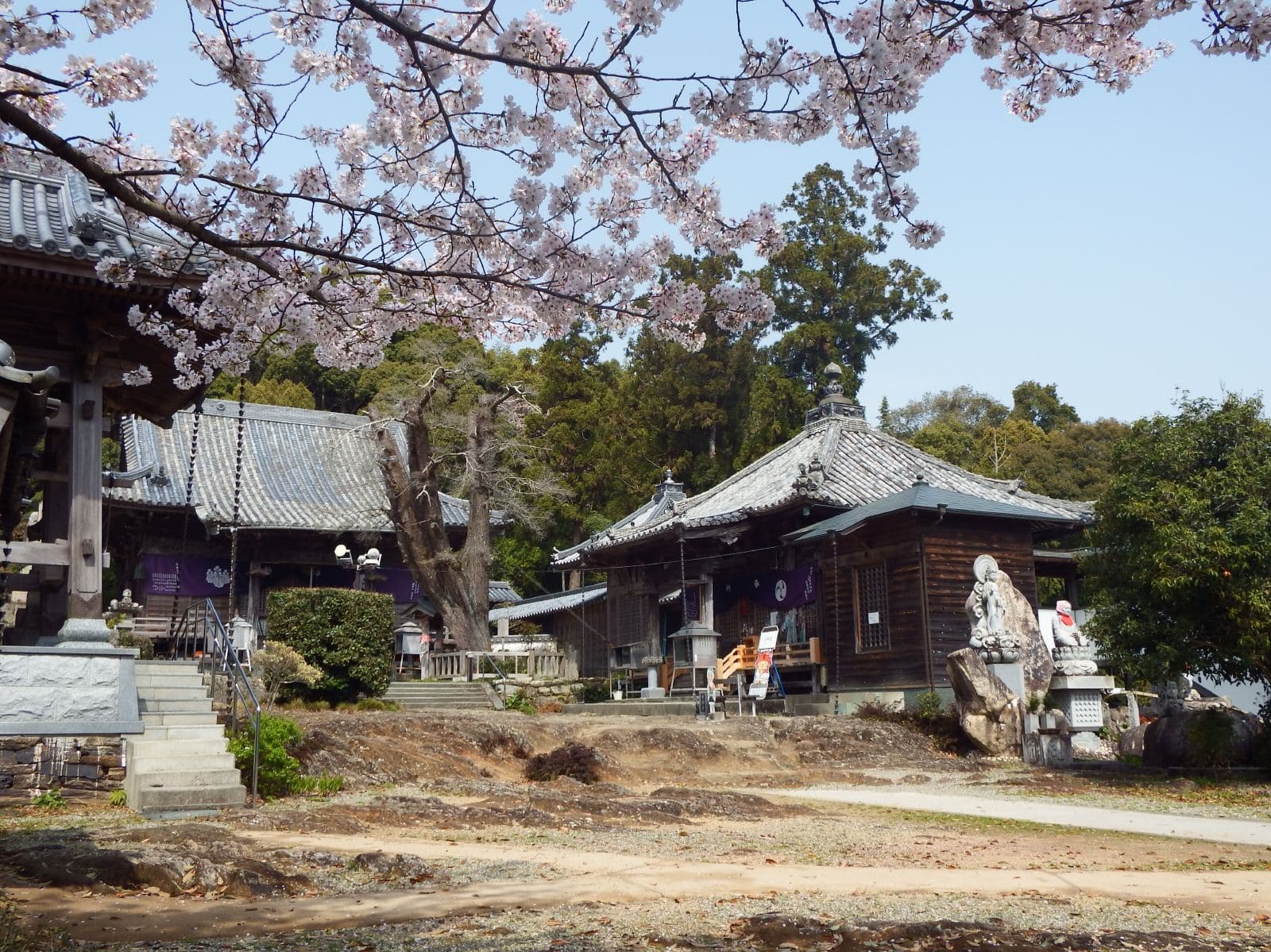
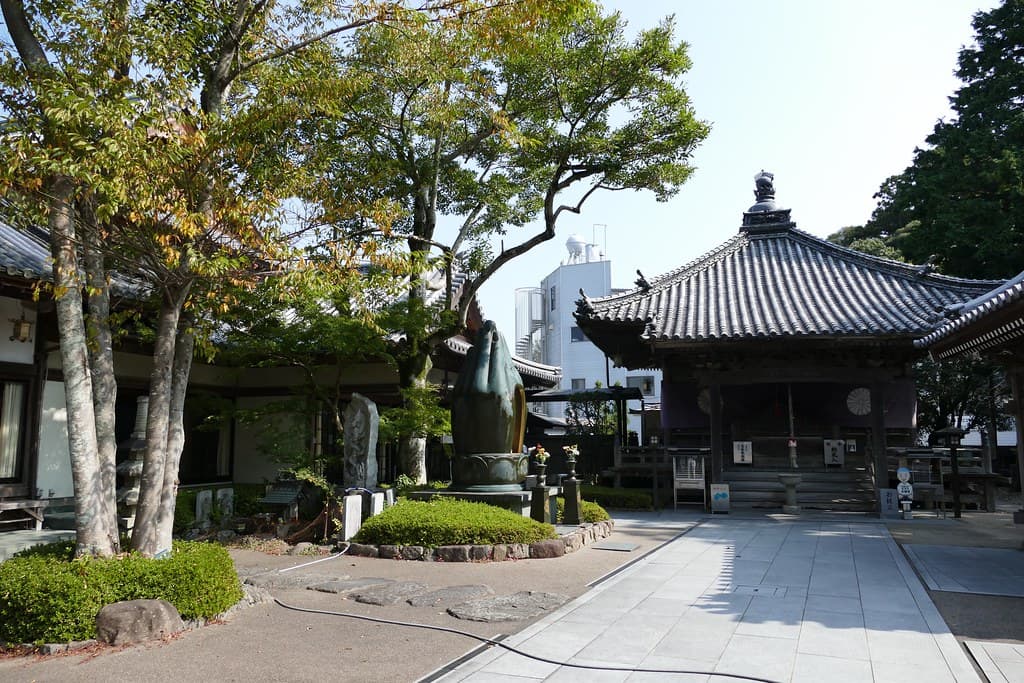
The interior precinct is small and quiet, with the Hondō and Daishi-dō facing each other in the standard pilgrim arrangement.
The interior layering deepens the place. The Senjū Kannon principal image, traditionally carved by Kūkai, is flanked by Fudō Myō-ō and Bishamonten in a configuration that reads, in esoteric terms, as a complete protective field: compassion at the centre, transformative wrath to one side, protective sovereignty to the other. The Yonaki Jizō, a small stone figure of the Bodhisattva of children and travellers, holds the place's other devotional centre.
Parents and grandparents come specifically to petition the Jizō for sleepless infants. The neighbourhood embedding becomes part of the temple's particular atmosphere: this is a sacred precinct quietly held within the everyday life of the houses around it.
Two layers of original purpose are visible. The first, attributed to Emperor Shōmu's reign (724–749), was an imperial pilgrimage place forming part of the broader Nara-period state-Buddhist network. The second, attributed to Kūkai's 816 visit, established the present temple as a Shingon Buddhist precinct dedicated to Senjū Kannon and protected by the attendant Fudō Myō-ō and Bishamonten—a complete protective triad for the surrounding community.
The temple was burnt down during the Tenshō era (1573–1592) by Chōsokabe Motochika's forces and rebuilt in 1659 (Manji era) by Hachisuka Mitsutaka, lord of Awa, whose patronage funded the imposing bell tower gate. The principal Senjū Kannon and attendant images, if Kūkai-attributed, did not survive the Tenshō destruction; the present images date from the post-1573 reconstruction.
The temple has continued in active service as Temple 16 of the Shikoku 88 throughout the modern period, accumulating a long tradition of folk-religious practices including the Yonaki Jizō devotion. Modern surrounding development has embedded the precinct within a residential Tokushima City neighbourhood.
Experience and orientation
Walking pilgrims arrive about three kilometres north of Awa Kokubun-ji, and the approach is ordinary. The henro path runs along streets in the Kokufu-chō / Awacho area of Tokushima City: small houses, parked cars, the normal sounds of a residential neighbourhood. The bell tower gate appears unexpectedly. Crossing under it is the temple's first interior gesture, and many pilgrims pause there briefly.
The precinct beyond is small and tree-shaded, with the Hondō, Daishi-dō, and the Yonaki Jizō all within easy reach.
The ritual sequence at the Hondō and Daishi-dō follows the standard pilgrim pattern. The Senjū Kannon mantra is chanted at the main hall, with the attendant Fudō Myō-ō and Bishamonten enshrined alongside the central image. After ritual, many pilgrims approach the Yonaki Jizō, a small stone figure that is the temple's most active site of folk devotion. Parents and grandparents come specifically to pray for sleepless babies; the Jizō receives small offerings and sometimes written wishes.
Many henro complete temples 14, 15, 16, and 17 in a single day given their proximity—Kannon-ji typically takes thirty to forty-five minutes, and the next stop (Ido-ji, Temple 17) is about three kilometres further north.
The temple sits within a residential area of Tokushima City (Kokufu-chō / Awacho area). The bell tower gate (shōrōmon) opens from the street directly into the precinct; inside, the courtyard holds the Hondō and Daishi-dō facing each other, with the Yonaki Jizō and the goshuin office within the precinct. Small free parking is available near the gate. Surrounding streets are residential—respect for neighbours' privacy and quiet is part of the temple's working etiquette.
Context and lineage
Tradition holds that an imperial pilgrimage place was established at this site during Emperor Shōmu's reign (724–749), making the location part of the broader Nara-period sacred network that also included Awa Kokubun-ji nearby. When Kūkai visited in 816, he carved the central Senjū Kannon and the attendant Fudō Myō-ō and Bishamonten, formally founding the temple as it is known today. The temple grew under Shingon patronage and was a working pilgrim site through the medieval consolidation of the Shikoku 88.
After Tenshō-era destruction, the 1659 reconstruction under the Hachisuka clan restored the precinct and added the imposing bell tower gate that still marks the entrance. The Yonaki Jizō devotion accumulated over later centuries as a folk-religious tradition specific to this temple.
Kōya-san Shingon: the major branch of Shingon Buddhism descended from Kūkai's monastic establishment on Mt. Kōya. Kannon-ji is administratively part of this branch and maintains the standard Shingon liturgy alongside the pilgrim chant sequence.
Senjū Kannon, the principal image, is one of the major esoteric Bodhisattvas of the Shingon pantheon; the attendant Fudō Myō-ō (a Wisdom King) and Bishamonten (one of the Four Heavenly Kings, protector of the nation) form a classic protective triad that situates the temple firmly within esoteric Buddhist iconography.
Kūkai (Kōbō Daishi)
Founder of the present temple in 816; traditional carver of the Senjū Kannon, Fudō Myō-ō, and Bishamonten
Emperor Shōmu
Imperial founder of the original pilgrimage place at the site
Hachisuka Mitsutaka
Edo-period rebuilder; funded the 1659 reconstruction including the bell tower gate
Traditions and practice
The henro sequence at Kannon-ji follows the standard Shikoku 88 pattern. Pilgrims bow at the bell tower gate (shōrōmon), purify hands and mouth at the temizuya, and sound the bell once on entry. At the Hondō: osamefuda, candle, three sticks of incense, a small coin, the Heart Sutra, and the Senjū Kannon mantra: On Bazara Tarama Kiriku. At the Daishi-dō: the same offerings and the Kōbō Daishi mantra: Namu Daishi Henjō Kongō.
The Yonaki Jizō receives prayers for crying babies and child welfare; parents and grandparents come specifically for this devotion, sometimes leaving small offerings or written wishes.
The nōkyō office is open 7:00–17:00 daily. Pilgrim reception runs year-round. The Yonaki Jizō remains a focus of folk devotion for parents and grandparents from the surrounding community, and the temple receives both pilgrim and non-pilgrim visitors throughout the day. The bell tower gate marks the entry threshold for all visitors. Many henro complete the cluster of Tokushima City temples (14, 15, 16, and sometimes 17) in a single day.
Walk slowly to the bell tower gate from the street. The contrast between residential ordinariness and the sacred precinct is part of the temple's particular tonality, and rushing through the gate misses the threshold gesture. After ritual at both halls, a brief pause at the Yonaki Jizō—simply present rather than petitioning—often opens the temple's quieter dimension. Those uncertain about the chants may simply offer incense and a coin at each hall.
Shingon Buddhism (Kōya-san branch)
ActiveKannon-ji is dedicated to Senjū Kannon (Thousand-Armed Kannon), the Bodhisattva of compassion who reaches out to all sentient beings simultaneously. The temple's enshrined attendants—Fudō Myō-ō (Immovable Wisdom King) and Bishamonten (Vaiśravaṇa, protector of the nation)—form a classic Shingon protective triad around the central honzon.
Pilgrims chant the Heart Sutra and the Senjū Kannon mantra (On Bazara Tarama Kiriku) at the Hondō, and the Kōbō Daishi mantra at the Daishi-dō. The Yonaki Jizō receives prayers for crying babies and child welfare.
Perspectives and open questions
Kannon-ji is read as Shingon protective-triad temple, as Yonaki Jizō folk-devotional centre, as residential-neighbourhood precinct, and as community-embedded pilgrim site. Each reading reveals a different facet of the same place.
Scholarly perspective
Historians treat the Emperor Shōmu and 816 Kūkai dates as traditional rather than strictly documented. The 1659 Hachisuka rebuild is well documented through Awa domain records. The temple's role within the Shikoku 88 is firmly established by at least the medieval consolidation of the route. The Yonaki Jizō folk devotion is undocumented in earliest sources but persists as living practice.
Living and traditional perspectives
Within Shingon, Kannon-ji is venerated as a place where Kūkai personally enshrined the protective triad of Senjū Kannon, Fudō Myō-ō, and Bishamonten. The Yonaki Jizō is regarded as a manifestation of Jizō Bosatsu's tender care for children, and the temple's continuing role in the cluster of Tokushima City sites makes it a working part of the local sacred geography.
Alternative interpretations
Esoteric readings see the triadic enshrinement (Senjū Kannon as compassion, Fudō Myō-ō as transformative wrath, Bishamonten as protective sovereignty) as a complete protective field for the precinct and its surrounding community. The temple's residential embedding is read as the dharma quietly held within the everyday life of the neighbourhood—a counterpoint to mountain temples like Shōsan-ji that hold the dharma in remoteness.
Open questions
The original founding-era statues, if Kūkai-attributed, did not survive the Tenshō destruction; the present principal images are post-1573 replacements whose continuity with the original carvings cannot be established. The earliest origin of the Yonaki Jizō folk devotion is undocumented. The numerous spiritual legends reportedly associated with Kannon-ji—mentioned by pilgrim sources—are not collected systematically in available English-language references.
Plan your visit
Access and arrival
Located in a residential area of Tokushima City (Kokufu-chō / Awacho area), Tokushima Prefecture. By car: small free parking near the bell tower gate. On foot (henro trail): about 3 kilometres north of Temple 15 Awa Kokubun-ji and about 3 kilometres south of Temple 17 Ido-ji. Nearest train station: JR Tokushima Station, then bus or taxi.
Pilgrim minshuku, ryokan, and small hotels are available in Tokushima City. The cluster of Temples 13–17 within a few kilometres makes a single-day or two-day completion realistic, with overnight stays in Tokushima City or along the route. Direct contact details and current availability should be confirmed in advance through the Shikoku Henro Reijōkai or local pilgrim guides.
Respectful visit
Modest casual clothing covering shoulders and knees; comfortable walking shoes. Pilgrim white hakui jackets, sedge hats, and kongō-zue staffs are common but optional.
Exterior photography of the precinct, bell tower gate, and Yonaki Jizō is permitted. Avoid flash and direct images of enshrined statues inside the halls. Avoid photographing surrounding private homes; the temple is in a residential area and neighbours' privacy must be respected.
Standard pilgrim offerings: osamefuda, candle, three incense sticks, and a small coin at each hall. Many leave specific prayers at the Yonaki Jizō for children's sleep, health, and growth, sometimes in the form of small offerings or written wishes.
Ring the bell only on entry. Keep voices low—the surrounding neighbourhood is residential. Do not block residential street parking; use designated temple parking only. Do not photograph private houses around the temple.
The temple is in a residential area; voices should be kept low, especially in early morning. Photography of the surrounding houses should be avoided. Do not block residential street parking; use the designated temple parking only. Photography of enshrined images inside the halls is generally restricted; check posted signage.
Current practical details
Address
Kanonji-49-2 Kokufuchō, Tokushima, 779-3123, Japan
Phone
Hours, fees, and access can change — verify on the official source before you travel. Practical details last checked Jun 2026.
Location
Map loads as you approach this section.
Pilgrim reflections
A portrait of encounter, not a score
Pilgrims describe what they felt, how present they could become, and whether the place would shape a journey. There are no stars and no ranking of traditions.
No reviewed reflections yet
The first pilgrims can help describe the character of being here.
Share a reflection
Available after an account-backed “Been there.” Every reflection is reviewed before publication.
Watch deeper
Films, episodes, and recorded talks for visitors who want more context before or after a visit. Speculative and alternative-history entries are labelled as perspectives, not as sources for established claims.
Nearby sacred places
Explore other sacred places in the region. Proximity does not establish access or travel time; check each place’s guidance.

References
Sources consulted for this page. Source categories describe the publication, not a guarantee that every claim is verified. Traditional accounts and outside interpretations may differ.
- 01Kannon-ji (Tokushima) - Wikipedia — Wikipedia contributorsencyclopediaConfirms Kōya-san Shingon affiliation, Senjū Kannon honzon, Kūkai's 816 visit, Hachisuka 1659 rebuild.
- 02Temple 16, Kannonji|What to See & Do|Tourism SHIKOKU — Shikoku Tourism Promotion OrganizationofficialFounding by Kūkai; statues of Fudō Myō-ō and Bishamonten; Yonaki Jizō tradition.
- 03Kannonji – Tokushima City, Tokushima Prefecture, Shikoku • Henro.org — Henro.orgguidePilgrim guide; bell tower gate.
- 04Customs and Etiquette of the Shikoku Pilgrimage - Henro.org — Henro.orgguideStandard henro etiquette.
- 05No. 16 Kannonji Temple - Shikoku Pilgrimage News — Shikoku Pilgrimage NewsguideNotes Kannon-ji's reputation for many spiritual legends.
- 06Kannonji Temple | Japan Experience — Japan ExperienceguideTourism overview confirming residential-area location and standard pilgrim layout.
Pilgrim glossary
- Kannon
- The bodhisattva of compassion, central to many East Asian pilgrimage routes.
- Bodhisattva
- An enlightened being who postpones full nirvana to help others toward awakening.
- Sutra
- A canonical Buddhist scripture, often chanted as part of practice.
- Mantra
- A sound, word, or phrase repeated as part of meditation or ritual.
- Dharma
- The teachings of the Buddha; also the universal law underlying them.
- Shingon
- An esoteric Japanese Buddhist school emphasizing ritual, mantra, and mandala practice.
Share a photo
Help visitors recognize Kannon-ji. Every submission is reviewed before publication.