Asuka-dera
Where Buddhism first took root in Japan, its oldest Buddha still watches
Understand sacred places, explore living traditions, and learn how to engage respectfully with Pilgrim Map.
Access has not been verified. Check current local guidance before planning a visit.
Asuka, Nara Prefecture, Japan
Read the sources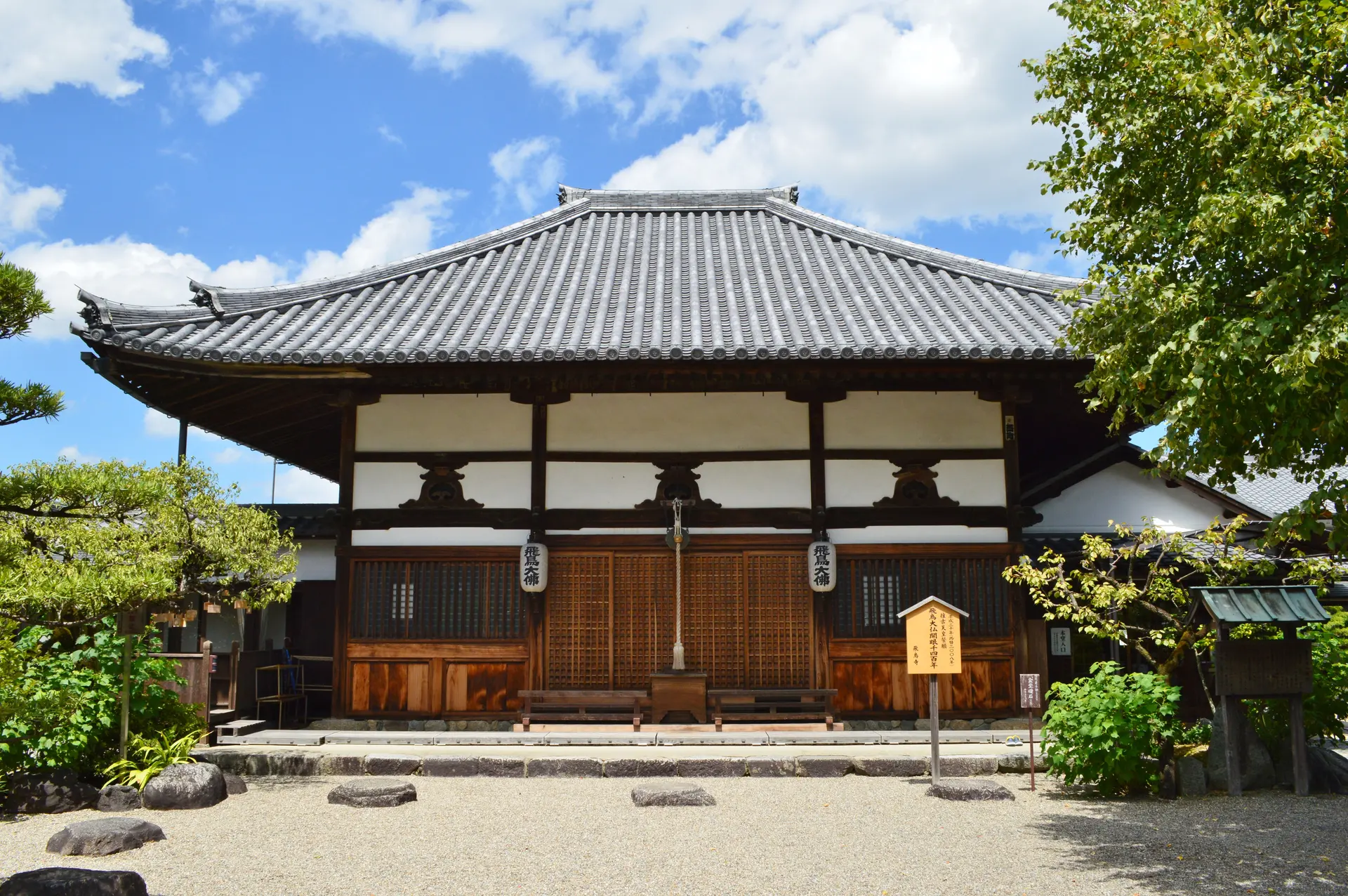
Image of Asuka-dera. Image source · CC0
Station 9 of 33
New Saigoku Kannon PilgrimageVisit essentials
A quick read before you go
- Duration
- 30 minutes to 1 hour at the temple itself.
- Access
- By bus: Asuka Daibutsu-mae stop via Kame Loop Bus from Kashiharajingu-mae Station (22 minutes,…
Overview
Before Nara and Kyoto, Asuka was the valley where Japanese civilization took shape. In 588 CE the Soga clan began Japan's first full-scale Buddhist temple, marking Buddhism's victory in its struggle for acceptance. Craftsmen summoned from Korea's Baekje kingdom built Japan's first proper temple complex—pagoda, lecture hall, and dormitories arranged on continental models. In 609 CE master sculptor Kuratsukuri no Tori completed the Great Buddha from 15 tons of copper and 30 kilograms of gold.
The Asuka Daibutsu has never moved: for over 1,400 years it remained through fires and neglect as the compound contracted around it. Today's modest temple sits among residential lanes and rice paddies, the Buddha accessible in a small, intimate hall. Its face is partly original bronze and partly mismatched copper repair after a 1196 fire. This imperfect survival witnesses everything that has unfolded in Japan since Buddhism arrived.
Why this place is sacred
What makes Asuka-dera thin is not spectacular architecture or dramatic landscape but simple persistence. The Buddha statue has not moved. When you stand before it, you occupy the same space that devotees have occupied since 609 CE—before Japan had a written language to record the moment, before the capital moved to Nara, before almost everything that constitutes Japanese history as we know it.
The statue was commissioned by Empress Suiko and created by Kuratsukuri no Tori, whose family had emigrated from Korea. It was the first major bronze Buddha in Japan, a technical achievement that represented the state's commitment to this foreign religion. When fires consumed the temple around it, the statue survived. When the temple complex shrank over centuries from a sprawling compound to a single modest hall, the statue remained.
The face you see is partly original and partly patched—damage from a 1196 fire repaired with copper that has aged differently than the original bronze. Far from diminishing the experience, this visible history deepens it. Here is something that has endured, imperfect but present, for longer than most civilizations last.
The surrounding Asuka landscape reinforces this sense of deep time: burial mounds rise from the rice fields, ancient stones mark unknown purposes, and the valley itself holds the memory of Japan's first true capital.
The temple was built to mark Buddhism's establishment in Japan following the Soga clan's victory over the anti-Buddhist Mononobe clan in 587 CE.
The original temple was vast, built with Korean expertise and containing Japan's first full temple complex. Over centuries, fires and neglect reduced it to the modest compound that exists today. What survives is the Buddha statue—and through it, unbroken connection to the moment everything changed.
Experience and orientation
Asuka-dera requires recalibration of expectations. There are no grand approaches, no sweeping temple complexes, no crowds. The temple sits in a quiet residential area, reached by walking lanes between rice paddies. The main hall is small, the grounds modest. And then you enter, and the Great Buddha is there—not behind glass, not roped off at a distance, but present and accessible. The face that has watched since 609 CE looks back at you from perhaps ten feet away.
The asymmetry is immediately visible: original bronze on one side of the face, later copper repair on the other. The damage speaks of the fire in 1196, but also of survival. This Buddha has outlasted the temple that housed it, the civilization that built it, and the religious controversies that surrounded its creation. Unusually for Japanese Buddhist statues, photography is permitted. But many visitors find that after a few photographs, they set their cameras down.
The encounter invites something more than documentation. The temple bell is available for ringing—a contemplative act that connects your moment to the countless moments before. Outside, the Asuka landscape extends in all directions: the burial mounds of ancient rulers, the rice fields that feed the region, the quiet hills where Japan's first imperial capital once stood.
Approach through the Asuka landscape, perhaps by rental bicycle from Kashiharajingu-mae Station, to experience the rural setting that preserves the atmosphere of ancient Japan. Allow time at the temple to simply sit with the Buddha rather than rushing through. The surrounding area—Ishibutai Kofun, Takamatsuzuka Tomb, other temple sites—creates a full day of immersion in Japan's earliest history.
Context and lineage
The temple emerged from religious conflict. When Buddhism arrived in Japan from Korea in the 6th century, the Soga clan embraced it while the Mononobe clan opposed it, seeing foreign religion as a threat to native kami worship. In 587, the conflict turned violent. Soga no Umako made a vow: if he defeated the Mononobe, he would build a Buddhist temple. Victory came, and construction began the following year.
Craftsmen from the Baekje kingdom of Korea arrived to share their expertise. A reliquary containing sarira (Buddha relics) was installed in 593; the pagoda pillar was erected. The temple was completed in 596, according to the Nihon Shoki. In 605, Empress Suiko commissioned a Buddha statue. The master sculptor Kuratsukuri no Tori—whose family had emigrated from Korea—spent four years creating the Great Buddha using 15 tons of copper and 30 kilograms of gold.
It was completed in 609 CE and has remained in place ever since.
The temple was the original home of what became Gangō-ji when the capital moved to Nara. The head priest Dōshō traveled to Tang China and returned with Chan Buddhist teachings, laying foundations for what would become Japanese Zen.
Soga no Umako
The powerful clan leader whose vow to build a temple after defeating the anti-Buddhist Mononobe clan resulted in Asuka-dera's founding
Kuratsukuri no Tori (Tori Busshi)
The master sculptor whose family emigrated from Korea; creator of the Asuka Daibutsu
Empress Suiko
The empress who commissioned the Great Buddha statue in 605 CE
Traditions and practice
The original temple served as a research institute for Buddhist teachings, hosting monks from Korea and China who transmitted continental learning. The head priest Dōshō's journey to Tang China and return with Chan Buddhism represents the temple's historical role as conduit for Buddhist transmission.
Daily worship services continue at the main hall. Visitors are welcomed to view the Asuka Daibutsu and may photograph it—unusual for Japanese Buddhist statues. The temple bell is available for ringing, creating participatory connection to the site's centuries of devotion.
Take time to sit with the Buddha rather than simply viewing and photographing. The intimate scale invites contemplation that larger temples may not afford. Ring the temple bell with full attention. Spend time in the surrounding Asuka landscape to appreciate the context of Japan's oldest surviving Buddhist site.
Buddhism
ActiveAsuka-dera holds unique significance as Japan's first full-scale Buddhist temple, marking the transition from Buddhism as foreign import to established Japanese institution. The temple served as a research institute for Buddhist teachings and was the original home of what became Gangō-ji in Nara.
Daily worship continues at the main hall housing the Asuka Daibutsu. Visitors can view and photograph the Buddha statue, ring the temple bell, and experience intimate encounter with Japan's oldest surviving Buddha image.
Perspectives and open questions
Asuka-dera can be understood as historical monument, as testimony to cultural exchange with Korea, or as the continuous presence of Buddhism's first major foothold in Japan.
Scholarly perspective
Historians and archaeologists recognize Asuka-dera as Japan's first full-scale Buddhist temple, with construction documented in the Nihon Shoki and confirmed by archaeological excavation. Recent scholarship has drawn parallels to the Wangheung-sa temple site in Korea, illuminating the Baekje craftsmen's role. The Asuka Daibutsu, despite damage and repairs, retains significant original material and is confirmed as Japan's oldest extant large-scale bronze Buddha. The temple represents crucial evidence of the Baekje-Japan cultural connection during Buddhism's transmission.
Living and traditional perspectives
Within Buddhist tradition, Asuka-dera marks the moment when the Dharma firmly established itself in Japanese soil. The Asuka Daibutsu embodies the presence of Shakyamuni Buddha, watching over this land for over 1,400 years. The statue's survival through fires and centuries of neglect is sometimes understood as miraculous protection, testament to the Buddha's continuing presence.
Alternative interpretations
Some visitors experience the statue's damaged face as teaching impermanence and endurance simultaneously. The repairs visible on the Buddha's face become text to be read: fire, survival, continuing care, the passage of time inscribed in bronze and copper.
Open questions
The exact techniques used to cast the original statue remain subjects of study. How much of the current statue is original versus later repair is debated among scholars. The full extent of the original temple complex, now buried beneath rice fields and houses, continues to be investigated through archaeology.
Plan your visit
Access and arrival
By bus: Asuka Daibutsu-mae stop via Kame Loop Bus from Kashiharajingu-mae Station (22 minutes, 290 yen, hourly departures). By bicycle: rent from Kashiharajingu-mae Station and ride 15 minutes through the Asuka countryside. The temple is in a quiet residential area.
Limited accommodations in Asuka itself; most visitors stay in Nara or Osaka and day-trip to the area.
Respectful visit
Modest dress appropriate for a Buddhist temple.
Photography of the Asuka Daibutsu is permitted—unusual for Japanese Buddhist statues. Use this privilege respectfully; be aware of other visitors.
Monetary offerings may be made at the altar. Incense is available.
Small entrance fee required. Treat the bell-ringing with appropriate reverence.
The temple is modest in scale—do not expect the grandeur of later Nara or Kyoto temples. This simplicity is itself meaningful, preserving a sense of Buddhism's early presence in Japan.
Current practical details
Address
682 Asuka, Takaichi District, Nara 634-0103, Japan
Phone
Hours
Hours, fees, and access can change — verify on the official source before you travel. Practical details last checked Jun 2026.
Location
Map loads as you approach this section.
Pilgrim reflections
A portrait of encounter, not a score
Pilgrims describe what they felt, how present they could become, and whether the place would shape a journey. There are no stars and no ranking of traditions.
No reviewed reflections yet
The first pilgrims can help describe the character of being here.
Share a reflection
Available after an account-backed “Been there.” Every reflection is reviewed before publication.
Nearby sacred places
Explore other sacred places in the region. Proximity does not establish access or travel time; check each place’s guidance.

References
Sources consulted for this page. Source categories describe the publication, not a guarantee that every claim is verified. Traditional accounts and outside interpretations may differ.
- 01Asukadera Temple - Official Nara Travel Guide — Visit NaraofficialOfficial Nara Prefecture tourism resource
- 02Asukadera Temple - JNTO — Japan National Tourism OrganizationofficialOfficial Japanese government tourism resource
- 03Tracing the Origin of Japan's First Buddhist Temple — MDPI Religions JournalacademicPeer-reviewed academic article on temple origins and Korean connections
- 04The Asuka Great Buddha - Nippon.com — Nippon.comspiritualJapanese cultural documentation
- 05Asuka-dera - Wikipedia — Wikipedia contributorsencyclopediaComprehensive historical overview with citations to Nihon Shoki
- 06Asukadera Temple - Japan Guide — Japan GuideguidePractical visitor information
Pilgrim glossary
- Dharma
- The teachings of the Buddha; also the universal law underlying them.
- Zen
- A Japanese Buddhist school emphasizing seated meditation and direct insight.
Share a photo
Help visitors recognize Asuka-dera. Every submission is reviewed before publication.