Nageshwar Jyotirlinga
The tenth Jyotirlinga, where Shiva subdued the demon Daruka and remained as lord of serpents
Understand sacred places, explore living traditions, and learn how to engage respectfully with Pilgrim Map.
Access has not been verified. Check current local guidance before planning a visit.
Dwarka, Gujarat, India
Read the sources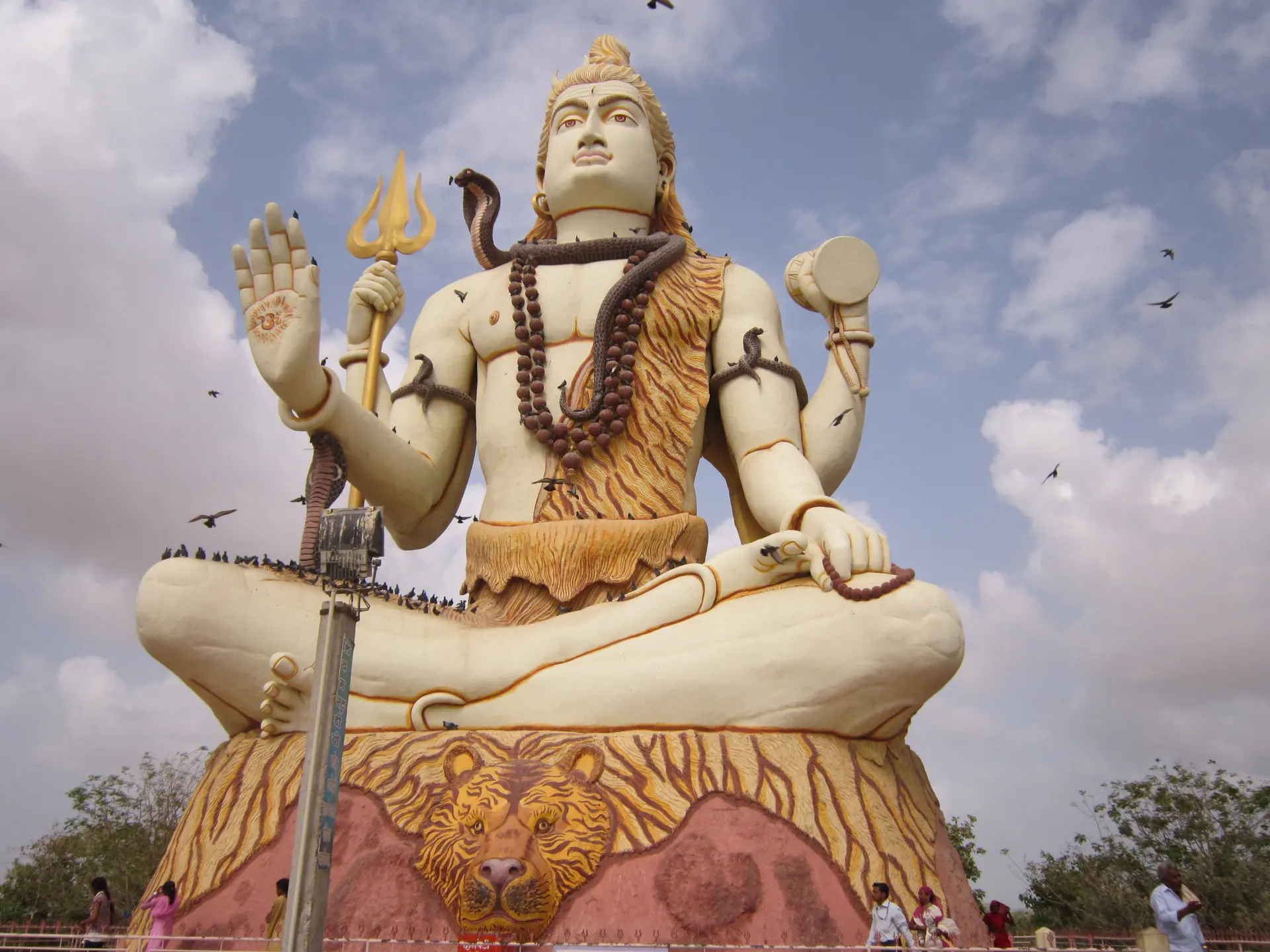
Visit essentials
A quick read before you go
- Duration
- Allow 1.5–2 hours at the temple itself including queue.
- Access
- 17 km north-west of Dwarka town along SH-25 (the Dwarka-Okha highway).
Overview
Nageshwar holds an unusual position in the Hindu sacred landscape. It is the only Jyotirlinga along the western seaboard, the only one where Shiva is invoked as protector against poison and serpents, and the only one woven directly into the geography of Krishna's earthly capital.
The Shiva Purana places it in Daruka-vana — the forest of Daruka — where Shiva manifested as a self-arisen pillar of light to liberate his devotee Supriya from imprisonment and to subdue the demon who had captured him. Gujarati Shaiva tradition reads the Purana's verse 'Daarukavane Nagesham' as identifying this Saurashtra coastal site, though Uttarakhand traditions claim Himalayan locations of the same name.
The contemporary visitor encounters two distinct presences. The historic shrine is small and intimate, with a sanctum where the lingam is bathed daily and where men remove their shirts before entering — a temple-specific rule maintained continuously. Beyond the temple stands a twenty-five-metre seated Shiva in padmasana, commissioned in the 1990s by industrialist-philanthropists and now the visual anchor of the entire complex.
The relationship between the ancient shrine and the modern statue is one many pilgrims describe as initially jarring and ultimately complementary — old fabric and new devotion held in a single horizon.
Why this place is sacred
Several factors converge here in a way no other Jyotirlinga site offers. The temple sits on a quiet stretch of Saurashtra coast between the Arabian Sea and Krishna's city of Dwarka — a meeting point of Shaiva and Vaishnava sacred geography. The dramatic twenty-five-metre seated Shiva is visible from kilometres of flat scrub before any temple structure comes into view; pilgrims report it as the first emotional anchor of the visit, well before darshan itself.
The pre-dawn Mangala Aarti around 5 AM, when the lingam is bathed and decorated before sunrise, is widely described as the most intimate moment of the day. The temple's relative isolation — unlike the dense urban temples of Varanasi or Madurai — gives the air around it a coastal openness that pilgrims often contrast with the enclosure of inland Shaiva shrines.
A Puranic Shaiva shrine marking the site of Shiva's manifestation as Nagesha — lord of serpents — in the legendary Daruka-vana forest.
Treated in Puranic tradition as svayambhu (self-manifest, timeless). The earliest surviving fabric on the site is generally dated to the medieval period; the present temple is a modern reconstruction and expansion atop the older shrine, with the colossal twenty-five-metre seated Shiva and surrounding complex completed in the 1990s under the sponsorship of Gulshan Kumar of T-Series.
Experience and orientation
The approach matters. The twenty-five-metre seated Shiva — right hand raised in abhaya mudra, eyes half-closed in meditation — comes into view long before any temple wall. Pilgrims commonly describe this first sighting as preparatory: a moment of arrival that precedes formal darshan. The temple itself, by contrast, is small. The sanctum is intimate and queues move quickly except during Sawan Mondays and Maha Shivratri, when waits can exceed several hours.
The requirement that men remove their shirts and upper garments before entering the inner sanctum is initially disorienting for visitors unfamiliar with the practice; most report that the gesture itself — undressing the upper body before the deity — becomes a focusing act, a small undoing that prepares the inner approach. Aarti participation is reported as deeply communal: the bell, conch, and lamp passed through tightly packed devotees, the lingam catching lamp-flame, the Mahamrityunjaya mantra threading through the hall.
If you are pursuing the twelve Jyotirlinga circuit, Nageshwar is most naturally visited with Somnath, the other Gujarat Jyotirlinga, roughly 230 km south along the same coast — together they form the western Jyotirlinga arc. Pair Nageshwar with Dwarkadhish and Bet Dwarka for the full Dwarka day-circuit. Arrive for the pre-dawn Mangala Aarti for the most intimate darshan; avoid Mondays of Sawan (Shravan, July–August) if seeking quiet.
Context and lineage
The Shiva Purana relates that a Shiva devotee named Supriya was captured along with other merchants by the demon Daruka and imprisoned in the forest of Daruka-vana. While imprisoned, Supriya continued to chant 'Om Namah Shivaya' and instructed the other captives in the mantra. Enraged, Daruka attempted to kill him; at that moment Shiva manifested as a luminous pillar — the Nageshwar Jyotirlinga — destroyed the demon, and remained at that spot as a protector against poison, snakes, and evil.
The form is invoked as Nagesha, lord of the nagas.
Shaiva Hinduism within the broader Smarta tradition, embedded in the Dwarka Vaishnava sacred geography as part of the Char Dham and Sapta Puri pilgrimage frameworks.
Supriya
Puranic devotee whose unbroken chanting of Om Namah Shivaya is said to have provoked Shiva's manifestation here
Daruka
The demon of Daruka-vana, subdued by Shiva's appearance as the Jyotirlinga
Gulshan Kumar (T-Series)
Industrialist-philanthropist who sponsored the modern temple expansion and the 25 m seated Shiva statue in the 1990s
Shree Nageshwar Jyotirlinga Trust
Current administering body under the guidance of the Dwarkadhish temple administration
Traditions and practice
Rudrabhishek anoints the lingam with panchamrita — milk, curd, ghee, honey, and sugar — followed by Gangajal. Bilva-patra is offered, and the Shiva Mahimna Stotra and Dwadasha Jyotirlinga Stotram are recited. Ceremonial aarti uses conch, bell, and lamp. Sponsored Rudrabhishek can be booked through the trust office.
Mangala Aarti around 5 AM; sanctum open for darshan roughly 6 AM–12:30 PM and 5 PM–9:30 PM (subject to seasonal change); Madhyahna and Shringar aartis through the day. Maha Shivratri sees overnight darshan and extended Rudri-path readings; the month of Sawan (Shravan, July–August) brings Monday-special abhishekam.
For a quiet first encounter, attend the pre-dawn Mangala Aarti around 5 AM, when the lingam is bathed before sunrise. If pursuing the twelve-Jyotirlinga vow, pair Nageshwar with Somnath the following day. Devotees seeking liberation from poisons — interpreted literally or metaphorically as negative influences and addictions — traditionally make vows here.
Shaiva Hinduism (Jyotirlinga tradition)
ActiveThe tenth of the twelve Jyotirlingas — self-manifest pillars of Shiva's infinite light — and the only Jyotirlinga where Shiva is invoked as Nagesha, lord of serpents and protector against poison and evil.
Daily Rudrabhishek with milk, water, honey, ghee, and Gangajal; bilva-patra offerings; chanting of the Mahamrityunjaya mantra and the Dwadasha Jyotirlinga Stotram; circumambulation of the sanctum; participation in Mangala, Madhyahna, and Shringar aartis.
Dwarka pilgrimage circuit (Char Dham / Sapta Puri)
ActiveDwarka is one of the four Char Dham of India and one of the Sapta Puri (seven sacred cities). Nageshwar is the principal Shiva node on the Dwarka circuit, traditionally visited alongside Dwarkadhish (Krishna), Rukmini Devi, Bet Dwarka, and Gomti Ghat — fusing Shaiva and Vaishnava devotion within a single coastal pilgrimage.
Bathing at Gomti Ghat at Dwarka before visiting Dwarkadhish; ferry to Bet Dwarka; road trip 17 km north-west to Nageshwar for Shiva darshan; circuit usually completed in one or two days.
Perspectives and open questions
Nageshwar is held by Gujarati Shaiva tradition as the unambiguous Daruka-vana of the Shiva Purana, and by an alternate Uttarakhand tradition as a Himalayan site of the same name. The contemporary Dwarka temple commands the largest pilgrim footprint of the three claimants. Multiple readings of the site coexist — scriptural, regional, tantric, and modern devotional.
Scholarly perspective
Scholars treat Nageshwar at Dwarka as a long-established Shaiva shrine on the western Indian coast whose Puranic identification is one of three competing claims for the tenth Jyotirlinga. The Shiva Purana verse is ambiguous and the resolution is regional rather than textually decisive; Dwarka commands the largest contemporary pilgrim footprint, Jageshwar in Uttarakhand the densest medieval temple complex, and Almora the strongest Kumaoni local claim.
Living and traditional perspectives
Gujarati Shaiva tradition holds Nageshwar at Dwarka as the unambiguous Daruka-vana site. Local Brahmin priests trace continuous worship at the site through medieval Saurashtra dynasties. The temple is woven into the family pilgrimage practice of Saurashtra communities and the wider Dwarka circuit.
Alternative interpretations
In tantric Shaiva readings, Nageshwar is associated with the kundalini-serpent — Shiva as Nagesha, master of the coiled serpent power — and with protection from poisons of both body and mind. The twenty-five-metre seated Shiva at the entrance, in padmasana with raised right hand in abhaya mudra, is a modern devotional installation echoing classical Shaiva iconography.
Open questions
The pre-medieval material history of the present site is poorly documented; underwater archaeology off Dwarka has revealed submerged structures attributed to the legendary Krishna-era city, but no securely dated continuous architectural sequence links Nageshwar to that horizon. The exact reading of the Shiva Purana's 'Daarukavane' line remains contested between three regional traditions.
Plan your visit
Access and arrival
17 km north-west of Dwarka town along SH-25 (the Dwarka-Okha highway). Nearest railway: Dwarka station (frequent autorickshaw, taxi, and shared-jeep service to the temple). Nearest airport: Jamnagar (~145 km) or Rajkot (~225 km). Free parking on site. The outer courtyard is wheelchair-accessible; the sanctum has a small step.
Dwarka town has a range of pilgrim accommodations from trust-administered dharamshalas to mid-range hotels. Most pilgrims base in Dwarka and make a half-day or full-day trip to Nageshwar.
Respectful visit
Modest traditional dress preferred. Men required to remove shirts and upper garments before entering the inner sanctum — temple-specific rule. Women wear sari, salwar-kameez, or modest western clothing with shoulders and knees covered.
Permitted in the outer courtyard and around the 25 m Shiva statue. Strictly prohibited inside the garbhagriha; phones and cameras deposited at the entrance.
Bilva leaves, white flowers, milk, water, ghee, panchamrita, and dried fruits. Cash offerings into the official hundi or through the trust receipt counter — not to individuals outside the gate.
No leather inside the sanctum (belts, wallets often deposited). No shoes — footwear stand at the entrance. Photography prohibited inside.
Photography is strictly prohibited inside the garbhagriha; phones and cameras are deposited at the entrance. Men must remove shirts before sanctum entry — bring an extra cloth or simply expect this. Avoid handing money to individuals approaching pilgrims outside the gate; offerings go into the official hundi or through the trust counter.
Current practical details
Address
Daarukavanam, Goriyali, Gujarat 361335, India
Hours
Hours, fees, and access can change — verify on the official source before you travel. Practical details last checked Jun 2026.
Location
Map loads as you approach this section.
Pilgrim reflections
A portrait of encounter, not a score
Pilgrims describe what they felt, how present they could become, and whether the place would shape a journey. There are no stars and no ranking of traditions.
No reviewed reflections yet
The first pilgrims can help describe the character of being here.
Share a reflection
Available after an account-backed “Been there.” Every reflection is reviewed before publication.
Nearby sacred places
Explore other sacred places in the region. Proximity does not establish access or travel time; check each place’s guidance.


References
Sources consulted for this page. Source categories describe the publication, not a guarantee that every claim is verified. Traditional accounts and outside interpretations may differ.
- 01Nageshwar Jyotirlinga — Wikipedia — Wikipedia contributorsencyclopediaOverview of the three claimed locations, Shiva Purana citation, Daruka legend, modern 25 m statue, festival schedule.
- 02Jyotirlinga — Wikipedia — Wikipedia contributorsencyclopediaConfirms Nageshwar as the tenth of the Dwadasha Jyotirlinga in the standard Shiva Purana Stotram listing.
- 03Shree Nageshwar Jyotirlinga Trust — Official Site — Shree Nageshwar Jyotirlinga Trust, DwarkaofficialOfficial temple trust: darshan timings (6 AM-12:30 PM and 5 PM-9:30 PM), Rudrabhishek booking, dress restrictions (men remove shirts in sanctum), Mangala Aarti at 5 AM.
- 04Gujarat Tourism — Nageshwar Mahadev Temple — Gujarat Tourism DepartmentofficialGovernment tourism office description of location 17 km from Dwarka, the 25 m Shiva statue donated by Gulshan Kumar (T-Series), and accessibility.
- 05Shiva Purana, Vidyeshvara Samhita and Koti Rudra Samhita (translations) — J. L. Shastri / Motilal Banarsidass critical editionsacademicPrimary scriptural source for the twelve Jyotirlinga list and the Daruka-vana legend underpinning Nageshwar's identity.
- 06Dwarka — Wikipedia — Wikipedia contributorsencyclopediaGeographic and historic context for the Dwarka pilgrimage circuit: Dwarkadhish, Bet Dwarka, Rukmini temple, Gomti Ghat.
- 07Prime Minister visits Nageshwar Jyotirlinga in Dwarka — The Hindu / PTInewsConfirms the site's national-pilgrimage stature and present-day administration; useful for visitor-numbers context.
- 08Nageshwar Jyotirlinga — pilgrim guide and review — Tripadvisor / Indian travel communityguideVisitor-reported queue lengths, weekend congestion, photography rules inside the garbhagriha, combined-circuit logistics with Dwarkadhish and Bet Dwarka.
Photo gallery
2 curated photos
Pilgrim glossary
- Mantra
- A sound, word, or phrase repeated as part of meditation or ritual.
- Mudra
- A symbolic hand gesture used in Buddhist iconography and practice.
Share a photo
Help visitors recognize Nageshwar Jyotirlinga. Every submission is reviewed before publication.