Somnath Jyotir Linga Shiva Temple, Somnath, Gujarat
The first of the twelve jyotirlingas, rebuilt seven times against the Arabian Sea
Understand sacred places, explore living traditions, and learn how to engage respectfully with Pilgrim Map.
Access has not been verified. Check current local guidance before planning a visit.
Veraval, Gujarat, India
Read the sources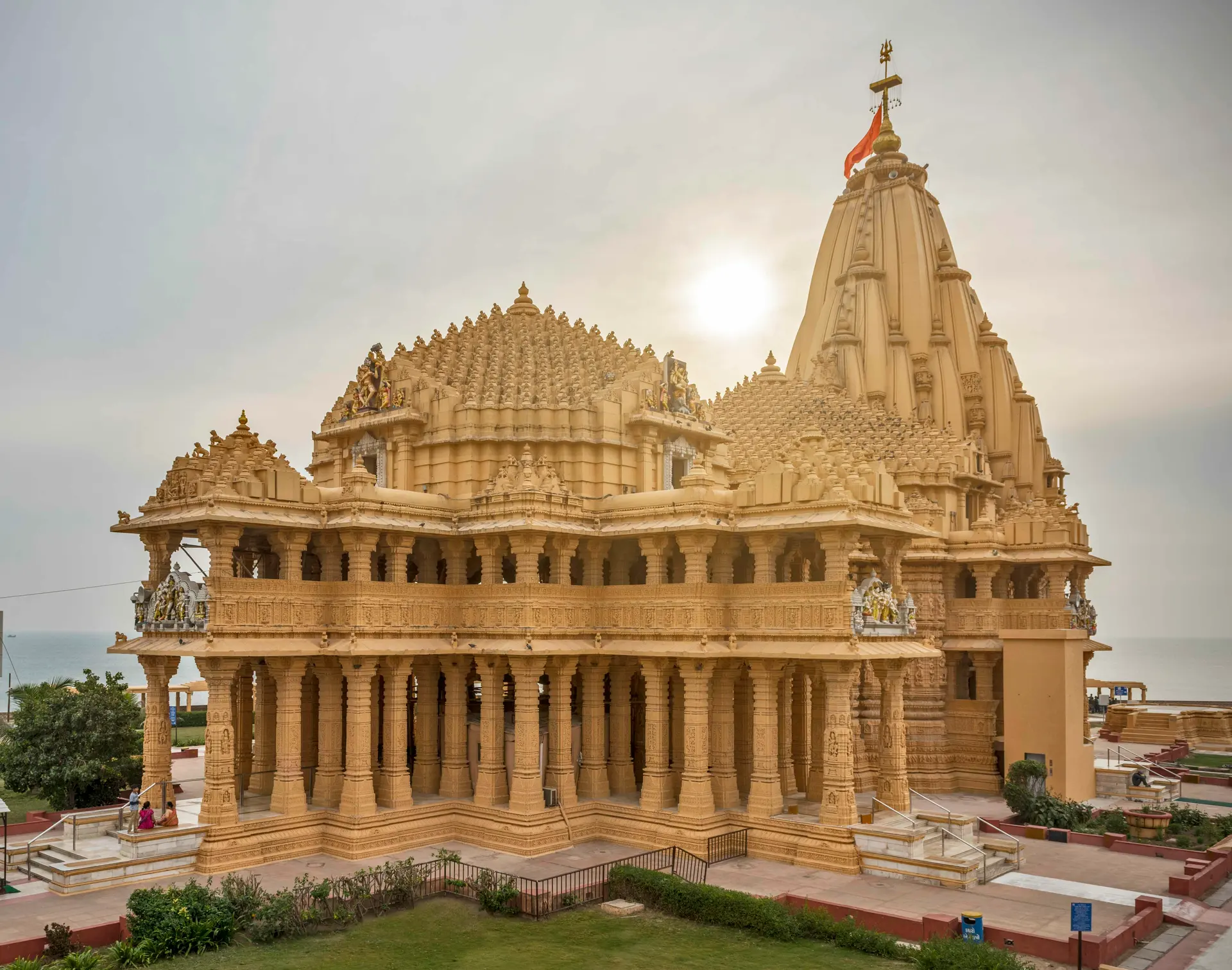
Image of Somnath Jyotir Linga Shiva Temple, Somnath, Gujarat. Image source · CC-BY-SA-4.0
Visit essentials
A quick read before you go
- Duration
- Two to three hours for the main temple including queue; the full Prabhas Patan pilgrimage…
- Access
- The temple stands in Prabhas Patan, 7 km east of Veraval town on the Saurashtra coast.
Overview
Somnath stands at the edge of the Arabian Sea, the first jyotirlinga in the list enumerated by Adi Shankaracharya in the Dwadasha Jyotirlinga Stotram. Tradition holds that Chandra, cursed by Daksha to wane and die, performed penance on this shore and installed the lingam in gratitude when Shiva relieved the curse — hence the name Soma-natha, Lord of the Moon.
The 11th-century Arab traveller Al-Biruni recorded a lingam apparently suspended in air by magnetic forces, a detail still woven into local tradition though no longer materially attested. What sets Somnath apart from the other eleven jyotirlingas is its history. In January 1026 the temple was sacked by Mahmud of Ghazni, an event that entered Indian memory as the paradigm of temple destruction.
It was rebuilt within decades by Bhimadeva I of the Chaulukya dynasty, destroyed again under Alauddin Khalji, Zafar Khan, Mahmud Begada, and Aurangzeb, and rebuilt each time. The present temple is the 1951 reconstruction commissioned by Sardar Vallabhbhai Patel as one of the first civic acts of independent India. For Hindu tradition the lingam is eternal regardless of the structure; each rebuilding is read as devotion's response.
The pilgrim who stands inside today is participating in a thousand-year argument that worship, not stone, is what survives.
Why this place is sacred
Somnath's thinness is built from layered claims. It is the Adi Jyotirlinga — the first — and the others are sometimes described as radiating outward from this point on the Saurashtra coast. The lingam is svayambhu and was installed, in tradition, by Chandra the moon-god himself.
The temple sits at a precise threshold: land ends here, and the south wall bears the Baan Stambh (Arrow Pillar) inscribed with the claim that from this point to the South Pole no landmass intervenes — an extraordinary cosmographic assertion of unknown date. Nearby lies Bhalka Tirth, where Krishna was struck by the hunter Jara's arrow, and the Triveni Sangam where Hiran, Kapila, and the mythical Saraswati meet — the site of his cremation.
The accumulation of departure points — the moon's curse lifted, Krishna's death, the ocean's edge, the southernmost landfall of Bharata — gives Somnath a quality unlike any other jyotirlinga: a place that has been ending and beginning continuously since before recorded time, and that survived a thousand years of repeated, deliberate erasure to be standing now.
Worship of Shiva as Somnath — Lord of the Moon-God — installed by Chandra as the first jyotirlinga, at the threshold where the Indian subcontinent meets the Arabian Sea.
From the mythological gold, silver, sandalwood, and stone temples of Chandra, Ravana, Krishna, and Bhimadeva, through seven recorded cycles of destruction and rebuilding under Junayd of Sindh, Mahmud of Ghazni, Alauddin Khalji, Zafar Khan, Mahmud Begada, and Aurangzeb, to Maharani Ahilyabai Holkar's small 1783 shrine and Sardar Patel's 1951 reconstruction completed in stone by Sompura sthapatis.
Experience and orientation
The first impression of Somnath is the sea. The temple's western face opens directly onto the Arabian Sea, and the roar of the waves is audible throughout the complex — during darshan, during abhishekam, and most powerfully during the 19:00 evening aarti when the sun sets over the ocean and the gold shikhar catches the last light. Pilgrims pass through extensive security and deposit all electronics before entering the sanctum.
Inside, the lingam is small, dark, and continuously wet from the pancha-amrit abhishekam — milk, curd, ghee, honey, and sugar. The three daily aartis at 07:00, 12:00, and 19:00 are well-spaced and accessible without booking. After darshan, many pilgrims walk the seafront promenade to the Baan Stambh on the south wall, then attend the 20:00 Sound and Light Show 'Jay Somnath' that narrates the destruction-rebuilding cycles in a register unusual among Indian temple complexes — explicit, civic, theatrical.
Visitors describe Somnath as Shiva's most defiant home: a place where the lesson is not transcendence but persistence. Many report that the sound of waves during abhishekam dissolves the distinction between water poured on the lingam and water arriving from the sea.
Combine darshan with the Sound and Light Show in a single evening for the fullest sense of the temple's narrative. Allow a full day for the wider pilgrimage circuit — Somnath, Bhalka Tirth, Triveni Sangam, Geeta Mandir, and the Sun Temple — which together hold the Krishna-Yadava departure story that frames the site.
Context and lineage
Chandra, the moon-god, was married to the twenty-seven daughters of Daksha Prajapati but favoured only Rohini. The other twenty-six wives complained to their father, who cursed Chandra with kshaya — to wane and die. Chandra performed severe penance to Shiva on the Saurashtra coast. Pleased, Shiva relieved the curse partially, decreeing that the moon would wax and wane in fortnightly cycles, and accepted residence in the lingam Chandra installed. Hence Soma-natha — Lord of the Moon.
An older layer of the tradition holds that Soma is the sacred drink of immortality (Soma rasa), and that Somnath is the dwelling of the Lord who grants amrita. A third tradition, woven through the same coast, holds that after Krishna's departure at nearby Bhalka Tirth and the submergence of Dwarka, Somnath became the holiest spot on this coast — where the Yadava civilization made its final offerings.
The temple is administered by the Shree Somnath Trust, founded in 1949 with Sardar Patel as a trustee. Ritual lineage descends from Pashupata Shaivism through the Chaulukya and Vaghela-era temple traditions of Gujarat to the present Smarta pandits who conduct the three daily aartis.
Chandra (Soma)
Mythological installer of the original jyotirlinga
Bhimadeva I of the Chaulukya dynasty
Rebuilt the temple in stone between 1026 and 1042 after Mahmud of Ghazni's raid
Sardar Vallabhbhai Patel
Commissioned the 1947–1951 reconstruction as one of the first civic acts of independent India
K. M. Munshi
Architect and chronicler of the 1951 reconstruction; founder of Bharatiya Vidya Bhavan
Romila Thapar
Historian whose 'Somanatha: The Many Voices of a History' is the definitive scholarly treatment of the temple's place in historical memory
Traditions and practice
The day at Somnath turns on the three aartis. Pancha-amrit abhishekam — milk, curd, ghee, honey, sugar — is offered continuously, and Rudrabhishek and Maharudrabhishek with 108 or 1008 Rudra mantra repetitions can be sponsored at the temple counter or online. Mahashivaratri brings a night-long jagran with continuous abhishekam. Kartik Purnima draws a large mela on the seashore, and Shravan Mondays bring kanwariyas carrying Ganga water across western India.
The trust runs the nightly Sound and Light Show 'Jay Somnath' (20:00, in Hindi, English, and Gujarati) — unusually well-produced for an Indian temple complex and a major draw in its own right. Free dharamshala accommodation is available through the trust for pilgrims. Online booking is available for abhishekam sponsorship and for the museum and Sound and Light Show. The annual Somnath Mahotsav in mid-November brings classical music and dance performances to the seafront.
Plan a two-day visit. The first afternoon for darshan, the evening aarti, and the Sound and Light Show. The second day for the surrounding pilgrimage — Bhalka Tirth, Triveni Sangam, the Sun Temple, the Geeta Mandir, and the Ahilyabai shrine within the complex. Pair the visit with Diu (90 km) or Sasan Gir National Park (60 km) for a wider Saurashtra circuit.
Shaivism — Adi Jyotirlinga (First of Twelve)
ActiveSomnath is enumerated as the first (Adi) of the twelve jyotirlingas in the Shiva Purana and Adi Shankaracharya's Dwadasha Jyotirlinga Stotram. The lingam is svayambhu and was originally said to be suspended in air by magnetic forces — recorded by 11th-century Arab traveller Al-Biruni. As the first jyotirlinga, it occupies a unique cosmological position: the others radiate outward from this point.
Pancha-amrit abhishekam with milk, curd, ghee, honey, sugar; bilva-patra offering; Rudrabhishek with 108 or 1008 Rudra mantra repetitions; three daily aartis at 07:00, 12:00, 19:00; Mahashivaratri night-long vigil.
Chandra (Soma) — Lunar Devotion
ActiveThe name Somnath means Lord of the Moon-God. Tradition holds that Chandra, cursed by Daksha to wane and die, performed severe penance to Shiva at this seashore. Shiva relieved the curse partially, decreeing the moon would wax and wane in fortnightly cycles, and accepted Chandra's installation of the jyotirlinga as his eternal home.
Special abhishekam on Somvar (Monday, the day of the moon); Chandra dosha nivaran puja; Pradosh Kala worship at twilight.
Vaishnava Connection — Krishna and Bhalka Tirth
ActiveJust 4 km from Somnath lies Bhalka Tirth, where Krishna was struck in the foot by the hunter Jara's arrow and departed his mortal body. The Triveni Sangam at Somnath is where he was cremated. Many pilgrims combine Somnath darshan with Bhalka Tirth and Dehotsarg.
Bath at Triveni Sangam; visit to the Bhalka Tirth Krishna shrine; pind daan at the Dehotsarg site.
Perspectives and open questions
Somnath is held simultaneously as a sacred jyotirlinga, a civic monument to Indian independence, a touchstone of nationalist memory, and a contested example in academic histories of medieval temple destruction. These readings continue to argue with each other.
Scholarly perspective
Historians — notably Romila Thapar — emphasise that the narrative of Somnath's repeated destruction was significantly amplified in the 19th and 20th centuries as part of nationalist memory-making. The 1026 raid by Mahmud of Ghazni was catastrophic but the temple was rebuilt by Bhimadeva I within decades. Successive destruction-rebuilding cycles reflect a complex political-religious history rather than a single linear story of victimhood. The 1951 reconstruction was a deliberate civic act linking the temple to the birth of independent India.
Living and traditional perspectives
For practising Shaivas, the historical destruction is theologically secondary. The jyotirlinga is eternal; it cannot be broken. Each rebuilding is interpreted as devotion's response, and the present temple stands not as a memorial of loss but as living proof that Shiva's presence cannot be displaced. Chandra installed it, kings rebuilt it, devotees still sustain it.
Alternative interpretations
The Baan Stambh on the south wall bears an inscription claiming that from this point to the South Pole no land intervenes — an extraordinary cosmographic statement of unknown date. Some read it as evidence of advanced ancient navigation; others as a meditative claim about Somnath as the southernmost spiritual edge of Bharata.
Open questions
The legend of the magnetically suspended lingam, recorded by Al-Biruni, has no confirmed archaeological basis but persists in tradition. The original idol of the pre-1026 temple has never been recovered. Pre-Mahmud architectural details survive only through textual descriptions.
Plan your visit
Access and arrival
The temple stands in Prabhas Patan, 7 km east of Veraval town on the Saurashtra coast. Diu Airport is 75 km (about 2 hours), Rajkot Airport 200 km (about 5 hours), and Ahmedabad 400 km (about 7 hours). Veraval railway station is 7 km / 20 minutes away. Direct buses run from Ahmedabad, Rajkot, Junagadh, and Diu. Temple open 06:00–21:00 daily; Sound and Light Show 20:00–21:00, subject to weather.
The Shree Somnath Trust offers free dharamshala accommodation for pilgrims, with simple to modest rooms bookable through the official trust website. A range of hotels operates in Veraval and along the Somnath seafront, from budget yatri houses to mid-range resorts. Booking ahead is essential during Shivaratri, Kartik Purnima, and Sawan.
Respectful visit
Modest, traditional attire is preferred. Shorts, sleeveless tops, and very short dresses are discouraged. Some abhishekam sponsorships require a dhoti for men.
Strictly forbidden inside the temple complex. All cameras, mobile phones, and electronic devices must be deposited at the cloakroom. Exterior, beach, and Sound and Light Show photography is permitted.
Bilva leaves, milk, Ganga water (often carried by kanwariyas), flowers, rudraksha mala, coconuts, and prasad — peda and sukhdi are traditional. Devotees often bring sand or seawater as symbolic offerings.
No electronics, no leather, no food or drink inside the sanctum. Separate queues for senior citizens and divyangs. Visitors should not turn their back on the lingam while exiting.
Security is extensive and slow at peak times — allow extra time on Mondays, on Shivaratri, and on Kartik Purnima. The coast is intensely hot from April to June; visit between October and February if possible. Photography inside the sanctum is strictly forbidden and electronics must be cloaked at the entrance.
Current practical details
Address
Somnath Mandir Rd, Somnath, Prabhas Patan, Gujarat 362268, India
Phone
Hours
Hours, fees, and access can change — verify on the official source before you travel. Practical details last checked Jun 2026.
Location
Map loads as you approach this section.
Pilgrim reflections
A portrait of encounter, not a score
Pilgrims describe what they felt, how present they could become, and whether the place would shape a journey. There are no stars and no ranking of traditions.
No reviewed reflections yet
The first pilgrims can help describe the character of being here.
Share a reflection
Available after an account-backed “Been there.” Every reflection is reviewed before publication.
Dates and observances
Upcoming festivals, feast days, and pilgrimages connected to this place. Add any to your calendar, or browse the full observance calendar.
- Add to calendar
Kartik Purnima Fair
Tue, Nov 24, 2026Festival
A fair on the full-moon day of Kartik with cultural programs, special Archana and a midnight Mahaarati; tradition holds the moon god takes his seat on the temple spire. The date shifts annually with the Hindu lunisolar calendar.
Nearby sacred places
Explore other sacred places in the region. Proximity does not establish access or travel time; check each place’s guidance.


References
Sources consulted for this page. Source categories describe the publication, not a guarantee that every claim is verified. Traditional accounts and outside interpretations may differ.
- 01Somnath temple — Wikipedia — Wikipedia contributorsencyclopediaComprehensive history including destruction cycles and 1951 reconstruction
- 02Shree Somnath Trust — Official Website — Shree Somnath TrustofficialOfficial trust website with darshan timings, aarti schedule, and history
- 03Somanatha: The Many Voices of a History — Romila ThaparacademicDefinitive scholarly analysis of Somnath in historical memory
- 04Jyotirlinga — Wikipedia — Wikipedia contributorsencyclopediaLists Somnath as the first of the twelve jyotirlingas
- 05Temple Desecration and Muslim States in Medieval India — Richard M. EatonacademicInfluential study contextualizing Somnath within wider patterns of medieval temple destruction
- 06Somnath Temple — Gujarat Tourism — Gujarat Tourism DepartmentofficialOfficial state tourism information
- 07Somnath Temple — Archaeological Survey of India — Archaeological Survey of IndiaguideASI conservation and archaeological information
- 08Somnath: The Temple That Refused to Die — BBC NewsnewsBackground on the temple's destruction-rebuilding history
- 09Somanatha: The Shrine Eternal — K. M. MunshiacademicAuthored by the architect of the 1951 reconstruction; foundational but partisan
Photo gallery
2 curated photos
Pilgrim glossary
- Mantra
- A sound, word, or phrase repeated as part of meditation or ritual.
Share a photo
Help visitors recognize Somnath Jyotir Linga Shiva Temple, Somnath, Gujarat. Every submission is reviewed before publication.