Omkareshwar Jyotir Linga Shiva temple, Omkareshwar, Madhya Pradesh
The island jyotirlinga shaped like the syllable Om, where Adi Shankaracharya took sannyasa
Understand sacred places, explore living traditions, and learn how to engage respectfully with Pilgrim Map.
Access has not been verified. Check current local guidance before planning a visit.
Omkareshwar, Madhya Pradesh, India
Read the sources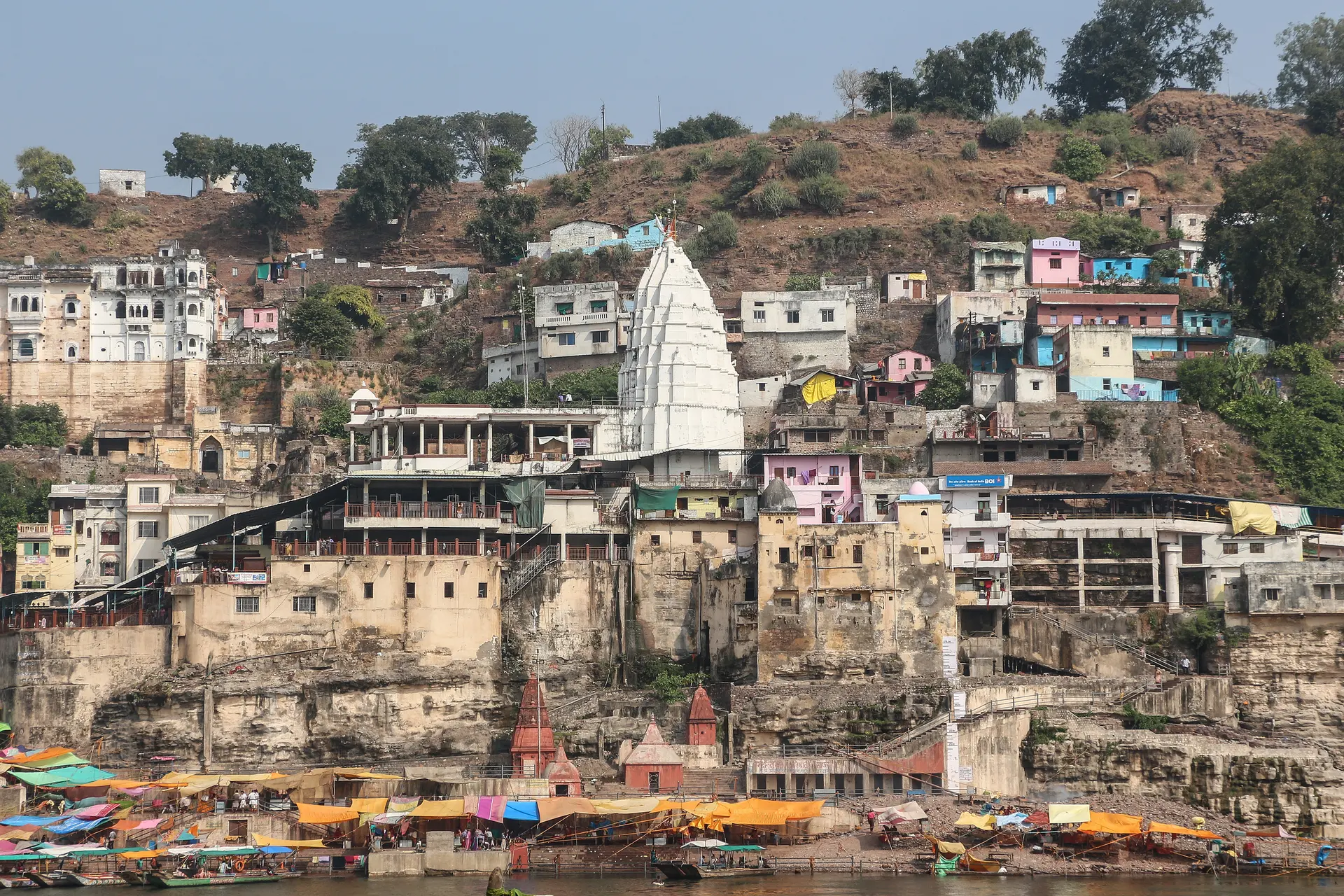
Visit essentials
A quick read before you go
- Duration
- Half day for darshan at both shrines plus one parikrama; full day with Statue of Oneness,…
- Access
- Indore Airport is 77 km from the site, about 2 hours by road.
Overview
Omkareshwar stands on Mandhata Island in the Narmada River, fourth in the canonical jyotirlinga sequence and the only island shrine among the twelve. Hindu cosmology regards the Narmada as older than the Ganga and the only river circumambulated as pilgrimage; it encircles the island on three sides before splitting around it.
Two jyotirlinga shrines belong to the vow: Omkar Mandhata on the island and Mamleshwar, also called Amareshwar, on the south bank. Both must be visited because tradition holds that the original lingam split in two when divine and human devotees each demanded its presence. The 5 km island parikrama, performed by every Omkareshwar pilgrim, walks the syllable Om as meditation.
Omkareshwar also belongs to Advaita Vedanta's foundational geography. Around 788–820 CE, Shankaracharya, then aged eight to twelve, is said to have received sannyasa initiation here from his guru Govinda Bhagavatpada, who lived in a south-bank cave. In September 2023, the island inaugurated a 108-foot bronze Statue of Oneness depicting the twelve-year-old teacher with an Advaita Lok museum complex. Wooded and watered, the site is quieter and more contemplative than the corridor jyotirlingas of Varanasi or Ujjain.
Why this place is sacred
Omkareshwar concentrates several thresholds. The Narmada is the only major river in India circumambulated as pilgrimage — the full parikrama from source to sea and back covers ~2,600 km and traditionally takes three years, three months, and thirteen days. Omkareshwar is one of the most important crossing points on that route.
The island itself is shaped — by tradition more than by aerial survey, but the resemblance is widely accepted in practice — like the syllable Om, with two arms of the Narmada forming the curves and the central waters the bindu. The dual jyotirlinga is theologically unusual: Omkareshwar on the island and Mamleshwar on the south bank are both claimed as the jyotirlinga, and traditional practice is to visit both.
Above all, the site is bound to Adi Shankaracharya's initiation into sannyasa, an event that anchors Omkareshwar in the lineage of Advaita Vedanta. The 2023 inauguration of the 108-foot Statue of Oneness has made this Advaita association civically visible for the first time at this scale.
Worship of Shiva as Omkareshwar — the Lord of the Syllable Om — through the island jyotirlinga and its paired south-bank shrine, and as the site of Shankaracharya's initiation into Advaita.
From mythological pre-history of King Mandhata's penance, through 9th–11th-century Paramara construction, Maratha-era Holkar restoration, Shankaracharya's c. 800 CE sannyasa initiation by Govinda Bhagavatpada, and the September 2023 inauguration of the Statue of Oneness and Advaita Lok complex.
Experience and orientation
Omkareshwar is approached on foot. The footbridge built in 2007 connects the south bank to the island and is open 24 hours; ferries and boats also ply the river through the day. Crossing in the morning, with the river still cool and the bells beginning, sets the contemplative tone the site is known for.
The Omkar Mandhata sanctum on the island holds the lingam continuously bathed in flowing Narmada water; sparsh darshan (touching the lingam) is permitted during early morning hours. Most pilgrims then walk the 5 km island parikrama, a self-guided circuit through wooded paths past Siddhanath, Gauri Somnath, and Kedareshwar temples — quieter, with the sound of the river always present. The Mamleshwar shrine on the south bank requires a short walk or boat ride back across the river.
Pilgrims who do not visit Mamleshwar are considered not to have completed the jyotirlinga darshan. Many add a visit to Govindpad Gufa — the cave where Govinda Bhagavatpada lived and where Shankaracharya received sannyasa — and a pradakshina of the Statue of Oneness. The evening aarti at 19:30, when hundreds of diyas float on the Narmada, is the moment most pilgrims describe as the site's emotional centre.
Plan at least a half day. Cross the footbridge before 09:00 to walk the parikrama in cool air, take darshan at both Omkar Mandhata and Mamleshwar, and stay through the 19:30 aarti for the floating-diya offering. Many pilgrims stay overnight to attend the 05:00 Mangala Aarti the following morning.
Context and lineage
King Mandhata of the Ikshvaku dynasty — the lineage of Rama — performed severe penance on this island in the Narmada. Shiva, pleased, agreed to manifest as a jyotirlinga here. The island has since been named Mandhata. A second tradition holds that the Vindhya Mountain, jealous of Mount Meru, performed penance to Shiva.
When both gods and human devotees prayed for his eternal presence, Shiva split the jyotirlinga in two — Omkareshwar (Parameshwar, the divine aspect) on the island and Mamleshwar (Amareshwar, the human-accessible aspect) on the south bank. Both must be visited. A third tradition is geographical: the island itself is shaped like the syllable Om, with two arms of the Narmada forming the curves and the central waters the bindu.
Pilgrims who circumambulate the island walk a meditation around the cosmic syllable itself.
The Omkar Mandhata temple is administered by the Shri Omkar Mandhata Trust; Mamleshwar runs as a separate adjacent shrine on the south bank. Ritual lineage runs through Pashupata Shaivism, Paramara temple tradition, and the Advaita Vedanta connection through Shankaracharya's initiation. The 2023 Advaita Lok complex and Statue of Oneness adds a contemporary Advaita-heritage institutional layer.
Mandhata
Mythological Ikshvaku-dynasty king whose penance brought Shiva to manifest as jyotirlinga on this island
Adi Shankaracharya
Founder of Advaita Vedanta, initiated into sannyasa here by Govinda Bhagavatpada around 800 CE
Govinda Bhagavatpada
Shankaracharya's guru, who lived in a cave on the south bank and conferred sannyasa initiation
King Bhoja
11th-century Paramara king under whom much of the present temple was constructed
Traditions and practice
The day at Omkareshwar turns on five aartis: Mangala Aarti at 05:00, daily puja and abhishekam through morning, Sandhya Aarti at 19:30 with the floating-diya offering on the Narmada, and Shayan Aarti at 21:30. Pancha-amrit abhishekam, Rudrabhishek, and the Narmadashtakam recitation are central. Mahashivaratri brings a night-long jagran; Narmada Jayanti (Magh Shukla Saptami, January–February) marks the river's birthday with grand processions.
The island parikrama — roughly 5 km, completed by most pilgrims in 1.5 to 2 hours — has become the contemplative backbone of contemporary visits. Boats and ferries connect both banks; the footbridge remains open 24 hours. The 2023 Statue of Oneness has added a pradakshina circuit and a museum visit to the standard itinerary.
Floating-diya offerings at sunset, with hundreds of lamps released by pilgrims along the south-bank ghats, has become one of the site's most photographed and emotionally resonant practices.
Allow at least a half day, ideally a full day with an overnight. Visit Omkar Mandhata in the morning, walk the island parikrama, cross to Mamleshwar, sit at Govindpad Gufa, and return for the 19:30 aarti and floating-diya offering. Combine with Mahakaleshwar at Ujjain (140 km / 3 hours) for a two-jyotirlinga Madhya Pradesh circuit, or add Maheshwar (60 km) for Ahilyabai Holkar's Narmada-ghat town.
Shaivism — Omkareshwar Jyotirlinga
ActiveOmkareshwar is the fourth jyotirlinga. Uniquely, two shrines on opposite banks of the Narmada — Omkar Mandhata on the island and Mamleshwar on the south bank — are both claimed as the jyotirlinga, and traditional practice is to visit both. The name Omkareshwar derives from the sacred syllable Om (ओम्/ॐ), which the island is said to resemble.
Pancha-amrit abhishekam at both shrines; bilva-patra offering; Narmadashtakam recitation; five daily aartis; Mahamrityunjaya Jaap.
Narmada Mata Worship and Parikrama
ActiveThe Narmada is the only river in India circumambulated as a pilgrimage — the full Narmada Parikrama covers ~2,600 km from source to sea and back, traditionally taking three years, three months, and thirteen days. Omkareshwar is one of the most important crossing points. The smaller, 5 km parikrama of Mandhata Island is performed by every Omkareshwar pilgrim.
5 km island parikrama (one circumambulation = one wish); Narmada snana; Narmada Jayanti celebrations on Magh Shukla Saptami; floating-diya offering at sunset.
Advaita Vedanta — Shankaracharya Initiation
ActiveAdi Shankaracharya, founder of Advaita Vedanta, was initiated into sannyasa at Omkareshwar by his guru Govinda Bhagavatpada, who lived in a cave on the south bank. The site is one of the most important to Advaita lineage. In September 2023, a 108-foot bronze Statue of Oneness depicting the twelve-year-old Shankaracharya was inaugurated on Mandhata Island, accompanied by an Advaita Lok museum.
Visit to Govindpad Gufa on the south bank; recitation of Shankaracharya's Bhaja Govindam and Nirvanashatakam; pradakshina of the Statue of Oneness.
Perspectives and open questions
Omkareshwar is held as a Puranic island jyotirlinga, an Advaita Vedanta initiation site, a Narmada-parikrama crossing point, and — since 2023 — a civic centre for Advaita heritage. These readings sit comfortably together on the same island.
Scholarly perspective
The Omkar Mandhata temple in its present form dates to the Paramara dynasty of Malwa (9th–11th century CE), with successive restorations. The dual-jyotirlinga tradition is well-attested in the Shiva Purana. Adi Shankaracharya's connection to Omkareshwar is historically secure — he received sannyasa initiation here from Govinda Bhagavatpada before composing his major commentaries. The 2023 Statue of Oneness is a deliberate civic-religious effort to position Omkareshwar as a centre of Advaita Vedanta heritage.
Living and traditional perspectives
For devotees, the island is literally the syllable Om made of land and water — pradakshina around it is meditation on Om itself. The dual jyotirlinga teaches that the apparently divine and the apparently accessible are one. Bathing in the Narmada is said to purify what the Ganga purifies in seven days, the Yamuna in three, and the Saraswati in one — instantaneous purification.
Alternative interpretations
Tantric traditions associate the island's two arms with ida and pingala (the lunar and solar nadis), with the temple at the place where they meet — the sushumna axis. The island is thus a geographical mandala of the subtle body.
Open questions
Whether the island is geometrically Om-shaped is contested — aerial imagery shows an oval island bisected by river channels, with the Om resemblance interpretive rather than literal. The Narmada is one of the only major rivers in the world flowing east-to-west in its middle course — a phenomenon variously explained by tectonics and by Hindu tradition, in which Narmada chose to flow against the Ganga as her independent vow.
Plan your visit
Access and arrival
Indore Airport is 77 km from the site, about 2 hours by road. Omkareshwar Road railway station is 12 km / 30 minutes; Khandwa station is 70 km / 2 hours. Ujjain — for a combined Mahakaleshwar–Omkareshwar pilgrimage — is 140 km / 3 hours. Direct buses run from Indore, Khandwa, Ujjain, and Bhopal. Temple open 05:00 to 21:30. Boats and ferries run 06:00 to 19:00; the footbridge is open 24 hours.
A range of dharamshalas, ashrams, and guesthouses operate on both banks — most simple and affordable, suited to pilgrims rather than tourists. The MP Tourism Narmada Resort on the south bank offers more comfortable accommodation. Booking ahead is wise during Shravan, Mahashivaratri, and Narmada Jayanti.
Respectful visit
Modest traditional attire is preferred. Bathing in the Narmada — pilgrims typically wear a dhoti or sari rather than swimwear.
Permitted on the island, during parikrama, and around the Statue of Oneness. Prohibited inside both sanctums.
Bilva leaves, milk, Narmada water, white flowers, Narmada-bank stones (banalingas — naturally Shiva-shaped pebbles), ghee, honey. Devotees often release lit diyas on the river at sunset.
Cameras and phones inside the sanctum are prohibited. No leather inside the temple. Quiet behaviour during parikrama. Respectful distance from bathing pilgrims.
Crowds on Mondays during Shravan are heavy, and the river runs high during monsoon — the parikrama can become slippery. Sparsh darshan windows are limited; check the trust website for current timings. The island has few shaded resting points in summer; carry water.
Current practical details
Address
Mandhata, Omkareshwar, Madhya Pradesh 450554, India
Phone
Hours
Hours, fees, and access can change — verify on the official source before you travel. Practical details last checked Jun 2026.
Location
Map loads as you approach this section.
Pilgrim reflections
A portrait of encounter, not a score
Pilgrims describe what they felt, how present they could become, and whether the place would shape a journey. There are no stars and no ranking of traditions.
No reviewed reflections yet
The first pilgrims can help describe the character of being here.
Share a reflection
Available after an account-backed “Been there.” Every reflection is reviewed before publication.
Nearby sacred places
Explore other sacred places in the region. Proximity does not establish access or travel time; check each place’s guidance.
Mahakaleshwar Jyotirlinga Shiva Temple, Ujjain, Madhya Pradesh
Ujjain, Madhya Pradesh, India
111.4 km away

Bhartrihari Caves, Ujjain, Madhya Pradesh
Ujjain, Madhya Pradesh, India
113.6 km away
Husain Tekri, Jaora
Jaora, Madhya Pradesh, India
187.7 km away

Ajanta caves, Maharashtra
Phardapur, Maharashtra, India
194.0 km away
References
Sources consulted for this page. Source categories describe the publication, not a guarantee that every claim is verified. Traditional accounts and outside interpretations may differ.
- 01Omkareshwar — Wikipedia — Wikipedia contributorsencyclopediaComprehensive overview of the town, island, and dual jyotirlinga tradition
- 02Jyotirlinga — Wikipedia — Wikipedia contributorsencyclopediaCanonical list and ranking among twelve
- 03Omkareshwar — Madhya Pradesh Tourism — MP Tourism BoardofficialOfficial tourism information including parikrama route and access
- 04Encyclopaedia of Indian Temples — Margaret and James StutleyacademicBackground on Narmada temple traditions
- 05Adi Shankaracharya at Omkareshwar — Sringeri Math — Sringeri Sharada PeethamspiritualAccount of Shankaracharya's initiation by Govinda Bhagavatpada at Omkareshwar
- 06Statue of Oneness inaugurated at Omkareshwar — The HindunewsSeptember 2023 unveiling of the 108-foot Statue of Oneness honoring Adi Shankaracharya
- 07Shri Omkar Mandhata Temple Trust — Omkar Mandhata TrustofficialOfficial temple trust site with aarti and darshan timings
- 08Narmada Parikrama Guide — Narmada MissionguideComprehensive guide to the Narmada Parikrama and Omkareshwar's role
Pilgrim glossary
- Mandala
- A symbolic diagram of the cosmos used in meditation and ritual.
Share a photo
Help visitors recognize Omkareshwar Jyotir Linga Shiva temple, Omkareshwar, Madhya Pradesh. Every submission is reviewed before publication.