Bhalka Tirth, Veraval, Gujarat
The shaded courtyard near Somnath where, by tradition, Krishna laid down his earthly life
Understand sacred places, explore living traditions, and learn how to engage respectfully with Pilgrim Map.
Access has not been verified. Check current local guidance before planning a visit.
Veraval, Gujarat, India
Read the sources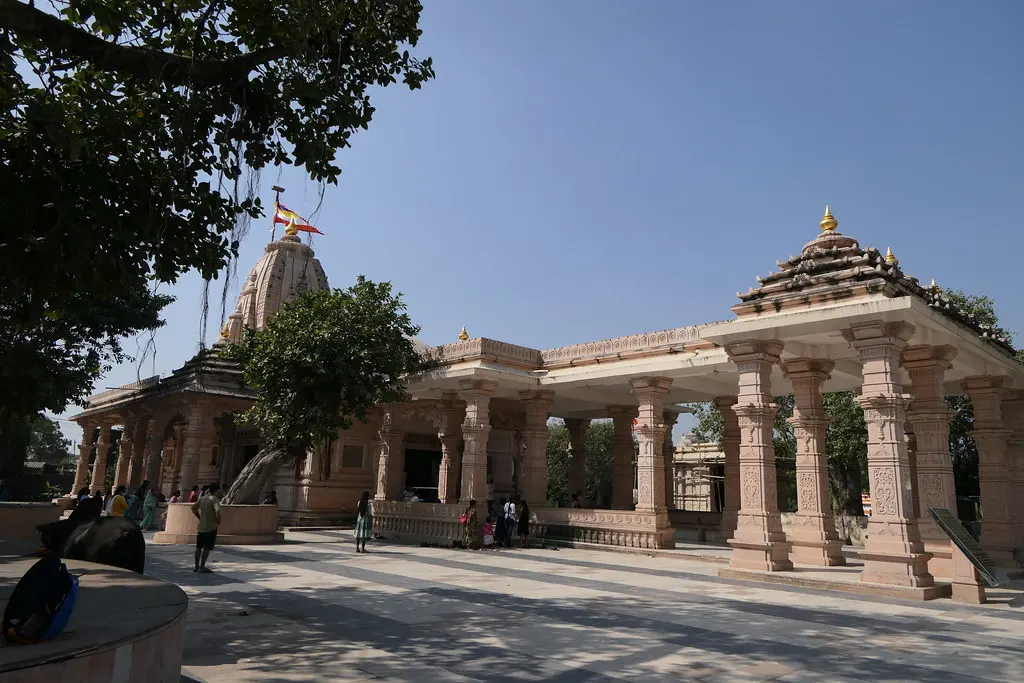
Image of Bhalka Tirth, Veraval, Gujarat. Image source
Visit essentials
A quick read before you go
- Duration
- About 40–70 minutes for darshan and quiet time in the courtyard.
- Access
- At Prabhas Patan near Veraval, about 4 km from the Somnath Temple and roughly 5 km from Somnath…
Overview
Some sacred places celebrate a birth or a victory. Bhalka Tirth holds something rarer: the memory of an ending. By tradition this is the spot where Krishna concluded his earthly life. After the Yadava clan had destroyed itself in civil war, the disheartened Krishna withdrew to the forest and sat in yoga-samadhi beneath a peepal tree, his left foot partly visible. A hunter named Jara, mistaking the foot for a deer, loosed an arrow that mortally wounded him.
The word bhal means arrow, and the place takes its name from that single shaft.
What makes the story moving rather than merely tragic is Krishna's response: he reassured the stricken hunter, linking the act to a deed from a previous age, and then — wounded — is said to have walked a short distance to bathe at the Triveni Sangam before leaving his body at Dehotsarg.
The episode is held to mark the close of the Dvapara Yuga and the onset of our own age, the Kali Yuga; an entire turning of cosmic time pivots on this courtyard.
The place itself is unassuming. Visitors describe a calm, shaded courtyard centred on the sacred peepal, with a shrine known also as Mahaprabhuji's Bethak in the Pushtimarg tradition. There is no grand monument here; the precise date of any historical shrine on the spot is not established, and the narrative rests on epic and Puranic tradition rather than archaeology.
It is one of the most emotionally affecting stops on the Somnath circuit precisely because it asks so little and contemplates so much.
Why this place is sacred
The density of Bhalka is emotional and temporal rather than architectural. It marks, by tradition, the precise place where the divine relinquished a human body — the close of one cosmic age and the beginning of another. To sit in its courtyard is to sit at a hinge of time as Hindu tradition reckons it.
The setting deepens this. Bhalka lies within the Prabhasa kshetra near Veraval, an area occupied since the Indus Valley period and celebrated in the Skanda Purana as one of the most powerful tirthas. It is bound to the Triveni Sangam, where three rivers meet and where Krishna is said to have bathed after being wounded, and to the Somnath Jyotirlinga a few kilometres away.
The sacred peepal tree at its centre gives the place a living focus, and the quiet of the shaded courtyard does much of the work that grand architecture does elsewhere.
A pilgrimage tirtha marking the traditional site of Krishna's earthly departure, venerated as part of the wider Prabhasa kshetra and revered in the Pushtimarg tradition as Mahaprabhuji's Bethak.
The site's sanctity derives from the Krishna-departure tradition rather than a dated monument; the precise construction date of any shrine on the spot is not established. Around it, the Prabhas Patan area shows ancient occupation reaching back to the Indus Valley period and is described in the Skanda Purana's Prabhasa Kshetra Mahatmya as a major tirtha.
Today Bhalka functions as a living and emotionally significant stop on the Somnath pilgrimage circuit, visited alongside the Triveni Sangam, Dehotsarg and the Somnath Jyotirlinga.
Experience and orientation
Bhalka does not announce itself. Visitors describe arriving at a calm courtyard shaded by large trees and centred on the peepal — the descendant, by tradition, of the tree under which Krishna sat — with the shrine known as Mahaprabhuji's Bethak nearby. The atmosphere is quietly moving rather than dramatic; many people report a contemplative, sometimes emotional response simply at being in the place associated with Krishna's departure.
Most pilgrims pair the visit with the Triveni Sangam, the three-river confluence where Krishna is said to have bathed after being wounded, and with the great Somnath Jyotirlinga. The site rewards a reflective pace: a quiet sit in the courtyard, especially in the early morning before the heat and crowds, or in the late afternoon on the way to the Somnath evening aarti. Janmashtami and other Krishna festivals bring larger gatherings and a heightened devotional charge.
Bhalka lies at Prabhas Patan near Veraval, easily reached by road as part of the Somnath circuit. Remove footwear before entering the shrine grounds. Take darshan at the shrine and the sacred peepal site, then sit quietly in the courtyard. Plan to continue to the Triveni Sangam — where ritual bathing is undertaken — and on to Dehotsarg and the Somnath Jyotirlinga. Early morning is quietest and coolest; late afternoon lets you finish before the Somnath evening aarti.
Context and lineage
The narrative is rooted in epic and Puranic tradition. After Gandhari's curse following the Kurukshetra war, the Yadava clan destroyed itself in a civil war; the disheartened Krishna withdrew to the forest and sat in yoga-samadhi beneath a peepal tree. The hunter Jara mistook Krishna's partly visible left foot for a deer and shot an arrow that mortally wounded him. Krishna reassured Jara, linking the act to the killing of Vali in a previous age.
Wounded, he is said to have walked a short distance to bathe at the Triveni Sangam and then to have left his body at Dehotsarg. The name Bhalka derives from bhal, meaning arrow. The episode is held to mark the end of the Dvapara Yuga and the onset of the Kali Yuga.
Vaishnavism within Hinduism, in its Krishna-devotional and Pushtimarg streams, carried at this site as part of the wider Prabhasa-kshetra pilgrimage tradition.
Krishna
The departing divine figure
Jara
The hunter
Vallabhacharya (Mahaprabhuji)
Pushtimarg founder
Gandhari
Source of the curse
Traditions and practice
Pilgrims take darshan and offer prayer at the shrine and the sacred peepal site; the wider Prabhasa tirtha includes ritual bathing, which is associated with the nearby Triveni Sangam confluence rather than with Bhalka itself.
Daily darshan continues, and the site is visited as part of the Somnath pilgrimage, frequently combined with Triveni Sangam, Dehotsarg and the Somnath Jyotirlinga. Janmashtami and other Krishna festivals draw larger crowds.
Let the place do its quiet work. Sit in the shaded courtyard near the peepal and allow the contemplation the site invites — the mystery of a willing divine departure, the turning of an age. Continue to the Triveni Sangam for ritual bathing if you wish, and pace your circuit so that Bhalka is experienced reflectively rather than rushed.
Vaishnavism (Krishna devotion)
ActiveBhalka Tirth marks the place where, by tradition, the hunter Jara's arrow struck Krishna's foot as he sat in yogic repose beneath a peepal tree, leading to his departure from the earth — an event held to mark the end of the Dvapara Yuga and the onset of the Kali Yuga. The main shrine is also revered as Mahaprabhuji's Bethak in the Pushtimarg tradition.
Darshan of the shrine and the sacred peepal site; reflection on Krishna's departure; the site is paired with the Triveni Sangam and Dehotsarg in the pilgrimage.
Perspectives and open questions
Bhalka is read by scholars as part of an ancient tirtha and by devotees as the exact spot of Krishna's departure; both readings are held here.
Scholarly perspective
Scholars place Bhalka within the ancient Prabhasa kshetra near Veraval, an area occupied since the Indus Valley period and celebrated as a major tirtha in the Skanda Purana; the Krishna-departure association is traditional rather than archaeologically datable.
Living and traditional perspectives
Devotees revere Bhalka as the exact spot of Krishna's earthly departure, marking the close of the Dvapara Yuga, and as Mahaprabhuji's Bethak in the Pushtimarg tradition.
Alternative interpretations
The episode is read as the willing relinquishing of the divine body and the cosmic turning into the Kali Yuga — an image of surrender at the level of the cosmos itself.
Open questions
The historical layering beneath the legend and the precise antiquity of any shrine on the spot remain undocumented.
Plan your visit
Access and arrival
At Prabhas Patan near Veraval, about 4 km from the Somnath Temple and roughly 5 km from Somnath railway station, in Gir Somnath district, Gujarat; easily reached by road as part of the Somnath circuit. (Sources differ on exact distances and on the shrine's closing time, cited variously between about 6:30 PM and 8:00 PM.)
Veraval and the Somnath area offer pilgrim lodging and hotels within a short drive.
Respectful visit
Modest, traditional dress; footwear removed before entering the shrine.
Generally tolerated of the courtyard and exterior; respect any restrictions at the shrine.
Flowers and prayers are customary; there is typically no entry fee.
Maintain a quiet, respectful demeanour befitting a place associated with Krishna's departure.
Current practical details
Address
tirth temple, Bhalka, Veraval, Somnath, Gujarat 362265, India
Hours
Hours, fees, and access can change — verify on the official source before you travel. Practical details last checked Jun 2026.
Location
Map loads as you approach this section.
Pilgrim reflections
A portrait of encounter, not a score
Pilgrims describe what they felt, how present they could become, and whether the place would shape a journey. There are no stars and no ranking of traditions.
No reviewed reflections yet
The first pilgrims can help describe the character of being here.
Share a reflection
Available after an account-backed “Been there.” Every reflection is reviewed before publication.
Nearby sacred places
Explore other sacred places in the region. Proximity does not establish access or travel time; check each place’s guidance.


References
Sources consulted for this page. Source categories describe the publication, not a guarantee that every claim is verified. Traditional accounts and outside interpretations may differ.
- 01Bhalka Tirtha — District Gir Somnath, Government of Gujarat — Gir Somnath District AdministrationofficialOfficial district account of Bhalka Tirth as the spot where the hunter Jara's arrow struck Krishna, marking his departure; part of the Prabhas/Somnath sacred area.
- 02Prabhas Patan — Wikipedia — Wikipedia contributorsacademicContext for the Prabhasa kshetra near Veraval/Somnath, including ancient occupation (Indus Valley period, c. 2000–1200 BCE) and its standing as a major Hindu tirtha.
- 03Bhalka Tirth, Somnath, Gujarat — Place Where Krishna Died (Im Voyager) — Im VoyagerSource contextDetailed retelling of the Gandhari curse, Yadava destruction, Jara's arrow under the peepal tree, and the meaning of 'Bhal' (arrow).
- 04Bhalka Teerth, Somnath — Timings, Festivals, History, Darshan (Trawell) — Trawell.inSource contextTimings, darshan and history; Bhalka ~4 km from Somnath Temple, ~5 km from Somnath railway station.
- 05Bhalka Tirth Temple Somnath — Darshan Timings, Photos and History (Yatradham) — Yatradham.orgSource contextDarshan timings, photos and the Krishna-departure legend; role within the Somnath circuit.
- 06Bhalka Tirth — This is how Shri Krishna died near Veraval, Gujarat — Stories with Kaustubh (blog)Source contextNarrative account of the legend and the connection to Dehotsarg and Triveni Sangam; experiential/epistemic marker.
Photo gallery
3 curated photos
Share a photo
Help visitors recognize Bhalka Tirth, Veraval, Gujarat. Every submission is reviewed before publication.