Iwamoto-ji
Five honzon under one roof, and a ceiling of 575 panels that includes Marilyn Monroe
Understand sacred places, explore living traditions, and learn how to engage respectfully with Pilgrim Map.
Access has not been verified. Check current local guidance before planning a visit.
Shimanto, Kochi Prefecture, Japan
Read the sources
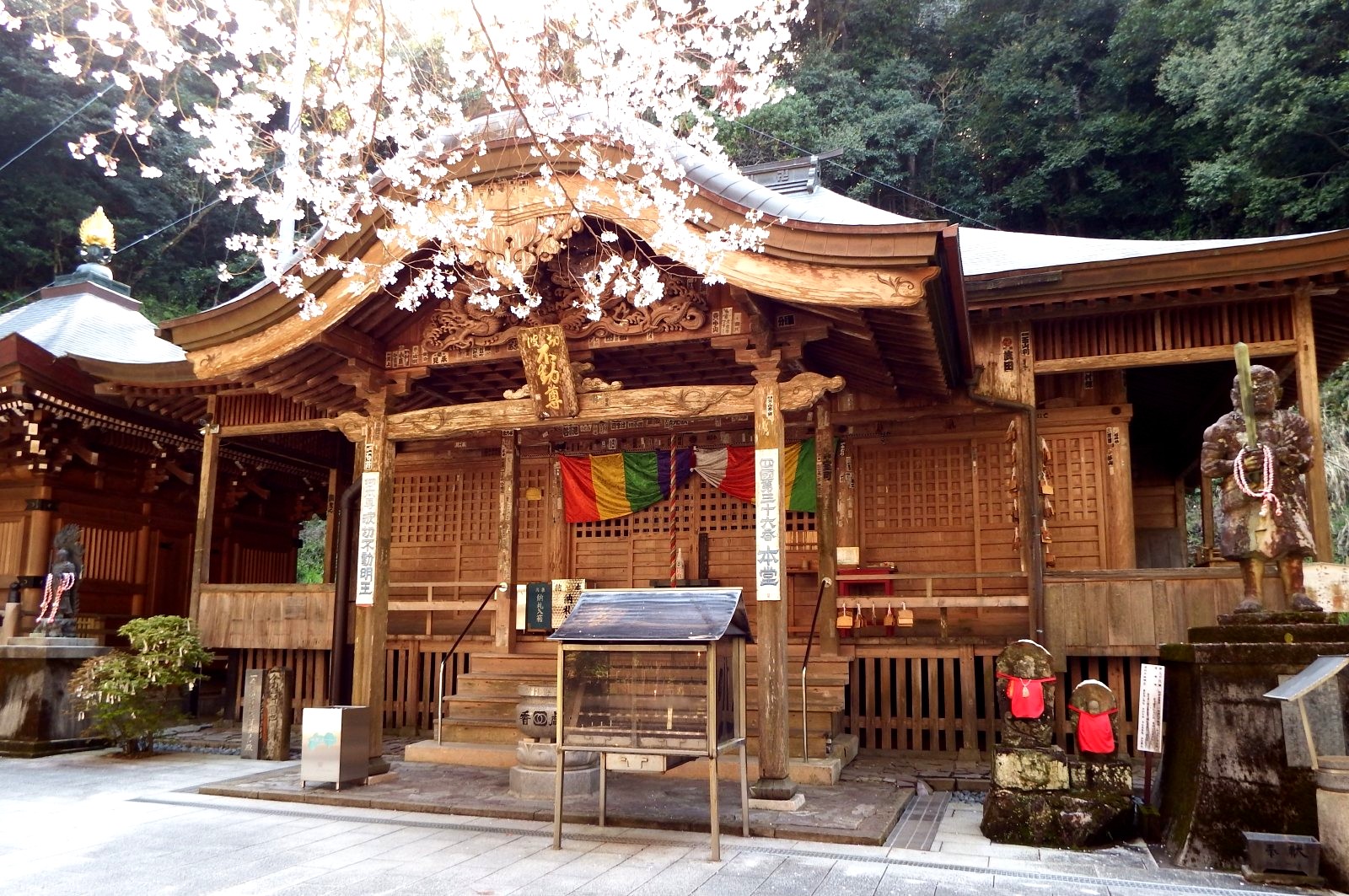
Image of Iwamoto-ji (岩本寺). Image source · CC-BY-SA-4.0
Station 37 of 88
Shikoku 88 Temple PilgrimageVisit essentials
A quick read before you go
- Duration
- 45–75 minutes for a thorough day visit including the painted ceiling.
- Access
- Located in Shimanto Town, Kōchi Prefecture, near Kubokawa Station on the JR Dosan Line and Tosa…
Overview
Iwamoto-ji is the doctrinal anomaly of the Shikoku 88 and one of its visual surprises. Founded in 729 by Gyōki Bosatsu under imperial command of Emperor Shōmu as part of the Nara-period kokubun-ji provincial-temple system, the site was reorganized by Kūkai a century later. Arriving in 810, Kūkai found a Niida-myōjin shrine complex; over fourteen years he developed it into five paired shrines and temples, each enshrining a distinct deity.
After Sengoku-era fires (1573–1592) the complex was suspended, and during the Edo period (1652–1688) it was rebuilt in a different location as a single consolidated temple holding all five honzon. The five surviving honzon were permanently moved here in 1889. Iwamoto-ji is, today, the only Shikoku 88 temple that veneates five principal images at once: Fudō Myōō, Shō Kannon, Amida Nyorai, Yakushi Nyorai, and Jizō Bosatsu.
In 1978 the temple commissioned a community art project for the main hall ceiling. Five hundred and seventy-five painted panels were contributed by professional and amateur artists from across Japan. The content ranges across Buddhist iconography, flora and fauna, and pop-culture figures including a panel of Marilyn Monroe. The ceiling is openly photographable; the temple's promotional material treats it as part of the contemporary identity of the precinct rather than as a curiosity.
Iwamoto-ji also holds a working shukubō (pilgrim lodging), well-regarded among walking henro and a useful node on what is otherwise a long and thinly serviced stretch of the Tosa coast. Pilgrims arriving from Shōryū-ji about fifty-eight kilometers northeast often time their stay to overnight here, because the next stage — to Temple 38 Kongōfuku-ji at Cape Ashizuri, approximately eighty-five kilometers south — is the longest gap between consecutive temples on the entire Shikoku 88 pilgrimage.
The transit-accessible Kubokawa Station at Shimanto sits nearby, on the JR Dosan Line and the Tosa Kuroshio Railway.
The five-honzon arrangement gives the Hondō an unusual devotional bandwidth. Within a single chant cycle, a pilgrim can address health (Yakushi), compassion (Kannon), wisdom-cutting (Fudō), pure-land welcome (Amida), and earth-realm rescue (Jizō). The temple's literature reads this as a vernacular mandala — five focal points distributing the totality of compassionate response within one space.
Why this place is sacred
What thins at Iwamoto-ji is the membrane between sacred and ordinary image-making. The five honzon arrangement is itself unusual: most Shikoku 88 temples have a single principal image around which liturgy is organized. Here the chant at the Hondō addresses the whole spread — Fudō's wrathful cutting, Kannon's compassion, Amida's welcome, Yakushi's healing, Jizō's earth-realm rescue — as a single moment.
Look up, and the ceiling carries the same logic into a lower register. Five hundred and seventy-five panels painted by hundreds of hands: classical Buddhist iconography and traditional flora and fauna, but also pop-culture figures including Marilyn Monroe. The Marilyn panel is the one most often photographed and remarked. It is also the one that most precisely tests the Shingon proposition that Buddha-nature pervades all phenomena.
If Buddhahood is everywhere, it is here too — in the cinema-culture face that flickered through twentieth-century mass image-making.
The ceiling's panels are not arranged hierarchically. The traditional images do not dominate the popular ones. The visual experience of standing in the main hall and tilting one's head back is one of dispersed, equal regard — a vernacular mandala rather than a centered one. Some readers within Shingon find this consistent with the school's deepest teaching: no domain of human experience is excluded from the Buddha's regard, including the popular image culture of the modern world.
Founded in 729 under imperial command as part of the Nara-period kokubun-ji provincial-temple system; reorganized by Kūkai in 810 into five paired shrines and temples, each enshrining a distinct deity.
Suspended after Sengoku-era fires (1573–1592). Rebuilt 1652–1688 in a different location as the consolidated Iwamoto-ji holding all five honzon. The five surviving honzon were permanently moved to the present site in 1889. The 1978 main hall ceiling project added 575 community-painted panels. Today the temple is a working Chizan-school Shingon site, an active Shikoku 88 stop, and a regional shukubō for walking pilgrims.
Experience and orientation
Pilgrims arriving from Shōryū-ji follow about fifty-eight kilometers southwest along the Tosa coast and inland. Iwamoto-ji is more transit-accessible than most Shikoku 88 temples — Kubokawa Station on the JR Dosan Line and the Tosa Kuroshio Railway is nearby. After the long Tosa stretch from Kōchi City, pilgrims often note the relief of arriving at a substantial temple with a shukubō.
The standard Shikoku henro liturgy proceeds at both halls. Bonshō rung once on entering, hands and mouth washed at the chōzuya, candle and three sticks of incense, fudasho-fuda placed in the wooden box, Heart Sutra and the Kōbō Daishi mantra (Namu Daishi Henjō Kongō), coin offering, repeated at the Daishi-dō. The nōkyō stamp is received at the temple office.
What is distinct at Iwamoto-ji is what happens at the Hondō. The five honzon ask, implicitly, for a fuller attention than a single-image hall. Some pilgrims hold five intentions in mind during the chant — health, compassion, decisive action, peaceful welcome, protection — and address each to the corresponding deity. Others simply chant once, letting the spread arrive on its own.
The ceiling rewards a slow look. Most pilgrims tilt their heads back at some point in the visit; some sit on the wooden floor for several minutes scanning the panels. The Marilyn Monroe panel is widely known and locatable, but the cumulative effect of the 575 panels is broader than any single image. Photography of the ceiling is openly invited.
Those staying at the shukubō receive evening service and morning chanting, usually with a Shingon-style ofukuro (priestly conversation) over a simple meal. The shukubō should be reserved in advance.
The temple sits in Shimanto Town, Kōchi Prefecture, near Kubokawa Station on the JR Dosan Line and the Tosa Kuroshio Railway. The precinct includes the Hondō (with the five honzon and the painted ceiling), the Daishi-dō, the bonshō, and the temple office. The shukubō is on the temple grounds. Free parking is available.
Context and lineage
Emperor Shōmu, building a national network of provincial temples, ordered Gyōki Bosatsu to found the temple in 729 CE. Kūkai (Kōbō Daishi) arrived in 810 and over fourteen years reorganized an existing Niida-myōjin shrine complex into five paired shrines and temples, each enshrining a distinct Buddhist deity. After Sengoku-era fires destroyed the complex (1573–1592), the sites were consolidated and rebuilt in a different location during the Edo period (1652–1688) as a single temple — Iwamoto-ji — holding all five honzon.
The five surviving honzon were permanently moved to the present site in 1889. In 1978 the temple commissioned a community art project for the Hondō ceiling: 575 painted panels contributed by professional and amateur artists from across Japan. The temple operates a shukubō and remains an active Chizan-school Shingon site.
Shingon Buddhism, Chizan branch (Chizan-ha). The temple's formal name is Fujiizan Gochiin Iwamotoji.
Emperor Shōmu
Imperial founder
Gyōki Bosatsu
Founder
Kūkai (Kōbō Daishi)
Reorganizer
Traditions and practice
Goma fire rituals to Fudō Myōō; healing rituals to Yakushi Nyorai; Kannon devotion; Jizō prayers for children and travelers; Amida nembutsu services on appropriate calendar days. The shukubō hosts overnight pilgrim retreats with evening and morning services.
Pilgrims chant the Heart Sutra and Kōbō Daishi mantra at the Hondō (with awareness of all five honzon) and at the Daishi-dō, light candles and incense, place fudasho-fuda, and receive nōkyō. Many pause beneath the ceiling for an extended look. The shukubō runs year-round for booked guests; meals are simple temple fare.
If you are arriving after the long Tosa stretch from Kōchi City, consider booking the shukubō and using Iwamoto-ji as a deliberate pause before the eighty-five-kilometer push to Kongōfuku-ji. At the Hondō, let the chant address all five honzon; you do not have to choose. Spend a few minutes with the ceiling. The mixture of registers — sacred image, flora and fauna, Marilyn Monroe — is part of the contemporary devotional life of the temple, not a distraction from it.
Shingon Buddhism (Chizan-ha)
ActiveOne of the few Shikoku 88 temples enshrining five distinct principal images simultaneously — Fudō Myōō, Shō Kannon, Amida Nyorai, Yakushi Nyorai, and Jizō Bosatsu. This polyvalent honzon configuration is the temple's defining doctrinal feature.
Standard Shingon henro liturgy with the unusual feature of sequentially honoring five honzon at the Hondō; goma fire rituals; healing and protection prayers spanning the domains of all five deities.
Perspectives and open questions
Iwamoto-ji is read as a doctrinal anomaly within the Shikoku 88, a community art project, and a working shukubō — three identities that hold together in the same precinct.
Scholarly perspective
Scholars view Iwamoto-ji as a clear example of late-ninth-century shrine-temple pairing (jingūji) reorganization under Kūkai's influence, with the eventual Edo-era consolidation reflecting the broader trend toward institutional simplification. The 1978 ceiling project is studied as a creative act of community Buddhism, redefining the temple as both heritage site and contemporary cultural commons.
Living and traditional perspectives
Local Shimanto-area devotion includes the surviving Niida-myōjin shrine traditions, with Iwamoto-ji as the Buddhist counterpart absorbing the deities once paired with that shrine. Within the broader Shikoku henro tradition, the temple is the thirty-seventh stop and a common shukubō overnight before the long Cape Ashizuri stretch.
Alternative interpretations
The five-honzon arrangement can be read as a vernacular mandala — five spatial focal points within one hall, distributing the totality of compassionate response (healing, mercy, wisdom-cutting, pure-land welcoming, earth-realm rescuing). The Marilyn Monroe ceiling panel, in this frame, is not a desecration but an embodied teaching that no domain of human experience is excluded from the Buddha's regard.
Open questions
The exact ninth-century geography of the original five-shrine, five-temple complex — and the identity of the present consolidated honzon relative to those originals — is not fully reconstructible.
Plan your visit
Access and arrival
Located in Shimanto Town, Kōchi Prefecture, near Kubokawa Station on the JR Dosan Line and Tosa Kuroshio Railway — one of the more transit-accessible Shikoku 88 temples. From Temple 36 Shōryū-ji is approximately 58 km southwest. From Temple 38 Kongōfuku-ji is approximately 85 km — the longest gap between consecutive temples on the entire pilgrimage. Free parking on grounds.
The temple operates a working shukubō well-regarded among walking henro. Reservations are required, especially in spring and autumn. Standard pilgrim and tourist lodging is also available in Shimanto Town and along the JR Dosan Line.
Respectful visit
Modest, respectful clothing. Pilgrim hakui and kongō-zue are common; a conical sedge hat (sugegasa) is also common but optional. Nōkyōchō (stamp book) is carried by most henro pilgrims. Remove hats and sunglasses inside halls, and remove shoes in the shukubō.
Permitted on grounds and at the painted ceiling. Avoid altar interiors and active prayer scenes. Ask before photographing pilgrims or guests at the shukubō.
Standard henro offerings — candle, three sticks of incense, fudasho-fuda placed in the box, coin offering. A printed Heart Sutra (kyōhon) is used for chanting at both halls.
Do not ring the bonshō on leaving (Shikoku 88 convention). Quiet conduct in the Hondō. Drones and tripods generally require permission.
Shukubō stays must be reserved in advance, especially in spring and autumn. Quiet conduct in the Hondō; though the ceiling is openly photographable, active prayer scenes should not be photographed. The bonshō rings on entering only.
Current practical details
Address
3-13 Shigekushimachi, Shimanto, Takaoka District, Kochi 786-0004, Japan
Phone
Hours
Hours, fees, and access can change — verify on the official source before you travel. Practical details last checked Jun 2026.
Location
Map loads as you approach this section.
Pilgrim reflections
A portrait of encounter, not a score
Pilgrims describe what they felt, how present they could become, and whether the place would shape a journey. There are no stars and no ranking of traditions.
No reviewed reflections yet
The first pilgrims can help describe the character of being here.
Share a reflection
Available after an account-backed “Been there.” Every reflection is reviewed before publication.
Watch deeper
Films, episodes, and recorded talks for visitors who want more context before or after a visit. Speculative and alternative-history entries are labelled as perspectives, not as sources for established claims.
Nearby sacred places
Explore other sacred places in the region. Proximity does not establish access or travel time; check each place’s guidance.


References
Sources consulted for this page. Source categories describe the publication, not a guarantee that every claim is verified. Traditional accounts and outside interpretations may differ.
- 01Iwamoto-ji - Wikipedia — Wikipedia contributorsencyclopediaCore facts; five honzon distinctive feature
- 02Iwamotoji Temple – 37th temple of the 88 sacred sites of Shikoku — Iwamoto-ji TempleofficialOfficial temple website
- 03Iwamotoji – Shimanto, Kochi Prefecture, Shikoku — Henro.orgguidePilgrim practicalities; shukubō (lodging)
- 04Kochi's Iwamotoji Temple — Japan National Tourism Organization (JNTO)official575-panel ceiling description
- 05Immerse yourself in Buddhism and pop art at Iwamoto-ji — Japan TodayguideMarilyn Monroe ceiling panel detail
Pilgrim glossary
- Honzon
- The principal Buddhist deity enshrined as a temple's central object of worship.
- Kannon
- The bodhisattva of compassion, central to many East Asian pilgrimage routes.
- Mandala
- A symbolic diagram of the cosmos used in meditation and ritual.
- Sutra
- A canonical Buddhist scripture, often chanted as part of practice.
- Mantra
- A sound, word, or phrase repeated as part of meditation or ritual.
- Shingon
- An esoteric Japanese Buddhist school emphasizing ritual, mantra, and mandala practice.
Share a photo
Help visitors recognize Iwamoto-ji. Every submission is reviewed before publication.