Kiyotaki-ji
Citrus groves below, a mirror pond above — the temple where Kūkai struck his staff and water came
Understand sacred places, explore living traditions, and learn how to engage respectfully with Pilgrim Map.
Access has not been verified. Check current local guidance before planning a visit.
Tosa, Kochi Prefecture, Japan
Read the sources
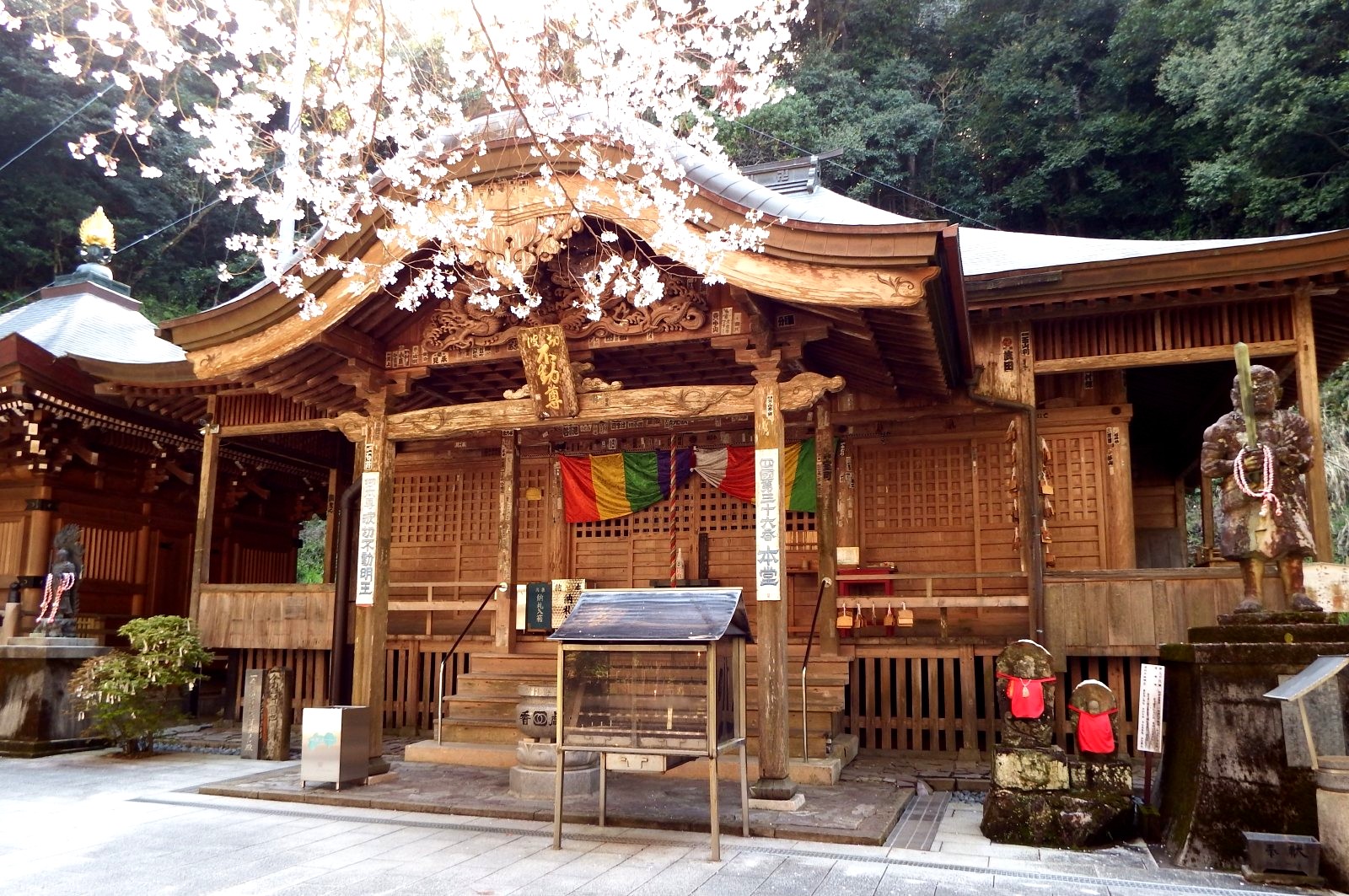
Image of Kiyotaki-ji (清滝寺). Image source · CC-BY-SA-3.0
Station 35 of 88
Shikoku 88 Temple PilgrimageVisit essentials
A quick read before you go
- Duration
- 45–60 minutes for the standard visit, including the climb, chanting at both halls, and the…
- Access
- Located on the slopes of Mt.
Overview
Kiyotaki-ji sits on Mt. Kiyotaki above Tosa City, reached by a steep narrow road that climbs through citrus groves and ends at a long flight of stone steps and a dragon-carved Niōmon. The climb is part of the temple. By the time you arrive at the precinct, breath quickened, you understand why the long form of the temple's name layers three different water symbols.
Gyōki Bosatsu, the Nara-period itinerant monk-engineer associated with irrigation works and provincial temple foundations, established the original site in 723. Kūkai's role came later: during his proselytization of Shikoku, he is said to have offered seven days of prayer for good harvest, then struck his staff against the prayer podium. A clear spring gushed forth and pooled into a mirror-flat surface. He renamed the temple Iōzan Kagamiike-in Kiyotaki-ji — Mountain of the Medicine Buddha, Mirror Pond Sub-temple, Clear Waterfall Temple.
The water-emergence legend belongs to a wider class of staff-and-spring miracles attached to Kūkai across Shikoku, but here the geography supports it: the hillside still produces clear water, and the citrus orchards below depend on the pattern.
The Hondō houses Yakushi Nyorai, the Medicine Buddha. A large outdoor Yakushi Nyorai statue installed in 1933 stands prominently on the grounds. The Niōmon's dragon carvings and paintings were done by Kubo Nansō in 1900 — folk-craft sacred imagery that frames the entry to the precinct. From the upper terrace pilgrims can see across the Niyodo River basin, with its blue-water tributaries that have given the area its tourism epithet, Niyodo Blue.
What distinguishes Kiyotaki-ji on the henro is the embodied arc of the visit: ascending through working farmland, climbing stone steps, arriving at clear water and a Medicine Buddha. The structure is a teaching in itself. The Yakushi Nyorai is here venerated specifically as Yakuyoke Yakushi — the evil-warding Medicine Buddha — and the temple's water is sometimes taken home by pilgrims as blessed water for healing prayers.
Why this place is sacred
Kiyotaki-ji thins through ascent. The narrow citrus-grove road, the stone steps, the dragon-carved gate, the Hondō at 137 meters — the geometry of the visit pulls the body upward, and the temple's name re-states the arc verbally. Iōzan, the Mountain of the Medicine King. Kagamiike-in, Mirror Pond Sub-temple. Kiyotaki-ji, Clear Waterfall Temple. Three water-related symbols stacked vertically: the elevated medicine, the reflecting pool, the falling water.
Within Shingon esoteric tradition, mirror imagery and water imagery are densely woven into the path of practice — the Buddha-mind reflects, water cleanses, the falling stream undoes attachment. Pilgrims sometimes read the temple's full name as a compressed teaching: the Medicine Buddha is realized through reflection and clarity, attained by ascent and purification. The geography is not metaphor laid over place; it is the place that shaped the metaphor.
The air at the upper terrace carries the scent of citrus from the slopes below, especially in late autumn during harvest. The 1933 outdoor Yakushi Nyorai stands tall against the sky. The water that emerges from the staff-strike spring, whether the original or its successor, still runs.
Founded by Gyōki Bosatsu in 723 CE as a Nara-period mountain temple in the Tosa region.
Renamed and re-narrated under Kūkai during his proselytization of Shikoku in the early ninth century, after the staff-strike spring miracle gave the site its current full name. The Niōmon's dragon carvings and paintings were added by Kubo Nansō in 1900. A large outdoor Yakushi Nyorai was installed in 1933. The temple has functioned as a Buzan-school Shingon site and an active Shikoku 88 pilgrimage stop into the present.
Experience and orientation
Pilgrims approaching from Tanema-ji follow about ten kilometers west and then begin the ascent of Mt. Kiyotaki. By car, the road is steep, narrow, and winding — drivers should take it cautiously, especially in wet weather, and remember that local farmers also use it. Walking pilgrims face a long flight of stone steps that climbs through the dragon-carved Niōmon to the precinct above.
At the upper terrace, the Hondō and Daishi-dō face a compact courtyard. The 1933 outdoor Yakushi Nyorai stands prominently on the grounds, visible from below as you approach. The standard Shikoku henro liturgy proceeds at both halls: bonshō rung once on entering, hands and mouth washed at the chōzuya, candle and three sticks of incense, fudasho-fuda placed in the wooden box, Heart Sutra and the Kōbō Daishi mantra (Namu Daishi Henjō Kongō) chanted, coin offering, repeated at the Daishi-dō.
The nōkyō stamp is received at the temple office.
The view across the Niyodo River basin from the upper terrace rewards the climb. Pilgrims often pause for several minutes here before descending. Some take a small amount of the temple's water home for healing prayers — a folk-Buddhist extension of the Yakuyoke Yakushi devotion. The descent feels different from the ascent; the body has been worked, the breath is steadier, the Medicine Buddha's blessing has been received.
The temple sits on the slopes of Mt. Kiyotaki at approximately 137 meters elevation in Tosa City, Kōchi Prefecture. The narrow approach road climbs from the valley through citrus groves; small parking is near the gate. From the gate, a long flight of stone steps leads up through the Niōmon to the upper precinct, where the Hondō, Daishi-dō, and outdoor Yakushi Nyorai are arranged.
Context and lineage
Gyōki Bosatsu — the Nara-period monk-engineer celebrated for irrigation projects and provincial temple foundations — established the temple in 723 CE. During his proselytization of Shikoku, Kūkai (Kōbō Daishi) visited the site, performed seven days of prayer for good harvest, and struck his staff against the prayer podium. A clear spring is said to have gushed forth at the strike, pooling into a mirror-flat surface.
Kūkai renamed the temple Iōzan Kagamiike-in Kiyotaki-ji — Mountain of the Medicine Buddha, Mirror Pond Sub-temple, Clear Waterfall Temple — to commemorate the miracle. The temple weathered Sengoku-era disruption and continued as a Buzan-school Shingon site through the Edo period. The dragon carvings and paintings on the Niōmon were added by Kubo Nansō in 1900, and a large outdoor Yakushi Nyorai statue was installed in 1933. The temple remains an active Shikoku 88 stop with full pilgrim services.
Shingon Buddhism, Buzan branch (Buzan-ha). The temple's formal name is Iōzan Kagamiike-in Kiyotaki-ji.
Gyōki Bosatsu
Founder
Kūkai (Kōbō Daishi)
Renamer, miracle-water tradition
Kubo Nansō
Niōmon dragon carver and painter
Traditions and practice
Standard Shingon Yakushi Nyorai veneration; goma fire rituals on appropriate calendar days; Kūkai Daishi memorial services. The temple's water is regarded as blessed; some pilgrims take small amounts home for healing prayers.
Pilgrims chant the Heart Sutra and Kōbō Daishi mantra at both the Hondō and Daishi-dō, light candles and incense, place fudasho-fuda, and receive nōkyō. The bonshō rings on entering only. Many pilgrims pause at the outdoor 1933 Yakushi Nyorai for an additional moment of healing prayer.
If the climb has worked you, let the breath settle before chanting at the Hondō. The geography of the temple is part of its teaching; the body that arrived at the top is not the body that started in the citrus groves. After the standard liturgy at both halls, walk to the upper terrace and look across the Niyodo basin for a few minutes. If you carry a wish for someone's healing, this is a place to place it.
Shingon Buddhism (Buzan-ha)
ActiveBuzan-school Shingon temple within the Kūkai-centered henro circuit. The temple's full name reflects deep Yakushi Nyorai (medicine king) symbolism interwoven with Kūkai's water-conjuring legend.
Standard Shingon henro liturgy; healing prayers to Yakuyoke Yakushi Nyorai; informal taking of blessed water by pilgrims.
Perspectives and open questions
Kiyotaki-ji is read as a Gyōki-founded mountain temple, a Kūkai miracle-water site, and a Yakushi Nyorai healing center — three layers that hold together easily in the visitor's experience.
Scholarly perspective
Scholars accept the Gyōki founding (723) as a representative example of early-eighth-century itinerant-monk temple establishment in Tosa. Kūkai's water-emergence legend is treated as one of many staff-and-spring miracle stories attached to him across Shikoku — temple traditions encoding both Kūkai's irrigation/engineering reputation and his role as a sanctifier of mountain water sources.
Living and traditional perspectives
Local devotion centers on Yakuyoke Yakushi Nyorai for warding off misfortune and disease. The temple's water is considered blessed and is sometimes taken home by pilgrims for healing prayers; the citrus orchards below are part of the working landscape.
Alternative interpretations
Within Shingon esoteric tradition, the temple's full name layers three water-related symbols — medicine king, mirror pond, clear waterfall — evoking the cleansing and reflective qualities by which the Buddha-mind is realized. Some pilgrims read this as a teaching about purification through ascent.
Open questions
The exact Edo-era and pre-Edo institutional history is sparsely documented in available English sources; details of how Kiyotaki-ji weathered the Sengoku-era Chōsokabe disruption relative to other Tosa temples are not fully clear.
Plan your visit
Access and arrival
Located on the slopes of Mt. Kiyotaki (137 m) in Tosa City, Kōchi Prefecture. By car: a steep, narrow, winding road climbs from the valley to a small parking area near the gate. Walking pilgrims arrive from Temple 34 Tanema-ji (~10 km east). The next stage to Temple 36 Shōryū-ji is approximately 14 km south, requiring a route around or across Uranouchi Bay.
No shukubō at Kiyotaki-ji itself. Standard pilgrim and tourist lodging is available in Tosa City and Kōchi City. Walking pilgrims often plan to stay near Tosa City and tackle Kiyotaki-ji and Shōryū-ji on consecutive days.
Respectful visit
Modest, respectful clothing. Sturdy footwear strongly recommended for the steep approach and stone steps. Pilgrim hakui not required for non-pilgrims; the kongō-zue is helpful on the climb.
Permitted outdoors. Interior altar photography is not allowed. Ask before photographing pilgrims at prayer.
Standard henro offerings — candle, three sticks of incense, fudasho-fuda placed in the box, coin offering. A printed Heart Sutra (kyōhon) is used for chanting at both halls.
Do not ring the bonshō on leaving. Drive carefully on the narrow mountain road. Drones and tripods generally require permission.
The approach road is steep, narrow, and winding; drive carefully and yield to farm vehicles. The stone steps can be slippery in rain. Do not block citrus orchards or local property when parking. The bonshō rings on entering only — never on leaving.
Current practical details
Address
568-1 Takaokachō, Tosa, Kochi 781-1104, Japan
Phone
Hours
Hours, fees, and access can change — verify on the official source before you travel. Practical details last checked Jun 2026.
Location
Map loads as you approach this section.
Pilgrim reflections
A portrait of encounter, not a score
Pilgrims describe what they felt, how present they could become, and whether the place would shape a journey. There are no stars and no ranking of traditions.
No reviewed reflections yet
The first pilgrims can help describe the character of being here.
Share a reflection
Available after an account-backed “Been there.” Every reflection is reviewed before publication.
Watch deeper
Films, episodes, and recorded talks for visitors who want more context before or after a visit. Speculative and alternative-history entries are labelled as perspectives, not as sources for established claims.
Nearby sacred places
Explore other sacred places in the region. Proximity does not establish access or travel time; check each place’s guidance.


References
Sources consulted for this page. Source categories describe the publication, not a guarantee that every claim is verified. Traditional accounts and outside interpretations may differ.
- 01Kiyotaki-ji - Wikipedia — Wikipedia contributorsencyclopediaHistory, sect, founder
- 02Kiyotakidera – Tosa, Kochi Prefecture, Shikoku — Henro.orgguidePilgrim guidance
- 03Temple 35, Kiyotaki-ji — Japan AdventurerguidePractical detail
- 04Kiyotakiji Temple is the 35th temple of the Shikoku 88 Pilgrimage — Niyodo BlueguideLocal tourism context
- 05Temple thirty five – Clean Waterfall Temple — Japan TravelguideAtmosphere and access
Pilgrim glossary
- Sutra
- A canonical Buddhist scripture, often chanted as part of practice.
- Mantra
- A sound, word, or phrase repeated as part of meditation or ritual.
- Shingon
- An esoteric Japanese Buddhist school emphasizing ritual, mantra, and mandala practice.
Share a photo
Help visitors recognize Kiyotaki-ji. Every submission is reviewed before publication.