Enkōji
A red turtle bringing a bronze bell from the sea — the last temple of the Tosa stretch
Understand sacred places, explore living traditions, and learn how to engage respectfully with Pilgrim Map.
Access has not been verified. Check current local guidance before planning a visit.
Sukumo, Kochi Prefecture, Japan
Read the sources
Station 39 of 88
Shikoku 88 Temple PilgrimageVisit essentials
A quick read before you go
- Duration
- 30–45 minutes for the standard temple visit.
- Access
- Located in Sukumo City, Kōchi Prefecture — the last temple in Tosa before the Ehime border.
Overview
Enkō-ji holds two functions in the Shikoku henro: it is a working healing temple, and it is a threshold. As the last temple in Tosa before pilgrims cross into Iyo (Ehime), it sits at the boundary between two phases of the pilgrimage — the Tosa dōjō of ascetic discipline (shugyō no dōjō) and the Iyo dōjō of attaining enlightenment (bodai no dōjō, temples 40–65). Pilgrims often pause here for stocktaking before the prefectural crossing.
The temple's foundation legend follows a Nara-period pattern. In 724, by tradition, Emperor Shōmu ordered Gyōki Bosatsu to establish the temple; Gyōki carved a Yakushi Nyorai and is said to have set some of the historical Buddha's ashes within the statue, dedicating it for prayers of safe delivery and warding off misfortune. Kūkai (Kōbō Daishi) visited the temple during the Enryaku era (782–805).
The temple's distinctive legend is the red turtle and the bronze bell. In 911, a red turtle is said to have climbed up to the temple grounds from the sea — or, in a parallel folk variant, from a dragon palace beneath the waves — carrying a bronze Buddhist bell on its back. The monks dedicated the bell to the temple, named the surrounding mountain Shakkizan ('Red Turtle Mountain'), and renamed the temple Enkō-ji ('Far-Light Temple').
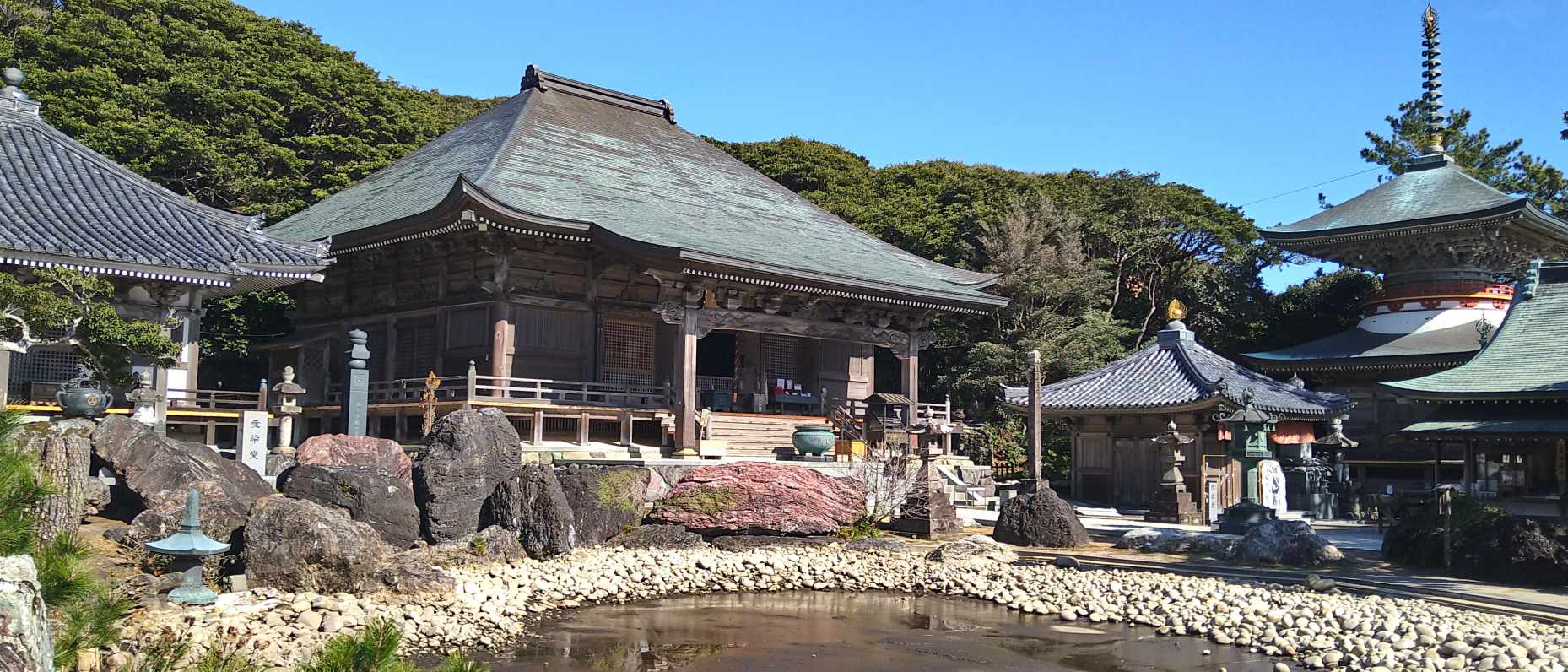
The bell remains at the temple as a National Important Cultural Property — the oldest Buddhist temple bell in Kōchi Prefecture. Pilgrims do not strike it; in the early Meiji period it was used to mark the opening and closing of the Kōchi Prefectural Assembly. The pond on the grounds, Kame-no-Ike ('Turtle's Pond'), is said to be where the turtle lived. Red turtle imagery runs through stone statuary across the precinct.
The other folk-Buddhist layer is the eye-cleaning water well. Pilgrims wash their eyes here as a practice associated with the temple's Yakushi Nyorai healing devotion — a participatory ritual that complements the standard henro liturgy. The pond garden, the stone garden, the eye-water well, and the small ancient bell give Enkō-ji a quietly contemplative atmosphere — water-rich and unhurried, well suited to the threshold function the temple still holds.
Why this place is sacred
What thins at Enkō-ji is two layers at once. The first is the boundary between the Tosa stretch and what comes after. Pilgrims arriving here have walked through forty-six kilometers of cape and coast since Cape Ashizuri, and have completed thirty-nine temples since beginning at Tokushima. Tosa is the dōjō of ascetic discipline; Iyo, beginning at Temple 40, is the dōjō of bodai, the path of attaining enlightenment.
Many pilgrims describe Enkō-ji as a place to sit with what the long Tosa walk has shaped — what remains, what fell away, what is ready to open differently in Iyo.
The second layer is the temple's water imagery. A red turtle bringing a bronze bell from the sea is, within esoteric Buddhist symbolic logic, the rising of dharma sound from the depths — the unconscious or oceanic mind producing the bell-tone of awakening. The bell is here. So is the pond where the turtle is said to have lived. So is the eye-cleaning well, where the practice is to clarify sight as a precondition for clarity of mind.
The water-rich grounds enact the symbolism without forcing it.
The 911 bell itself, kept in protective housing, is not struck by pilgrims. Its silence at the moment of the visit is part of the experience. The pilgrim's bonshō rings on entry; the ancient bell waits.
Founded in 724 by Gyōki Bosatsu under imperial command of Emperor Shōmu as a Yakushi Nyorai healing temple, with prayers for safe delivery and warding off misfortune; the carved Yakushi Nyorai is said to have been set with some of the historical Buddha's ashes.
Visited by Kūkai (Kōbō Daishi) during the Enryaku era (782–805). Renamed Enkō-ji in 911 after the red-turtle-and-bell legend; the bronze bell from that year remains as a National Important Cultural Property. Continues today as an active Chizan-school Shingon temple and the final Shikoku 88 stop in the Tosa (Kōchi) section before the crossing into Iyo (Ehime).
Experience and orientation
Pilgrims approaching from Cape Ashizuri follow approximately fifty-five kilometers north along the coast and inland to Sukumo. Enkō-ji sits in the city, with the pond garden visible from the entry. Free parking is available on grounds.
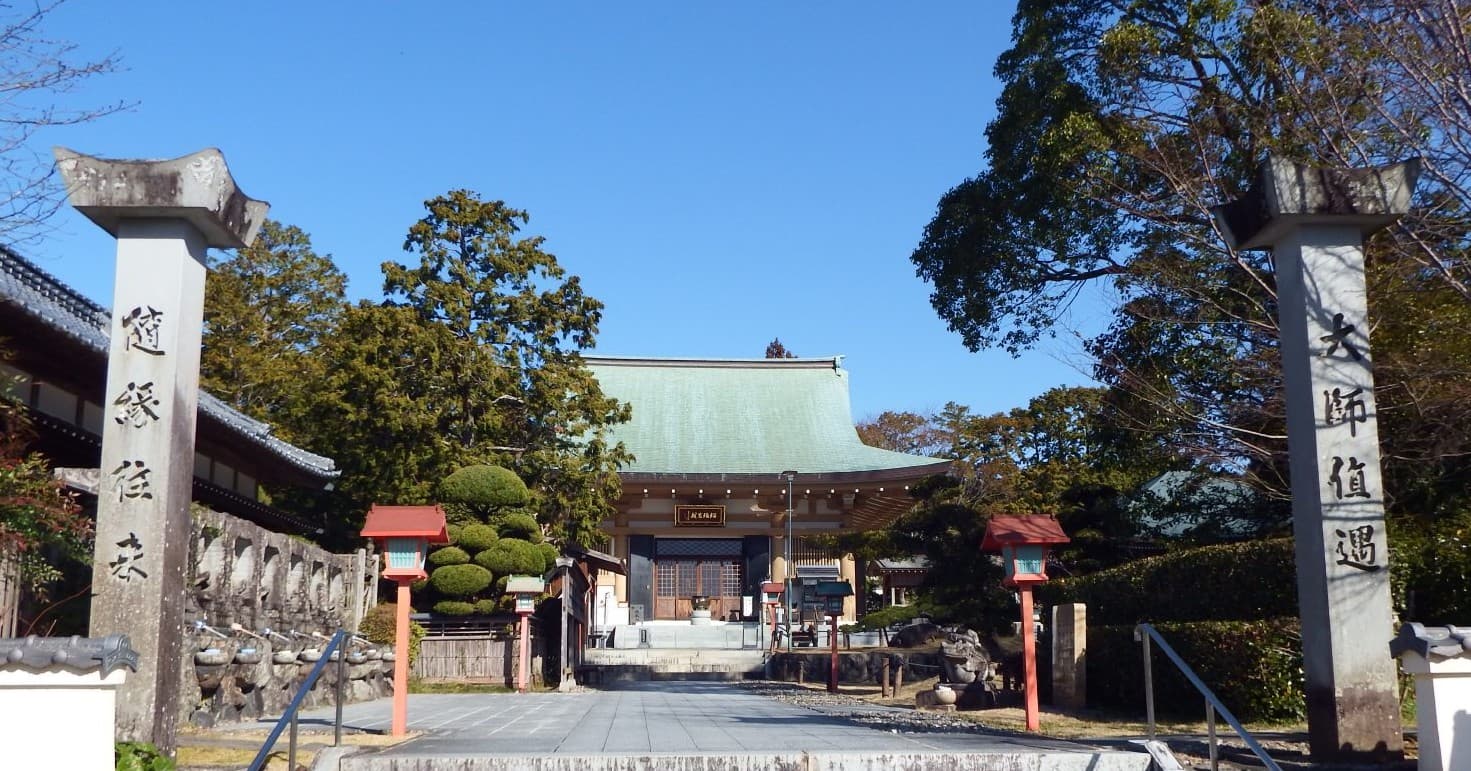
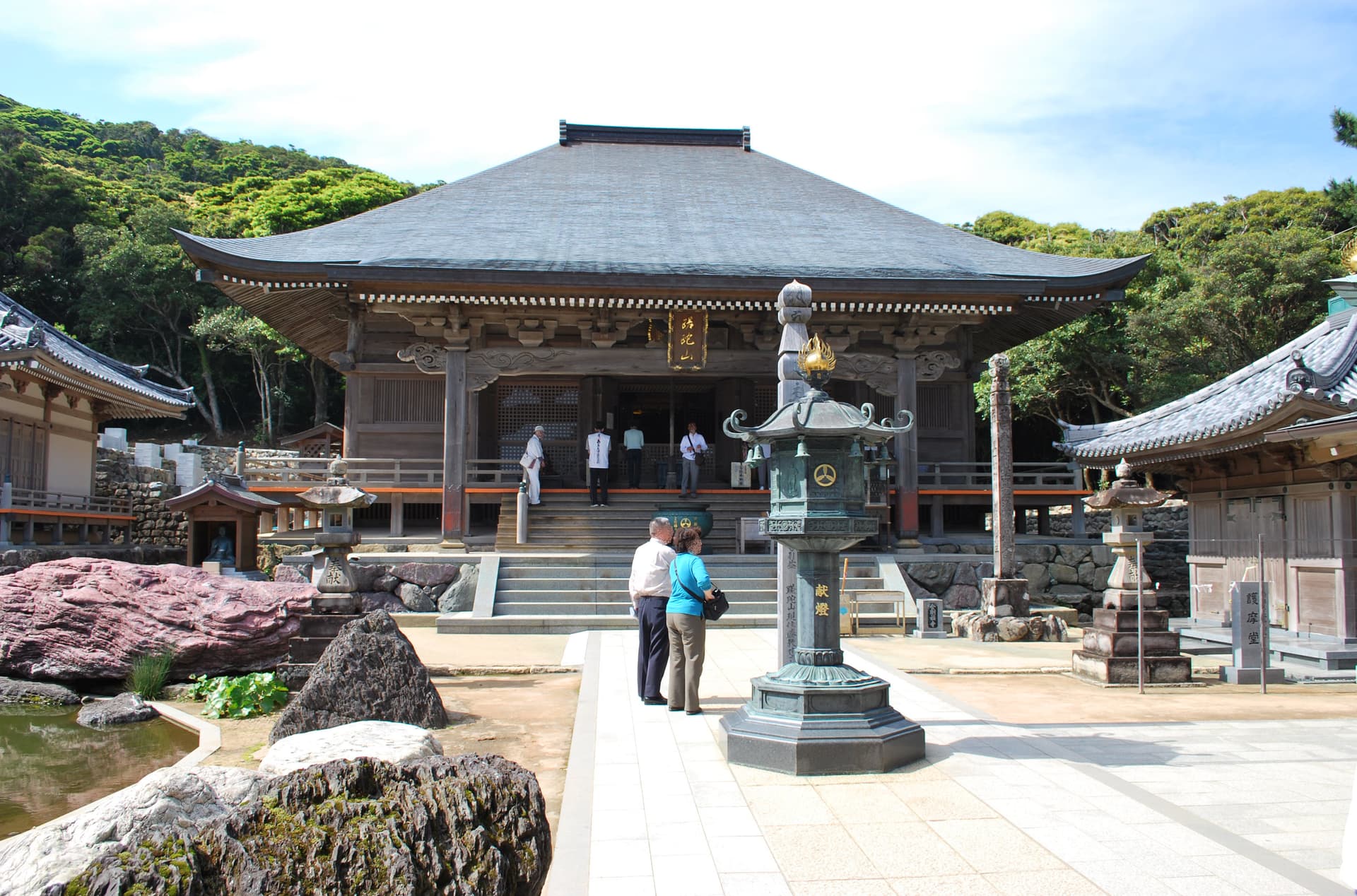
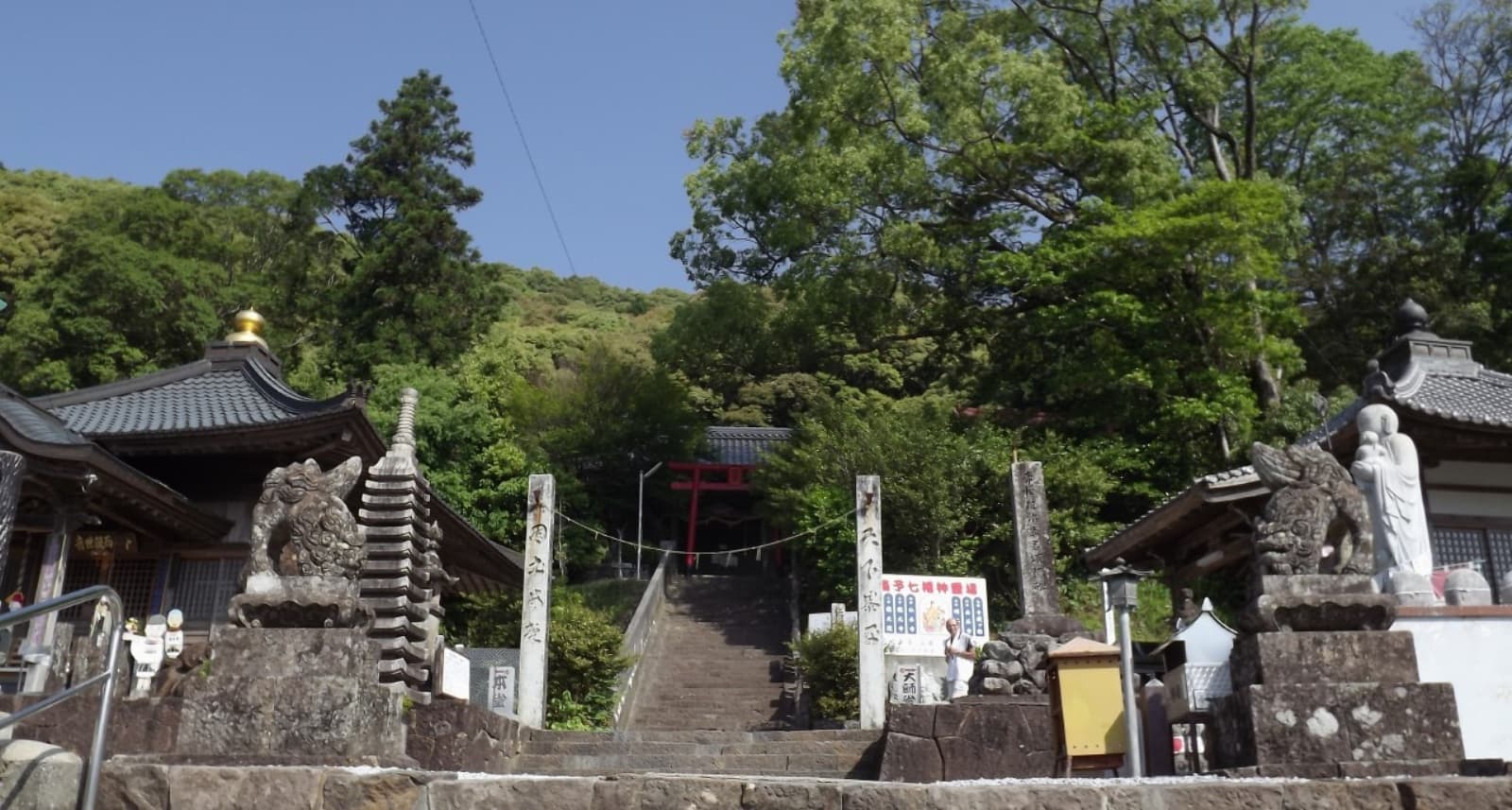
The Niōmon opens into a precinct that is quiet and water-rich. The Hondō, Daishi-dō, the eye-cleaning water well, the protected 911 bronze bell housing, and the pond Kame-no-Ike are arranged through the grounds. Stone statuary throughout the precinct includes red turtles in various forms, marking the legend visually.
The standard Shikoku henro liturgy proceeds at the Hondō and Daishi-dō: bonshō rung once on entering, hands and mouth washed at the chōzuya, candle and three sticks of incense, fudasho-fuda placed in the wooden box, Heart Sutra and the Kōbō Daishi mantra (Namu Daishi Henjō Kongō), coin offering, repeated at the Daishi-dō. The nōkyō stamp is received at the temple office.
Many pilgrims wash their eyes at the eye-cleaning water well as a folk-Buddhist healing practice associated with the Yakushi Nyorai devotion of the temple. The 911 bell is venerated visually but not struck. Pilgrims often sit by the pond garden for several minutes before leaving — Enkō-ji is one of the calmer temples on the henro, and the layered water imagery rewards a slower visit. Some pilgrims explicitly use the visit for stocktaking before the prefectural crossing into Ehime.
The temple sits in Sukumo City, Kōchi Prefecture, the last temple in Tosa before the Ehime border. The precinct includes the Hondō, Daishi-dō, eye-cleaning water well, the 911 bronze bell in protective housing, the Kame-no-Ike pond, and a stone garden. Free parking is available on grounds.
Context and lineage
By temple tradition, Emperor Shōmu ordered Gyōki Bosatsu to establish the temple in 724 CE. Gyōki carved a Yakushi Nyorai for prayers of safe delivery and warding off misfortune, setting some of the historical Buddha's ashes within the statue. Kūkai (Kōbō Daishi) visited the temple during the Enryaku era (782–805), integrating it into what would become the Shikoku pilgrimage circuit.
In 911, a red turtle is said to have climbed up to the temple grounds from the sea (or, in a parallel folk variant, from a dragon palace) carrying a bronze Buddhist bell on its back. The monks dedicated the bell to the temple, named the surrounding mountain Shakkizan ('Red Turtle Mountain'), and renamed the temple Enkō-ji ('Far-Light Temple').
The bell — the oldest Buddhist temple bell in Kōchi Prefecture — remains at the temple as a National Important Cultural Property; in the early Meiji period it was used to mark the opening and closing of the Kōchi Prefectural Assembly. The Kame-no-Ike pond on the grounds is said to be where the turtle lived. The temple has continued as an active Chizan-school Shingon site through the Edo and modern periods.
Shingon Buddhism, Chizan branch (Chizan-ha). The temple's formal name is Shakkizan Jisanin Enkō-ji.
Emperor Shōmu
Imperial founder
Gyōki Bosatsu
Founder, carver of the Yakushi Nyorai honzon
Kūkai (Kōbō Daishi)
Visitor, integrator
Traditions and practice
Yakushi Nyorai healing services; eye-water blessings; standard Shingon goma rituals; Kōbō Daishi memorial services. Local Sukumo devotion has long centered on the eye-healing water and the protective Yakushi Nyorai.
Pilgrims complete the henro liturgy at the Hondō and Daishi-dō, and many wash their eyes at the eye-cleaning water well as a folk-Buddhist healing practice. The 911 bell is venerated visually; pilgrims do not strike it. The pond, stone garden, and red-turtle stone statuary are part of the contemplative environment of the visit.
If you are arriving as the last Tosa stop, give yourself extra time. The temple rewards a slower visit — the pond garden, the eye-cleaning well, the stone-garden moments, the housing of the 911 bell. After the standard liturgy at both halls, sit for a few minutes by the pond. Pilgrims often use Enkō-ji explicitly for stocktaking before crossing into Ehime: what has the long Tosa walk shaped, and what is ready to open differently in Iyo?
Shingon Buddhism (Chizan-ha)
ActiveChizan-school Shingon temple. Yakushi Nyorai veneration is paramount, with strong folk-Buddhist overlay through the eye-healing water and the red turtle / bronze bell legend.
Standard Shingon henro liturgy; Yakushi healing prayers (especially for eye and general ailments); pilgrims wash their eyes at the temple's eye-cleaning water well.
Perspectives and open questions
Enkō-ji is read as the final Tosa temple, a Yakushi Nyorai healing site, and the home of a millennium-old bell with a folk legend that gave the temple and its mountain their names.
Scholarly perspective
Scholars treat the eighth-century imperial founding under Gyōki as a representative example of Nara-period kokubun-ji (provincial temple) establishment. The 911 bell is one of the earliest precisely datable Buddhist bells in southern Shikoku and is studied as a source for early-tenth-century metalwork. The red-turtle legend is treated as a temple narrative encoding the temple's later renaming, not as historical fact.
Living and traditional perspectives
Local Sukumo devotion has long centered on the eye-healing water and the protective Yakushi Nyorai; the red turtle is a beloved folk symbol throughout the temple precinct. Within the broader Shikoku henro tradition, Enkō-ji is the threshold between the Tosa and Iyo stretches — a place for stocktaking before the crossing into the dōjō of bodai.
Alternative interpretations
Within esoteric Buddhist symbolic logic, a turtle bringing a bell from the sea images the rising of dharma sound from the depths — the unconscious or oceanic mind producing the bell-tone of awakening. The bell as an oceanic gift suggests the dharma's universal accessibility across element and species.
Open questions
The exact provenance of the 911 bell — whether it was cast on Shikoku or imported — is not conclusively documented.
Plan your visit
Access and arrival
Located in Sukumo City, Kōchi Prefecture — the last temple in Tosa before the Ehime border. By road from Temple 38 Kongōfuku-ji is approximately 55 km north. By road to Temple 40 Kanjizai-ji (the first Ehime temple) is approximately 28 km west.
No shukubō at Enkō-ji itself. Pilgrim and standard lodging is available in Sukumo City. Many walking pilgrims plan a Sukumo overnight to consolidate before the Ehime crossing the next day.
Respectful visit
Modest, respectful clothing. Pilgrim hakui and kongō-zue are common; a conical sedge hat (sugegasa) is also common but optional. Nōkyōchō (stamp book) is carried by most henro pilgrims. Remove hats and sunglasses inside halls.
Permitted on grounds. Avoid altar interiors and respect the protected bell housing. Ask before photographing pilgrims at prayer or at the eye-cleaning well.
Standard henro offerings — candle, three sticks of incense, fudasho-fuda placed in the box, coin offering. A printed Heart Sutra (kyōhon) is used for chanting at both halls.
Do not strike the 911 bell. Do not ring the bonshō on leaving. Use the eye-cleaning well only for the traditional practice.
Do not strike the 911 Important Cultural Property bell. Do not handle the eye-cleaning water excessively or use it for purposes other than the traditional eye-washing practice. The bonshō rings on entering only — never on leaving.
Current practical details
Address
Nakayama-390 Hiratacho, Sukumo, Kochi 788-0782, Japan
Phone
Hours
Hours, fees, and access can change — verify on the official source before you travel. Practical details last checked Jun 2026.
Location
Map loads as you approach this section.
Pilgrim reflections
A portrait of encounter, not a score
Pilgrims describe what they felt, how present they could become, and whether the place would shape a journey. There are no stars and no ranking of traditions.
No reviewed reflections yet
The first pilgrims can help describe the character of being here.
Share a reflection
Available after an account-backed “Been there.” Every reflection is reviewed before publication.
Watch deeper
Films, episodes, and recorded talks for visitors who want more context before or after a visit. Speculative and alternative-history entries are labelled as perspectives, not as sources for established claims.
Nearby sacred places
Explore other sacred places in the region. Proximity does not establish access or travel time; check each place’s guidance.
References
Sources consulted for this page. Source categories describe the publication, not a guarantee that every claim is verified. Traditional accounts and outside interpretations may differ.
- 01Enkōji - Wikipedia — Wikipedia contributorsencyclopediaSect, history, turtle-bell legend
- 02Shakkizan Jisanin Enkoji – Shikoku 88 Temple Pilgrimage — Shikoku 88 ReijokaiofficialOfficial entry
- 03Enkoji – Sukumo, Kochi Prefecture, Shikoku — Henro.orgguidePilgrim guide
- 04Temple 39, Enkōji|What to See & Do — Shikoku TourismofficialYakushi statue history; eye-cleaning water
- 05Temple 39: Enkouji — Your Pilgrimage in JapanguideGarden description; final Tosa temple framing
Pilgrim glossary
- Sutra
- A canonical Buddhist scripture, often chanted as part of practice.
- Mantra
- A sound, word, or phrase repeated as part of meditation or ritual.
- Dharma
- The teachings of the Buddha; also the universal law underlying them.
- Shingon
- An esoteric Japanese Buddhist school emphasizing ritual, mantra, and mandala practice.
Share a photo
Help visitors recognize Enkōji. Every submission is reviewed before publication.