Kongōfuku-ji
At the southernmost cape of Shikoku, a gate inscribed Toward Potalaka — Kannon's pure land across the Pacific
Understand sacred places, explore living traditions, and learn how to engage respectfully with Pilgrim Map.
Access has not been verified. Check current local guidance before planning a visit.
Tosashimizu, Kochi Prefecture, Japan
Read the sources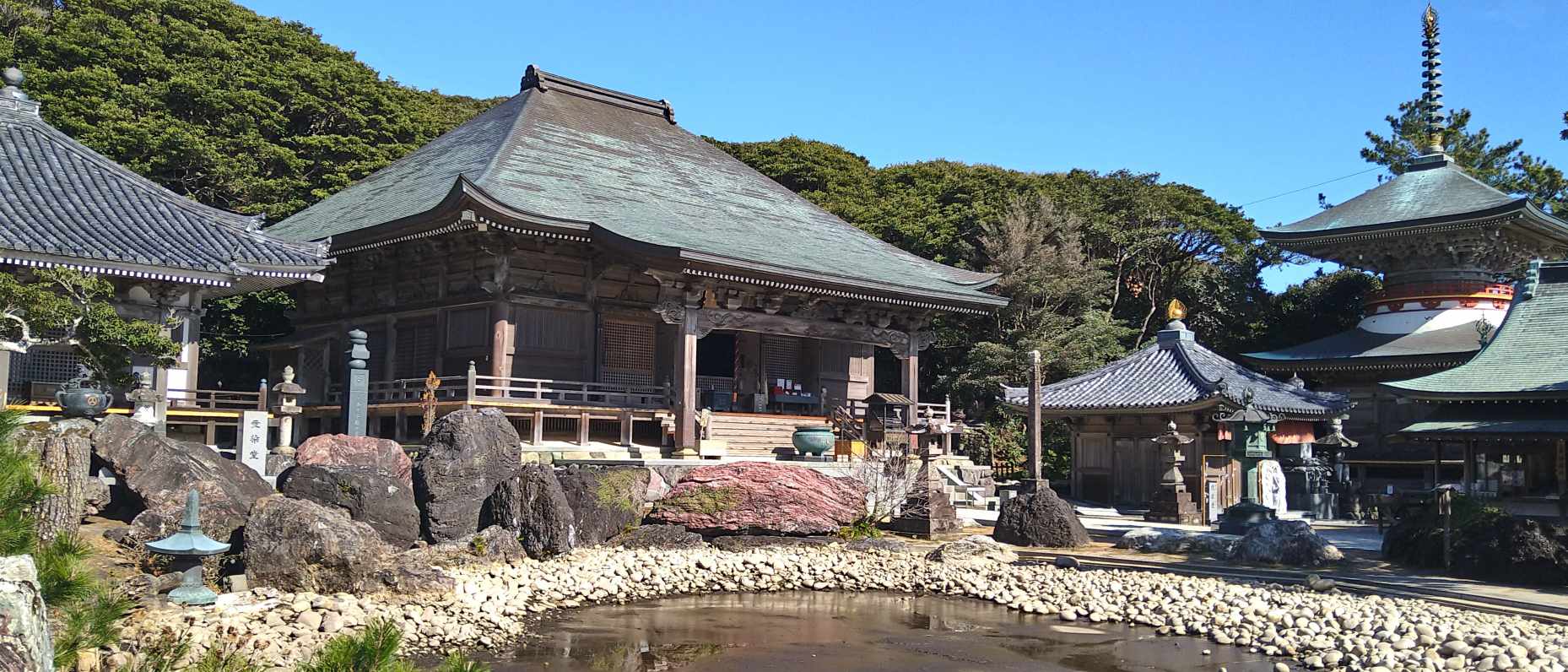
Image of Kongōfuku-ji (金剛福寺). Image source · CC0
Station 38 of 88
Shikoku 88 Temple PilgrimageVisit essentials
A quick read before you go
- Duration
- 60–90 minutes for the temple itself, including chanting at both halls and the Fudaraku-tomon.
- Access
- Located at the tip of the Ashizuri Peninsula in Tosashimizu City, Kōchi Prefecture — the…
Overview
Kongōfuku-ji sits above the Pacific at Cape Ashizuri, Shikoku's southernmost point, after the pilgrimage's longest gap: approximately eighty-five kilometres and thirty walking hours from Temple 37, Iwamoto-ji.
By temple tradition, the forty-nine-year-old Kūkai stood here in 822 and sensed Fudaraku—Kannon Bosatsu's southern pure land, Sanskrit Potalaka—across the ocean. Under Emperor Saga's commission, he carved the three-faced, thousand-armed Senju Kannon honzon and founded the temple. Inscriptions on the Niōmon and Fudaraku-tomon, the 'Gate Toward Potalaka,' are attributed to the emperor.
From the late Heian through Sengoku periods, devotees left this gate on Fudaraku Tokai voyages, sealing themselves in small boats and rowing alone into the Pacific in pursuit of Kannon's paradise. The practice ceased centuries ago but remains central to the temple's identity. Stone Buddhist carvings, the lighthouse-and-cliff walking trail, and the Kūkai-associated 'Seven Wonders of Ashizuri' extend the precinct into the cape's wider sacred landscape.
Why this place is sacred
What thins at Kongōfuku-ji is the boundary between geography and cosmology. The cape is a literal edge of land, beyond which lies open water for thousands of kilometers. By the cosmology of Pure Land Kannon devotion, that ocean is not empty — it is the surface across which Fudaraku, the southern paradise of Kannon, can be approached.
The Fudaraku-tomon is not a metaphor for that approach; it is the ritual gateway through which medieval devotees walked before getting into their sealed boats.
The Fudaraku Tokai history adds a register that is hard to hold but harder to dismiss. Devotees rowed alone into the Pacific seeking Kannon's paradise. Some accounts describe the boats as windowless, the doors nailed shut from outside, the food and drink minimal. The voyages were rare — perhaps a few dozen across several centuries from this site — but each one was a definitive event in the local sacred imagination.
For a contemporary visitor, the practice raises the question it always raised: what does it mean to surrender into something invisible? The temple's literature does not endorse the practice as something to be revived. It also does not pretend the practice did not happen. Standing at the Fudaraku-tomon, looking south, the cosmology and the geography hold the same line of sight. The wind off the cape is not gentle.
The wider Cape Ashizuri walking trail, the lighthouse, the cliff drops, the stone Buddhist carvings scattered through the grounds — all extend the contemplative environment of an edge.
Founded in 822 by Kūkai under imperial command of Emperor Saga as a Buzan-school Shingon temple identifying the southern Pacific with Fudaraku, Kannon's southern pure land; honzon a three-faced thousand-armed Senju Kannon carved by Kūkai by temple tradition.
Medieval prosperity under the Ichijō family, the Tosa domain, and the Yamauchi family. From the late Heian through Sengoku periods, the temple was a noted departure point for the Fudaraku Tokai sea-pilgrimage. The practice ceased; the temple continued. Today functions as a Buzan-school Shingon site within Ashizuri-Uwakai National Park, an active Shikoku 88 stop, and a major draw for both pilgrims and general tourists visiting Cape Ashizuri.
Experience and orientation
After the eighty-five-kilometer approach from Iwamoto-ji, pilgrims arrive at Tosashimizu and follow the road out onto the Ashizuri Peninsula. The temple sits at the tip, above the cliffs of Cape Ashizuri. Free parking is available on the grounds.
The Niōmon and the Fudaraku-tomon mark the entry — both with inscriptions attributed to Emperor Saga. The standard Shikoku henro liturgy proceeds at the Hondō and the Daishi-dō: bonshō rung once on entering, hands and mouth washed at the chōzuya, candle and three sticks of incense, fudasho-fuda placed in the wooden box, Heart Sutra and the Kōbō Daishi mantra (Namu Daishi Henjō Kongō) chanted, coin offering. The nōkyō stamp is received at the temple office.
What distinguishes the visit is what surrounds the standard liturgy. The temple grounds carry many stone Buddhist carvings; the Senju Kannon honzon (three-faced, thousand-armed) is venerated as a gateway image toward Fudaraku. Pilgrims often pause at the Fudaraku-tomon for several minutes, looking south. The wider Cape Ashizuri walking trail loops out past the lighthouse and along the cliff edge — about an hour of additional walking that pulls the temple visit into the wider sacred geography of the cape.
Many pilgrims describe arrival here as one of the contemplative climaxes of the entire henro. The vastness of the Pacific from the cape, the visible engagement of the temple with that vastness through the Fudaraku-tomon, and the long approach all combine into what most use as a moment of pause and stocktaking. The Seven Wonders of Ashizuri — folk-religious sites associated with Kūkai around the cape — extend the visit into another loop for those with time.
The temple sits at the tip of the Ashizuri Peninsula in Tosashimizu City, Kōchi Prefecture — the southernmost point of Shikoku. The precinct is on cliff-top ground above the open Pacific. The Niōmon faces inland; the Fudaraku-tomon opens toward the sea. The Hondō and Daishi-dō are within the main precinct; many stone carvings are scattered through the grounds. Cape Ashizuri lighthouse and the coastal walking trail are immediately adjacent.
Context and lineage
By temple tradition, Kūkai (Kōbō Daishi), then forty-nine years old, stood at Cape Ashizuri in 822 CE and sensed Potalaka — the southern pure land of Kannon Bosatsu — across the ocean. He carved a three-faced, thousand-armed Senju Kannon, enshrined it as the honzon, and named the temple Kongōfuku-ji ('Vajra-Fortune Temple') under Emperor Saga's commission. Both the Niōmon and the Fudaraku-tomon are said to carry inscriptions attributed to Emperor Saga himself.
The Fudaraku-tomon — the 'Gate Toward Potalaka' — is described in temple tradition as the closest material gateway to Kannon's pure land. From the late Heian through Sengoku periods, devotees performed Fudaraku Tokai from the cape: sealing themselves into small boats and rowing alone into the Pacific in pursuit of Kannon's paradise. The practice ceased centuries ago. The temple continued, with medieval prosperity under the Ichijō family, the Tosa domain, and the Yamauchi family.
Today it sits within Ashizuri-Uwakai National Park.
Shingon Buddhism, Buzan branch (Buzan-ha). The temple's formal name is Sadazan Fudarakuin Kongōfuku-ji.
Kūkai (Kōbō Daishi)
Founder, carver of the honzon
Emperor Saga
Imperial patron
Ichijō family
Medieval patrons
Yamauchi family
Edo-period patrons
Traditions and practice
Senju Kannon devotion; goma fire rituals; standard Kūkai memorial services. The historical Fudaraku Tokai practice — sealing into small boats and rowing into the Pacific seeking Kannon's pure land — was performed from the late Heian through Sengoku periods and is no longer practiced today.
Pilgrims chant the Heart Sutra and Kōbō Daishi mantra at the Hondō (Senju Kannon) and the Daishi-dō, light candles and incense, place fudasho-fuda, and receive nōkyō. Many pilgrims also walk the perimeter of the cape (Cape Ashizuri walking trail) to experience the wider sacred geography. Some leave small written prayers (fudasho-fuda) at the Fudaraku-tomon directed toward Fudaraku.
After the long approach, give yourself time. The standard liturgy at both halls takes thirty to forty-five minutes; the longer visit — including the Fudaraku-tomon, the stone carvings throughout the grounds, the lighthouse, and the coastal walking trail — is an afternoon. The cape is a place where many pilgrims pause for stocktaking. The Tosa stretch (the dōjō of ascetic discipline) closes after Temple 39, and the Iyo stretch (the dōjō of attaining enlightenment) begins at Temple 40.
Kongōfuku-ji is a natural place to consider what the long discipline has shaped.
Shingon Buddhism (Buzan-ha)
ActiveBuzan-school Shingon temple founded by Kūkai under imperial command of Emperor Saga in 822. The Senju Kannon honzon and the temple's identification with Fudaraku (Potalaka) make it one of the most theologically distinctive sites on the pilgrimage.
Standard Shingon henro liturgy; Senju Kannon devotion; goma fire rituals; Kūkai memorial services.
Fudaraku Tokai (Potalaka Sea-Crossing)
HistoricalFrom the late Heian through Sengoku periods, Kongōfuku-ji was a noted departure point for the Fudaraku Tokai practice — pilgrims sealed into small boats rowed alone into the Pacific seeking Kannon's pure land. The practice is no longer performed but remains a defining historical layer of the temple's sacred identity.
Historical only — not performed today.
Perspectives and open questions
Kongōfuku-ji is read as the southernmost temple of the pilgrimage, the geographic anchor of medieval Pure Land Kannon devotion in southwestern Japan, and a contemplative climax of the Tosa stretch.
Scholarly perspective
Scholars treat Kongōfuku-ji as a major node of medieval Japanese Pure Land–oriented Kannon devotion linked to the broader Fudaraku Tokai phenomenon (also documented at Nachi in Kii). The 822 founding under Emperor Saga's patronage situates Kūkai's network of imperial-sponsored temples in the early ninth century. The geographical drama of the cape is consistently cited as a primary factor in the temple's enduring sacred status.
Living and traditional perspectives
Local Tosa coastal communities have long regarded Cape Ashizuri as a thin place where Kannon's pure land approaches the human world. Folk traditions of the Seven Wonders of Ashizuri encode this in landscape features around the cape. Within the broader Shikoku henro tradition, Kongōfuku-ji marks the southernmost point of the pilgrimage and one of its emotional climaxes.
Alternative interpretations
Within Shingon esoteric tradition, the temple's posture toward the open ocean enacts a 'gaze toward Potalaka' — a directed contemplation that aligns the practitioner's attention with Kannon's compassionate field across spatial vastness. The Fudaraku Tokai is sometimes interpreted not as suicidal but as the most extreme form of letting-go practice — a position that historical scholars treat with caution.
Open questions
The total number of historical Fudaraku Tokai voyages from Kongōfuku-ji, and the identities of those who undertook them, are incompletely documented.
Plan your visit
Access and arrival
Located at the tip of the Ashizuri Peninsula in Tosashimizu City, Kōchi Prefecture — the southernmost point of Shikoku. By road from Temple 37 Iwamoto-ji is approximately 85 km, the longest gap between consecutive temples on the entire pilgrimage; on foot this is roughly 30 walking hours for an average pilgrim. Many pilgrims take a bus from Nakamura Station to Cape Ashizuri. Free parking on grounds.
No shukubō at Kongōfuku-ji itself. Pilgrim and standard lodging is available in Tosashimizu City and at hotels around Cape Ashizuri serving the broader tourist trade. Booking ahead is advised in spring, autumn, and on weekends.
Respectful visit
Modest, respectful clothing. Warm or wind-resistant layers recommended; the cape's weather is variable. Sturdy footwear for the coastal walking trail. Pilgrim hakui not required for casual visitors.
Permitted outdoors and across the temple grounds. Interior altar photography is not allowed. Ask before photographing pilgrims at prayer.
Standard henro offerings — candle, three sticks of incense, fudasho-fuda placed in the box, coin offering. Some pilgrims leave small written prayers at the Fudaraku-tomon directed toward Fudaraku.
Do not ring the bonshō on leaving (Shikoku 88 convention). Stay on marked paths near the cliffs; the cape's geology is steep. Drones generally require permission, particularly in the national park.
The cape is exposed; weather changes rapidly and winds can be strong. Stay on marked paths near the cliffs — the geology is steep and unforgiving. Typhoon season (late summer to early autumn) can bring dramatic seas and unsafe cliff conditions. The bonshō rings on entering only.
Current practical details
Address
214-1 Ashizurimisaki, Tosashimizu, Kochi 787-0315, Japan
Phone
Hours
Hours, fees, and access can change — verify on the official source before you travel. Practical details last checked Jun 2026.
Location
Map loads as you approach this section.
Pilgrim reflections
A portrait of encounter, not a score
Pilgrims describe what they felt, how present they could become, and whether the place would shape a journey. There are no stars and no ranking of traditions.
No reviewed reflections yet
The first pilgrims can help describe the character of being here.
Share a reflection
Available after an account-backed “Been there.” Every reflection is reviewed before publication.
Watch deeper
Films, episodes, and recorded talks for visitors who want more context before or after a visit. Speculative and alternative-history entries are labelled as perspectives, not as sources for established claims.
Nearby sacred places
Explore other sacred places in the region. Proximity does not establish access or travel time; check each place’s guidance.


References
Sources consulted for this page. Source categories describe the publication, not a guarantee that every claim is verified. Traditional accounts and outside interpretations may differ.
- 01Kongōfuku-ji - Wikipedia — Wikipedia contributorsencyclopediaCore facts: Buzan Shingon, founded 822 by Kūkai under Emperor Saga, Senju Kannon honzon
- 02Sadazan Fudarakuin Kongohukuji – Shikoku 88 Temple Pilgrimage — Shikoku 88 ReijokaiofficialOfficial entry; Fudaraku Tokai history
- 03Kongofukuji – Tosashimizu, Kochi Prefecture, Shikoku — Henro.orgguidePilgrim practicalities; distance from Temple 37
- 04Temple 38, Kongōfukuji|What to See & Do — Shikoku TourismofficialOrigin under Emperor Saga; Fudaraku Tomon gate
- 05Kongofukuji Temple, Temple No. 38 of the Sacred Temples of Shikoku — Shikoku Pilgrimage NewsguideSeven Wonders of Ashizuri folklore
Pilgrim glossary
- Honzon
- The principal Buddhist deity enshrined as a temple's central object of worship.
- Kannon
- The bodhisattva of compassion, central to many East Asian pilgrimage routes.
- Sutra
- A canonical Buddhist scripture, often chanted as part of practice.
- Mantra
- A sound, word, or phrase repeated as part of meditation or ritual.
- Shingon
- An esoteric Japanese Buddhist school emphasizing ritual, mantra, and mandala practice.
- Pure Land
- A Buddhist tradition focused on rebirth in Amida Buddha's western paradise through devotional practice.
Share a photo
Help visitors recognize Kongōfuku-ji. Every submission is reviewed before publication.