Tanema-ji
Where bottomless ladles wait by the Kosodate Kannon hall, returned in thanks for safe births
Understand sacred places, explore living traditions, and learn how to engage respectfully with Pilgrim Map.
Access has not been verified. Check current local guidance before planning a visit.
Haruno, Kochi Prefecture, Japan
Read the sources
Image of Tanema-ji (種間寺). Image source · CC-BY-SA-4.0
Station 34 of 88
Shikoku 88 Temple PilgrimageVisit essentials
A quick read before you go
- Duration
- 30–45 minutes for the standard pilgrim ritual at both halls plus the Kosodate Kannon-dō.
- Access
- Located at 781 Akiyama, Haruno-cho, Kōchi City.
Overview
Tanema-ji holds three quiet origins folded into one temple. The first is a storm at sea: tradition relates that in 577 CE, Buddhist sculptors from Baekje on the Korean peninsula — returning home after working on Shitennō-ji in Naniwa — were caught in a typhoon off the Tosa coast. They took refuge near Mt. Motoo, carved a 145-centimeter seated Yakushi Nyorai as a prayer for safe passage, enshrined it on the summit, and continued their voyage when the storm calmed.
The second origin is agricultural. When Kūkai returned from his studies in Tang China in the early ninth century, he is said to have founded a temple around the Baekje-carved statue and sowed within the grounds five grains brought from China — rice, barley, millet, sorghum, and beans. The temple's name, 種間寺 (Tanema-ji), means 'Sown Seeds Temple.' In 947–957 Emperor Murakami granted the imperial seal 'Tanema,' confirming the name into official record.
The third origin, still living, is folk-Buddhist. The Yakushi Nyorai of Tanema-ji is popularly called Anzan no Yakushi — Yakushi of Safe Childbirth. Expectant mothers (or families on their behalf) receive a wooden ladle with the bottom removed, blessed at the temple, and take it home until birth. The hollow form symbolizes the wish that the baby may pass through easily, yoku tsuujiru. After a successful birth, the ladle is returned to the Kosodate (child-rearing) Kannon-dō as a thanks-offering.
Walls of returned ladles line the hall — each one a quiet record of a life passed safely into the world.
The temple has no formal mountain gate, which gives the grounds an open, working-rural feel that contrasts with the more dramatic Shikoku 88 mountain temples. Pilgrims arriving from Sekkei-ji six and a half kilometers east often note this — a temple woven into rice paddies and coastal plain, modest in scale, layered in meaning.
Why this place is sacred
What thins at Tanema-ji is the boundary between thresholds. The temple's three layered origins — Baekje sculptors carving for safe sea passage, Kūkai sowing seeds for harvest, expectant mothers praying for safe birth — collapse into a single contemplative theme: passage. Through storms. Through harvest cycles. Through the birth canal. Each ladle around the Kosodate Kannon-dō marks one such passage completed.
The bottomless form of the ladle is itself a meditation. To pour through it would be to pour into nothing — but that is the point: the wish is for unimpeded flow, the baby moving through without obstruction. Stand near the wall of returned ladles and the field is not abstract. Each ladle was carried home by a particular woman or family, kept through pregnancy, returned in person after birth.
The cumulative weight is not solemn; it is steady, like a long count of thank-yous.
The rice paddies surrounding the temple extend the layer. Kūkai's five grains, the seasonal harvests of Kōchi, the temple's name itself — all keep the agricultural and human registers of fertility entangled. Some readers within Shingon describe this as a vernacular form of macrocosm-microcosm correspondence: the same blessing extending across cosmos and womb.
An enshrined Yakushi Nyorai statue carved at sea by Baekje sculptors as a prayer for safe voyage (sixth century, by tradition); reorganized as a Shingon temple by Kūkai in the early ninth century with the addition of agricultural blessing through the sowing of five grains brought from Tang China.
The temple was suppressed during the Meiji haibutsu kishaku in 1871 and rebuilt in 1880. Today functions as a Shingon Buzan-school temple, an active Shikoku 88 pilgrimage stop, and a regional center for safe-childbirth devotion.
Experience and orientation
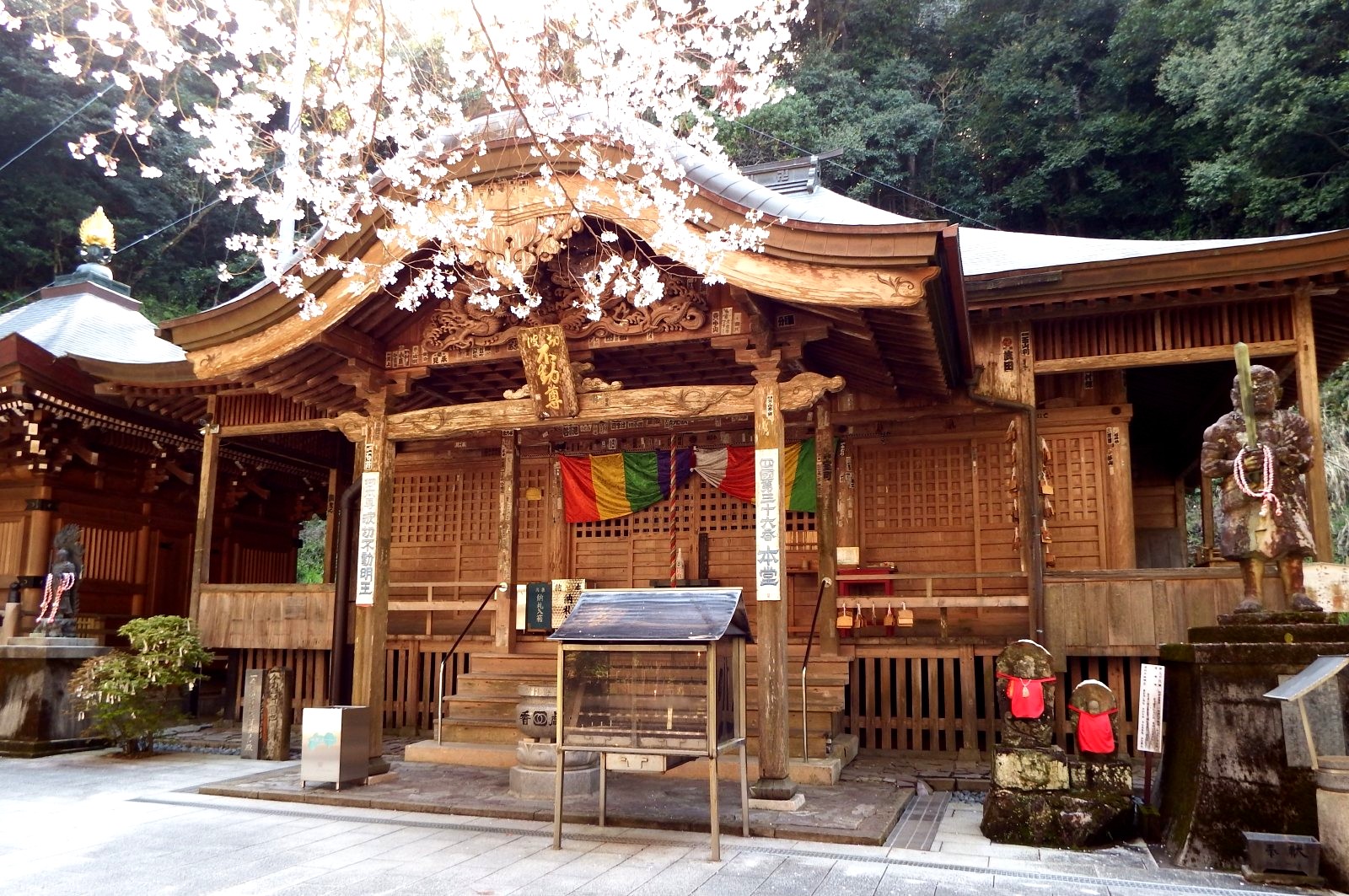
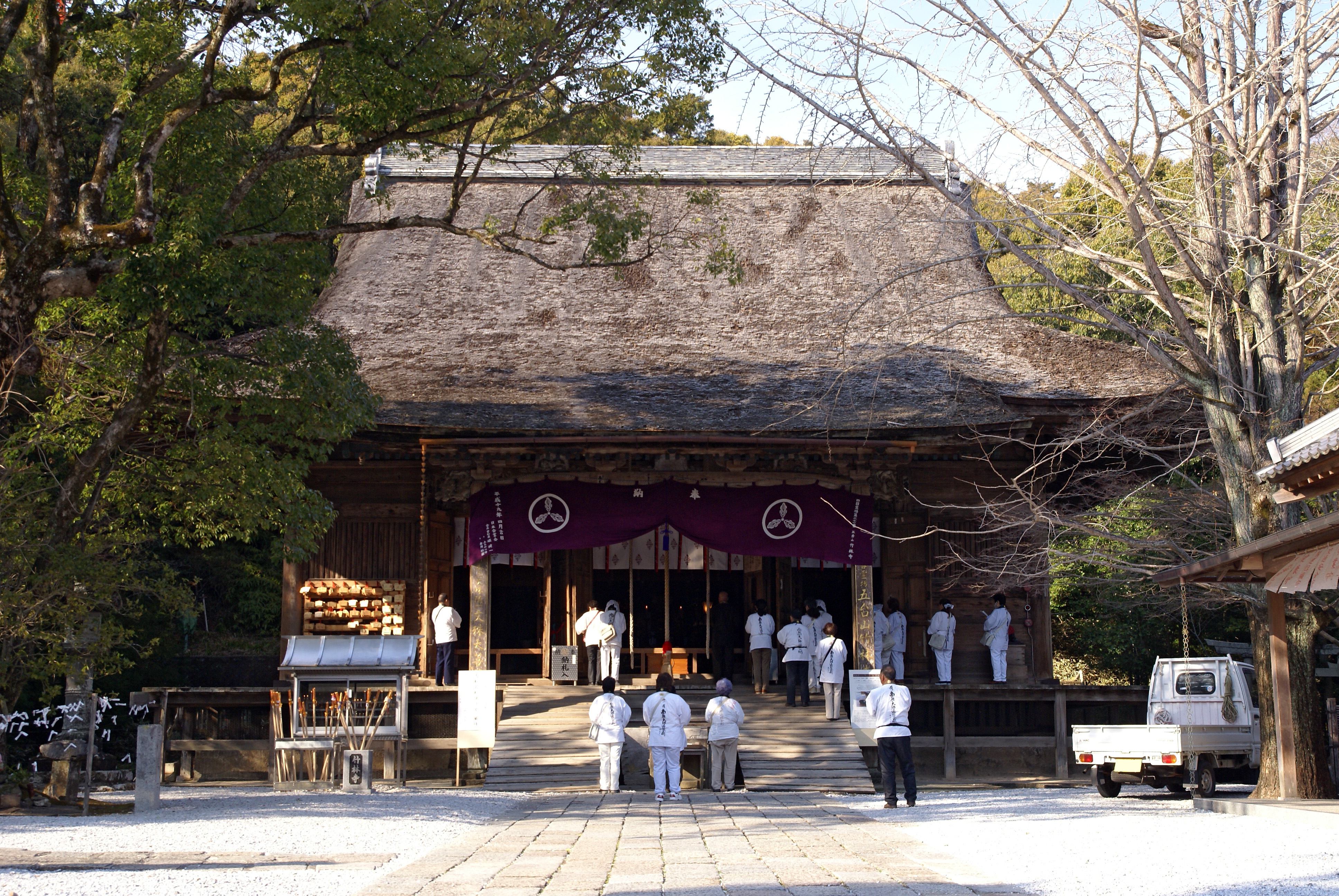
The approach from Sekkei-ji follows roughly six and a half kilometers of flat farmland west toward Haruno. Tanema-ji has no formal Niōmon, so the precinct simply opens — a working-rural quality that pilgrims often comment on. The Hondō, Daishi-dō, and Kosodate Kannon-dō face an unornamented courtyard. Free parking is available on grounds.
The ritual sequence at the Hondō and Daishi-dō follows the standard Shikoku henro form: candle, three sticks of incense, fudasho-fuda placed in the wooden box, Heart Sutra and the Kōbō Daishi mantra (Namu Daishi Henjō Kongō), coin offering, repeated at both halls. The bonshō rings on entry only — never on leaving.
The distinct stop here is the Kosodate Kannon-dō. Its walls are lined with wooden ladles whose bottoms have been removed; some are recent, others have weathered into pale gray. Each one was given to an expectant mother as a blessing object, kept at home until the birth, then returned in thanks. Pilgrims often pause here longer than the standard ritual would suggest.
Photography of the wall is common, but each ladle is somebody's personal ex-voto and close-ups of recent offerings are best avoided.
For families seeking an anzan (safe-birth) blessing, the temple office can prepare a ladle on request. The arrangement is simple and personal — not a tourist transaction.
The temple sits in flat coastal-plain land in Haruno, Kōchi, near rice paddies. The grounds open without a formal gate. The Hondō and Daishi-dō stand to one side; the Kosodate Kannon-dō with its wall of bottomless ladles is on the other. The nōkyō office is between them. Free parking is available on grounds for 70 standard cars and 5 large vehicles.
Context and lineage
By temple tradition, Buddhist sculptors from the Korean kingdom of Baekje were caught in a storm off Tosa in 577 CE while returning home from work on Shitennō-ji in Naniwa. They took refuge near Mt. Motoo, carved a 145-centimeter seated Yakushi Nyorai as a prayer for safe passage, and enshrined it on the summit before continuing their voyage.
Kūkai (Kōbō Daishi), returning from China in the Kōnin era (814–824), built a temple around the existing image and sowed five grains brought from Tang China within the grounds — giving the temple its name. Emperor Murakami granted the imperial seal 'Tanema' during the Tenryaku era (947–957). The temple was suppressed during the Meiji haibutsu kishaku in 1871 and rebuilt in 1880 under continuing Yamauchi (Tosa daimyō) and local patronage.
Folk-Buddhist devotion to the Yakushi Nyorai as Anzan no Yakushi — Yakushi of Safe Childbirth — has shaped the temple's identity for centuries and remains active.
Shingon Buddhism, Buzan branch (Buzan-ha). The temple's formal name is Motoozan Suzakuin Tanemaji.
Baekje sculptors (uncredited)
Original carvers of the Yakushi Nyorai
Kūkai (Kōbō Daishi)
Temple founder
Emperor Murakami
Imperial patron
Yamauchi family
Edo-period patrons
Traditions and practice
Annual blessings of bottomless ladles for safe childbirth; Yakushi Nyorai healing services; Shingon goma fire rituals; Kōbō Daishi memorial services. Local families have practiced the bottomless-ladle anzan tradition across generations.
Pilgrims complete the standard henro liturgy at the Hondō and the Daishi-dō — bell on entering, hands and mouth washed at the chōzuya, candle and three sticks of incense, fudasho-fuda placed in the box, Heart Sutra and Kōbō Daishi mantra chanted, coin offering, nōkyō stamp at the office. Expectant mothers and families request blessed bottomless ladles to take home; after a safe birth, the ladle is returned to the Kosodate Kannon-dō.
Walk the henro liturgy at both halls in the standard form, then spend a few minutes at the Kosodate Kannon-dō. The wall of returned ladles is most contemplated rather than photographed — sit or stand for a while and let the cumulative quality settle. If you carry a private wish for someone's safe passage, this is a good place to place it.
Shingon Buddhism (Buzan-ha)
ActiveThe temple's resident sect — Buzan-school Shingon — within the Kūkai-centered henro circuit. Yakushi Nyorai veneration and Shingon esoteric ritual frame the temple's regular liturgy.
Standard Shingon henro liturgy plus prayers to Yakushi Nyorai for healing and to Kosodate Kannon for safe childbirth and child-rearing.
Folk Buddhist childbirth devotion (Anzan no Yakushi)
ActiveTanema-ji is one of the most prominent Shikoku temples for anzan (safe-birth) prayers. The principal image is popularly called 'Anzan no Yakushi' and the bottomless-ladle practice is maintained across generations.
Expectant mothers (or families on their behalf) receive a blessed bottomless wooden ladle (sokonuke hishaku) from the temple, take it home until birth, and return it to the Kosodate Kannon-dō as a thanks-offering after a safe delivery.
Perspectives and open questions
Tanema-ji is read through three overlapping registers — maritime origin legend, agricultural blessing, and folk-Buddhist childbirth devotion — none of which fully exhausts the temple's identity.
Scholarly perspective
Historians treat the Baekje sculptor origin as a temple legend rather than verified history, while acknowledging that sixth- and seventh-century Korean influence on early Japanese Buddhist sculpture is well-attested. Kūkai's foundation in the early ninth century is consistent with Shingon-temple establishment patterns elsewhere on Shikoku. The Yamauchi-era prosperity and Meiji-era suppression follow the standard arc of Tosa Buddhist institutions.
Living and traditional perspectives
Local Tosa tradition strongly identifies Tanema-ji with safe childbirth; women across Kōchi Prefecture maintain the bottomless-ladle practice across generations. Within the broader Shikoku henro tradition, the temple is read as the thirty-fourth stop in the Tosa stretch — the dōjō of ascetic discipline.
Alternative interpretations
Some readers interpret the temple's combination of agricultural seed-sowing (Kūkai's five grains) and human seed-passage (anzan devotion) as a quietly Shingon embodiment of macrocosm-microcosm correspondence — the same fertility blessing extending across cosmos and womb, harvest and birth.
Open questions
Whether the present honzon is in fact the original sixth-century Baekje statue, as tradition holds, or a later replacement, is not conclusively documented in publicly available scholarship.
Plan your visit
Access and arrival
Located at 781 Akiyama, Haruno-cho, Kōchi City. By bus: from Sakaimachi terminal in Kōchi City take a Takaoka-eigyōsho bound bus and alight at Negitani-guchi (~30 minute walk to the temple). Free parking on grounds for 70 standard cars and 5 large vehicles. Walking from Temple 33 Sekkei-ji: ~6.5 km west. Walking to Temple 35 Kiyotaki-ji: ~10 km.
No shukubō at Tanema-ji itself. Standard pilgrim and tourist lodging is available in Kōchi City, about ten to fifteen minutes by car east. Walking pilgrims often stay in Kōchi City or in small inns near Tosa City to the west.
Respectful visit
Modest, respectful clothing. Pilgrim hakui and kongō-zue are common; nōkyōchō (stamp book) is carried by most henro pilgrims. Remove hats inside halls.
Permitted outdoors. Interior altar photography is not allowed. The ladle wall may be photographed at a respectful distance; close-ups of individual recent offerings are not appropriate.
Standard henro offerings — candle, three sticks of incense, fudasho-fuda, coin in the saisen-bako. The distinctive offering at Tanema-ji is the bottomless ladle returned in thanks after safe childbirth.
Do not ring the bonshō on leaving (Shikoku 88 convention). Quiet conduct near the Kosodate Kannon-dō. Drones and tripods generally require permission.
The bottomless ladles around the Kosodate Kannon-dō are personal devotional offerings. Treat them as you would ex-votos at any sacred site: respectful viewing, no handling, no intrusive photography of recent offerings. Do not ring the bonshō on leaving.
Current practical details
Address
72 秋山 春野町 Kochi, 781-0321, Japan
Phone
Hours
Hours, fees, and access can change — verify on the official source before you travel. Practical details last checked Jun 2026.
Location
Map loads as you approach this section.
Pilgrim reflections
A portrait of encounter, not a score
Pilgrims describe what they felt, how present they could become, and whether the place would shape a journey. There are no stars and no ranking of traditions.
No reviewed reflections yet
The first pilgrims can help describe the character of being here.
Share a reflection
Available after an account-backed “Been there.” Every reflection is reviewed before publication.
Watch deeper
Films, episodes, and recorded talks for visitors who want more context before or after a visit. Speculative and alternative-history entries are labelled as perspectives, not as sources for established claims.
Nearby sacred places
Explore other sacred places in the region. Proximity does not establish access or travel time; check each place’s guidance.


References
Sources consulted for this page. Source categories describe the publication, not a guarantee that every claim is verified. Traditional accounts and outside interpretations may differ.
- 01Tanema-ji - Wikipedia — Wikipedia contributorsencyclopediaCore history and sect
- 02Motoozan Suzakuin Tanemaji – Shikoku 88 Temple Pilgrimage — Shikoku 88 ReijokaiofficialOfficial association entry
- 03Tanemaji – Kochi City, Kochi Prefecture, Shikoku — Henro.orgguidePilgrim practicalities
- 0434th temple of the Shikoku Pilgrimage, Tanemaji Temple — Shikoku Pilgrimage NewsguideBaekje sculptors origin story; Kosodate Kannon detail
- 05Tanema-ji Temple Sokonukehishaku — TripAdvisor / local pilgrim accountsguideConfirms bottomless ladle (sokonuke hishaku) ritual
Pilgrim glossary
- Honzon
- The principal Buddhist deity enshrined as a temple's central object of worship.
- Kannon
- The bodhisattva of compassion, central to many East Asian pilgrimage routes.
- Sutra
- A canonical Buddhist scripture, often chanted as part of practice.
- Mantra
- A sound, word, or phrase repeated as part of meditation or ritual.
- Shingon
- An esoteric Japanese Buddhist school emphasizing ritual, mantra, and mandala practice.
Share a photo
Help visitors recognize Tanema-ji. Every submission is reviewed before publication.