Motoyama-ji
The horse-headed Kannon — National Treasure Hondō and the only Batō Kannon honzon on the Shikoku 88
Understand sacred places, explore living traditions, and learn how to engage respectfully with Pilgrim Map.
Access has not been verified. Check current local guidance before planning a visit.
Mitoyo, Kagawa Prefecture, Japan
Read the sources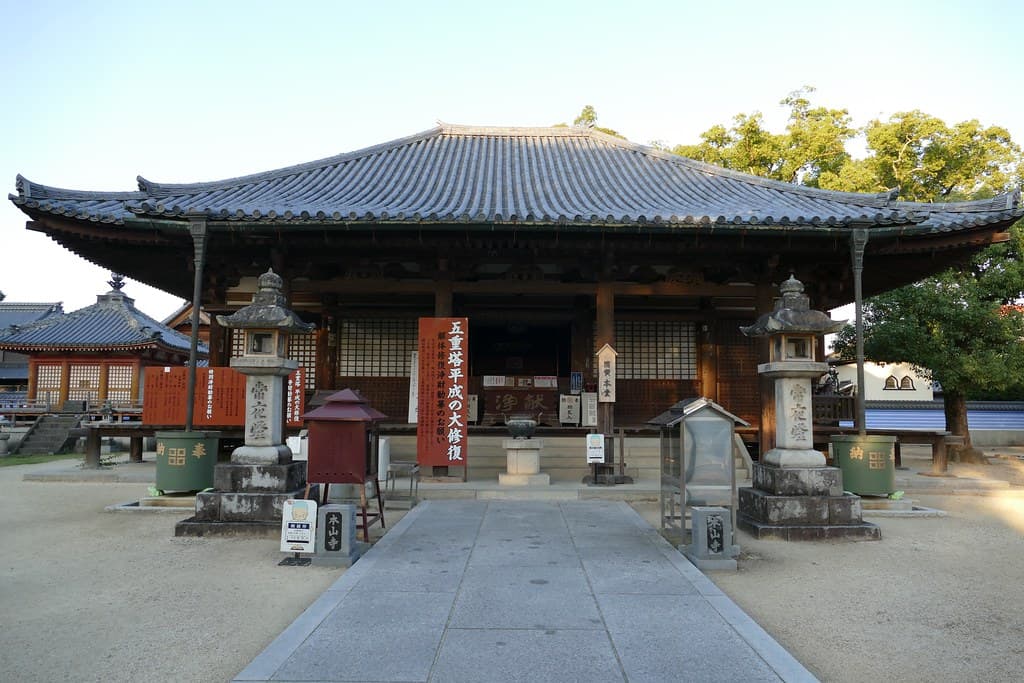
Image of Motoyama-ji (本山寺). Image source
Station 70 of 88
Shikoku 88 Temple PilgrimageVisit essentials
A quick read before you go
- Duration
- 45 to 75 minutes on site.
- Access
- Set on the Mitoyo plain in Toyonaka-chō, Kagawa.
Overview
Motoyama-ji is one of the visually most striking temples on the Shikoku 88. Set on a 20,000-square-metre precinct in the rice fields of Mitoyo's Toyonaka district, it announces itself from a distance: a vermillion five-storied pagoda — one of only four pagodas of this scale on the entire pilgrimage — silhouetted against the Sanuki plain. The temple was founded by Kūkai in 807 on imperial command from Emperor Heizei.
Across nearly 1,200 years its central architectural axis, Hondō and pagoda, has held the basic shape of a mature Heian-era esoteric temple plan. The current Hondō was rebuilt in 1300 — a Kamakura-period reconstruction — and is one of the few buildings on the entire Shikoku 88 designated a National Treasure of Japan.
The five-storied pagoda visible across the paddies is more recent, rebuilt in the early twentieth century (sources vary between 1910 and 1913) after a Meiji-era collapse, but the silhouette it cuts against the plain is older than any of the wood. What sets Motoyama-ji apart for henro, beyond architecture, is its honzon. Of the eighty-eight temples, this is the only one whose principal image is Batō Kannon — Hayagrīva, the horse-headed manifestation of Avalokiteśvara.
Where most Kannon manifestations are gentle (Senju, Shō, Jūichimen), Batō is a wrathful protector — invoked traditionally for the welfare of working horses and oxen, and more broadly for animals and travellers. A horse statue near the Hondō honours the honzon. Local farmers have brought their working animals here for generations; the modern continuity of pet-protection prayer threads back to that older agricultural devotion.
Pilgrims often cite Motoyama-ji as one of the most distinctive stops in Kagawa, both for the pagoda silhouette and for the unusual quality of the Batō Kannon devotion — fierce compassion as the temple's particular teaching.
Why this place is sacred
Motoyama-ji's atmosphere is shaped by the unusual coexistence of scale and quiet. The precinct is large — 20,000 square metres — yet held in a contained dignity by the surrounding farmland. The Hondō, rebuilt in 1300 and now a National Treasure, is the structural anchor: dark-timbered, unadorned by recent intervention, with the somber proportions of the Kamakura period. The five-storied pagoda is the visual anchor, vermillion against the green of summer paddies and the gold of autumn rice.
Inside the temple's life, though, the thinness gathers around the honzon. Batō Kannon is unusual on the pilgrimage. The horse head, the wrathful expression, the fierce stance — all are read in Shingon tantra as the swift aspect of compassion, the manifestation that 'devours' delusion rather than gently coaxing it apart.
Local farmers have brought working animals here for centuries to be blessed; pet-protection offerings continue that tradition into the present, threading the pilgrim's contemplative practice into a longer agricultural-religious continuity. For henro coming from the gentler Kannon manifestations elsewhere on the route, Motoyama-ji's Batō can be unsettling — a useful unsettling, suggesting that compassion has shapes that are not soft.
Founded in 807 by Kūkai on imperial command from Emperor Heizei. Established as a major Heian-era Shingon esoteric temple with the now-distinctive Hondō-and-pagoda axis defining its precinct.
The Hondō was rebuilt in 1300 — a Kamakura-period reconstruction that is now a designated National Treasure of Japan. The five-storied pagoda collapsed in the Meiji era and was rebuilt in the early 20th century (reported as 1910 or 1913). The temple has remained a working monastic establishment under Kōyasan Shingon-shū throughout, with continuous pilgrim reception.
Experience and orientation
Pilgrims approach Motoyama-ji along flat country roads — five kilometres or so from Kannon-ji at Temple 69, an easy walking stage that provides a rest after the doubled rhythm of the Mt. Kotohiki precinct. The first sight of the temple is usually the pagoda, lifting above the rice fields. The vermillion against green or gold makes the temple legible from a distance long before the gate. Inside the precinct, the scale opens.
Twenty thousand square metres is large by Shikoku 88 standards, and the open ground between the gate, the Hondō, and the pagoda gives the place a different feel from the more compressed mountain temples. The 1300 Hondō faces forward, dark-timbered and quietly authoritative. Pilgrims approach: candle from one's own flame, three sticks of incense, osamefuda, coin, Heart Sutra. The honzon inside is Batō Kannon.
The figure is not always visible, depending on shrine arrangement, but the attention shifts when the chant begins; the wrathful aspect of compassion has a different acoustic in the body than the gentler Kannon forms. A horse statue near the Hondō is a quiet reminder of the temple's animal-protection role. The Daishi-dō stands close by; pilgrims chant the Kōbō Daishi mantra. Photography of the pagoda and grounds is encouraged; photography inside the National Treasure Hondō is strictly forbidden.
Many henro find the visit grounding — an open precinct, a serious building, a fierce honzon, and the rice fields visible in every direction.
Approach across the Mitoyo plain by car or on foot. Bow at the gate. Wash hands at the chōzuya. Approach the Hondō (1300, National Treasure): light a candle from your own flame, three sticks of incense, osamefuda, small coin, Heart Sutra. The honzon inside is Batō Kannon — the only horse-headed Kannon on the Shikoku 88. Move to the Daishi-dō and repeat with the Kōbō Daishi mantra. Walk to the pagoda.
If carrying intentions for animals or travellers, this is the appropriate temple at which to leave them. Visit the nōkyō office for your stamp before 17:00.
Context and lineage
Tradition holds that Kūkai built Motoyama-ji on imperial command in 807, defining the mature Heian-style esoteric temple plan that the precinct has preserved across 1,200 years — Hondō and pagoda set in axial relation across a wide ground. The Kamakura-period rebuilding of the Hondō in 1300 produced the building still standing today, which has become one of the few National Treasures on the Shikoku 88. The early-20th-century pagoda rebuild reproduced the silhouette of the medieval pagoda after a Meiji-era collapse.
Kōyasan Shingon-shū — the largest of the Shingon sects, headquartered at Mt. Kōya. Motoyama-ji has belonged to this lineage throughout its modern history.
Kūkai (Kōbō Daishi)
Founder
Emperor Heizei
Imperial patron of the founding
Traditions and practice
Batō Kannon devotion (a wrathful Kannon, with mantras and mudras particular to this manifestation); Shingon esoteric services; Kōbō Daishi commemorations.
Daily Shingon liturgy by resident clergy; pilgrim reception; nōkyō stamp office; continuing tradition of animal- and pet-protection blessings.
Begin at the Hondō with full henro practice — the National Treasure status of the building is part of the offering, and standing in front of it slowly is a contemplative gesture in itself. At the Daishi-dō, perform the rite as usual. Pause at the horse statue near the Hondō; many pilgrims leave intentions here for working animals, pets, or travellers. The pagoda is worth circumambulating at a slow pace.
Shingon Buddhism (Kōyasan-shū)
ActiveMotoyama-ji belongs to the Kōyasan Shingon-shū, the largest of the Shingon sects, headquartered at Mt. Kōya. It is uniquely the only temple on the Shikoku 88 with Batō Kannon (Hayagrīva, Horse-Headed Avalokiteśvara) as its principal image — a wrathful protector of animals and travellers.
Esoteric Shingon ritual centred on Batō Kannon; Kōbō Daishi devotion at the Daishi-dō; large-temple liturgy on the substantial 20,000-square-metre precinct.
Perspectives and open questions
Motoyama-ji can be read as a rare surviving Kamakura-period architectural ensemble, a Heian-era imperial foundation, an animal-protection sanctuary, or a contemplative encounter with fierce compassion as a Shingon teaching.
Scholarly perspective
Motoyama-ji's 1300 Hondō is one of the rare Kamakura-period halls surviving on the Shikoku 88 and is well-studied as architecture; its National Treasure designation reflects this. The Batō Kannon honzon and its uniqueness on the route are also well documented. The pagoda's early-20th-century rebuild date is reported variably (1910 or 1913).
Living and traditional perspectives
Local farmers historically prayed to Batō Kannon for the welfare of working horses and oxen; the temple's continuing tradition of pet and animal blessings carries that practice into the present. The agricultural-religious continuity here is unusually intact.
Alternative interpretations
Batō Kannon's horse head is read in Shingon tantra as the swift, fierce aspect of compassion that 'devours' delusion — a counterweight to the gentler Senju and Shō Kannon manifestations elsewhere on the pilgrimage. To meet this Kannon at Temple 70, after Kannon devotion at multiple earlier temples, can produce a useful contrast in practice.
Open questions
Whether the present Batō Kannon honzon descends from Kūkai's original 807 carving or is a later replacement is not publicly resolved.
Plan your visit
Access and arrival
Set on the Mitoyo plain in Toyonaka-chō, Kagawa. Easy by car with on-site parking. On foot from Temple 69 Kannon-ji it is roughly 5 kilometres of flat walking — one of the gentler stages on the Kagawa stretch.
Pilgrim inns and minshuku in the Mitoyo and Zentsuji area; some walking pilgrims overnight near Kan'onji or in central Mitoyo. Confirm specifics through the official Shikoku 88 pilgrim office or local tourism authority.
Respectful visit
Modest, comfortable clothing. Traditional henro whites — hakui, sedge hat, kongō-zue, juzu — welcomed but not required.
Outdoor photography of the pagoda, grounds, and Hondō exterior is encouraged. The National Treasure Hondō has strict no-photography rules inside; observe signage.
One candle (from your own flame), three sticks of incense, an osamefuda slip, and a small coin offering at each of the Hondō and the Daishi-dō. Pet- and animal-protection offerings are traditional here; the temple supports this practice openly.
Do not enter roped-off interior areas of the Hondō. The stamp office stops issuing at 17:00. Animals brought for blessing should be controlled and respectful of other pilgrims.
The National Treasure Hondō has strict no-photography rules inside. Do not enter roped-off interior areas. Photography of the building and grounds outdoors is welcome and encouraged.
Current practical details
Address
Ko-1445 本山甲 豊中町 Mitoyo, Kagawa 769-1506, Japan
Phone
Hours
Hours, fees, and access can change — verify on the official source before you travel. Practical details last checked Jun 2026.
Location
Map loads as you approach this section.
Pilgrim reflections
A portrait of encounter, not a score
Pilgrims describe what they felt, how present they could become, and whether the place would shape a journey. There are no stars and no ranking of traditions.
No reviewed reflections yet
The first pilgrims can help describe the character of being here.
Share a reflection
Available after an account-backed “Been there.” Every reflection is reviewed before publication.
Watch deeper
Films, episodes, and recorded talks for visitors who want more context before or after a visit. Speculative and alternative-history entries are labelled as perspectives, not as sources for established claims.
Nearby sacred places
Explore other sacred places in the region. Proximity does not establish access or travel time; check each place’s guidance.



References
Sources consulted for this page. Source categories describe the publication, not a guarantee that every claim is verified. Traditional accounts and outside interpretations may differ.
- 01Motoyama-ji — WikipediaencyclopediaEncyclopedia entry confirming Kōyasan Shingon-shū affiliation and 807 founding.
- 02The 70th Temple Motoyamaji Temple — Rekinabi SanukiofficialKagawa cultural authority.
- 03Customs and Etiquette of the Shikoku Pilgrimage — Henro.orgguidePilgrim etiquette baseline.
- 04Temple 70, Motoyamaji — 88temples.infoguideDetailed temple-by-temple guide.
- 05Temple 70, Motoyama-ji — Shikoku ToursguidePilgrim travel guide.
- 06Honzan-ji Temple, Temple No. 70 — Shikoku Pilgrimage NewsofficialDetailed pilgrim feature.
Pilgrim glossary
- Honzon
- The principal Buddhist deity enshrined as a temple's central object of worship.
- Kannon
- The bodhisattva of compassion, central to many East Asian pilgrimage routes.
- Sutra
- A canonical Buddhist scripture, often chanted as part of practice.
- Mantra
- A sound, word, or phrase repeated as part of meditation or ritual.
- Shingon
- An esoteric Japanese Buddhist school emphasizing ritual, mantra, and mandala practice.
Share a photo
Help visitors recognize Motoyama-ji. Every submission is reviewed before publication.