Shusshakaji
Where a child's leap became the founder's vow
Understand sacred places, explore living traditions, and learn how to engage respectfully with Pilgrim Map.
Access has not been verified. Check current local guidance before planning a visit.
Zentsūji, Kagawa Prefecture, Japan
Read the sources
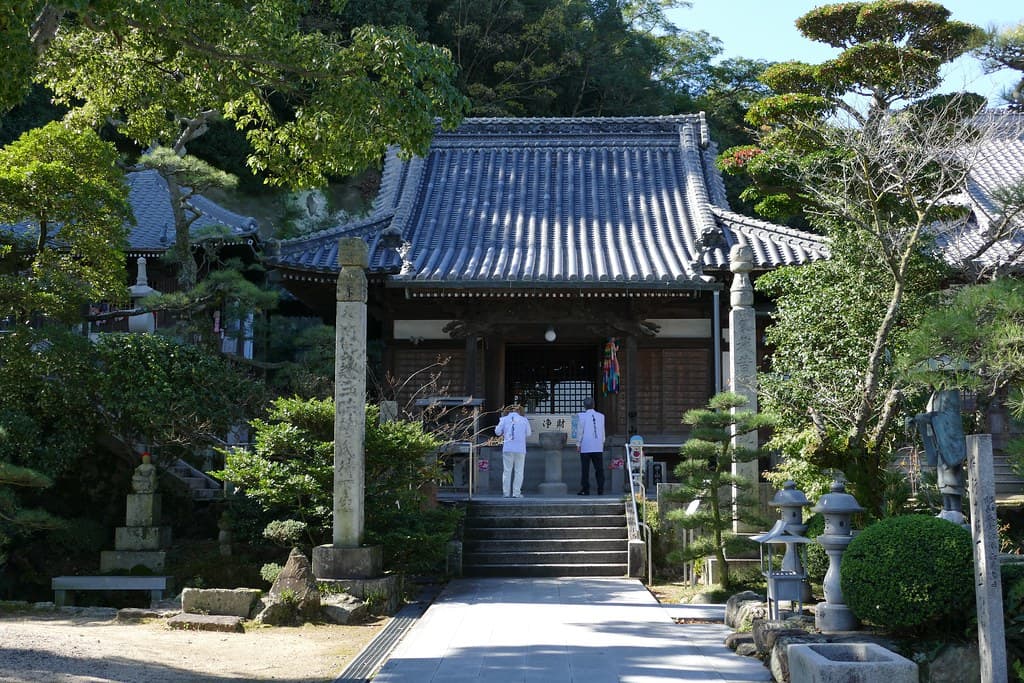
Image of Shusshakaji (出釈迦寺). Image source · CC-BY-SA-4.0
Station 73 of 88
Shikoku 88 Temple PilgrimageVisit essentials
A quick read before you go
- Duration
- 30–45 minutes for the lower precinct; an additional 60–90 minutes round-trip if climbing to the…
- Access
- Located in Zentsūji City, Kagawa, at the foot of Mt Gahaishi.
Overview
Shusshakaji is the seventy-third stop on the Shikoku 88-temple pilgrimage and the closest formal site to one of the founding legends of Shingon Buddhism. The lower precinct sits at the base of Mt Gahaishi in Zentsūji City, where pilgrims arrive after the steep approaches of nearby Mandara-ji. Inside the main hall, Shaka Nyorai — Shakyamuni Buddha — is enshrined as honzon.
Above the temple, reached by an unpaved climb of about thirty minutes, the okunoin (inner sanctuary) marks the legendary site of Mao's Leap.
The story attaches to a seven-year-old child. Mao, the boy who would later be known as Kūkai and posthumously as Kōbō Daishi, is said to have climbed Mt Gahaishi and stood on a cliff edge. He declared that if he were destined to save sentient beings, the Buddha should appear; otherwise his life should end on the rocks below. He leapt.
According to the tradition preserved here, a heavenly maiden caught him while Shaka Nyorai descended on a purple cloud and confirmed his vocation. The boy ascended further and is said to have built a small temple at the summit. The current main hall sits beneath the cliff; the okunoin marks the height.
For pilgrims, Shusshakaji works on two scales. The lower hall offers the standard liturgy of the Shikoku route — the bell, incense, candle, osamefuda, the recitation of the Heart Sutra — completed in thirty to forty minutes. The okunoin asks more: an hour and a half of climbing, the view across the Sanuki Plain from Mao's Leap, and time alone with a story whose subject was a child. Henro who choose the climb often describe a quiet recalibration.
The legend concerns vocation given early, before the language for it exists. Whether the leap happened or not, the gesture it preserves — handing over the outcome — is older than any school. Spring brings cherry blossom; cool, dry days are best for the upper path.
Why this place is sacred
What gives Shusshakaji its concentrated atmosphere is the convergence of a child's narrative, a near-fatal drop, and the descent of a Buddha at the moment of self-offering. Shikoku has dozens of Kūkai legends; this one places him at his youngest and most exposed. The lower hall is unremarkable architecturally — a working pilgrimage temple with a stamp office and standard halls. The thinness lives upslope.
From the okunoin, the Sanuki Plain opens out below; the rock at Mao's Leap is uncovered, neither railed nor restyled. Pilgrims who climb often pause there before turning back. The sense of standing at the place where a future founder agreed to live is harder to dismiss than its hagiographic surface might suggest.
Founded according to legend by Kūkai himself at the summit of Mt Gahaishi after his survival on the cliff. The original hall is said to have stood near the present okunoin; the lower precinct grew up later as the principal pilgrimage stop.
The temple operates today as a Shingon Omuro-school site. The main hall and Daishi-dō receive standard henro liturgy; the okunoin remains unpaved and informal, requiring sturdy footwear and roughly a ninety-minute round trip from the lower precinct.
Experience and orientation
Most pilgrims arrive on foot from Temple 72 Mandara-ji, the two sites separated by a short walk on the henro trail. The lower precinct of Shusshakaji is compact: a main hall housing Shaka Nyorai, a Daishi-dō for Kūkai, a bell, a stamp office. The standard liturgy takes thirty to forty minutes. Many henro stop there.
The choice that defines the site is whether to walk on. From the lower precinct an unpaved trail climbs Mt Gahaishi to the okunoin. The path is steep enough to demand attention but short enough to attempt without special equipment. The okunoin itself is small and exposed; just beyond it sits the rock identified as Mao's Leap. The drop below is real — not theatrical, not framed for spectacle.
Standing there, the Sanuki Plain spreads out flat under haze in summer, sharper in winter, the temple's tile roofs visible far below. Many pilgrims chant the Heart Sutra a second time at the okunoin before turning back. The descent takes longer than expected on tired knees.
Approach from the parking area or the henro trail to the lower precinct. Complete liturgy at the main hall and Daishi-dō. If climbing, allow ninety minutes round trip to the okunoin; bring water and sturdy shoes.
Context and lineage
The legend holds that Mao, the future Kūkai, climbed Mt Gahaishi at seven and leapt from the cliff to test whether he was destined to save sentient beings. A heavenly maiden caught him; Shaka Nyorai descended on a purple cloud. The boy ascended to the summit and is said to have built a temple.
Whether one reads this as biography or hagiography, it preserves the founder's vocation as something received, not earned — a gift confirmed at the edge of death.
Shingon Buddhism, Omuro school. Working temple of the Shikoku 88-temple pilgrimage.
Kūkai (Kōbō Daishi)
Legendary founder; child protagonist of the Mao legend
Shaka Nyorai (Shakyamuni Buddha)
Honzon (principal image)
Traditions and practice
At the lower precinct: ring the bell once on entry, light a candle and three sticks of incense, deposit an osamefuda slip in the boxes at both the main hall and the Daishi-dō, offer a coin in the saisen-bako, and chant the Heart Sutra and the mantra of Shaka Nyorai. Receive the nōkyō stamp at the office. The same pattern is repeated at the Daishi-dō for Kūkai.
Daily reception of pilgrims and visitors. The okunoin climb is a self-directed addition; many henro complete it as part of the same visit, others leave it for a return trip.
If time and fitness allow, walk to the okunoin after completing the lower liturgy. Carry water. Stand at Mao's Leap before turning back. If pressed for time, the lower precinct alone is a complete visit.
Shingon Buddhism (Omuro school)
ActiveHonzon is Shaka Nyorai. The temple commemorates the legendary appearance of Shaka Nyorai to the seven-year-old Kūkai on Mt Gahaishi, anchoring a foundational episode of Shingon hagiography.
Sutra chanting, osamefuda offering at the main hall and Daishi-dō, nokyocho stamp service, ritual climb to the okunoin and Mao's Leap.
Perspectives and open questions
The legend at the centre of Shusshakaji is biographically unverifiable but spiritually defining; readings of it differ depending on the reader's stance toward hagiography.
Scholarly perspective
Historians treat the Mao legend as part of a cycle of childhood stories that grew up around Kūkai's birthplace area, accepting the temple's antiquity (Nara to early Heian period) while reading the leap itself as devotional narrative rather than verified biography.
Living and traditional perspectives
Shingon tradition reads the leap as a confirmation of bodhisattva vow at exceptional youth. The descent of Shaka Nyorai is understood as personal sanction of Kūkai's later ministry, anchoring the entire Shikoku pilgrimage in a single childhood gesture.
Alternative interpretations
Within the broader Kūkai cult, the Mt Gahaishi episode is sometimes interpreted as one of several childhood signs marking him as an avatar of Maitreya, or as a continuation of the tradition that he remains in nyūjō (eternal samadhi) on Mt Kōya.
Open questions
The precise location of the original temple at the summit is not preserved with certainty. The historicity of the leap itself cannot be recovered from the available sources.
Plan your visit
Access and arrival
Located in Zentsūji City, Kagawa, at the foot of Mt Gahaishi. On-site parking. The henro trail from Temple 72 Mandara-ji passes immediately below; many pilgrims walk this short stretch.
Pilgrim minshuku and small hotels in Zentsūji City; Temple 75 Zentsū-ji has a shukubō (temple lodging) by reservation.
Respectful visit
Modest dress. Many pilgrims wear the white hakui jacket and a sugegasa hat; both are encouraged but not obligatory.
Generally permitted in the temple grounds and at the okunoin. Refrain from photographing worshippers in active prayer.
Osamefuda slips at both the main hall and the Daishi-dō; small coins in the saisen-bako; incense and candles available on site.
Do not retrieve or read osamefuda from the boxes. Keep voices low during chanting. Use sturdy footwear on the okunoin path.
The trail to the okunoin is unpaved and steep. Sturdy footwear is essential; the rock at Mao's Leap is unfenced. Avoid the climb in heavy rain or on icy days.
Current practical details
Address
1091 Yoshiwarachō, Zentsuji, Kagawa 765-0061, Japan
Phone
Hours
Hours, fees, and access can change — verify on the official source before you travel. Practical details last checked Jun 2026.
Location
Map loads as you approach this section.
Pilgrim reflections
A portrait of encounter, not a score
Pilgrims describe what they felt, how present they could become, and whether the place would shape a journey. There are no stars and no ranking of traditions.
No reviewed reflections yet
The first pilgrims can help describe the character of being here.
Share a reflection
Available after an account-backed “Been there.” Every reflection is reviewed before publication.
Watch deeper
Films, episodes, and recorded talks for visitors who want more context before or after a visit. Speculative and alternative-history entries are labelled as perspectives, not as sources for established claims.
Nearby sacred places
Explore other sacred places in the region. Proximity does not establish access or travel time; check each place’s guidance.



References
Sources consulted for this page. Source categories describe the publication, not a guarantee that every claim is verified. Traditional accounts and outside interpretations may differ.
- 01Gabaishizan Gumonjiin Shusshakaji – Shikoku 88 Temple Pilgrimage — Shikoku 88 Temple ReijokaiofficialOfficial temple-association entry.
- 02The 73rd Temple Shusshakaji Temple — Sanuki History & Culture GuideguideDetailed legend of seven-year-old Mao on Mt Gahaishi.
- 03Shusshakaji – Zentsuji, Kagawa Prefecture — Henro.orgguidePilgrim community reference site.
- 04Zentsuji City Tourism (Kukai NAVI) — Zentsuji City Tourism AssociationofficialOfficial city tourism on Kukai-related sites.
- 05Customs and Etiquette of the Shikoku Pilgrimage — Henro.orgguideEtiquette and visiting hours.
- 06Temple 73, Shusshaka-ji — Shikoku ToursguideVisitor-facing guide with practical info.
- 07Shikoku Pilgrimage — Wikipedia contributorsencyclopediaGeneral context on the 88-temple route.
Pilgrim glossary
- Honzon
- The principal Buddhist deity enshrined as a temple's central object of worship.
- Bodhisattva
- An enlightened being who postpones full nirvana to help others toward awakening.
- Sutra
- A canonical Buddhist scripture, often chanted as part of practice.
- Mantra
- A sound, word, or phrase repeated as part of meditation or ritual.
- Shingon
- An esoteric Japanese Buddhist school emphasizing ritual, mantra, and mandala practice.
Share a photo
Help visitors recognize Shusshakaji. Every submission is reviewed before publication.