Daikō-ji
Two schools on one precinct — where Kūkai's Shingon and Saichō's Tendai shared one temple ground for centuries
Understand sacred places, explore living traditions, and learn how to engage respectfully with Pilgrim Map.
Access has not been verified. Check current local guidance before planning a visit.
Mitoyo, Kagawa Prefecture, Japan
Read the sources
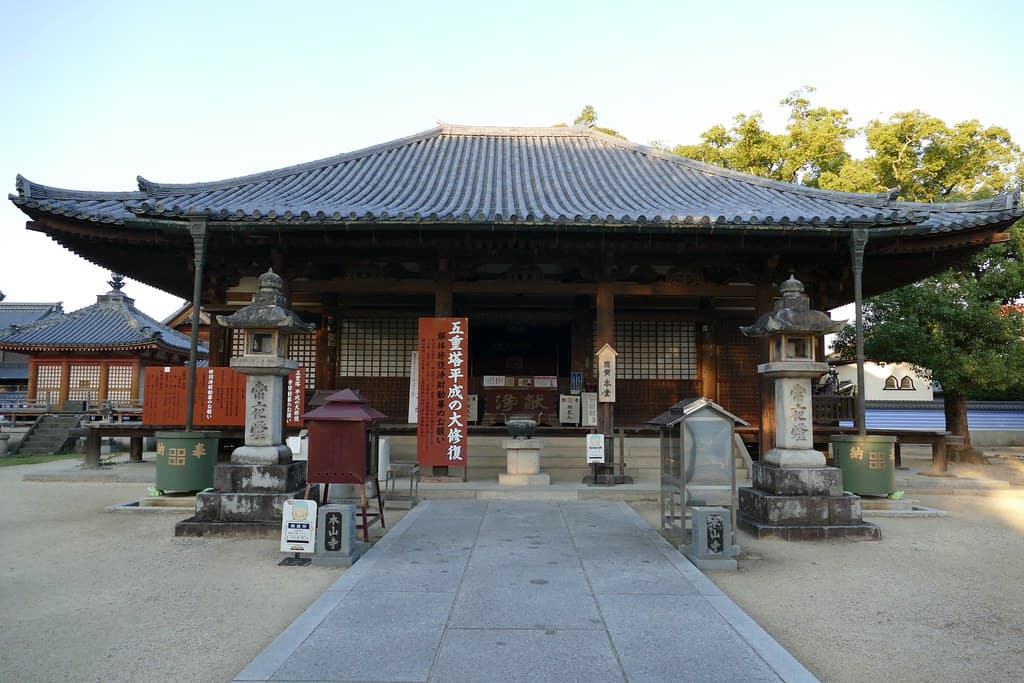
Image of Daikō-ji (大興寺). Image source · CC-BY-SA-3.0
Station 67 of 88
Shikoku 88 Temple PilgrimageVisit essentials
A quick read before you go
- Duration
- 30 to 60 minutes on site.
- Access
- Set in farmland on a low hill in the Yamamoto area of Mitoyo, Kagawa.
Overview
Daikō-ji is the kind of temple that reads small and proves large. Set on a low hill in the rice-fields of Mitoyo, Kagawa, it is approached by a quiet country road and entered through the Niōmon — the gate whose two guardian kings, at 3.14 metres each, are the largest Niō on the entire Shikoku 88. Beyond them the Hondō faces forward and the Daishi-dō stands close at hand, as on most temples of the route.
What makes Daikō-ji unusual is what is not immediately visible: the temple is one of the few places on the pilgrimage where Shingon and Tendai Buddhism shared one precinct as institutional realities rather than ideas. In its Edo-period peak the grounds held twenty-four Shingon dwellings and twelve Tendai dwellings under one roof — the Daishi-dō (Shingon, honouring Kūkai) and the Tendai-dō (honouring Saichō and Chishō Daishi Enchin) standing within sight of one another.
The Tendai monastic residence ended long ago, but the Tendai-dō is still on the grounds, still containing a statue of Chishō Daishi. The temple's documented history begins in 742 as a Nara-period satellite of Tōdaiji, originally located about a kilometre to the northwest. Tradition holds that Kūkai visited in 792 on a preaching tour and restored the temple; in 822 it was rebuilt under an imperial edict from Emperor Saga.
The current Hondō dates to 1741, an Edo-period reconstruction after Chōsokabe-era destruction. A massive camphor and a kaya (Japanese nutmeg) tree on the grounds are traditionally said to have been planted by Kūkai himself, materially anchoring the temple to his ministry. Daikō-ji holds what is held to be the oldest Kōbō Daishi statue in Shikoku, alongside a Tendai Daishi statue carved the same year — a quiet teaching, by configuration alone, that Japanese esotericism flowed through more than one channel.
As the third stop in Kagawa's Nirvana stage, Daikō-ji is where pilgrims often pause to consider that breadth.
Why this place is sacred
Daikō-ji's atmosphere is built from layered presences rather than a single dramatic feature. The 3.14-metre Niō Kings at the gate set the tone: large enough to be physically arresting at first sight, weathered enough to feel ancestral. Inside, the precinct holds three trees of consequence — a massive camphor and a kaya tree traditionally said to have been planted by Kūkai, and an old pine.
Whether the trees actually date to Kūkai's lifetime is unverifiable, but they are old enough that the question is not absurd. The temple's distinctive thinness, though, is institutional. The two-Daishi axis — Kōbō Daishi for the Shingon line and Tendai's Daishi for the other — embodies a configuration almost unique on the Shikoku 88: a temple that for centuries simultaneously practised two distinct esoteric Buddhist traditions on the same ground.
The historic dual-sect coexistence has faded to a Shingon-only present, but the Tendai-dō still stands beside the Daishi-dō, and the configuration still teaches by being there. Pilgrims who pause at the Tendai hall after their work at the Hondō and Daishi-dō often find the visit unexpectedly enlarging.
Founded in 742 as a Nara-period Buddhist temple, originally a satellite of Tōdaiji about a kilometre northwest of the present site. Restored by Kūkai in 792 on a preaching tour and rebuilt in 822 under imperial edict from Emperor Saga as a major regional temple.
Across the medieval period the temple developed an unusual dual-sect structure, housing both Shingon and Tendai sub-communities on one precinct. Damaged during the 16th-century Chōsokabe invasions; the current Hondō was reconstructed in 1741. Tendai monastic residence ended long ago, but the Tendai-dō survives on the grounds. Today Daikō-ji belongs to the Shingon-shū Zentsuji-ha, with its head temple at nearby Zentsuji.
Experience and orientation
Walking henro descend to Daikō-ji from Unpen-ji on the ridge above — a long, mostly downhill stage of nine or ten kilometres through Mitoyo's farmland. The descent itself, after the cloud-line altitude of Temple 66, is part of the experience: the air thickens, the rice paddies open, and the body comes back into ordinary weather. Drivers approach by a quiet country road that ends in a small parking area near the Niōmon.
The gate is the first thing pilgrims encounter at any temple, but here it lands harder. The two Niō Kings stand 3.14 metres tall — the largest on the route — and their carved presence carries the weight of a whole pilgrimage's worth of guardian sculpture in two figures. Inside, the precinct is calm. The Hondō faces forward with its Yakushi Nyorai, the Buddha of healing. The Daishi-dō stands beside it.
Off to the side, the Tendai-dō contains a statue of Chishō Daishi (Enchin), the great Tendai master. Many pilgrims, having performed the standard henro rite at the first two halls, walk over to the Tendai-dō and bow there too — an extra act not strictly required by Shikoku 88 etiquette but appropriate here.
The camphor and kaya trees rise from the precinct like quiet witnesses; the kaya is dense-grained and dark, the camphor wider, with the smooth bark of an old tree that has shed many storms. The Daishi-dō is reported to hold the oldest Kōbō Daishi statue in Shikoku. After the chants, pilgrims walk to the nōkyō office for their stamp. Daikō-ji is not a long visit, but it can be a thoughtful one.
The two halls together carry a teaching that no single hall could.
Enter through the Niōmon and pause at the Niō Kings. Approach the Hondō first, then the Daishi-dō. Walk to the Tendai-dō as an additional gesture of respect appropriate to the temple's dual-sect history. Note the camphor and kaya trees attributed to Kūkai, then visit the nōkyō office for your stamp before 17:00.
Context and lineage
Daikō-ji was founded in 742 in the Nara period, originally located about a kilometre northwest of the present site as a satellite of Tōdaiji, the great state temple in Nara. Tradition holds that Kūkai visited the area in 792 on a preaching tour and restored the temple, and that in 822 it was rebuilt under an imperial edict from Emperor Saga.
Across centuries the temple developed an unusual configuration — one precinct, two sects — with twenty-four Shingon dwellings and twelve Tendai dwellings under one roof at its peak. The current Hondō was rebuilt in 1741 after Chōsokabe-era destruction.
Shingon-shū Zentsuji-ha — the Zentsuji branch of Shingon, with its head temple at nearby Zentsuji (Temple 75). Historically, Tendai Buddhism also had a sub-community on the same precinct, but Tendai monastic residence ended long ago; the Tendai-dō remains as architectural witness.
Kūkai (Kōbō Daishi)
Restorer and ritual founder
Saichō (Dengyō Daishi)
Tendai patriarch (honored)
Chishō Daishi (Enchin)
Tendai master enshrined in the Tendai-dō
Emperor Saga
Imperial patron of 822 rebuilding
Traditions and practice
Yakushi Nyorai healing devotion at the Hondō; Kōbō Daishi commemorations at the Daishi-dō; historic Tendai observances at the Tendai-dō, now ceremonial rather than resident.
Daily Shingon liturgy under the Zentsuji-ha; pilgrim reception; nōkyō stamp office; the Tendai-dō remains accessible to pilgrims as part of the visit.
Begin at the Niōmon and pause at the guardian kings. At the Hondō, light a candle from your own flame, place three sticks of incense, leave an osamefuda and a coin, and chant the Heart Sutra. Move to the Daishi-dō and repeat with the Kōbō Daishi mantra. Then walk to the Tendai-dō and bow there as well. Stand a moment at the camphor and kaya trees attributed to Kūkai; their material presence is part of the practice.
Receive your stamp at the nōkyō office.
Shingon Buddhism (Zentsuji branch)
ActiveDaikō-ji belongs to the Shingon-shū Zentsuji-ha, one of Kūkai's lineages with its head temple at nearby Zentsuji.
Esoteric ritual centred on Yakushi Nyorai (Medicine Buddha) for healing; Kōbō Daishi devotion at the Daishi-dō.
Tendai Buddhism (historic co-residence)
HistoricalHistorically Daikō-ji was unusual in housing Shingon and Tendai sub-temples on the same precinct — twenty-four Shingon dwellings and twelve Tendai dwellings under one roof.
Historic Tendai liturgy on the grounds, now ceremonial rather than resident. The surviving Tendai-dō contains a statue of Chishō Daishi (Enchin).
Perspectives and open questions
Daikō-ji can be read as a Tōdaiji satellite reabsorbed into Heian Shingon, as a unique Edo-period dual-sect institution, as a tree-anchored Kūkai biography site, or as a quiet teaching against sectarian narrowness.
Scholarly perspective
Daikō-ji's documented history as a Nara-period Tōdaiji satellite restored under Kūkai and Emperor Saga is well attested; its unusual Shingon-Tendai dual-sect Edo-period configuration is one of the more distinctive on the Shikoku 88. The current Hondō dates to 1741 (Edo reconstruction). The temple now belongs to Shingon-shū Zentsuji-ha. One source claims Daikō-ji was 'founded by Kobo Daishi in 742,' but Kūkai was born in 774; the more credible reading is that the original temple predates him and he restored it.
Living and traditional perspectives
Local tradition holds the camphor and kaya trees as living relics of Kūkai's ministry — a folk-Buddhist mode of biographical sanctity through landscape. Whether the trees actually date to his lifetime is unverifiable, but the tradition itself is part of how the place is held.
Alternative interpretations
The dual-Daishi axis (Kōbō and Saichō) is read by some as a quiet teaching against sectarianism — a reminder that Japanese esotericism flowed through more than one channel, and that pilgrims walking a Shingon route can still bow to a Tendai master in the same courtyard.
Open questions
Whether the 'Kūkai-planted' trees actually date to his lifetime is unverifiable; carbon-dating-quality evidence is not available. The exact relationship between the historic dual-sect monastic community and the present-day Shingon-only operation is under-documented.
Plan your visit
Access and arrival
Set in farmland on a low hill in the Yamamoto area of Mitoyo, Kagawa. By car: easily reached by local roads with on-site parking. On foot: the henro trail descends from Temple 66 Unpen-ji along the ridge into Mitoyo, about nine to ten kilometres of mostly downhill walking.
Pilgrim inns and minshuku in the Mitoyo and Kan'onji area; some walking pilgrims overnight in Kan'onji before continuing to Temples 68 and 69. Confirm specifics through the official Shikoku 88 pilgrim office or local tourism authority.
Respectful visit
Comfortable walking clothes for the country approach. Traditional henro whites — hakui, sedge hat, kongō-zue, juzu — are welcomed but not required.
Outdoor photography fine; the Niōmon and ancient trees are popular subjects. No flash, no tripods near altars, no photography inside the halls.
One candle (lit from your own match), three sticks of incense, an osamefuda slip, and a small coin offering at each of the Hondō, the Daishi-dō, and ideally also the Tendai-dō.
Do not touch or climb the Kūkai-attributed trees. The stamp office stops issuing at 17:00. No eating in worship areas.
Do not touch or climb the Kūkai-attributed trees. Observe silence near worshipers. Do not enter inner-sanctum areas of any of the three halls.
Current practical details
Address
4209 Yamamotochotsuji, Mitoyo, Kagawa 768-0101, Japan
Phone
Hours
Hours, fees, and access can change — verify on the official source before you travel. Practical details last checked Jun 2026.
Location
Map loads as you approach this section.
Pilgrim reflections
A portrait of encounter, not a score
Pilgrims describe what they felt, how present they could become, and whether the place would shape a journey. There are no stars and no ranking of traditions.
No reviewed reflections yet
The first pilgrims can help describe the character of being here.
Share a reflection
Available after an account-backed “Been there.” Every reflection is reviewed before publication.
Watch deeper
Films, episodes, and recorded talks for visitors who want more context before or after a visit. Speculative and alternative-history entries are labelled as perspectives, not as sources for established claims.
Nearby sacred places
Explore other sacred places in the region. Proximity does not establish access or travel time; check each place’s guidance.

References
Sources consulted for this page. Source categories describe the publication, not a guarantee that every claim is verified. Traditional accounts and outside interpretations may differ.
- 01Daikoji – Mitoyo, Kagawa Prefecture, Shikoku — Henro.orgguidePilgrim reference.
- 02Daikoji Temple — Mitoyo Tourism and Exchange AuthorityofficialLocal official tourism source.
- 03The 67th Temple Daikoji Temple — Sanuki History & Culture Guide — Rekinabi SanukiofficialKagawa cultural authority.
- 04Komatsuozan Fudoukoin Daikoji — Shikoku 88 Temple Pilgrimage (88shikokuhenro.jp)officialOfficial Shikoku 88 reference.
- 05Customs and Etiquette of the Shikoku Pilgrimage — Henro.orgguidePilgrim etiquette baseline.
- 06Temple 67, Daikō-ji — Japan AdventurerguideDetailed history of multi-sect coexistence.
Pilgrim glossary
- Sutra
- A canonical Buddhist scripture, often chanted as part of practice.
- Mantra
- A sound, word, or phrase repeated as part of meditation or ritual.
- Shingon
- An esoteric Japanese Buddhist school emphasizing ritual, mantra, and mandala practice.
- Tendai
- A Japanese Buddhist school based on the Lotus Sutra, foundational to many later traditions.
Share a photo
Help visitors recognize Daikō-ji. Every submission is reviewed before publication.