Jinne-in
A temple born by separation — Amida of Kotohiki, severed from a Hachiman shrine in 1868 and given new ground next door
Understand sacred places, explore living traditions, and learn how to engage respectfully with Pilgrim Map.
Access has not been verified. Check current local guidance before planning a visit.
Kan'onji, Kagawa Prefecture, Japan
Read the sources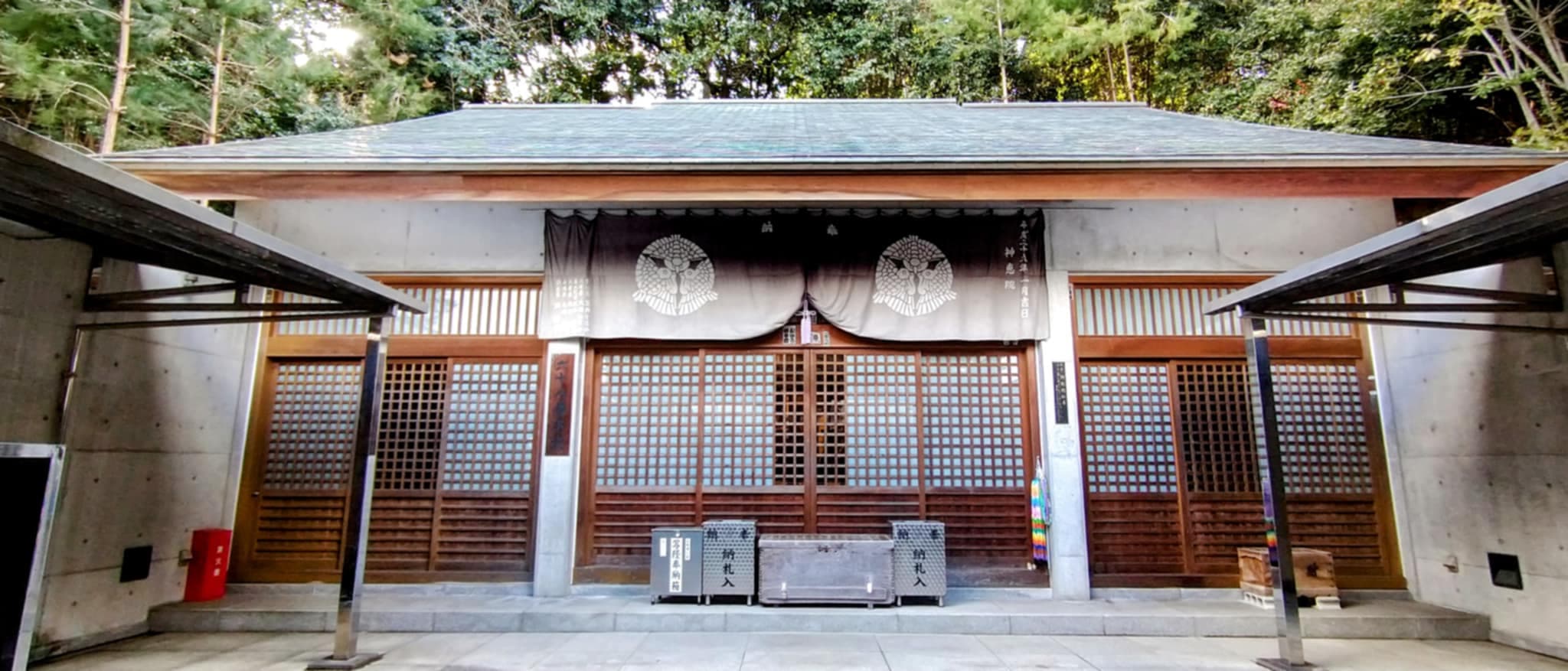
Image of Jinne-in (神恵院). Image source · CC0
Station 68 of 88
Shikoku 88 Temple PilgrimageVisit essentials
A quick read before you go
- Duration
- 60 to 90 minutes for the combined Jinne-in (68) + Kannon-ji (69) precinct visit.
- Access
- On Mt.
Overview
Jinne-in is one of the most concrete embodiments on the Shikoku 88 of Japan's deep shinbutsu-shūgō past — the centuries before 1868 when kami and Buddhas were worshipped together in shared shrine-temple complexes. The Amida Nyorai now sitting in the Hondō was once the principal Buddhist image of Kotohiki Hachimangū, the Hachiman shrine on Mt. Kotohiki. Across Japan thousands of shrine-temple complexes were broken apart; many Buddhist halls within shrine grounds were demolished.
For pilgrims, the result is one of the strangest configurations on the Shikoku 88: two temples — Jinne-in and Kannon-ji — share one precinct, share one stamp office, and require two complete henro routines on a single hillside. Visitors do four halls in succession (Hondō and Daishi-dō at each temple) and walk away with two stamps in the nōkyōchō.
Standing between the modern concrete Hondō of Jinne-in and the older wooden halls of Kannon-ji, with Kotohiki Hachimangū still operating as an independent Shinto shrine just over the rise, the recent religious history of the country is unusually visible.
Why this place is sacred
Jinne-in's atmosphere is shaped less by a single sacred feature than by the historical configuration of the place. Mt. Kotohiki itself is a low, forested hill above the Kan'onji coast, home for over a thousand years to a combined shrine-temple complex — one of the great pre-modern norms of Japanese religion. What gives the precinct its present feel is the visible record of that arrangement's rupture.
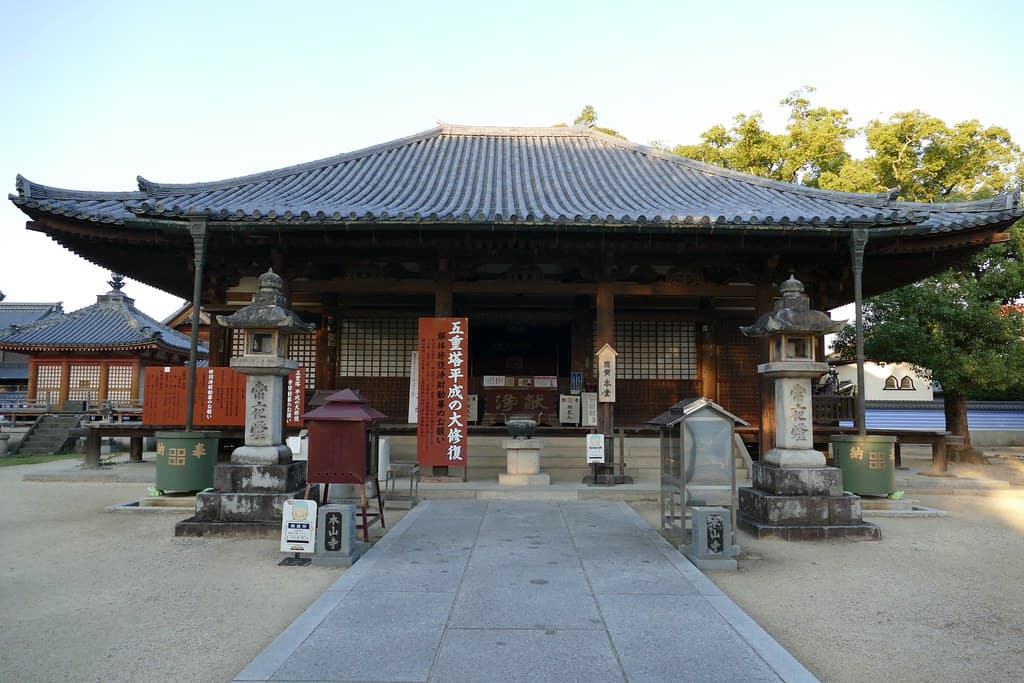
The modern concrete Hondō of Jinne-in stands beside ancient cedars and the older wooden halls of Kannon-ji at Temple 69. Kotohiki Hachimangū — the Hachiman shrine to which Jinne-in's Amida once belonged — continues independently a short walk away as a Shinto institution, with its own torii, its own priests, its own etiquette. The two-temples-on-one-precinct layout produces a doubled rhythm in pilgrim practice: four halls, four sets of offerings, two stamps.
For pilgrims attentive to the weight of religious history, Jinne-in carries a particular contemplative charge: this is a place where you can see, materially, what 1868 did to Japan's spiritual landscape — and what it preserved by improvising a new institutional shape.
The Amida Nyorai now enshrined at Jinne-in was originally the principal Buddhist image of Kotohiki Hachimangū, dedicated by Kūkai in 807. From the early 9th century until 1868, the figure served as the Buddhist face of a shrine-temple complex that united Hachiman worship and esoteric Buddhism in a single practice.
In 1868, under Meiji shinbutsu-bunri (separation of kami and Buddhas) edicts, the Amida and its Buddhist functions were forcibly removed from Kotohiki Hachimangū and relocated to the Saikondō building on the Kannon-ji precinct, which became the new temple Jinne-in. The current Hondō housing the Amida is a concrete reconstruction reported to date to 2002. Kotohiki Hachimangū continues independently as a Shinto shrine; Jinne-in remains an independent Buddhist temple sharing the Mt. Kotohiki precinct with Kannon-ji.
Experience and orientation
Pilgrims approach Jinne-in either on foot from Kotohiki Park at the foot of the hill or by car using the shared parking lot that serves both Jinne-in (68) and Kannon-ji (69). The walk-up from the park is gentle — wooded, shaded, brief enough that the body does not register it as a climb. At the top the precinct opens onto an unusual sight. The two temples share the ground but the buildings are visibly distinct in age and material.
The Hondō of Jinne-in is concrete, reportedly rebuilt in 2002 — squared, modern, plain. Beside it stand the older wooden halls of Kannon-ji, weathered with the patina of generations. The Daishi-dō of each temple sits within its own zone of the precinct. Pilgrims do the full henro routine four times in sequence: Jinne-in's Hondō, Jinne-in's Daishi-dō, Kannon-ji's Hondō, Kannon-ji's Daishi-dō. At each, candle from one's own flame, three sticks of incense, osamefuda, coin, Heart Sutra.
At the Daishi-dō halls add the Kōbō Daishi mantra. Many pilgrims experience the doubling as a slow widening of practice — by the fourth hall the chanting has settled into a rhythm. The shared nōkyō office issues both stamps; the calligraphy at each entry distinguishes the two temples in the same book.
After the temple work, pilgrims often walk to the viewpoint overlooking Kotohiki Park, where the famous Zenigata Sunae — a giant Edo-period sand sculpture in the shape of an old Japanese coin — is visible from above. Kotohiki Hachimangū itself can be visited as an independent Shinto shrine; pilgrims who do should observe shrine etiquette there rather than temple etiquette.
From Kotohiki Park, climb to the top of Mt. Kotohiki on foot, or drive up to the shared parking lot. Bow at the gate. Wash hands at the chōzuya. Begin with Jinne-in: at its Hondō, light a candle from your own flame, three sticks of incense, osamefuda, coin, Heart Sutra. Move to Jinne-in's Daishi-dō and repeat with the Kōbō Daishi mantra. Then move to Kannon-ji's Hondō and Daishi-dō and perform the same rite at each.
At the shared nōkyō office, receive both stamps before 17:00. If walking down to the Zenigata Sunae viewpoint, allow extra time. Treat Kotohiki Hachimangū, if visited, as an independent Shinto shrine.
Context and lineage
Tradition holds that Kūkai visited Mt. Kotohiki in 807 (Daidō era), carved an Amida Nyorai for the Hachiman shrine, and built the seven major halls of a great temple complex modelled on Kōfuku-ji in Nara. That arrangement — a Buddhist temple and a Hachiman shrine bound together as a single religious body — persisted for over a thousand years. In 1868, the Meiji government's shinbutsu-bunri edicts ordered the separation of Buddhism from Shinto across Japan.
The Amida statue and its Buddhist functions were moved out of Kotohiki Hachimangū to the Saikondō building on the Kannon-ji precinct, which became the temple Jinne-in. The shrine continued without its Buddhist face; the temple continued without its shrine. The current Hondō housing the Amida is reported to date to 2002 — a concrete reconstruction.
Shingon Buddhism. Jinne-in is now an independent Shingon temple sharing a precinct with Kannon-ji (Temple 69). Until 1868 it was the Buddhist face of Kotohiki Hachimangū in a syncretic shrine-temple body.
Kūkai (Kōbō Daishi)
Founder of the original Amida cult on Mt. Kotohiki
Traditions and practice
Amida Nyorai devotion; Pure Land–inflected Shingon practice; Kōbō Daishi commemorations.
Daily liturgy by resident clergy; the shared nōkyō stamp office with Kannon-ji — one office, two stamps — is unusual on the route and reflects the joined precinct configuration.
Plan to perform the henro rite at all four halls (Hondō and Daishi-dō of each temple) before going to the stamp office. Move slowly between the two zones of the precinct; the doubling is part of the practice. After the halls, walk to the viewpoint over Kotohiki Park and the Zenigata Sunae below. If visiting Kotohiki Hachimangū as well, treat it as a separate Shinto institution with its own etiquette.
Shingon Buddhism
ActiveEsoteric Shingon temple with Amida Nyorai as honzon, originally venerated as the Buddhist face of Kotohiki Hachimangū shrine and split off as a freestanding Buddhist temple in the 1868 Meiji shinbutsu-bunri.
Amida-related esoteric ritual; Kōbō Daishi devotion; pilgrim chanting of Heart Sutra and the Daishi mantra.
Hachiman / Shinto (historic relationship)
HistoricalUntil 1868, the Amida Nyorai now enshrined at Jinne-in served as the principal Buddhist image of Kotohiki Hachimangū — an example of the centuries of shinbutsu-shūgō (kami-Buddha syncretism) characteristic of pre-Meiji Japan.
Historic syncretic ritual at the shrine-temple complex on Mt. Kotohiki. Today Kotohiki Hachimangū continues independently as a Shinto shrine while Jinne-in remains Buddhist.
Perspectives and open questions
Jinne-in can be read as an artefact of Meiji religious policy, a continuation of a thousand-year Amida tradition, a Shingon Womb-Diamond complement to Kannon-ji's wisdom-compassion, or simply a pilgrim's strange double stop.
Scholarly perspective
Jinne-in is a textbook case of the disruption caused by Meiji shinbutsu-bunri policy: a Buddhist deity of a shrine-temple complex was forcibly relocated and constituted as a separate temple, leaving a strange modern legacy of two temples on one precinct beside an independent shrine. The 2002 concrete Hondō is itself part of the historical record — a recent reconstruction of a temple that was itself a recent improvisation in 1868.
Living and traditional perspectives
Folk continuity persists in pilgrim practice: many henro still feel they are visiting 'the Amida of Kotohiki Hachiman,' even though the institutional break is now over 150 years old. The temple's identity has not fully separated in the way that the institutions did.
Alternative interpretations
The two-temples-on-one-mountain layout — Jinne-in (Amida) and Kannon-ji (Kannon) — is sometimes interpreted in Shingon mandala terms as a Womb–Diamond pairing of compassion and the wisdom-in-compassion that responds to it, sharing a single sacred ground.
Open questions
Whether the Amida Nyorai now enshrined is the original 807 Kūkai-attributed carving or a later replacement is not definitively documented in public sources. The exact 2002 vs. later renovation date for the current Hondō is reported variably.
Plan your visit
Access and arrival
On Mt. Kotohiki in Kan'onji, Kagawa. Walk up from Kotohiki Park at the foot of the hill or drive to the shared parking lot serving both temples. The henro trail from Daikō-ji at Temple 67 is gentle, mostly through Mitoyo farmland.
Pilgrim inns and minshuku in central Kan'onji; some walking pilgrims overnight here before the Mitoyo plain stretch. Confirm specifics through the official Shikoku 88 pilgrim office or local tourism authority.
Respectful visit
Modest, comfortable. Traditional henro whites — hakui, sedge hat, kongō-zue, juzu — welcomed but not required.
Outdoor photography on the precinct permitted; please respect worshipers, especially around the modern Hondō where acoustics carry chanting. No photography inside any of the halls.
One candle (from your own flame), three sticks of incense, an osamefuda slip, and a small coin offering at each of the four halls — two temples × Hondō and Daishi-dō.
The shared nōkyō office stops issuing stamps at 17:00. Do not enter Kotohiki Hachimangū expecting it to be Buddhist; it has its own Shinto etiquette.
The acoustics around the modern concrete Hondō carry chanting and conversation farther than at older wooden halls; keep voices low. Do not enter Kotohiki Hachimangū expecting it to be Buddhist — it is now an independent Shinto shrine.
Current practical details
Address
1-chōme-2-7 Yahatachō, Kanonji, Kagawa 768-0061, Japan
Phone
Hours
Hours, fees, and access can change — verify on the official source before you travel. Practical details last checked Jun 2026.
Location
Map loads as you approach this section.
Pilgrim reflections
A portrait of encounter, not a score
Pilgrims describe what they felt, how present they could become, and whether the place would shape a journey. There are no stars and no ranking of traditions.
No reviewed reflections yet
The first pilgrims can help describe the character of being here.
Share a reflection
Available after an account-backed “Been there.” Every reflection is reviewed before publication.
Watch deeper
Films, episodes, and recorded talks for visitors who want more context before or after a visit. Speculative and alternative-history entries are labelled as perspectives, not as sources for established claims.
Nearby sacred places
Explore other sacred places in the region. Proximity does not establish access or travel time; check each place’s guidance.



References
Sources consulted for this page. Source categories describe the publication, not a guarantee that every claim is verified. Traditional accounts and outside interpretations may differ.
- 01Jinnein – Kanonji, Kagawa Prefecture, Shikoku — Henro.orgguidePilgrim authoritative reference.
- 02Shippozan Jinnein — Shikoku 88 Temple PilgrimageofficialOfficial Shikoku 88 site.
- 03The 68th & 69th Temple Jinnein & Kannonji — Sanuki History & Culture Guide — Rekinabi SanukiofficialKagawa cultural authority on the history of both temples.
- 04Kotohiki Hachimangū — WikipediaencyclopediaEncyclopedia entry on the original shrine and its Buddhist relationship.
- 05Customs and Etiquette of the Shikoku Pilgrimage — Henro.orgguidePilgrim etiquette baseline.
- 06Temple 68, Jinne-in — Japan AdventurerguideDetailed pilgrim guide.
Pilgrim glossary
- Kannon
- The bodhisattva of compassion, central to many East Asian pilgrimage routes.
- Mandala
- A symbolic diagram of the cosmos used in meditation and ritual.
- Sutra
- A canonical Buddhist scripture, often chanted as part of practice.
- Mantra
- A sound, word, or phrase repeated as part of meditation or ritual.
- Torii
- The traditional Japanese gate marking the entrance to a Shinto sacred area.
- Shingon
- An esoteric Japanese Buddhist school emphasizing ritual, mantra, and mandala practice.
- Pure Land
- A Buddhist tradition focused on rebirth in Amida Buddha's western paradise through devotional practice.
Share a photo
Help visitors recognize Jinne-in. Every submission is reviewed before publication.