Kannon-ji
Older than its neighbour — Shō Kannon on Mt. Kotohiki since 703, refounded by Kūkai in 807
Understand sacred places, explore living traditions, and learn how to engage respectfully with Pilgrim Map.
Access has not been verified. Check current local guidance before planning a visit.
Kan'onji, Kagawa Prefecture, Japan
Read the sources
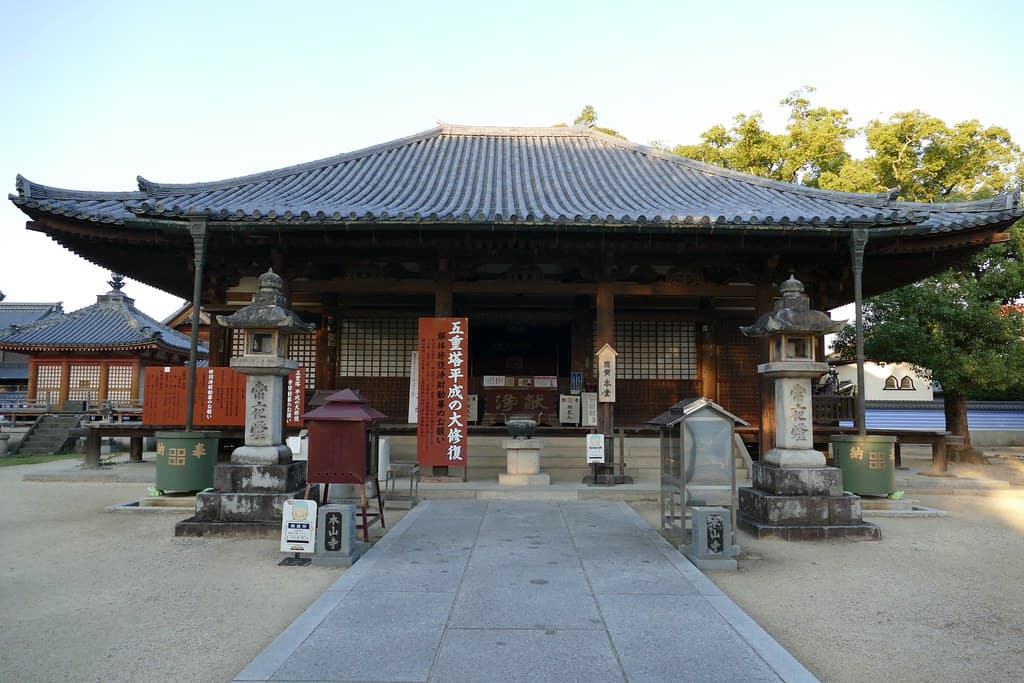
Image of Kannon-ji (観音寺). Image source · CC-BY-SA-4.0
Station 69 of 88
Shikoku 88 Temple PilgrimageVisit essentials
A quick read before you go
- Duration
- Combined with Jinne-in: about 60 to 90 minutes for the precinct.
- Access
- On Mt.
Overview
Kannon-ji's identity rests on two traditional foundations and a shared precinct. In 703 the Hossō priest Nisshō is said to have received an oracle from Usa Hachiman of Kyushu while training on Mt. Kotohiki and to have found a sacred boat and koto at sea. He founded the temple as the Buddhist face of what became Kotohiki Hachimangū.
In 807 Kūkai arrived as seventh head priest, carved Shō Kannon—the “Sacred Form” of Avalokiteśvara—built seven major halls modeled on Kōfuku-ji in Nara, and renamed it Shippozan Kannonji, Seven Treasure Mountain Kannonji. It remained the shrine's Buddhist seat through the medieval period.
Under the 1868 shinbutsu-bunri separation, an Amida Nyorai also carved by Kūkai was moved from the shrine to Kannon-ji's Saikondō, which became Jinne-in (Temple 68). One shrine-temple body thus became Kotohiki Hachimangū, Kannon-ji, and neighbouring Jinne-in. The two temples still share a Mt. Kotohiki precinct—among the Shikoku 88's rarest arrangements—where pilgrims visit four halls and receive both stamps at one nōkyō office.
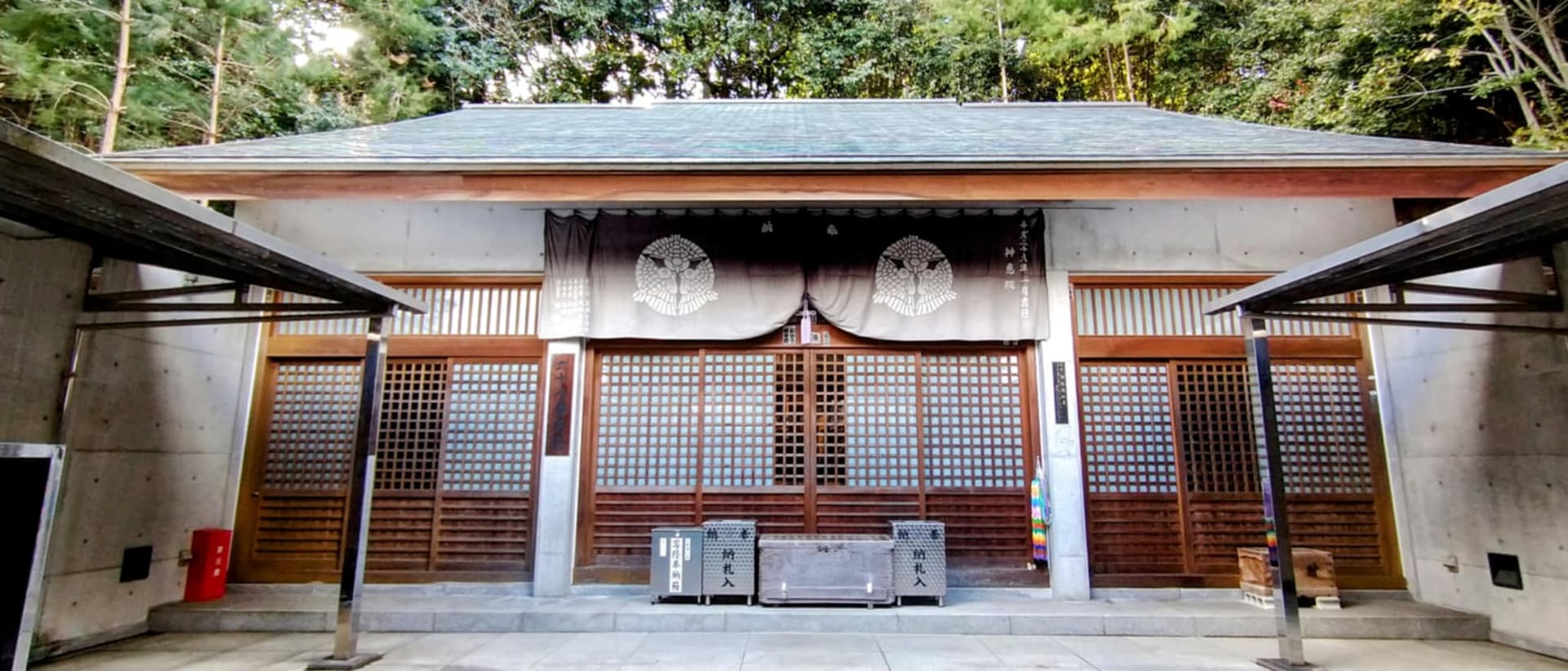
Kannon-ji's older wooden halls contrast with Jinne-in's modern concrete Hondō; below, the Zenigata Sunae forms a giant Edo-period coin in the park.
Why this place is sacred
Kannon-ji's atmosphere comes from its layered duration. The site has been a Buddhist temple here for over thirteen hundred years. It has changed sect identity at least once (from Hossō to Shingon under Kūkai's 807 reorganization), endured the medieval centuries as the Buddhist face of Kotohiki Hachimangū, survived the 1868 Meiji separation that broke so many other shrine-temple complexes, and emerged on the other side still functioning. Its older wooden halls visibly carry that continuity in their grain and patina.
Pilgrims also experience Kannon-ji's thinness through configuration. The shared precinct with Jinne-in produces a doubled rhythm — four halls, four sets of offerings, two stamps from one office — and forces a slowing down. The hill itself, forested above the Kan'onji coast, holds the temple in a contained quiet despite the busy town below.
Below the hill, the Zenigata Sunae sand sculpture — an Edo-period giant coin design in Kotohiki Park — provides a visual reminder of the temple's improbable historical setting: a 1,300-year-old continuous practice nested inside a public park beside an independent Shinto shrine and a 2002 concrete Hondō. The continuity is the wonder.
Founded in 703 CE by the Hossō-school priest Nisshō as the Buddhist face of what would become Kotohiki Hachimangū, following an oracle he received from Usa Hachiman while training on the mountain. Reorganized in 807 by Kūkai into a Shingon temple with seven main halls modelled on Kōfuku-ji.
Held continuous identity through the centuries as the Buddhist seat of Kotohiki Hachimangū. In 1868 the shrine-temple complex was broken apart under shinbutsu-bunri policy; the Amida Nyorai of the shrine was moved to a Saikondō on the Kannon-ji grounds, becoming the new temple Jinne-in (Temple 68). Kannon-ji itself remained an independent Shingon temple sharing a precinct with its new neighbour.
Experience and orientation
Pilgrims arrive at Kannon-ji the same way they arrive at Jinne-in: on foot from Kotohiki Park or by car using the shared parking lot. The climb up the wooded hill is gentle. At the precinct gate, the doubling of the temples becomes immediately visible — Jinne-in's modern concrete Hondō to one side, Kannon-ji's older wooden halls to the other. Most pilgrims handle the four halls in sequence; the order matters less than completing the rite at each.
At Kannon-ji's Hondō the Shō Kannon is the focal presence — Avalokiteśvara in the standard 'Sacred Form' rather than the more elaborate manifestations honoured elsewhere on the route. The Daishi-dō stands close by. The chants — Heart Sutra at the Hondō, Heart Sutra plus Kōbō Daishi mantra at the Daishi-dō — are the same as at every other temple, but the sequencing of four halls in a row produces a slower tempo.
By the second pair of halls the body is in a different rhythm than at single-temple stops. The shared nōkyō office issues both Jinne-in and Kannon-ji stamps in the nōkyōchō, with distinct calligraphy distinguishing the two temples. After the temple work, many pilgrims walk to the famous viewpoint above Kotohiki Park, where the Zenigata Sunae — an enormous Edo-period sand sculpture in the form of an old Japanese coin — is best seen from above.
The detour is widely reported as a memorable break in pilgrim discipline. Kotohiki Hachimangū can also be visited as a separate Shinto shrine.
From Kotohiki Park, walk up to the precinct or drive to the shared parking lot. Bow at the gate and wash hands at the chōzuya. Plan to perform the henro rite at all four halls (Jinne-in's Hondō and Daishi-dō, Kannon-ji's Hondō and Daishi-dō). At Kannon-ji's Hondō: candle from your own flame, three sticks of incense, osamefuda, coin, Heart Sutra. At Kannon-ji's Daishi-dō: repeat with the Kōbō Daishi mantra. Receive both stamps at the shared nōkyō office before 17:00.
Walk to the Zenigata Sunae viewpoint if time permits. Treat Kotohiki Hachimangū as a separate Shinto shrine.
Context and lineage
Nisshō, a high priest of the Hossō school — one of the six Nara schools of Buddhism — was training on Mt. Kotohiki when he received an oracle from Usa Hachiman, the great Hachiman shrine on Kyushu. He is also said to have discovered a sacred boat and koto at sea. On the strength of these revelations he founded the temple in 703, with the mountain's name 'Kotohiki' (literally 'koto-pulling') reflecting the discovered koto.
Just over a century later, in 807, Kūkai entered the temple as its seventh head priest, carved a Shō Kannon statue, built seven main halls modelled on Kōfuku-ji in Nara, and gave the temple its present name, Shippozan Kannonji — Seven Treasure Mountain Kannonji.
Shingon Buddhism. The temple's pre-807 identity was Hossō, one of the six Nara schools; that earlier lineage is no longer practised on site. Kannon-ji has been Shingon since Kūkai's reorganization.
Nisshō
Founder
Kūkai (Kōbō Daishi)
Refounder and 7th head priest
Traditions and practice
Shō Kannon devotion at the Hondō; Heart Sutra recitation; Kōbō Daishi commemorations.
Daily Shingon liturgy; the shared nōkyō office issues stamps for both Kannon-ji and Jinne-in; the precinct receives heavy daily pilgrim and tourist traffic.
Plan to do the henro rite at all four halls — Jinne-in's two and Kannon-ji's two — before going to the stamp office. Move slowly between the two zones of the precinct to let the doubling settle into a single rhythm. After the halls, walk to the viewpoint above Kotohiki Park for the Zenigata Sunae below. If visiting Kotohiki Hachimangū as well, treat it as a separate Shinto institution.
Shingon Buddhism
ActiveEsoteric Shingon temple with Shō Kannon (Sacred Form of Avalokiteśvara) as honzon. Reorganized by Kūkai in 807 as the seventh head priest into a Shingon temple from its earlier Hossō foundation.
Kannon devotional practices for compassion; esoteric Shingon ritual; Kōbō Daishi devotion at the Daishi-dō.
Hossō Buddhism (founding tradition)
HistoricalFounding priest Nisshō was a high priest of the Hossō school, one of the six Nara schools. The temple's pre-Shingon identity is a reminder of the Nara-era doctrinal mix that pre-dates Kūkai's esoteric synthesis.
No longer practised on site.
Perspectives and open questions
Kannon-ji can be read as a Nara-Hossō foundation absorbed into Heian Shingon, as a survivor of the 1868 separation, as the Kannon counterpart to Jinne-in's Amida in a shared mandala configuration, or as a cultural-history viewing platform on the Setouchi coast.
Scholarly perspective
Kannon-ji is a clear example of a Nara-era Hossō-Hachiman temple absorbed into the Heian Shingon esoteric system through Kūkai's intervention. Its survival of the Meiji separation as an independent temple is unusual given how much of the pre-modern shrine-temple landscape was dismantled. The 703 Nisshō foundation and the 807 Kūkai reorganization are both attested in tradition; the precise relationship between the historic seven-hall complex Kūkai is said to have built and the present-day footprint is not fully documented.
Living and traditional perspectives
Local tradition keeps the sea-oracle of Nisshō alive in the shrine's foundational identity. The Mt. Kotohiki name (literally 'koto-pulling') itself gestures to the discovered koto in the founding story — geography as a continuing narrative. The Zenigata Sunae below the hill, though Edo-period and unrelated to Buddhist practice, has been integrated into the cultural memory of the place.
Alternative interpretations
Pairing Kannon (wisdom-compassion) at Temple 69 with Amida (Pure Land salvation) at Temple 68 on one mountain is sometimes read as a single esoteric configuration of saving response and saving form. In Shingon mandala terms, the two halls together can be experienced as a Womb–Diamond pair on one ground.
Open questions
The exact relationship between the historic seven-hall complex Kūkai is said to have built and the present-day footprint is not fully documented. Whether the present Shō Kannon honzon descends from Kūkai's 807 carving is not publicly resolved.
Plan your visit
Access and arrival
On Mt. Kotohiki in Kan'onji, Kagawa. Reached on foot from Kotohiki Park or by car using the shared parking lot serving Jinne-in (68) and Kannon-ji (69). The henro trail from Daikō-ji at Temple 67 is gentle, mostly through farmland.
Pilgrim inns and minshuku in central Kan'onji; Kotohiki Park area itself has limited accommodation. Confirm specifics through the official Shikoku 88 pilgrim office or local tourism authority.
Respectful visit
Modest, comfortable clothing. Traditional henro whites — hakui, sedge hat, kongō-zue, juzu — welcomed but not required.
Outdoor photography is generally permitted on the precinct; not inside the halls. Be aware that Kotohiki Hachimangū next door is a separate Shinto institution with its own customs.
One candle (lit from your own flame), three sticks of incense, an osamefuda slip, and a small coin offering at each Kannon-ji hall and again at each Jinne-in hall.
The shared nōkyō office stops issuing stamps at 17:00. Respect signage at the boundary between the two temples and the adjacent Hachimangū.
Be aware that Kotohiki Hachimangū next door is a separate Shinto shrine with its own etiquette; do not enter it expecting it to be Buddhist. The shared nōkyō office can develop queues at busy hours.
Current practical details
Address
Kanonji, Kagawa, Japan
Hours, fees, and access can change — verify on the official source before you travel. Practical details last checked Jun 2026.
Location
Map loads as you approach this section.
Pilgrim reflections
A portrait of encounter, not a score
Pilgrims describe what they felt, how present they could become, and whether the place would shape a journey. There are no stars and no ranking of traditions.
No reviewed reflections yet
The first pilgrims can help describe the character of being here.
Share a reflection
Available after an account-backed “Been there.” Every reflection is reviewed before publication.
Watch deeper
Films, episodes, and recorded talks for visitors who want more context before or after a visit. Speculative and alternative-history entries are labelled as perspectives, not as sources for established claims.
Nearby sacred places
Explore other sacred places in the region. Proximity does not establish access or travel time; check each place’s guidance.


References
Sources consulted for this page. Source categories describe the publication, not a guarantee that every claim is verified. Traditional accounts and outside interpretations may differ.
- 01Kannonji – Kanonji, Kagawa Prefecture, Shikoku — Henro.orgguidePilgrim authoritative reference.
- 02Shippozan Kannonji — Shikoku 88 Temple PilgrimageofficialOfficial Shikoku 88 site.
- 03The 68th & 69th Temple Jinnein & Kannonji — Rekinabi SanukiofficialKagawa cultural authority.
- 04Kotohiki Hachimangū — WikipediaencyclopediaEncyclopedia entry.
- 05Customs and Etiquette of the Shikoku Pilgrimage — Henro.orgguidePilgrim etiquette baseline.
- 06Kannonji Temple — Japan ExperienceguideTravel-press reference.
Pilgrim glossary
- Kannon
- The bodhisattva of compassion, central to many East Asian pilgrimage routes.
- Mandala
- A symbolic diagram of the cosmos used in meditation and ritual.
- Sutra
- A canonical Buddhist scripture, often chanted as part of practice.
- Mantra
- A sound, word, or phrase repeated as part of meditation or ritual.
- Torii
- The traditional Japanese gate marking the entrance to a Shinto sacred area.
- Shingon
- An esoteric Japanese Buddhist school emphasizing ritual, mantra, and mandala practice.
- Pure Land
- A Buddhist tradition focused on rebirth in Amida Buddha's western paradise through devotional practice.
Share a photo
Help visitors recognize Kannon-ji. Every submission is reviewed before publication.