Iyadani-ji
A spirit mountain — 540 stone steps, 1,500 carved Amidas, and the cave where the boy Kūkai once studied
Understand sacred places, explore living traditions, and learn how to engage respectfully with Pilgrim Map.
Access has not been verified. Check current local guidance before planning a visit.
Mitoyo, Kagawa Prefecture, Japan
Read the sources
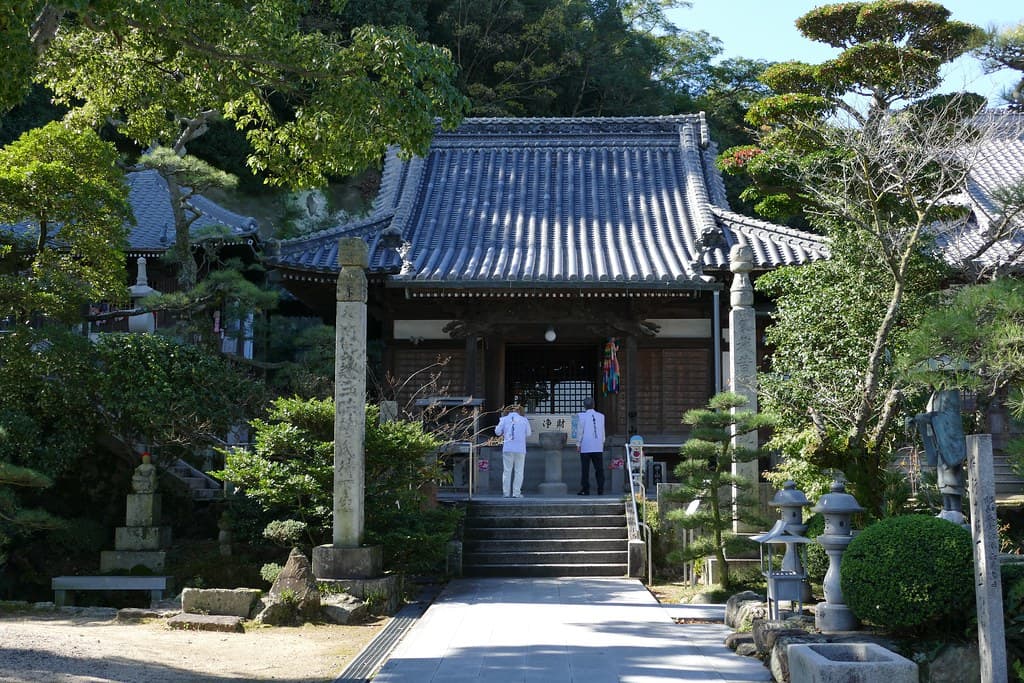
Image of Iyadani-ji (弥谷寺). Image source · CC-BY-SA-3.0
Station 71 of 88
Shikoku 88 Temple PilgrimageVisit essentials
A quick read before you go
- Duration
- 75 to 120 minutes including the climb.
- Access
- On a mountain in northern Mitoyo, Kagawa.
Overview
Iyadani-ji asks more of pilgrims than most temples on the Shikoku 88 and gives more in return. Its 540 stone steps climb a northern Mitoyo mountain through cypress and cedar, demanding a different quality of attention. Regarded across Shikoku as a reizan—one of three places where souls of the dead come to dwell—the mountain is a literal threshold in folk Buddhist tradition.
Villagers have brought memorial slips for generations, especially during Bon, while Shingon contemplation reads the upper Cave of the Waterhole as a mandalic entrance to Mt. Meru, the Buddhist cosmic axis. More than 1,500 Amida figures cover the upper rock walls; tradition attributes their Namu Amida Butsu inscription to the 13th-century saint Ippen, though the carving tradition is older.
In the Shishi-no-Iwaya, or Lion Cave, Kūkai is said to have studied between roughly ages nine and twelve, reading at night by its window from the sutra repository donated by Empress Kōmyō. This makes Iyadani-ji one of the route's most directly Kūkai-biographical temples. Its honzon is Senju Kannon, the Thousand-Armed Avalokiteśvara, whose many arms extend compassion in every direction—fitting for a place holding both the dead and the living memory of a saint's youth.
Why this place is sacred
Iyadani-ji's thinness is dense and layered. The reizan tradition is the most particular quality. Folk Buddhism across Shikoku treats this mountain as a place where ancestral souls gather — a literal threshold rather than a metaphor — and the temple has functioned for centuries as a site of memorial practice. Pilgrims and locals alike bring slips for the dead, particularly during the Obon period in summer; the mountain's atmosphere is shaped by that continuing kuyō (memorial offering) practice.
The 540 stone steps, climbing through old forest, do their own contemplative work — by the time most visitors reach the upper precinct the body has emptied of the day's small concerns. At the top the mountain itself becomes the structure. Halls are built directly onto volcanic-ash bedrock; rock walls dense with carved Amidas surround the inner precinct. The Shishi-no-Iwaya, the Lion Cave, holds the tradition of Kūkai's boyhood study and is treated with corresponding reverence.
The Cave of the Waterhole is held in some Shingon interpretations as a mandalic entrance to Mt. Meru, the cosmic mountain at the centre of the Buddhist universe — turning the climb itself into a vertical mandala practice. For most pilgrims, the cumulative effect is one of the most emotionally affecting visits on the entire pilgrimage. Many describe the temple as more atmospheric than they expected, and many leave a memorial slip for someone who has died.
Traditionally founded approximately 1,300 years ago in the early 8th century by the priest Gyōki on the order of Emperor Shōmu, with Empress Kōmyō donating a copy of the Avatamsaka Sutra to a sutra repository on the mountain. From its earliest period, the site combined imperial Nara Buddhism, sacred-mountain practice, and what would become the local reizan tradition.
Tradition holds that Kūkai studied as a boy in the Shishi-no-Iwaya cave between roughly the ages of nine and twelve, and as an adult founded the temple's mature form on a spiritual revelation around 807. The rock-carving tradition, particularly the inscriptions of Namu Amida Butsu attributed to the 13th-century saint Ippen, layered Pure Land devotion onto the older Shingon and sacred-mountain practice. The temple now holds these layers together as one of the densest religious sites on the Shikoku 88.
Experience and orientation
Pilgrims approach Iyadani-ji from the Mitoyo plain after a roughly 12-kilometre walk from Motoyama-ji at Temple 70 — much of it gentle, until the final ascent. A parking area and a lower temple gate sit at the foot of the mountain. From there the work begins.
The 540 stone steps climb through cypress and cedar in a long series of pauses; older henro and pilgrims with mobility limitations should know that wheelchair and step-free access to the upper precinct is not feasible. The climb is part of the practice. Bodies tire honestly. By the time the upper grounds open, the day's surface noise has fallen away. The first impression at the top is of the rock itself. Halls and shrines are built directly onto volcanic-ash bedrock.
The walls of the inner precinct are dense with carved Amida Buddhas — over 1,500 figures across the stone, many bearing the inscription Namu Amida Butsu. Some are sharply legible, others worn nearly smooth by weather. Pilgrims walk slowly here. At the Hondō: candle from one's own flame, three sticks of incense, osamefuda, coin, Heart Sutra. The honzon inside is Senju Kannon. At the Daishi-dō, the rite continues with the Kōbō Daishi mantra.
Behind the Daishi-dō, the cave deepens into the mountain — the Shishi-no-Iwaya tradition, the place where the young Kūkai is said to have studied. Many pilgrims spend extra silence here. Many also add a memorial slip for a person they have lost — the reizan character of the temple makes this gesture particularly fitting. After the halls, the Cave of the Waterhole on the upper grounds is read in Shingon as an entrance to Mt. Meru.
Pilgrims who attend to the climb as part of the practice sometimes describe the descent afterwards as feeling lighter — as if something has been left on the mountain.
Park or arrive at the lower temple gate. Climb the 540 stone steps slowly, allowing the body to settle into the rhythm of the ascent. At the upper precinct, bow at the gate. Wash hands at the chōzuya. Approach the Hondō: light a candle from your own flame, three sticks of incense, osamefuda, small coin, Heart Sutra. Move to the Daishi-dō and repeat with the Kōbō Daishi mantra.
Behind the Daishi-dō, the Shishi-no-Iwaya cave is open to respectful approach; pause there in silence. If carrying a memorial intention for someone who has died, this is an appropriate temple at which to leave a slip — the reizan tradition supports the practice. Visit the rock-carved Amidas slowly. Receive your stamp at the nōkyō office before 17:00.
Context and lineage
Tradition places the founding of Iyadani-ji approximately 1,300 years ago, in the early 8th century, by the priest Gyōki on the order of Emperor Shōmu (reigned 724–749). Empress Kōmyō is said to have donated a copy of the Avatamsaka Sutra to a sutra repository established on the mountain.
A century later, in the boyhood of Kūkai, tradition holds that the future Kōbō Daishi (then known by his childhood name) studied in the Shishi-no-Iwaya — the Lion Cave — between roughly the ages of nine and twelve, drawing on the sutra repository for late-night reading by the cave window light. As an adult, Kūkai founded the temple's mature form on a spiritual revelation around 807.
The rock-carving tradition that has so shaped the upper precinct — over 1,500 carved Amidas — is partly attributed to the 13th-century saint Ippen, though the carving tradition itself is older.
Shingon Buddhism. The temple has held this lineage continuously, with Pure Land devotional layering through the rock-carving tradition and a folk-Buddhist reizan dimension that links it to the broader Shikoku tradition of sacred mountains and ancestral souls.
Gyōki
Founder
Empress Kōmyō
Patron of the sutra repository
Kūkai (Kōbō Daishi)
Boyhood student and adult refounder
Ippen
Rock-carving tradition
Traditions and practice
Senju Kannon devotion; ancestral memorial practice (kuyō) appropriate to the reizan tradition; sutra recitation in the rock-carved areas; Daishi devotion in the cave behind the Daishi Hall.
Daily liturgy; pilgrim reception; nōkyō stamp office; ancestral memorial services arranged by the temple, particularly during the Bon period in summer.
Climb the 540 steps slowly — the climb is part of the practice and shifts the body into a different attentive state. At the Hondō and Daishi-dō, perform the standard henro rite. Stand or sit a while at the Lion Cave behind the Daishi-dō; this is among the most directly Kūkai-biographical sites on the route.
If you carry a memorial intention for someone who has died, an osamefuda slip with their name is appropriate here — the reizan tradition supports the practice. Walk the rock-carved Amidas slowly enough to notice individual figures.
Shingon Buddhism
ActiveEsoteric Shingon temple with Senju (Thousand-Armed) Kannon as honzon. Iyadani-ji holds an exceptional place in Kūkai biography because tradition places his boyhood study in the Shishi-no-Iwaya here, making it one of the formative landscapes of his early religious life.
Senju Kannon devotion; Kōbō Daishi commemorations in the Daishi Cave; sutra recitation against the rock face. Folk Buddhist memorial practice (kuyō) is woven into pilgrim activity here, given the temple's reizan character.
Perspectives and open questions
Iyadani-ji can be read through the layered lenses of mountain-Buddhism, Pure Land devotion, Shingon esotericism, and folk reizan tradition — and these readings are not separate, they have grown into one another at this site over more than a thousand years.
Scholarly perspective
Iyadani-ji is one of the best-documented examples on the pilgrimage of the layering of sangaku-shinkō (mountain-Buddhism), Pure Land practice (the rock-carved Amidas and the Ippen attribution), and Shingon esotericism. Kūkai's documented boyhood study at Shishi-no-Iwaya is widely accepted in the tradition, with the precise dates remaining traditional rather than dated. How early the rock-carving tradition began is not archaeologically resolved.
Living and traditional perspectives
The temple is widely regarded across Shikoku as a reizan where the dead linger; villagers traditionally bring memorial slips here as part of Bon-period observances. The continuing kuyō practice and the temple's quiet support of memorial offerings make this one of the most directly folk-Buddhist sites on the pilgrimage.
Alternative interpretations
The Cave of the Waterhole is read in some Shingon interpretations as a mandalic entrance to the cosmic mountain Sumeru — turning the climb itself into a vertical mandala practice in which the pilgrim's body becomes the practitioner-figure on the cosmic axis.
Open questions
How early the rock-carving tradition began is not archaeologically established; claims of 13th-century Ippen authorship for the carved Namu Amida Butsu are traditional rather than dated. How much of the cave shaping is natural versus humanly enhanced is not publicly resolved.
Plan your visit
Access and arrival
On a mountain in northern Mitoyo, Kagawa. Reached via stone steps from a parking area or the lower temple gate; the climb to the main hall is approximately 540 steps. By foot from Temple 70 Motoyama-ji it is roughly 12 km, much of it gentle until the final ascent. Wheelchair and step-free access to the upper precinct is not feasible.
Pilgrim inns and minshuku in the Zentsuji and Mitoyo areas; some walking pilgrims overnight before the Iyadani-ji climb. Confirm specifics through the official Shikoku 88 pilgrim office or local tourism authority.
Respectful visit
Sturdy walking shoes are essential for the steps; modest clothing; layers in cooler months. Traditional henro whites — hakui, sedge hat, kongō-zue, juzu — welcomed but not required.
Outdoor photography of the carved rock faces, halls, and pagoda is generally permitted. Photograph the Lion Cave and shrine areas respectfully and never inside the Daishi-dō or Hondō. No flash near the rock carvings; no posed photography on the steps.
One candle (lit from your own flame), three sticks of incense, an osamefuda slip, and a small coin offering at each of the Hondō and the Daishi-dō. Many pilgrims add a memorial slip for the dead given the reizan character of the site.
Do not deface, touch, or rub the rock carvings. Do not enter restricted cave areas. The stamp office stops issuing at 17:00. Wheelchair and mobility access to the upper precinct is limited because of the stone-step approach.
The 540 stone steps make this temple physically demanding; sturdy walking shoes are essential. Wheelchair and step-free access to the upper precinct is limited. The carved Buddhas on the rock walls are devotional; do not deface, touch, or rub them. The reizan character of the temple deserves quiet — voices low throughout.
Current practical details
Address
乙70, Minochō Ōmi, Mitoyo, Kagawa 767-0031, Japan
Phone
Hours
Hours, fees, and access can change — verify on the official source before you travel. Practical details last checked Jun 2026.
Location
Map loads as you approach this section.
Pilgrim reflections
A portrait of encounter, not a score
Pilgrims describe what they felt, how present they could become, and whether the place would shape a journey. There are no stars and no ranking of traditions.
No reviewed reflections yet
The first pilgrims can help describe the character of being here.
Share a reflection
Available after an account-backed “Been there.” Every reflection is reviewed before publication.
Watch deeper
Films, episodes, and recorded talks for visitors who want more context before or after a visit. Speculative and alternative-history entries are labelled as perspectives, not as sources for established claims.
Nearby sacred places
Explore other sacred places in the region. Proximity does not establish access or travel time; check each place’s guidance.



References
Sources consulted for this page. Source categories describe the publication, not a guarantee that every claim is verified. Traditional accounts and outside interpretations may differ.
- 01Iyadaniji – Mitoyo, Kagawa Prefecture, Shikoku — Henro.orgguidePilgrim authoritative reference.
- 02Iyadaniji Temple — Mitoyo Tourism and Exchange AuthorityofficialLocal official tourism source.
- 03The 71st Temple Iyadaniji Temple — Rekinabi SanukiofficialKagawa cultural authority.
- 04Kengozan Seijuin Iyadaniji — Shikoku 88 Temple PilgrimageofficialOfficial Shikoku 88 site.
- 05Customs and Etiquette of the Shikoku Pilgrimage — Henro.orgguidePilgrim etiquette baseline.
- 06Temple 71, Iyadani-ji — Shikoku ToursguidePilgrim travel guide.
Pilgrim glossary
- Honzon
- The principal Buddhist deity enshrined as a temple's central object of worship.
- Kannon
- The bodhisattva of compassion, central to many East Asian pilgrimage routes.
- Mandala
- A symbolic diagram of the cosmos used in meditation and ritual.
- Sutra
- A canonical Buddhist scripture, often chanted as part of practice.
- Mantra
- A sound, word, or phrase repeated as part of meditation or ritual.
- Shingon
- An esoteric Japanese Buddhist school emphasizing ritual, mantra, and mandala practice.
- Pure Land
- A Buddhist tradition focused on rebirth in Amida Buddha's western paradise through devotional practice.
Share a photo
Help visitors recognize Iyadani-ji. Every submission is reviewed before publication.