Kōyama-ji
Prayer aimed at a reservoir wall
Understand sacred places, explore living traditions, and learn how to engage respectfully with Pilgrim Map.
Access has not been verified. Check current local guidance before planning a visit.
Zentsūji, Kagawa Prefecture, Japan
Read the sources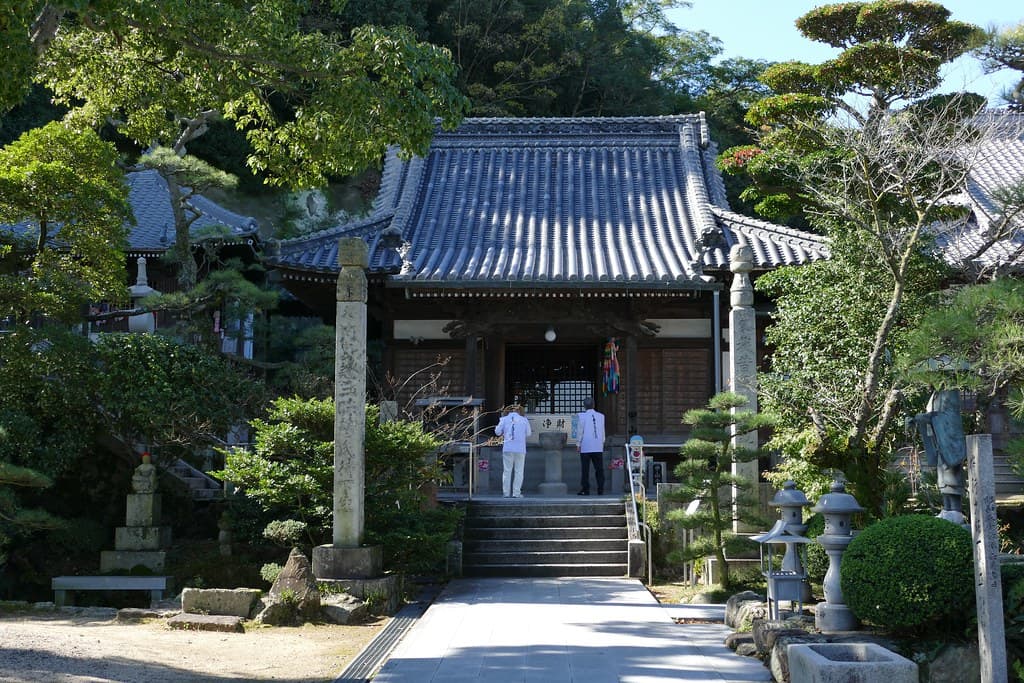
Image of Kōyama-ji (甲山寺). Image source
Station 74 of 88
Shikoku 88 Temple PilgrimageVisit essentials
A quick read before you go
- Duration
- 20–30 minutes for the precinct including the Bishamonten cave.
- Access
- In Zentsūji City near the foot of Mt Kōyama.
Overview
Kōyama-ji is the seventy-fourth Shikoku temple, set at the base of Mt Kōyama in Zentsūji City, Kagawa. The mountain takes its name from a perceived resemblance to the curve of a warrior's helmet (kabuto), and the temple takes its name from the mountain.
The honzon is Yakushi Nyorai, the Medicine Buddha; a small natural rock cave to the left of the Daishi-dō houses a Bishamonten image, and pilgrims who pause there often describe it as the original heart of the site.
The foundational story here ties contemplative prayer to civil engineering. In 821, the Imperial Court under Emperor Saga commissioned Kūkai — by then returned from study in Tang China and recognised as an exceptional ritualist — to oversee the repair of Mannoike, a large irrigation reservoir that had repeatedly failed. The legend preserved at Kōyama-ji holds that Kūkai prayed at this site for the work's success and completed in three months a project that had defeated previous attempts.
The temple is said to have been built using a portion of the twenty thousand sen the court awarded him.
The origin story behind the prayer is older still. Tradition holds that while Kūkai sought a temple site on Mt Kōyama, an old saint emerged from a rock cave and instructed him to build there. Kūkai carved a Bishamonten figure for the cave and a Yakushi Nyorai for the principal hall. The cave — about twelve metres deep, undisturbed natural stone — remains the site's quiet centre.
Above ground, statues and tiles featuring rabbits multiply across the precinct; locally Kōyama-ji is the 'rabbit temple,' the motif tied loosely to Yakushi's lunar associations and to folk-belief about good fortune. Pilgrims usually complete the visit in twenty to thirty minutes, including a moment at the cave for a brief offering.
Why this place is sacred
Kōyama-ji's particular atmosphere comes from the directness of its central image: not a hall, not a built shrine, but a natural cave roughly twelve metres deep, holding a Bishamonten statue. The cave is treated as the place where the saint emerged to direct Kūkai to build. Around it, the rest of the temple — main hall, Daishi-dō, stamp office, rabbit-motif tiles — radiates outward.
The Mannoike story attached to the site is unusual among the eighty-eight temples in tying a foundational legend to public works rather than to private vision. The thinness here is workmanlike: prayer brought to bear on a wall that needed to hold water for farmers downstream.
Founded by Kūkai in the early ninth century after the legendary cave-saint encounter; the temple commemorates both the founding vision and the successful Mannoike reservoir repair of 821.
The temple has functioned continuously as a Shingon site receiving Shikoku pilgrims. The Bishamonten cave remains the original physical centre; the rabbit motif accumulated over later periods through folk devotion.
Experience and orientation
Kōyama-ji is reached on foot or by car within Zentsūji City, often visited the same morning as nearby Shusshakaji and Zentsū-ji. The precinct is small, mostly flat, and largely free of crowds outside the spring and autumn pilgrimage peaks. Entering the gate, pilgrims pass the bell and proceed to the main hall, where the standard liturgy is offered to Yakushi Nyorai. The Daishi-dō for Kūkai sits to the left.
The small Bishamonten cave is set into rock immediately beside the Daishi-dō. Stooping at its mouth and offering a coin or a brief mantra is a common addition to the standard liturgy here; many henro do so. The walls inside are uneven natural stone, the air noticeably cooler than the open precinct in summer. Around the rest of the grounds, rabbit imagery appears repeatedly — small statues, roof-tile ornaments, votive plates — earning the temple its local nickname.
The Mannoike reservoir, the engineering site that lies behind the temple's founding story, is several kilometres south and accessible by a short drive for pilgrims interested in the wider geography of the legend.
Enter the gate, ring the bell, complete liturgy at the main hall, then visit the Daishi-dō. The Bishamonten cave sits immediately to the left of the Daishi-dō; offer briefly there before moving to the stamp office.
Context and lineage
While Kūkai sought a temple site on Mt Kōyama, an old saint is said to have emerged from a rock cave and told him to build there. Kūkai carved a Bishamonten image for the cave and a Yakushi Nyorai for the main hall, naming the temple Kōyama-ji because the mountain's curve resembled a warrior's helmet.
In 821 he was commissioned by Emperor Saga to repair the Mannoike reservoir; tradition holds that prayer at this site contributed to the project's three-month completion.
Shingon Buddhism. Working temple of the Shikoku 88-temple pilgrimage.
Kūkai (Kōbō Daishi)
Founder; engineer of the Mannoike reservoir repair
Emperor Saga
Imperial patron
Yakushi Nyorai (Medicine Buddha)
Honzon (principal image)
Bishamonten
Cave-deity
Traditions and practice
At the main hall: ring the bell, light a candle and three incense sticks, deposit an osamefuda, offer a coin, and chant the Heart Sutra together with the mantra of Yakushi Nyorai (On koro koro sendari matogi sowaka). Repeat the pattern at the Daishi-dō. Receive the nōkyō stamp at the office.
Daily reception of henro and visitors. Healing prayers — particularly for eyes, body, and family — are made before Yakushi. Brief offerings at the Bishamonten cave for prosperity and protection are common.
Plan twenty to thirty minutes for an unhurried visit. Approach the cave quietly; the cool interior asks for stillness rather than ceremony. Continue to Temple 75 Zentsū-ji on foot or by short drive.
Shingon Buddhism
ActiveYakushi Nyorai is enshrined as honzon. The temple commemorates Kūkai's Mannoike reservoir repair under Emperor Saga's commission, tying esoteric prayer to imperial civil engineering and rural welfare.
Daily worship, nokyocho stamp, sutra chanting at main hall and Daishi-dō, prayer for healing and successful work at the Bishamonten cave.
Perspectives and open questions
Kōyama-ji holds together a documentable civil-engineering achievement and a legendary cave-encounter; readings of the site differ in how they balance the two.
Scholarly perspective
Historians accept that Kūkai was indeed appointed by the Imperial Court to oversee the Mannoike repair in 821. The temple-founding details — the saint emerging from the cave, the carving of both images — are layered with later legend but rest on documented imperial activity.
Living and traditional perspectives
Shingon devotees see the saint as an emanation of Bishamonten and the rapid Mannoike completion as evidence of esoteric power applied to the public good. The temple is read as a model of engaged practice: meditation directed at concrete community needs.
Alternative interpretations
The rabbit motif is sometimes connected to Yakushi's lunar associations and East Asian moon-rabbit symbolism; popular folk belief ties the rabbits to fertility and good fortune.
Open questions
The historicity of the rock-cave saint encounter is not recoverable. The original location of Kūkai's first hut versus the present main hall is not preserved in the documentary record.
Plan your visit
Access and arrival
In Zentsūji City near the foot of Mt Kōyama. Reachable on foot from Temple 73 Shusshakaji or Temple 75 Zentsū-ji; on-site parking for drivers.
Pilgrim minshuku and hotels in Zentsūji City; Temple 75 Zentsū-ji offers shukubō by reservation.
Respectful visit
Modest dress. Pilgrim hakui jacket optional but appreciated.
Permitted in outdoor precincts. Ask before photographing inside halls or the Bishamonten cave during active worship.
Osamefuda at both the main hall and the Daishi-dō; small coin offerings; incense and candles available at the temple.
Do not enter cordoned-off areas of the cave. Do not handle ritual objects.
Do not enter cordoned sections of the cave. Avoid the precinct in heavy rain when the stone path becomes slippery.
Current practical details
Address
1765-1 Hirotachō, Zentsuji, Kagawa 765-0071, Japan
Phone
Hours
Hours, fees, and access can change — verify on the official source before you travel. Practical details last checked Jun 2026.
Location
Map loads as you approach this section.
Pilgrim reflections
A portrait of encounter, not a score
Pilgrims describe what they felt, how present they could become, and whether the place would shape a journey. There are no stars and no ranking of traditions.
No reviewed reflections yet
The first pilgrims can help describe the character of being here.
Share a reflection
Available after an account-backed “Been there.” Every reflection is reviewed before publication.
Watch deeper
Films, episodes, and recorded talks for visitors who want more context before or after a visit. Speculative and alternative-history entries are labelled as perspectives, not as sources for established claims.
Nearby sacred places
Explore other sacred places in the region. Proximity does not establish access or travel time; check each place’s guidance.


References
Sources consulted for this page. Source categories describe the publication, not a guarantee that every claim is verified. Traditional accounts and outside interpretations may differ.
- 01Iozan Tahozan Koyamaji – Shikoku 88 Temple Pilgrimage — Shikoku 88 Temple ReijokaiofficialOfficial temple-association entry.
- 02The 74th Temple Koyamaji Temple — Sanuki History & Culture GuideguideDetailed founding legend and Mannoike connection.
- 03Temple 74, Kōyamaji — Tourism ShikokuofficialGovernment tourism portal.
- 04Koyamaji – Zentsuji, Kagawa Prefecture — Henro.orgguidePilgrim community reference.
- 05Zentsuji City Tourism (Kukai NAVI) — Zentsuji City Tourism AssociationofficialOfficial tourism on Kukai-related sites.
- 06Customs and Etiquette of the Shikoku Pilgrimage — Henro.orgguideEtiquette and visiting hours.
Pilgrim glossary
- Honzon
- The principal Buddhist deity enshrined as a temple's central object of worship.
- Sutra
- A canonical Buddhist scripture, often chanted as part of practice.
- Mantra
- A sound, word, or phrase repeated as part of meditation or ritual.
- Shingon
- An esoteric Japanese Buddhist school emphasizing ritual, mantra, and mandala practice.
Share a photo
Help visitors recognize Kōyama-ji. Every submission is reviewed before publication.