Mandara-ji
The mandala temple of the Saeki clan — Kūkai's ancestral ground, modelled on Qing-Long-Si in Chang'an
Understand sacred places, explore living traditions, and learn how to engage respectfully with Pilgrim Map.
Access has not been verified. Check current local guidance before planning a visit.
Zentsūji, Kagawa Prefecture, Japan
Read the sources
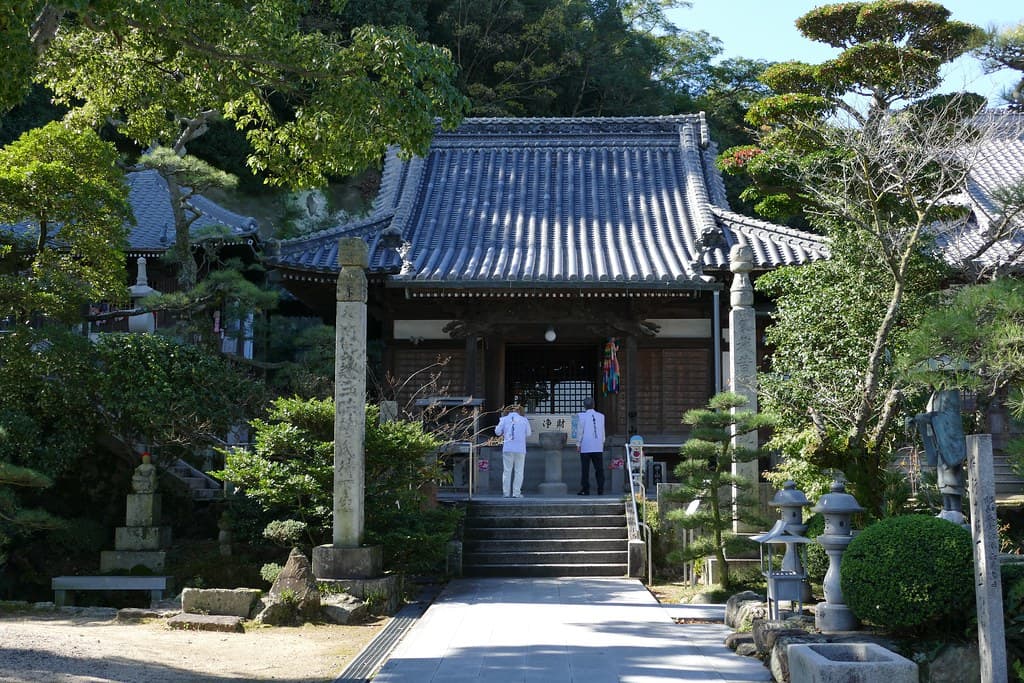
Image of Mandara-ji (曼荼羅寺). Image source · CC-BY-SA-4.0
Station 72 of 88
Shikoku 88 Temple PilgrimageVisit essentials
A quick read before you go
- Duration
- 30 to 45 minutes on site.
- Access
- On the western edge of Zentsuji City, Kagawa, in a residential and farming area at the foot of…
Overview
Mandara-ji is one of the most personally Kūkai-connected temples on the Shikoku 88. It stands in Zentsuji City, the district where Kūkai was born in 774, on the western edge of the city at the foot of Mt. Gabaishi. The temple is the Saeki clan ancestral temple — Saeki being the family into which Kūkai was born on his father's side. Tradition places its original founding in 596 CE, well before Kūkai's lifetime, as a Saeki clan establishment.
What makes it distinctive on the pilgrimage is what Kūkai did here after returning from Tang China in 806. Having spent two years in Chang'an studying esoteric Buddhism under master Huiguo at Qing-Long-Si (Chinese: Qīnglóngsì; Japanese: Seiryūji), and having received transmission of the Vajradhātu and Garbhadhātu mandalas — the Diamond Realm and Womb Realm — Kūkai is said to have refounded Mandara-ji over three years on the model of Qing-Long-Si.
He painted the Two Mandalas — Vajra and Garbha — from which the temple takes its present name (mandara is the Japanese reading of mandala), and enshrined Dainichi Nyorai (Mahāvairocana, the Great Sun Buddha) as honzon. Dainichi is the supreme cosmic Buddha of Shingon esotericism, the Buddha at the centre of both mandalas, and Mandara-ji's enshrinement places it at the conceptual heart of post-China Japanese Shingon.
Pilgrims commonly combine Mandara-ji with closely-spaced temples 73 (Shusshakaji), 74 (Kōyama-ji), and 75 (Zentsuji) in a single morning — a short Kūkai-biography circuit through his birth district. Compared with the larger Zentsuji at Temple 75, Mandara-ji is quieter and more inward. The honzon's cosmic scope, the mandala name, and the Saeki ancestral character produce a particular contemplative weight.
Why this place is sacred
Mandara-ji's depth is ancestral and conceptual rather than scenic. Through its Saeki clan identity, family graves, and ancestral character, it stands closer to Kūkai's bloodline than almost any temple on the route. Its model, Qing-Long-Si in Chang'an—the Tang temple of his master Huiguo—gives it rare Sino-Japanese resonance as one of the few Shikoku 88 sites deliberately descended architecturally and ritually from a specific Chinese temple. The configuration joins Tang Buddhism to emerging Japanese Shingon.
The temple takes its name from the Two Mandalas Kūkai brought from Huiguo: Vajradhātu, the Diamond Realm of wisdom, and Garbhadhātu, the Womb Realm of compassion. Folk tradition says an old man emerged from a cave at nearby Mt. Koyama's foot and directed Kūkai to build between today's Mandara-ji and Zentsuji, making this one of the Zentsuji landscape's original 'mystical spots.'
A grounds pine traditionally attributed to Kūkai stood over 1,200 years before declining in modern times; the Fudaraku-no-matsu site remains. The result is a quiet, inward visit, physically small but conceptually expansive.
Originally founded in 596 CE according to tradition as the Saeki clan ancestral temple — making it among the older establishments in the Zentsuji area and tying it directly to Kūkai's paternal lineage.
Refounded by Kūkai over three years between 806 and 809 after his return from Tang China, on the architectural and ritual model of Qing-Long-Si (Seiryū-ji) in Chang'an, the temple of his master Huiguo. He painted the Two Mandalas — Vajradhātu and Garbhadhātu — and enshrined Dainichi Nyorai as honzon, giving the temple its current name. The historic Kūkai-pine on the grounds stood for centuries; subsequent restorations have carried the temple through into its present form.
Experience and orientation
Pilgrims walking from Iyadani-ji at Temple 71 cover roughly nine kilometres to reach Mandara-ji — a stage that shifts from the mountain solitude of Iyadani-ji into the residential and farming landscape on the western edge of Zentsuji City. The temple sits at the foot of Mt. Gabaishi in a quiet neighbourhood. Drivers approach by local roads and find a modest parking area near the gate.
The precinct itself is small, especially compared to nearby Zentsuji at Temple 75 — there is less ground to cover, and pilgrims report visits often run thirty to forty-five minutes. The Hondō faces forward; the Daishi-dō stands close by. At the Hondō, the honzon is Dainichi Nyorai (Mahāvairocana), the cosmic Buddha at the centre of both Shingon mandalas — the Great Sun Buddha whose body is the universe.
Pilgrims perform the standard rite: candle from one's own flame, three sticks of incense, osamefuda, coin, Heart Sutra. At the Daishi-dō the Kōbō Daishi mantra continues. The Two-Mandala emblems and pictorial representations are part of the precinct's character; pilgrims with some background in Shingon contemplative practice often find these particularly resonant — Vajradhātu on one side, Garbhadhātu on the other, Dainichi at the centre of each.
The historic Kūkai-pine site, where a pine traditionally said to have been planted by Kūkai stood for over 1,200 years, is worth a moment of reflection; the original tree has declined in modern times. The Saeki ancestral graves in or near the temple grounds carry the clan-ancestry weight of the place. Many pilgrims continue directly to Shusshakaji at Temple 73, less than a kilometre away — the densest temple cluster on the entire Shikoku 88.
Approach the temple at the foot of Mt. Gabaishi by car or on foot. Bow at the gate. Wash hands at the chōzuya. Approach the Hondō: light a candle from your own flame, three sticks of incense, osamefuda, small coin, Heart Sutra. The honzon inside is Dainichi Nyorai — the cosmic Buddha at the centre of both Shingon mandalas. Move to the Daishi-dō and repeat with the Kōbō Daishi mantra.
Pause at the Two-Mandala emblems and at the historic Kūkai-pine site. The Saeki ancestral graves are part of the temple's character; treat them with corresponding respect. Visit the nōkyō office for your stamp before 17:00. Most pilgrims continue directly to Temple 73 Shusshakaji within walking distance.
Context and lineage
Tradition holds that Mandara-ji was founded in 596 CE as the ancestral temple of the Saeki clan — Kūkai's paternal lineage — making it one of the older establishments in the Zentsuji area. Kūkai studied in Tang China between 804 and 806, receiving transmission of the Two Mandalas (Vajradhātu and Garbhadhātu) from master Huiguo at Qing-Long-Si in Chang'an.
After his return in 806, he refounded Mandara-ji over three years (806–809), building it on the model of Qing-Long-Si, painting the two great mandalas — from which the temple takes its present name — and enshrining Dainichi Nyorai as honzon. Folk tradition adds that an old man emerged from a cave at the foot of nearby Mt.
Koyama and instructed Kūkai where to build a temple between what is now Mandara-ji and Zentsuji — locating Mandara-ji as one of the original 'mystical spots' of the Zentsuji landscape.
Shingon Buddhism. The temple's identity is uniquely tied to the post-China esoteric synthesis that Kūkai brought back from Huiguo at Qing-Long-Si — making it one of the most directly Tang-Sino-Japanese Buddhist sites on the Shikoku 88.
Kūkai (Kōbō Daishi)
Refounder
Huiguo (Keika)
Kūkai's master in Chang'an
Saeki clan
Original founders and ancestral lineage
Traditions and practice
Dainichi Nyorai esoteric devotion; Two-Mandala visualization practice (Vajradhātu and Garbhadhātu — the Diamond and Womb Realms); Kōbō Daishi commemorations.
Daily Shingon liturgy by resident clergy; pilgrim reception; nōkyō stamp office.
At the Hondō, perform the standard henro rite. The honzon is Dainichi Nyorai, the cosmic Buddha at the centre of both Shingon mandalas; some pilgrims find it useful to bring a brief mandala visualization into their chant if they have the practice. At the Daishi-dō, repeat with the Kōbō Daishi mantra. Pause at the Two-Mandala emblems on the precinct and at the Saeki ancestral graves. Reflect at the historic Kūkai-pine site.
Most pilgrims continue directly to Shusshakaji at Temple 73 within a short walk.
Shingon Buddhism
ActiveMandara-ji is the ancestral temple of the Saeki clan, Kūkai's paternal lineage, and is therefore one of the most personally Kūkai-connected temples on the pilgrimage. After returning from China in 806, Kūkai refounded it on the model of Qing-Long-Si in Chang'an, painted the Two Mandalas (Vajradhātu and Garbhadhātu), and enshrined Dainichi Nyorai (Mahāvairocana) as honzon — the supreme cosmic Buddha of Shingon esotericism.
Esoteric Shingon ritual centred on Dainichi Nyorai and the Two Mandalas; Kōbō Daishi devotion; pilgrim chanting.
Perspectives and open questions
Mandara-ji can be read as a Saeki ancestral temple, as a Tang–Japanese Buddhist transplant, as the conceptual centre of Kūkai's post-China esoteric synthesis, or as one of five Zentsuji 'mystical spots' in a tightly-coupled Kūkai-biography landscape.
Scholarly perspective
Mandara-ji is widely accepted as a Saeki ancestral temple refounded by Kūkai after his 806 return from China; the site's role in his post-China temple-building program is well attested in tradition. The 596 founding date is legendary rather than archaeologically verified. The model on Qing-Long-Si is a documented part of the temple's tradition and consistent with Kūkai's known biography.
Living and traditional perspectives
Local Zentsuji-area tradition treats Mandara-ji, Shusshakaji, Kōyama-ji, and Zentsuji as a single Kūkai-birth landscape; the city's tourism programme presents them as 'five mystical Kūkai spots.' Pilgrims often experience the four temples as a single morning — a coherent Kūkai-biography circuit.
Alternative interpretations
The temple's name and dual-mandala emblem are read by Shingon practitioners as the union of the Garbhadhātu (Womb Realm — compassion) and Vajradhātu (Diamond Realm — wisdom), the foundational pair of esoteric maps Kūkai brought from Huiguo. Standing at Mandara-ji is, in this reading, standing at the conceptual centre of post-Tang Japanese Buddhism.
Open questions
Whether the present Dainichi Nyorai honzon descends from the original Kūkai-era enshrinement is not publicly resolved. Whether the historic Fudaraku-no-matsu pine genuinely dated to Kūkai himself is not archaeologically verified.
Plan your visit
Access and arrival
On the western edge of Zentsuji City, Kagawa, in a residential and farming area at the foot of Mt. Gabaishi. Walk-up from Temple 71 (Iyadani-ji) is approximately 9 km. The next temple, Shusshakaji (Temple 73), is less than 1 km from Mandara-ji — making this stretch the densest temple cluster on the pilgrimage. Easy by car with on-site parking.
Pilgrim inns, business hotels, and minshuku in Zentsuji City; many walking pilgrims base here for the duration of the dense Kūkai-birth district stretch. Confirm specifics through the official Shikoku 88 pilgrim office or local tourism authority.
Respectful visit
Modest, comfortable. Traditional henro whites — hakui, sedge hat, kongō-zue, juzu — welcomed but not required.
Outdoor photography of the grounds, the pagoda area, and the Two-Mandala emblems is generally permitted. No photography inside the halls.
One candle (lit from your own flame), three sticks of incense, an osamefuda slip, and a small coin offering at each of the Hondō and the Daishi-dō.
Do not climb on the historic pine remains or touch ancestral graves. The stamp office stops issuing at 17:00. No eating in worship areas.
Do not climb on the historic pine remains or touch ancestral graves. The Saeki clan character of the site deserves restraint.
Current practical details
Address
1380-1 Yoshiwarachō, Zentsuji, Kagawa 765-0061, Japan
Phone
Hours
Hours, fees, and access can change — verify on the official source before you travel. Practical details last checked Jun 2026.
Location
Map loads as you approach this section.
Pilgrim reflections
A portrait of encounter, not a score
Pilgrims describe what they felt, how present they could become, and whether the place would shape a journey. There are no stars and no ranking of traditions.
No reviewed reflections yet
The first pilgrims can help describe the character of being here.
Share a reflection
Available after an account-backed “Been there.” Every reflection is reviewed before publication.
Watch deeper
Films, episodes, and recorded talks for visitors who want more context before or after a visit. Speculative and alternative-history entries are labelled as perspectives, not as sources for established claims.
Nearby sacred places
Explore other sacred places in the region. Proximity does not establish access or travel time; check each place’s guidance.



References
Sources consulted for this page. Source categories describe the publication, not a guarantee that every claim is verified. Traditional accounts and outside interpretations may differ.
- 01Mandaraji – Zentsuji, Kagawa Prefecture, Shikoku — Henro.orgguidePilgrim authoritative reference.
- 02The 72nd Temple Mandaraji Temple — Rekinabi SanukiofficialKagawa cultural authority.
- 03Zentsuji City: Mystical spots associated with Kobo Daishi — Zentsuji City Tourism Association (Kukai NAVI)officialLocal tourism authority on Kūkai sites in Zentsuji.
- 04Kūkai — WikipediaencyclopediaBackground on Kūkai, the Saeki clan, and his time in China.
- 05Customs and Etiquette of the Shikoku Pilgrimage — Henro.orgguidePilgrim etiquette baseline.
- 06Temple 72, Mandara-ji — Shikoku ToursguidePilgrim travel guide.
Pilgrim glossary
- Honzon
- The principal Buddhist deity enshrined as a temple's central object of worship.
- Mandala
- A symbolic diagram of the cosmos used in meditation and ritual.
- Sutra
- A canonical Buddhist scripture, often chanted as part of practice.
- Mantra
- A sound, word, or phrase repeated as part of meditation or ritual.
- Shingon
- An esoteric Japanese Buddhist school emphasizing ritual, mantra, and mandala practice.
Share a photo
Help visitors recognize Mandara-ji. Every submission is reviewed before publication.