Jōruri-ji
Named for the Pure Land of Lapis Lazuli Light, with hand and foot stones for healing
Understand sacred places, explore living traditions, and learn how to engage respectfully with Pilgrim Map.
Access has not been verified. Check current local guidance before planning a visit.
Matsuyama, Ehime Prefecture, Japan
Read the sources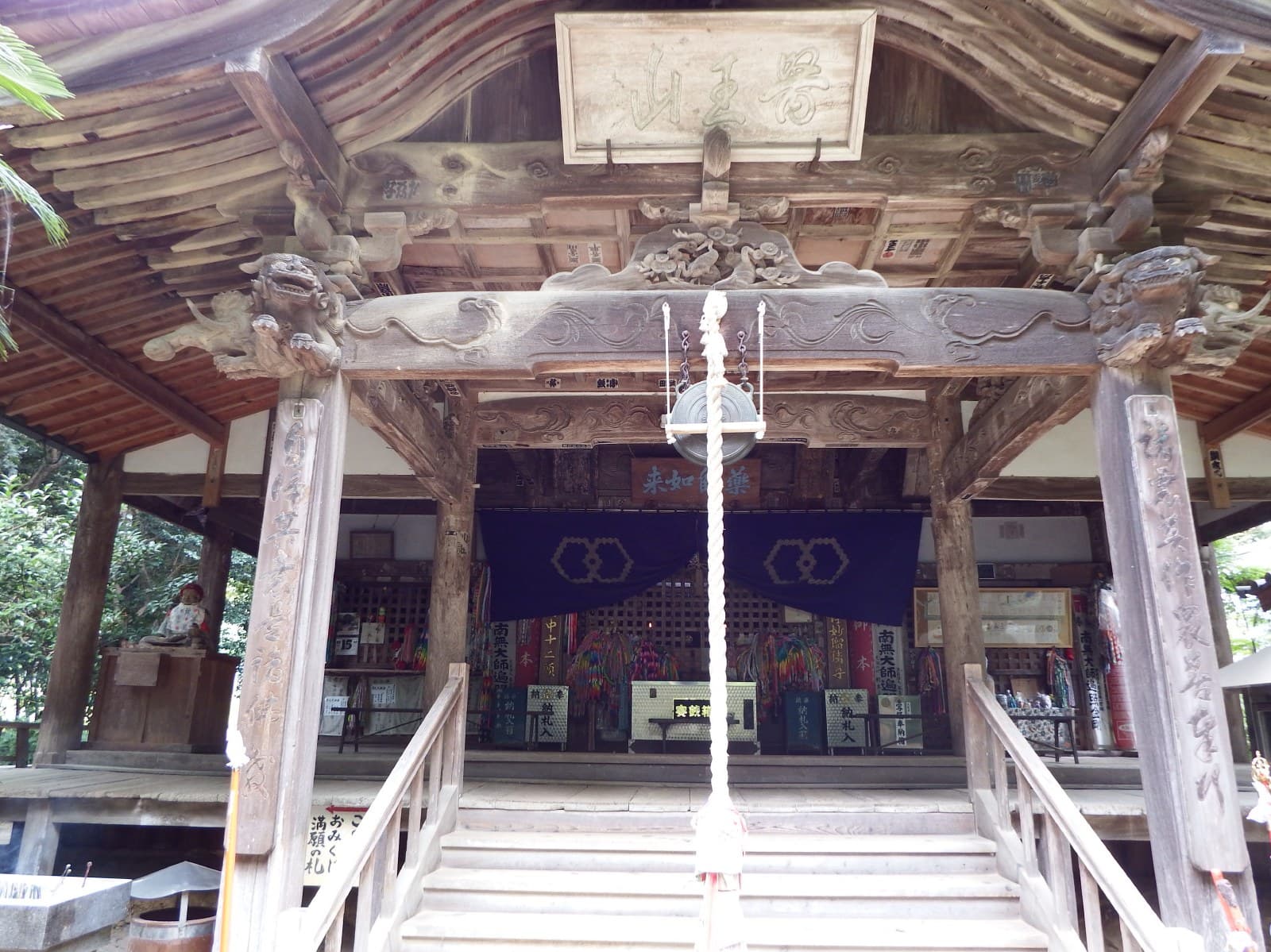
Image of Jōruri-ji (浄瑠璃寺). Image source · CC0
Station 46 of 88
Shikoku 88 Temple PilgrimageVisit essentials
A quick read before you go
- Duration
- 30-45 minutes for the formal ritual, busseki touch-stones, and juniper grove circuit.
- Access
- Southern edge of Matsuyama City.
Overview
Jōruri-ji is named for Rurikō Jōdo, Yakushi Nyorai's Pure Land of Lapis Lazuli Light. At Temple 46, illness, grief, and road fatigue are placed within healing rather than denial. The Hondō's Yakushi honzon is invoked with Onkorokoro-sendari-matōgi-sowaka, the mantra of the Buddha-realm named on the gate.
On Matsuyama City's southern edge, it is the first of eight temples in the Matsuyama cluster. Tradition says wandering priest-engineer Gyōki founded it in 708, carved Yakushi Nyorai, and named the site for the Medicine Buddha's Pure Land. Returning from Tang China, Kūkai restored it in 807 within Shingon esotericism. Its surviving 1785 layout follows reconstruction by head priest Gyōon, a former village official who travelled for funds after Sengoku destruction and Edo fires.
Rice fields at the boundary and a gentle sloping approach give the precinct a peace pilgrims often note.
Healing becomes tactile at the busseki: palms touch the hand imprint and soles the foot imprint lightly, never stepping on them, for the body part needing healing. Ema name ailments. Ancient byakushin junipers are designated natural monuments and protected sacred trees, not ornaments; pilgrims do not lean on them. After the long Kuma Highland descent from Temple 45 Iwaya-ji, Jōruri-ji begins the Matsuyama plain and an easier pace through eight closely spaced Iyo temples.
Why this place is sacred
The thinness pilgrims report at Jōruri-ji is tactile. Most Shikoku temples direct devotion at images and chanted text. Jōruri-ji adds a register of touch. The hand-imprint stone and foot-imprint stone, the busseki, are flat carved surfaces with the Buddha-mark depressions sized for human contact. A pilgrim with a hand injury places the affected hand lightly on the imprint and chants. A pilgrim with a foot injury places the sole.
The instruction is precise — light contact, not stepped on, not leaned on — and the action is brief. But for the duration of the touch, the boundary between body and Buddha-field thins in a way more abstract devotion does not match.
The ancient junipers reinforce the register. Designated natural monuments, the trees are old enough to be treated as devotional rather than ornamental presences. Pilgrims do not lean against their trunks. The sloping agricultural setting — rice paddies coming up to the boundary wall — is an unbroken rural fabric that the temple does not stand apart from.
Yakushi Nyorai's lapis lazuli light is read in Shingon mikkyō as the radiance of the unchanging dharma-body manifested as healing presence; the temple grounds become an embodied therapeutic mandala. Pilgrims carrying illness or grief often stay longer here than at temples without the explicit healing frame, and the touch-stone practice gives the body a way to participate in the devotion that words alone do not provide.
Founded according to temple tradition in 708 CE by Gyōki, the wandering priest-engineer, who carved a Yakushi Nyorai image and named the place after the Medicine Buddha's Pure Land of Lapis Lazuli Light (Rurikō Jōdo). The original purpose was a Yakushi healing shrine.
Restored in 807 CE by Kūkai upon his return from Tang China, which incorporated the temple into the Shingon esoteric framework and into the Shikoku pilgrimage circuit. Destroyed in the Sengoku period and burned again in the Edo period. Rebuilt in 1785 by head priest Gyōon, a former village official who traveled to raise reconstruction funds; the 1785 layout largely survives. The Yakushi healing cult and the busseki touch-stone practice continue as the temple's distinctive devotional register.
Experience and orientation
Pilgrims walking down from the Kuma Highlands and Temple 45 Iwaya-ji arrive at Jōruri-ji on the southern edge of the Matsuyama plain after one of the longer descents on the circuit. The contrast is sensory. The mountain forest gives way to rice paddies and the gentle slope of the agricultural plain; the air pressure changes with the altitude drop; the pace of walking flattens. The temple sits on a gentle slope with rice fields up to the boundary wall.
The approach is short and unceremonious by Shikoku standards. Pilgrims bow at the gate, wash hands and mouth at the chōzuya, and enter the precinct. The ancient juniper grove draws the eye first — old, twisted trunks with the patina of centuries, designated as natural monuments. Pilgrims do not lean against them. The Hondō houses Yakushi Nyorai.
The seven-step ritual proceeds: bow at the threshold, light a candle, place three sticks of incense, deposit a fudasho-fuda, place a saisen coin, chant the Heart Sutra and the Yakushi Nyorai mantra (Onkorokoro-sendari-matōgi-sowaka) and the mantra of Kōbō Daishi (Namu-Daishi-Henjō-Kongō), bow on departure. The same sequence at the Daishi-dō, with the Daishi mantra alone.
The carved hand-imprint and foot-imprint stones — the busseki — sit on the precinct. The hand stone receives palms placed lightly on the imprint depressions; the foot stone receives soles, also lightly, never stepped on. Pilgrims with a specific injury or illness pause here and place the affected part on the corresponding stone, chanting the Yakushi mantra silently or aloud. The touch is brief; the chanting can be longer. Ema painted with named ailments hang on the ema rack.
Pilgrims who wish to add a healing prayer for a relative or friend can write the name on an ema. The goshuin stamp is taken at the nōkyō-jō. Continuing pilgrims walk the short hop to Temple 47 Yasaka-ji about one kilometer north — fifteen to twenty minutes on foot through the same rural fabric that surrounds Jōruri-ji.
The temple sits on a gentle slope on the southern edge of Matsuyama. Bow at the gate. The Hondō and Daishi-dō form the main devotional axis. The carved hand-imprint and foot-imprint stones (busseki) sit on the precinct nearby; the ancient juniper grove lines the boundary. The nōkyō-jō for the goshuin stamp is near the Hondō. The walk to Temple 47 Yasaka-ji takes about 15-20 minutes on foot to the north.
Context and lineage
Temple tradition records that in 708 CE Gyōki, the wandering priest-engineer, stopped at this site, carved a Yakushi Nyorai image, and named the place after the Medicine Buddha's Pure Land of Lapis Lazuli Light. Kūkai's 807 restoration, on his return from Tang China, incorporated the site into the Shingon framework and into the Shikoku pilgrimage circuit.
Destruction in the Sengoku and Edo periods led to a 1785 reconstruction by head priest Gyōon, a former village official who traveled to raise reconstruction funds; the 1785 layout largely survives.
Shingon Buddhism. The temple is part of the Shikoku 88-temple circuit attributed to Kūkai. The Yakushi (Medicine Buddha) cult preserved at the temple traces to Gyōki's 8th-century foundation and to the broader 8th-century spread of Yakushi devotion across Japan. The busseki touch-stone practice is a local enrichment of the broader Yakushi cult, tied specifically to body-part healing in Matsuyama tradition.
Gyōki
Founder per temple tradition; carver of the original Yakushi Nyorai image
Kūkai (Kōbō Daishi)
Restorer in 807 CE; incorporated the temple into the Shikoku circuit
Gyōon
Head priest who rebuilt the temple in 1785 after Edo-period fire damage
Traditions and practice
The seven-step pilgrim ritual at each main hall: bow at the threshold, light a candle, place three sticks of incense, deposit a fudasho-fuda in the slip box, place a saisen coin, chant the Heart Sutra and the Yakushi Nyorai mantra at the Hondō (Onkorokoro-sendari-matōgi-sowaka) and the mantra of Kōbō Daishi at the Daishi-dō (Namu-Daishi-Henjō-Kongō), bow on departure.
At the busseki: place the affected hand or foot lightly on the imprint depression, chant the Yakushi mantra, hold for a moment, lift gently. Ema for healing requests can be added at the ema rack. Sutra-copying (shakyō) for a sick relative is a continuing practice.
Daily Shingon liturgy is performed by resident priests. Healing ema and shakyō practice continue. New Year and Yakushi-festival observances draw additional devotional traffic. The busseki touch-stones see steady use from pilgrims and local visitors, especially those with body-part-specific injuries.
Allow time at the busseki. Many pilgrims rush past them or treat them as photo objects; the contact practice is brief but deserves silence and attention. If you carry an injury or illness, name it silently while touching the imprint. If you carry someone else's illness, write their name on an ema. Walk a quiet circuit of the juniper grove without leaning on the trunks.
The next temple, Yasaka-ji, is close enough to walk to within twenty minutes — there is no need to rush.
Shingon Buddhism
ActiveTemple 46 of the Shikoku 88-temple pilgrimage. The founding by Gyōki in 708 predates Shingon, but Kūkai's 807 restoration brought the site firmly into the Shingon esoteric framework with Yakushi Nyorai (Medicine Buddha) as principal image.
Yakushi Nyorai mantra (Onkorokoro-sendari-matōgi-sowaka); Heart Sutra; healing prayers; candle and incense offerings; daily Shingon liturgy.
Yakushi Medicine Buddha healing cult
ActiveThe temple is named after the Pure Land of Lapis Lazuli Light (Rurikō Jōdo) where Yakushi Nyorai resides. Pilgrims and locals come for prayers for healing of body and mind. The carved hand-imprint and foot-imprint busseki stones are a distinctive local feature.
Touch-stones for healing parts of the body; ema offerings naming illnesses; sutra-copying (shakyō) for sick relatives; healing prayers in the Hondō.
Perspectives and open questions
Jōruri-ji is read variously as a Gyōki-era Yakushi foundation, a Shingon healing temple, and a local body-part healing site through the busseki tradition.
Scholarly perspective
Jōruri-ji is read as a Gyōki-era foundation re-purposed by Kūkai's pilgrimage system. The Yakushi cult attached to Gyōki temples spread widely in 8th-century Japan, and the site preserves that pattern. The 1785 reconstruction by Gyōon is documented and the layout largely survives, making Jōruri-ji a relatively clear case of Edo-period temple rebuilding.
Living and traditional perspectives
Local Matsuyama tradition treats the temple as a healing temple specifically tied to body parts (hands, feet) via the imprint stones. This is a local enrichment of the broader Yakushi cult; in other regions Yakushi devotion centers on illness in general or on specific diseases rather than on body-part contact. The busseki at Jōruri-ji give Matsuyama-area pilgrims a tactile devotional vocabulary that the rest of the Yakushi cult does not always include.
Alternative interpretations
Shingon mikkyō reading: Yakushi Nyorai's lapis-lazuli light is the radiance of the unchanging dharma-body manifested as healing presence. The temple grounds become an embodied therapeutic mandala, with the busseki touch-stones marking points of contact between the dharma-body and the pilgrim's specific suffering body. The healing is not metaphorical in this reading; it is the dharma-body operating through the structural form of the precinct.
Open questions
Whether the original 708 image survives in any form is unclear; multiple fires destroyed nearly all temple property except (per local claim) the principal image and side statues, but documentation of those survivals is patchy. The exact ages of the ancient junipers cited in multiple sources are unverified, though the trees are designated as natural monuments.
Plan your visit
Access and arrival
Southern edge of Matsuyama City. Bus from JR Matsuyama (Iyo Tetsu route to the Tobe-Jōruri-ji area) about 40-50 minutes. On-site car park. The walk to Temple 47 Yasaka-ji is about 1 km on foot, 15-20 minutes.
Pilgrim minshuku and small inns throughout Matsuyama; Dōgo Onsen offers traditional ryokan. The Matsuyama cluster (Temples 46-53) is densely walkable and many pilgrims base themselves in central Matsuyama or Dōgo for several nights.
Respectful visit
Pilgrim hakui welcomed; modest casual dress acceptable. The Matsuyama-area cluster is at low elevation and the walking pace is gentle; mountain-grade gear is not necessary here.
Permitted on grounds. Avoid the honzon and any private prayer. Photographs of the busseki touch-stones are common but ask before photographing pilgrims using them.
Three incense sticks, one candle, a fudasho-fuda, a saisen coin at each of the Hondō and Daishi-dō. Ema for healing requests at the ema rack with a small offering.
Do not climb on the busseki or hand-imprint stones — light touch only, never stepped on. Do not lean against the ancient juniper trunks. Photography of the honzon is not permitted. Voices low in the halls.
Do not climb on the busseki or hand-imprint stones — they are touched lightly with hand or sole, not stepped on. Do not lean against the ancient juniper trunks. Photography of the honzon is not permitted. Voices low in the halls.
Current practical details
Address
282 Jōrurimachi, Matsuyama, Ehime 791-1133, Japan
Phone
Hours
Hours, fees, and access can change — verify on the official source before you travel. Practical details last checked Jun 2026.
Location
Map loads as you approach this section.
Pilgrim reflections
A portrait of encounter, not a score
Pilgrims describe what they felt, how present they could become, and whether the place would shape a journey. There are no stars and no ranking of traditions.
No reviewed reflections yet
The first pilgrims can help describe the character of being here.
Share a reflection
Available after an account-backed “Been there.” Every reflection is reviewed before publication.
Watch deeper
Films, episodes, and recorded talks for visitors who want more context before or after a visit. Speculative and alternative-history entries are labelled as perspectives, not as sources for established claims.
Nearby sacred places
Explore other sacred places in the region. Proximity does not establish access or travel time; check each place’s guidance.


References
Sources consulted for this page. Source categories describe the publication, not a guarantee that every claim is verified. Traditional accounts and outside interpretations may differ.
- 01Joruriji – Matsuyama, Ehime Prefecture, Shikoku — Henro.orgguideStandard reference
- 02Iozan Yojyuin Jyoruriji – Shikoku 88 Temple Pilgrimage — Shikoku 88 Temple Pilgrimage OfficialofficialOfficial temple network site
- 03Joruri-ji Temple - Tourism Matsuyama — Tourism Matsuyama (Official)officialOfficial Matsuyama city tourism
- 04Joruri-ji Temple — Japan HoppersguideVisitor guide
- 05Joruriji Temple 46 Shikoku pilgrimage — Ojisanjake (Jake Davies)blogFirst-person account
Pilgrim glossary
- Honzon
- The principal Buddhist deity enshrined as a temple's central object of worship.
- Mandala
- A symbolic diagram of the cosmos used in meditation and ritual.
- Sutra
- A canonical Buddhist scripture, often chanted as part of practice.
- Mantra
- A sound, word, or phrase repeated as part of meditation or ritual.
- Dharma
- The teachings of the Buddha; also the universal law underlying them.
- Shingon
- An esoteric Japanese Buddhist school emphasizing ritual, mantra, and mandala practice.
- Pure Land
- A Buddhist tradition focused on rebirth in Amida Buddha's western paradise through devotional practice.
Share a photo
Help visitors recognize Jōruri-ji. Every submission is reviewed before publication.