Yasaka-ji
Three lineages on one precinct: Kumano Shugendō, Amida devotion, and the first-pilgrim legend
Understand sacred places, explore living traditions, and learn how to engage respectfully with Pilgrim Map.
Access has not been verified. Check current local guidance before planning a visit.
Matsuyama, Ehime Prefecture, Japan
Read the sources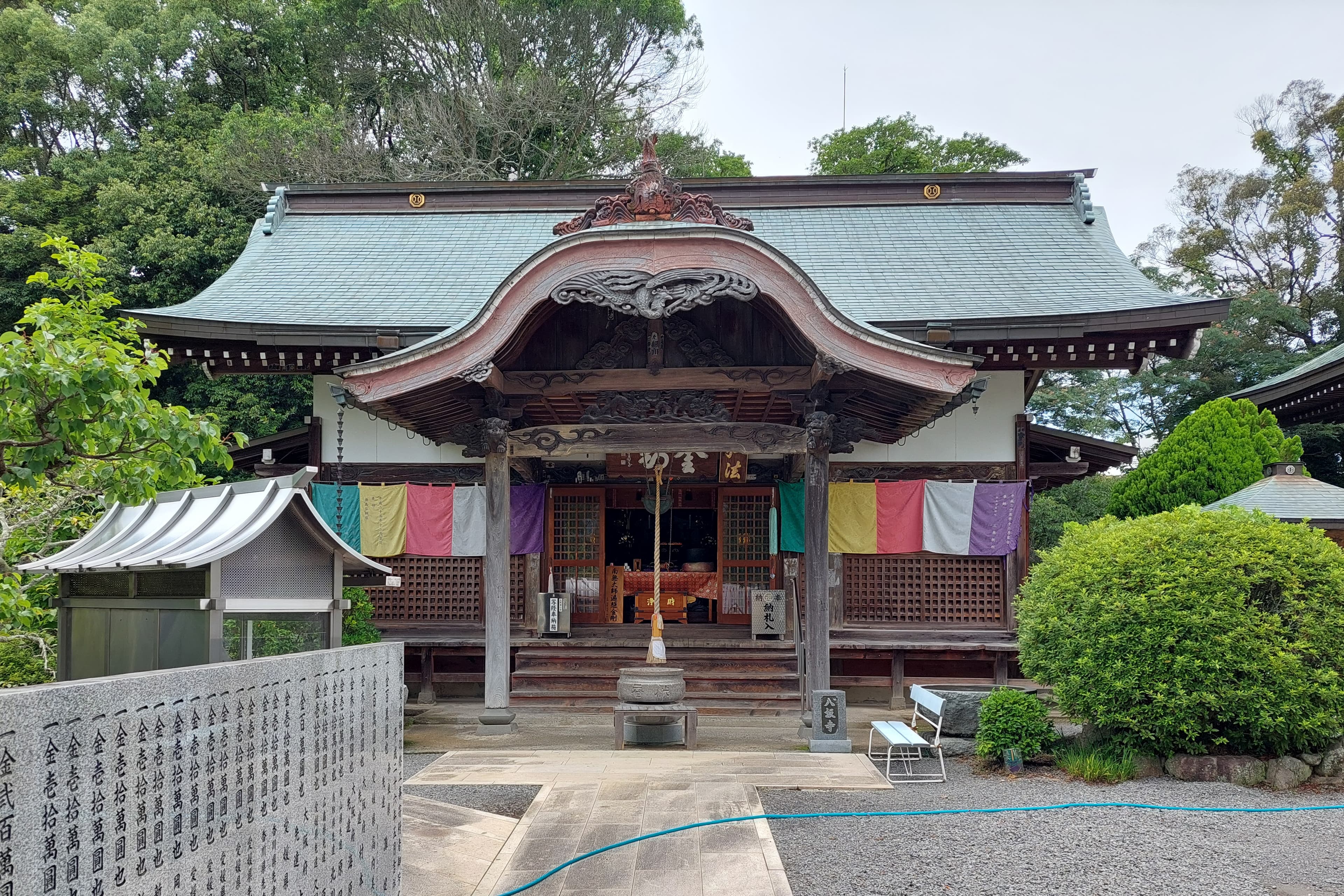
Image of Yasaka-ji (八坂寺). Image source · CC0
Station 47 of 88
Shikoku 88 Temple PilgrimageVisit essentials
A quick read before you go
- Duration
- 45-60 minutes including the Enma-dō and the underground heaven-hell tunnels.
- Access
- About 1 km north of Temple 46 Jōruri-ji — walking pilgrims continue on foot in 15-20 minutes.
Overview
Yasaka-ji combines three identities. Tradition says En no Gyōja founded a Shugendō practice site here in 701. In the Kamakura period it became a Kumano-affiliated mountain-ascetic center administering 48 branches, remembered in the name Kumanozan. Kūkai rebuilt it in 815; as a Shikoku pilgrimage temple, it centers Amida Nyorai, unusual because Shingon is typically Dainichi- or Yakushi-centered, and reflecting medieval Pure Land blending.
The Matsuyama area's Emon Saburō legend makes this an origin landscape for henro. Tradition says the wealthy Saburō refused alms to a wandering monk and broke his bowl into eight pieces; his eight sons died in succession soon after. Learning the monk was Kūkai, he became the first ohenro, circling Shikoku in repentance. Eight nearby mounds are attributed to his sons.
Yasaka, “eight hills/slopes,” is variously linked to those mounds, a story that the temple was built across eight slopes, or pilgrims' ascent chant.
In the Enma-dō, pilgrims face Enma, judge of the dead, then walk underground tunnels painted with heaven, hell, six realms, and the bardo journey. Elsewhere, 8,000 small ceramic Amida figures, each named for a devotee, create a precinct-scale offering. Historical Shugendō and Kumano lineages, Shingon-Amida devotion, pilgrimage repentance, embodied afterlife imagery, and named intercession remain layered together.
Why this place is sacred
Yasaka-ji's density comes from layers that remain distinct: En no Gyōja's Shugendō foundation, the Kumano center that governed 48 branches, and Shikoku Amida devotion.
The Enma-dō makes mortality bodily. Pilgrims face the seated judge, then spend a few minutes walking tunnels painted with heaven, hell, the six realms, and bardo passage. Those open to a rehearsal-of-death framing sometimes call it the 88-temple journey's most concentrated mortality contemplation.
A second register appears in 8,000 named ceramic Amida statues. Pilgrims may sponsor a figure for themselves or a relative, adding intention to the wall. Vermilion bridge, vivid Enma, sober tunnels, and multiplied Amida hold festive color and eschatological gravity in one precinct.
Founded according to temple tradition in 701 CE by En no Gyōja, the patriarch of Shugendō. The original main hall was built by Ochi Tamaoki, governor of Iyo Province, by imperial decree of Emperor Monmu. The original purpose was a Shugendō mountain-asceticism practice site.
Rebuilt by Kūkai in 815. Developed in the Kamakura period as a major Kumano-affiliated mountain-asceticism center, administering 48 branch temples — the mountain-name Kumanozan preserves this lineage. Destroyed in Sengoku-period wars and rebuilt at smaller scale in subsequent centuries. Acquired the Shikoku-circuit identity with Amida Nyorai as honzon, an unusual choice in a Shingon setting that reflects medieval blending with Pure Land devotion. The Enma-dō and underground heaven-and-hell tunnels developed as part of the temple's distinctive somatic-eschatology installations.
The 8,000 ceramic Amida statues represent ongoing devotional sponsorship over decades.
Experience and orientation
The approach is colorful. A bright vermilion bridge crosses a small watercourse to the precinct, and the sanmon stands beyond. The walk in from Temple 46 Jōruri-ji has taken only fifteen to twenty minutes through rural Matsuyama, so pilgrims arrive without the fatigue of a long climb. The seven-step ritual proceeds at the Hondō, where Amida Nyorai is the honzon — an unusual principal image for a Shingon temple.
Bow at the threshold, light a candle, place three sticks of incense, deposit a fudasho-fuda, place a saisen coin, chant the Heart Sutra and the Amida Nyorai mantra (Onamiritateizei-karaun) and the mantra of Kōbō Daishi (Namu-Daishi-Henjō-Kongō), bow on departure. The same sequence at the Daishi-dō. Some pilgrims also chant the nenbutsu (Namu Amida Butsu) at the Hondō, drawing on the Pure Land register of the Amida cult.
The Enma-dō is the unusual element. Pilgrims enter the hall and stand briefly before the seated image of Enma. The figure is dramatic — wide-eyed, holding the staff of judgment, painted with the conventions of bardo iconography. The atmosphere is sober. Pilgrims who choose to do so then walk the underground heaven-and-hell tunnels, which begin from the Enma-dō and pass beneath the precinct. The walls of the tunnels are painted with scenes from the six realms and the bardo journey.
The walk takes a few minutes; flash photography is discouraged to preserve the tunnel atmosphere. Pilgrims emerge into daylight at a different point of the precinct.
The ceramic Amida wall lines part of the precinct. Eight thousand small statues, each bearing a devotee's name, are arranged in tiered shelves. Pilgrims can sponsor a new statue at the temple office and add a name to the wall — a long-term offering that remains as a named bodhisattva on the precinct. Behind the temple is a large modern graveyard, observed quietly. The goshuin stamp is taken at the nōkyō-jō.
Continuing pilgrims face the walk to Temple 48 Sairin-ji about four kilometers north, the third in the Matsuyama cluster.
Approach over a vermilion bridge to the sanmon. The Hondō and Daishi-dō form the main devotional axis on the precinct; the Enma-dō and the entrance to the underground heaven-hell tunnels are nearby. The ceramic Amida wall lines part of the precinct. Behind the temple is a large modern graveyard — observe quiet. The nōkyō-jō for the goshuin stamp is near the Hondō. The walk to Temple 48 Sairin-ji takes about an hour on foot to the north.
Context and lineage
Temple tradition records the founding in 701 CE by En no Gyōja, the patriarch of Japanese Shugendō. The original main hall was built by Ochi Tamaoki, governor of Iyo Province, by imperial decree of Emperor Monmu. Kūkai rebuilt the temple in 815. In the Kamakura period it developed into a major Kumano-affiliated mountain-asceticism center administering 48 branch temples, with the mountain-name Kumanozan preserving the lineage.
The Sengoku-period wars destroyed the temple and it was rebuilt at smaller scale in subsequent centuries. The Emon Saburō legend, central to the Matsuyama-area pilgrimage cluster, ties the temple to the origin narrative of the henro practice itself — Saburō as the first pilgrim, chasing Kūkai in repentance after refusing him alms, with his eight sons buried in eight nearby burial mounds.
Shingon Buddhism. The temple is part of the Shikoku 88-temple circuit attributed to Kūkai. The Shugendō foundation under En no Gyōja and the Kamakura-period Kumano headquarters identity remain visible in the temple's institutional history. The Amida Nyorai honzon reflects medieval Shingon blending with Pure Land devotion, and the temple's contemporary practice combines Shingon liturgy with Amida-related observances and the Enma-dō somatic-eschatology installations.
En no Gyōja
Founder per temple tradition; patriarch of Japanese Shugendō
Ochi Tamaoki
Imperial-commissioned builder of the original main hall
Kūkai (Kōbō Daishi)
Rebuilder in 815; the figure who incorporated Yasaka-ji into the Shikoku circuit
Emon Saburō
Traditionally the first pilgrim of the Shikoku circuit
Traditions and practice
The seven-step pilgrim ritual at each main hall: bow at the threshold, light a candle, place three sticks of incense, deposit a fudasho-fuda in the slip box, place a saisen coin, chant the Heart Sutra and the Amida Nyorai mantra at the Hondō (Onamiritateizei-karaun) and the mantra of Kōbō Daishi at the Daishi-dō (Namu-Daishi-Henjō-Kongō), bow on departure. Some pilgrims also chant the nenbutsu (Namu Amida Butsu) at the Hondō.
After the formal ritual, visit the Enma-dō and walk the underground heaven-and-hell tunnels. Pilgrims who wish can sponsor a ceramic Amida statue with their name (or another's) added to the wall.
Daily Shingon liturgy is performed by resident priests. The ongoing Amida-statue dedication program continues to add named ceramic statues to the wall. Periodic Kumano-related observances continue from the Kamakura-headquarters lineage. Pilgrim traffic on the Shikoku 88 circuit is steady year-round.
Allow time for both the formal devotion and the somatic installations. After completing the seven-step ritual at the Hondō and Daishi-dō, walk the Enma-dō with attention rather than as a sightseeing pass-through; the tunnels are not long but the pictorial cosmology rewards slow walking. If you carry a relative who has died or who is dying, the Enma-dō walk can serve as a deliberate rehearsal of the bardo journey on their behalf.
Sponsoring a named ceramic Amida is a long-term offering; pilgrims with a specific intention often add a name here.
Shingon Buddhism
ActiveTemple 47 of the Shikoku 88-temple pilgrimage. The honzon is Amida Nyorai — unusual in a Shingon (typically Dainichi or Yakushi-centric) setting, reflecting medieval blending with Pure Land devotion.
Heart Sutra; Amida Nyorai mantra (Onamiritateizei-karaun); nenbutsu; candle and incense offerings; daily Shingon liturgy.
Kumano Shugendō
ActiveFounded by Shugendō patriarch En no Gyōja and developed in the Kamakura period as a major Kumano-affiliated mountain-asceticism center, administering 48 branch temples. The mountain-name Kumanozan preserves this lineage.
Historic mountain-ascetic training; today pilgrims participate via the Enma-dō trial and the heaven-hell tunnel walk, which carry the somatic-eschatology register from the Shugendō tradition.
Emon Saburō first-pilgrim cult
ActiveThe Matsuyama area near Temples 46-47 is closely tied to the legend of Emon Saburō, traditionally the first ohenro pilgrim. He chased Kūkai across Shikoku in repentance after refusing him alms; his eight sons are said to be buried in eight burial mounds in the surrounding fields. The temple's 'Eight Hill' name is variously linked to these tumuli.
Pilgrims commemorate Emon Saburō as the model of repentance and as the originator of the henro practice itself. The eight burial mounds are visited by interested pilgrims, though they are not formal temple property.
Perspectives and open questions
Yasaka-ji is read variously as a model of medieval Shugendō-Kumano-Shingon synthesis, a judgment-and-bardo temple through the Enma-dō, and the anchor of the Emon Saburō first-pilgrim legend.
Scholarly perspective
Yasaka-ji exemplifies the medieval combination of Shugendō, Kumano cult, and Shingon institutional framework that produced many Shikoku temples. The 47-temple cluster around Matsuyama anchors the Emon Saburō legend that legitimates the entire pilgrimage practice. The Kumanozan mountain-name preserves the Kamakura-period headquarters lineage; the Amida honzon reflects medieval Shingon blending with Pure Land devotion.
Living and traditional perspectives
Matsuyama-area popular religion treats Yasaka-ji as a 'judgment temple' where one rehearses Enma's verdict in life so as to be prepared in death. The Emon Saburō legend is locally vivid — the eight burial mounds are pointed out, and the first-pilgrim story gives Yasaka-ji a meta-narrative that other Shikoku temples do not carry to the same degree.
Alternative interpretations
Shingon-Pure Land synthesis reading: Amida is the western paradise, Enma the eastern judge — walking from the Hondō through the tunnels to the Enma-dō is a directional rehearsal of the bardo journey. The 8,000 ceramic Amida statues function as a wall of named bodhisattvas, multiplying intercession at architectural scale. The somatic-eschatology of the Enma-dō and tunnels takes the bardo from imagined to walked.
Open questions
The historical relationship between En no Gyōja's 701 foundation and the 815 Kūkai rebuilding is poorly documented. The eight burial mounds traditionally attributed to Emon Saburō's sons are unexcavated; their actual antiquity is unverified. The exact count and current condition of the 8,000 Amida ceramic statues are not independently audited, though the figure is consistent across sources.
Plan your visit
Access and arrival
About 1 km north of Temple 46 Jōruri-ji — walking pilgrims continue on foot in 15-20 minutes. Bus access from central Matsuyama; on-site car park.
Pilgrim minshuku and small inns throughout Matsuyama; Dōgo Onsen offers traditional ryokan. The Matsuyama cluster (Temples 46-53) is densely walkable and many pilgrims base themselves in central Matsuyama or Dōgo for several nights.
Respectful visit
Pilgrim hakui welcomed; modest dress acceptable. The Matsuyama cluster is at low elevation and walkable; mountain-grade gear is not necessary.
Permitted on grounds, the vermilion bridge, and the ceramic Amida wall. Flash photography discouraged in the dim heaven-hell tunnels to preserve atmosphere. Ask before photographing the Enma image up close. Avoid photographing the honzon and pilgrims mid-prayer.
Three incense sticks and one candle at each of the Hondō and Daishi-dō; a fudasho-fuda; a saisen coin in each offering box. Sponsorship payment for a ceramic Amida statue (a long-term offering that bears a chosen name) is available at the temple office.
Do not touch the painted tunnel walls. Quiet voices in the Enma-dō. The graveyard behind the temple is private. No flash in the tunnels. Photography of the honzon is not permitted.
Do not touch the painted tunnel walls — flash photography is discouraged to preserve atmosphere. Quiet voices in the Enma-dō. Do not photograph the Enma image up close without permission. The graveyard behind the temple is observed quietly; do not enter unless on family business.
Current practical details
Address
773 Jōrurimachi, Matsuyama, Ehime 791-1133, Japan
Phone
Hours
Hours, fees, and access can change — verify on the official source before you travel. Practical details last checked Jun 2026.
Location
Map loads as you approach this section.
Pilgrim reflections
A portrait of encounter, not a score
Pilgrims describe what they felt, how present they could become, and whether the place would shape a journey. There are no stars and no ranking of traditions.
No reviewed reflections yet
The first pilgrims can help describe the character of being here.
Share a reflection
Available after an account-backed “Been there.” Every reflection is reviewed before publication.
Watch deeper
Films, episodes, and recorded talks for visitors who want more context before or after a visit. Speculative and alternative-history entries are labelled as perspectives, not as sources for established claims.
Nearby sacred places
Explore other sacred places in the region. Proximity does not establish access or travel time; check each place’s guidance.


References
Sources consulted for this page. Source categories describe the publication, not a guarantee that every claim is verified. Traditional accounts and outside interpretations may differ.
- 01Yasakaji – Matsuyama, Ehime Prefecture, Shikoku — Henro.orgguideStandard reference
- 02Kumanozan Myokenin Yasakaji – Shikoku 88 Temple Pilgrimage — Shikoku 88 Temple Pilgrimage OfficialofficialOfficial temple network site
- 03Yasaka-dera Temple, the 47th of Sacred Temples of Shikoku — Shikoku Henro NewsguideDetailed history
- 04Yasaka-ji — WikipediaencyclopediaEncyclopedic summary
- 05Emon Saburō — WikipediaencyclopediaFirst-pilgrim legend
Pilgrim glossary
- Honzon
- The principal Buddhist deity enshrined as a temple's central object of worship.
- Bodhisattva
- An enlightened being who postpones full nirvana to help others toward awakening.
- Sutra
- A canonical Buddhist scripture, often chanted as part of practice.
- Mantra
- A sound, word, or phrase repeated as part of meditation or ritual.
- Shingon
- An esoteric Japanese Buddhist school emphasizing ritual, mantra, and mandala practice.
- Pure Land
- A Buddhist tradition focused on rebirth in Amida Buddha's western paradise through devotional practice.
Share a photo
Help visitors recognize Yasaka-ji. Every submission is reviewed before publication.