Hanta-ji
A medicine-buddha temple watching south Matsuyama from a wooded ridge
Understand sacred places, explore living traditions, and learn how to engage respectfully with Pilgrim Map.
Access has not been verified. Check current local guidance before planning a visit.
Matsuyama, Ehime Prefecture, Japan
Read the sources
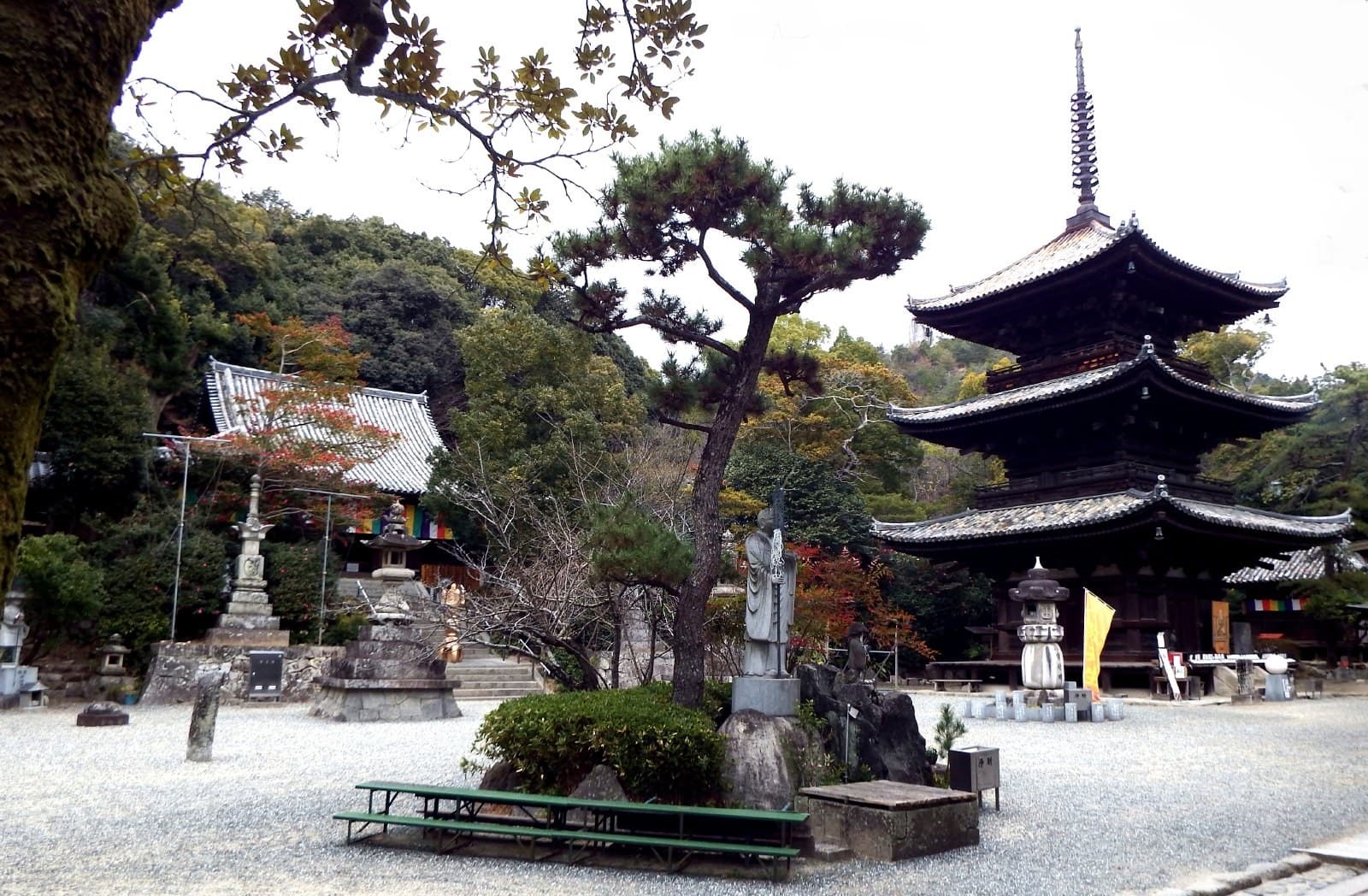
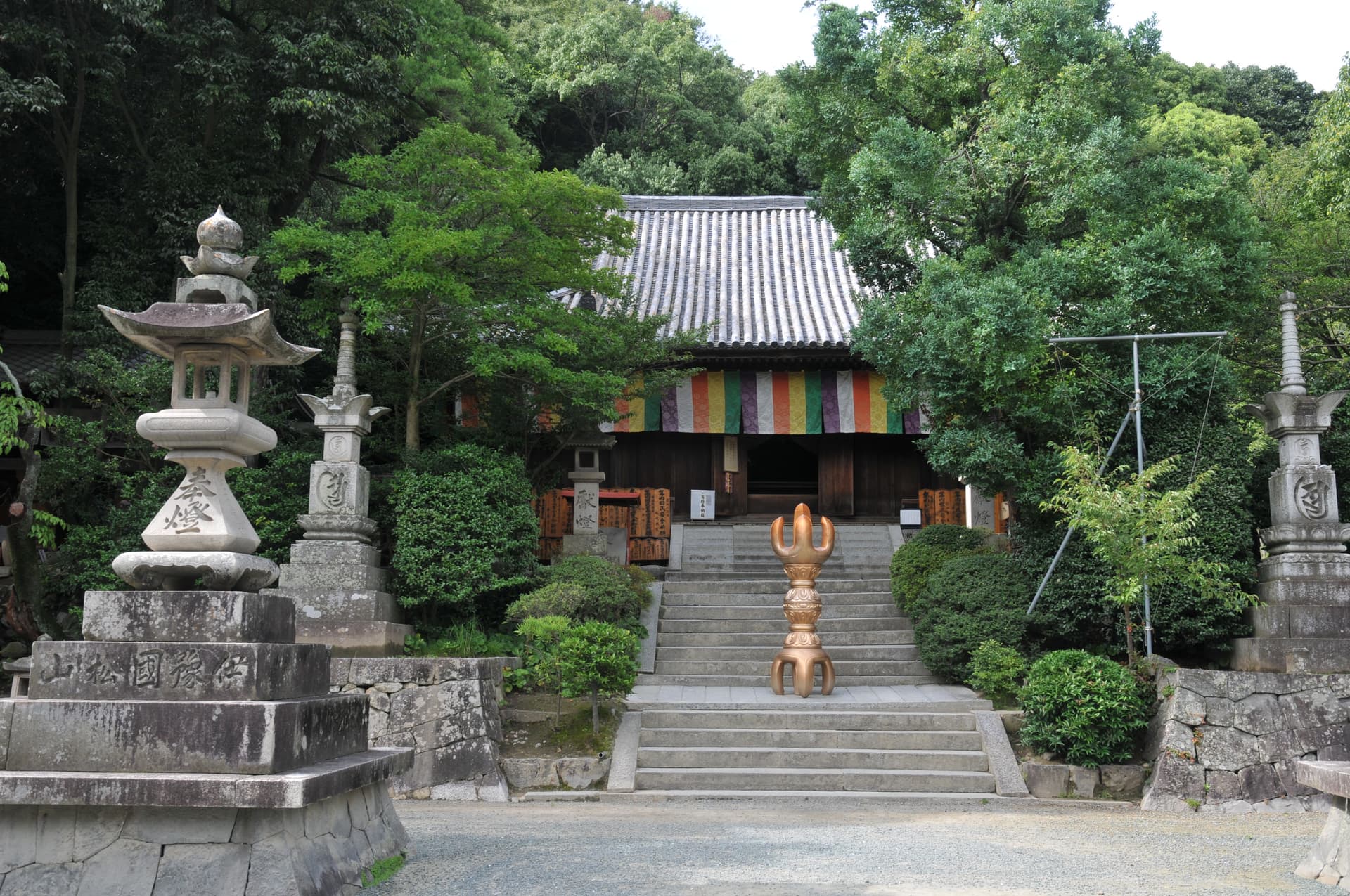
Image of Hanta-ji (繁多寺). Image source · CC-BY-SA-3.0
Station 50 of 88
Shikoku 88 Temple PilgrimageVisit essentials
A quick read before you go
- Duration
- 30–45 minutes including both halls, the panoramic view, and the stamp office.
- Access
- Located on a wooded hillside south of Matsuyama at 33.8281° N, 132.8046° E.
Overview
Hanta-ji stands in a protected forest above south Matsuyama, its courtyard opening toward the city, low hills, and Inland Sea. Its principal image is Yakushi Nyorai, the Medicine Buddha: tradition attributes the carving to the wandering bodhisattva-monk Gyōki (668–749) at imperial command and remembers Kūkai establishing the temple as a Shingon dōjō.
The name Hanta-ji (繁多寺), “temple of abundance and multiplicity,” is read by some henro guides as auspicious for multiplying merit or small mercies. Between Jōdo-ji's quiet halls and Ishite-ji's pageantry, many pilgrims find Hanta-ji the calmest of the three. As the Yakushi Sūtra's long list of healings meets a slowing breath and open horizon, the route turns toward healing.
Why this place is sacred
Hanta-ji's thinness is unspectacular and durable. The temple has functioned in roughly the same place for some 1,250 years, attached to two of Japanese Buddhism's most influential figures by tradition: Gyōki, whose carved Yakushi remains the principal image, and Kūkai, whose visit reorganized it as Shingon. The forest around the precinct has been protected long enough to feel ancient on its own terms.
The Yakushi Nyorai — the healing Buddha — gives the site its devotional centre. Pilgrims arrive from the route having walked thousands of steps that day; the Yakushi Sūtra's enumerations of healing land differently here than they would in a city temple. Body fatigue meeting healing iconography is a basic henro experience, and Hanta-ji is one of the route's most direct expressions of it.
The panoramic view south over Matsuyama to the Inland Sea adds an unrepeatable element. To stand at the temple's edge and trace the line where city ends, hills begin, and water lies beyond is to encounter the long horizon at the same moment as the long lineage. Few stops on the henro give both at once.
An imperial-foundation temple of the Tenpyō-shōhō era (749–757), commissioned under Empress Kōken with a Yakushi Nyorai image attributed to Gyōki. Intended as a centre of state-sponsored healing devotion within the Nara provincial Buddhist network.
Visited and reorganized by Kūkai (Kōbō Daishi) in the early ninth century, anchoring it as a Shingon dōjō. Incorporated into the Shikoku 88-temple pilgrimage as Temple 50, where it has functioned continuously. Affiliated today with the Toyoyama-ha branch of Shingon. The surrounding forest was later designated a Scenic Forest Protection Area, preserving its setting.
Experience and orientation
Most pilgrims arrive at Hanta-ji on foot from Jōdo-ji, a 1.6-kilometre walk that climbs gently through residential lanes and then a forested approach. Tour-bus pilgrims and drivers come up by road. The Niōmon stands at the top of a final stone-stepped rise; the courtyard beyond is broad, sky-open, and unusually quiet for a henro temple in a major city's outskirts.
Walk the leftward path past the Hondō to the southern edge of the precinct. Below lies south Matsuyama: low rooftops, the river system, the green inserts of small farms, and on a clear day the Inland Sea as a thin band of light. The view is one of the most expansive of the entire pilgrimage. Many pilgrims do their osamefuda offerings first and only then come back to look.
The Hondō houses the Yakushi Nyorai. Standard henro liturgy applies: candle, three incense sticks, sutra recitation, name slip, small coin in the box. Some pilgrims add the short Yakushi mantra after the Heart Sutra. The Daishi-dō is a few steps further. Smoke from the incense braziers rises into the trees with the particular flatness of windless summer afternoons or is bent eastward in autumn.
The stamp office sits beside the courtyard. The walk back down to the road is the same short forest path, though many pilgrims continue directly from here to Ishite-ji, about 2.8 kilometres further along.
From Jōdo-ji, follow the henro trail (red arrow markers) approximately 1.6 km north and slightly uphill through residential streets and a forested final ascent. By bus from central Matsuyama, the Iyotetsu line stops at Hanta-ji-mae; walk uphill from the stop. The precinct is laid out with the Niōmon at the southern entrance, Hondō to the north, Daishi-dō to the east, and the panoramic view from the southwestern edge. Allow 30–45 minutes.
Context and lineage
By tradition, the temple was founded in the Tenpyō-shōhō era (749–757) at the command of Empress Kōken. The wandering monk Gyōki (668–749) — known for his roving construction of bridges, irrigation works, and temples through the Japanese countryside, and posthumously revered as a bodhisattva — is said to have carved the Yakushi Nyorai principal image enshrined here. In the early ninth century, Kūkai visited Hanta-ji during his organization of the Shikoku circuit and anchored it as a Shingon training site.
The temple's name, Hanta (繁多), carries connotations of abundance and multiplicity — read by some henro guides as auspicious for the pilgrim seeking the multiplication of merit accumulated along the route. The forest surrounding the temple has been protected for sufficient time that its old growth and stillness are themselves part of the precinct's character.
Shingon Buddhism, Toyoyama-ha branch (Buzan-affiliated). The Gyōki tradition links the temple to the Nara-period bodhisattva-monk lineage; Kūkai's later patronage establishes the Shingon line that continues today.
Gyōki
Founder-sculptor by tradition
Empress Kōken (Shōtoku)
Imperial founder
Kūkai (Kōbō Daishi)
Shingon refounder
Traditions and practice
Pilgrim sequence: bow at the Niōmon, purify hands and mouth at the temizuya, offer one candle and three incense sticks at the Hondō, recite the Heart Sutra, present an osamefuda, repeat at the Daishi-dō, receive the temple stamp at the nōkyōjo. Pilgrims often add a short recitation of the Yakushi Sūtra or its mantra at the Hondō, since the principal image is the Medicine Buddha.
The same sequence is followed by today's pilgrims. Many international visitors pause additionally at the panoramic edge before or after offering, integrating the long view into their visit. Pilgrims with specific health concerns sometimes write them on osamefuda left at the Hondō.
If you have a healing intention — physical, emotional, or for someone else — bring it consciously to the Hondō and the offering of incense. After the formal liturgy, walk to the southern edge and let the long view extend the pause. The transition between healing prayer and open horizon is part of what this temple offers.
Shingon Buddhism
ActiveTemple 50 of the Shikoku 88-temple pilgrimage, affiliated with the Toyoyama-ha branch of Shingon. Centred on Yakushi Nyorai (the Medicine Buddha), invoked for physical and spiritual healing.
Pilgrim liturgy at Hondō and Daishi-dō; healing-oriented prayers and Yakushi-mantra recitation.
Gyōki bodhisattva-monk lineage
HistoricalThe principal Yakushi image is attributed by tradition to Gyōki (668–749), the wandering monk later venerated as a bodhisattva. His association links Hanta-ji to a Nara-period current of mobile compassion-in-action.
Historical only; not a current liturgical school. Preserved as devotional memory through the principal image's attribution.
Perspectives and open questions
Hanta-ji is read variously as a typical Nara-imperial foundation absorbed into the Shingon network, as a Yakushi temple of healing, and — in a quieter folk register — as a place of multiplication and abundance.
Scholarly perspective
Architectural and textual historians regard Hanta-ji as a typical Nara-period imperial foundation later incorporated into the Shingon network through Kūkai-attribution narratives. The Gyōki/Empress Kōken founding pattern recurs across many Japanese temple legends and reflects a widespread tradition of attributing important images to Gyōki rather than necessarily a literal historical record. Documentation of the temple's medieval history is sparse in surviving sources.
Living and traditional perspectives
Within the henro tradition, Hanta-ji is one of multiple healing manifestations along the route — Yakushi Nyorai joining Kannon, Jizō, Fudō, and Amida as the bodhisattvas and Buddhas the pilgrim encounters across Shikoku. The placement of a healing Buddha at this point on the circuit (after the long Iyo entry) is read as fitting: the body is tired, healing is offered.
Alternative interpretations
Some henro guides emphasize the temple's name 'Hanta' (繁多 — abundance, multiplicity) as auspicious. The temple becomes a site to ask not for one thing but for the multiplication of merit and mercies — a subtle counter-current to single-prayer specificity.
Open questions
Limited records survive of Hanta-ji's medieval history. The precise dates of major rebuildings are not well documented in available English-language sources, and the exact attribution of the principal Yakushi image to Gyōki is traditional rather than archaeologically established.
Plan your visit
Access and arrival
Located on a wooded hillside south of Matsuyama at 33.8281° N, 132.8046° E. From central Matsuyama, take the Iyotetsu bus toward Hanta-ji-mae; walk uphill to the temple. By taxi from Matsuyama Station: approximately 25 minutes. Walking pilgrims approach from Jōdo-ji (Temple 49), 1.6 km south, or continue to Ishite-ji (Temple 51), 2.8 km north.
No shukubō at Hanta-ji. Pilgrims typically stay in central Matsuyama or Dōgo Onsen, where ryokan and business hotels are abundant. Walking pilgrims often time the day to overnight in Dōgo, combining onsen bathing with the temple cluster.
Respectful visit
Modest, comfortable clothing covering shoulders and knees. Traditional white hakui, sedge hat, stole, and kongōzue staff are welcomed but not required. Sturdy footwear is helpful for the short forest climb from Jōdo-ji.
Permitted in the outdoor precinct including the Niōmon, courtyard, and panoramic view. Avoid photographing the principal image or interior shrines without permission. No flash inside any hall.
One candle and three incense sticks at each of the Hondō and Daishi-dō. A small coin offering at each box is customary. Do not light from another pilgrim's flame. Place an osamefuda in the box at each hall.
Quiet behavior. No eating, drinking, or smoking on the precinct. Do not stray off the main paths into the surrounding forest. Do not climb on stone walls or boundary structures.
Do not light your candle from another pilgrim's flame. Keep voices low, particularly inside and immediately around the halls. Do not enter forest paths off the main precinct without permission; the surrounding woodland is protected.
Current practical details
Address
32 Hataderamachi, Matsuyama, Ehime 790-0912, Japan
Phone
Hours
Hours, fees, and access can change — verify on the official source before you travel. Practical details last checked Jun 2026.
Location
Map loads as you approach this section.
Pilgrim reflections
A portrait of encounter, not a score
Pilgrims describe what they felt, how present they could become, and whether the place would shape a journey. There are no stars and no ranking of traditions.
No reviewed reflections yet
The first pilgrims can help describe the character of being here.
Share a reflection
Available after an account-backed “Been there.” Every reflection is reviewed before publication.
Watch deeper
Films, episodes, and recorded talks for visitors who want more context before or after a visit. Speculative and alternative-history entries are labelled as perspectives, not as sources for established claims.
Nearby sacred places
Explore other sacred places in the region. Proximity does not establish access or travel time; check each place’s guidance.


References
Sources consulted for this page. Source categories describe the publication, not a guarantee that every claim is verified. Traditional accounts and outside interpretations may differ.
- 01Hantaji – Henro.org — Henro.orgguidePilgrim guide entry.
- 02Hanta-ji Temple — Official Tourism Matsuyama — Tourism MatsuyamaofficialFounding by Gyōki, Kūkai connection, Scenic Forest Protection Area.
- 03Customs and Etiquette of the Shikoku Pilgrimage — Henro.orgguideEtiquette and hours.
- 04Hanta-ji Temple No. 50 — Japan Travel — Japan TravelguideViews, atmosphere.
- 05Temple 50, Hanta-ji — Shikoku Tours — Shikoku ToursguidePractical pilgrim info.
Pilgrim glossary
- Kannon
- The bodhisattva of compassion, central to many East Asian pilgrimage routes.
- Bodhisattva
- An enlightened being who postpones full nirvana to help others toward awakening.
- Sutra
- A canonical Buddhist scripture, often chanted as part of practice.
- Mantra
- A sound, word, or phrase repeated as part of meditation or ritual.
- Shingon
- An esoteric Japanese Buddhist school emphasizing ritual, mantra, and mandala practice.
- Pure Land
- A Buddhist tradition focused on rebirth in Amida Buddha's western paradise through devotional practice.
Share a photo
Help visitors recognize Hanta-ji. Every submission is reviewed before publication.