Jōdo-ji
Where a wandering nenbutsu saint left his face behind
Understand sacred places, explore living traditions, and learn how to engage respectfully with Pilgrim Map.
Access has not been verified. Check current local guidance before planning a visit.
Matsuyama, Ehime Prefecture, Japan
Read the sources
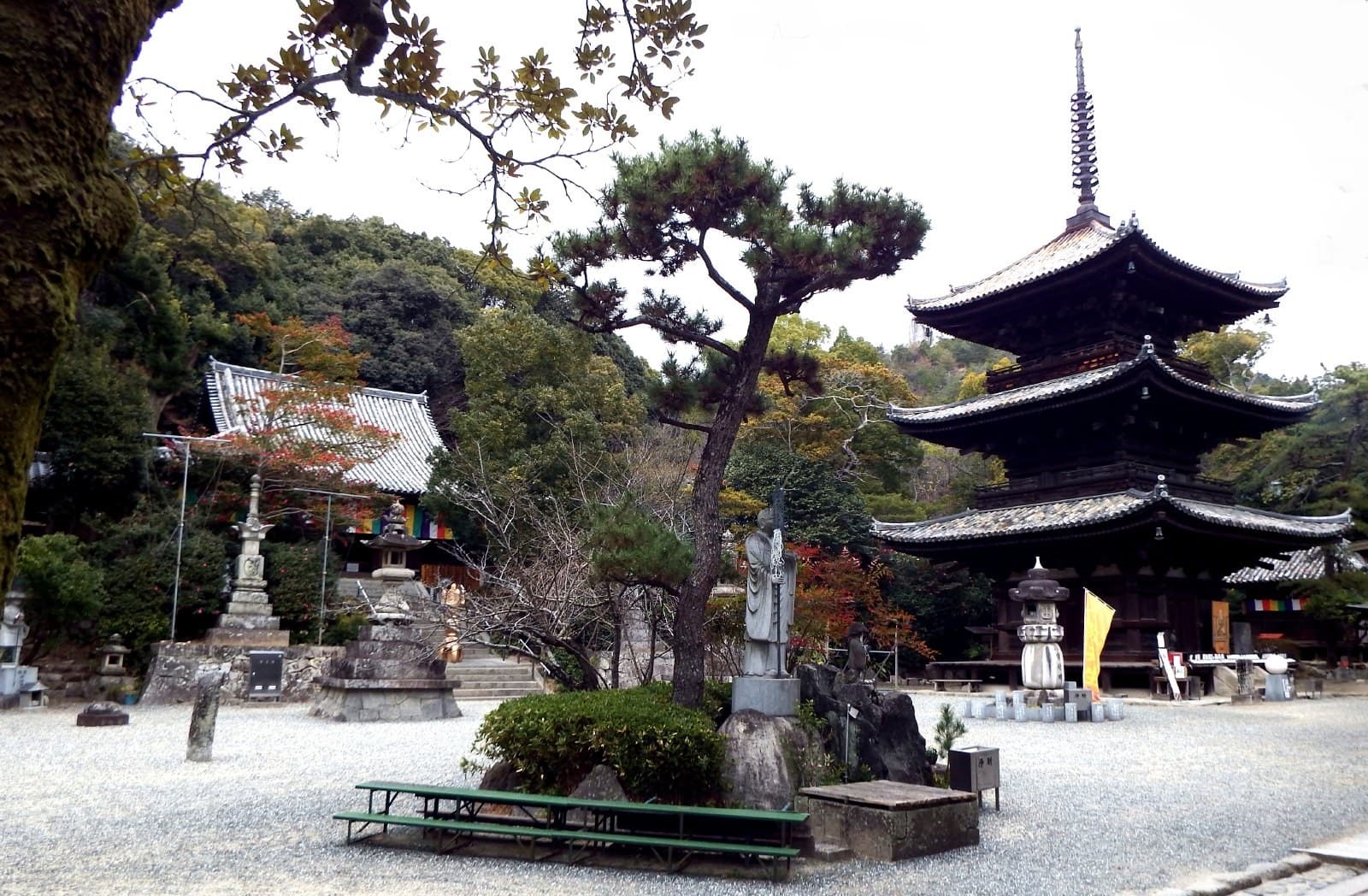
Image of Jōdo-ji (浄土寺). Image source · CC0
Station 49 of 88
Shikoku 88 Temple PilgrimageVisit essentials
A quick read before you go
- Duration
- 30–45 minutes for a complete pilgrim visit covering both halls, the Kūya statue viewing, and the…
- Access
- Located against low hills south of Matsuyama at 33.8167° N, 132.8085° E.
Overview
Jōdo-ji rests against low hills south of Matsuyama, quieter than nearby Ishite-ji. Within Iyo—the second of Shikoku's four spiritual quarters, the dōjō of bodhi or awakening—its weathered halls and modest courtyards invite a slower register.
Its singular image is a wooden statue of Kūya Shōnin (903–972), the wandering nenbutsu saint who stayed here for three years before going to Kyoto to aid plague victims. Six tiny Amida Buddhas emerge from his open mouth, one for each syllable of Namu Amida Butsu. The carving renders Kūya's roving street-corner chant literally in sculpture. This National Important Cultural Property carries Pure Land devotion inside a Shingon temple.
Tradition layers a mid-eighth-century Hossō imperial foundation under Empress Kōken, Kūkai's early-ninth-century Shingon reconsecration, and Kūya's tenth-century presence without erasing any strand. Muromachi- and Edo-period pilgrims scratched names and prayers into the Main Hall, leaving some of Shikoku's earliest surviving pilgrimage records. Between Hanta-ji's hilltop and Ishite-ji's crowded gates, henro can set down the kongōzue, light a candle, and let the Kūya image turn devotion outward.
Why this place is sacred
Jōdo-ji's thinness is one of accumulation rather than spectacle. The temple has been continuously functioning for some 1,250 years across at least three doctrinal frames — Hossō Yogācāra in the Nara period, Shingon esotericism after Kūkai, and the Pure Land nenbutsu lineage carried by Kūya Shōnin in the tenth century. Each occupied the same wooden halls; none of them displaced the others entirely.
The Kūya statue concentrates this layering. To find a Shingon-administered Important Cultural Property depicting a Pure Land saint mid-chant, in a temple now read as part of a circuit organized around Kōbō Daishi, is to encounter the porousness of Japanese Buddhist categories at the level of devotional object. The pilgrim who pauses before this image meets several centuries of practice meeting in a single mouth.
Muromachi- and Edo-period graffiti scratched into the Main Hall's wooden walls names earlier henro by hand. To run fingers along these inscriptions is to be in literal contact with the touch of pilgrims long dead — a continuity that few sites on the route preserve so directly.
An imperial Hossō-school temple founded at Empress Kōken's command in the mid-eighth century, intended as a centre of doctrinal study and state-supported merit-making.
Reconsecrated by Kūkai (Kōbō Daishi) in the early ninth century as a Shingon temple. In the tenth century it sheltered Kūya Shōnin for three years; the saint carved a self-portrait statue at the temple's request before leaving for Kyoto. Restored in the late twelfth century at the prayer of Minamoto no Yoritomo, sponsored by the Kōno clan of Iyo. Incorporated into the Shikoku 88-temple pilgrimage as Temple 49, where it remains today.
Experience and orientation
Most pilgrims arrive at Jōdo-ji either on foot from Hanta-ji along the henro path or by bus from central Matsuyama. The Niōmon at the entrance is unassuming compared with Ishite-ji's National Treasure gate a few kilometres east; pass under it, walk the leftward path that pilgrims have followed for centuries, and the precinct opens into low courtyards.
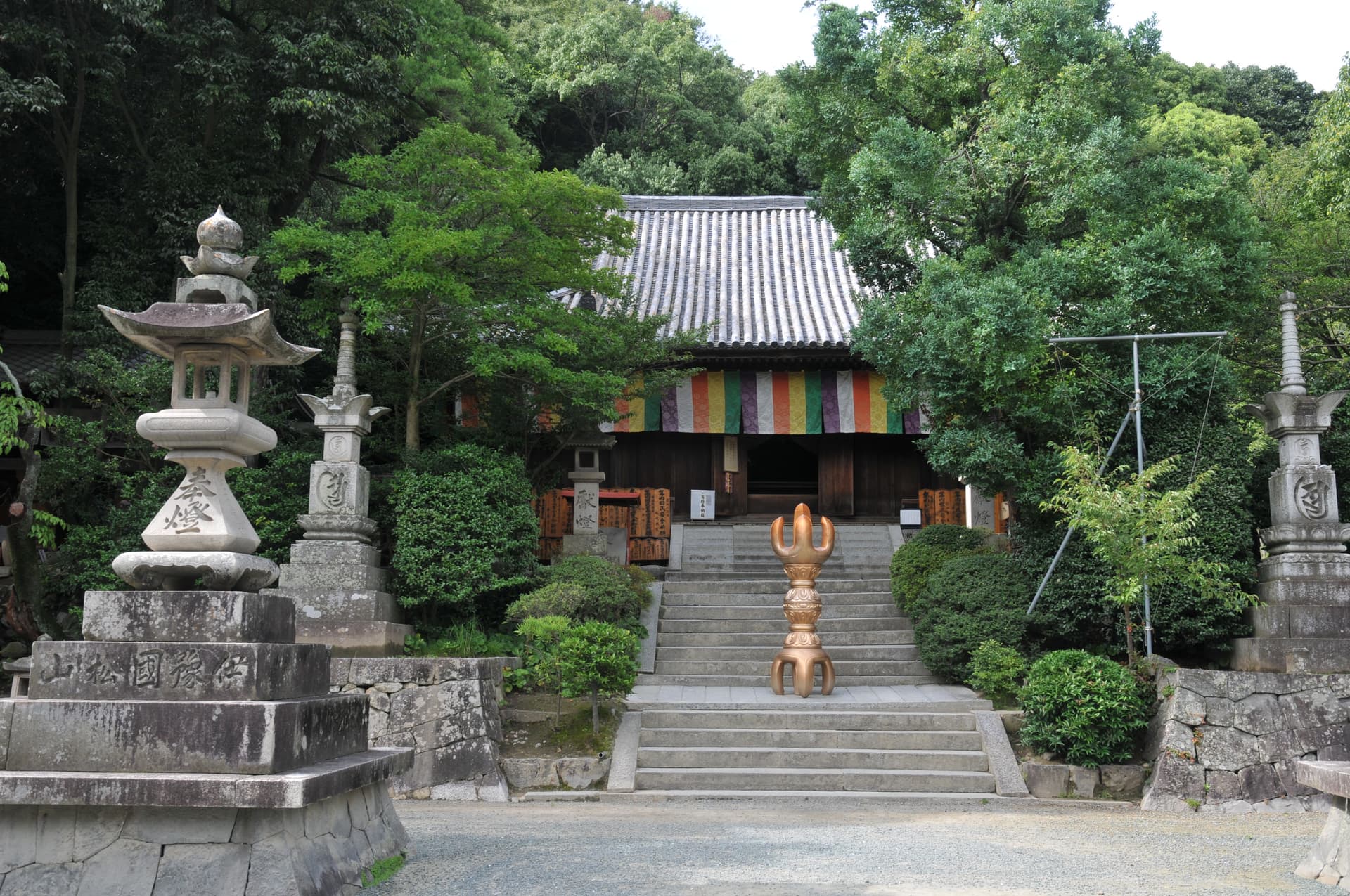
The Main Hall stands quietly. Inside, behind the railing, the Kūya Shōnin statue is the reason to slow. The carving is intimate in scale — the saint stepping forward, mouth open, six small Amida figures hanging in a row from his lips. There is no spectacle to it, only devotion sculpted as motion. Pilgrims often spend longer here than elsewhere on the day's circuit.
The Daishi-dō is short walk away through the courtyard. Bells, incense smoke, the rasp of a striker against a candle wick, the soft thud of an osamefuda slip dropped in its box: the small sounds of henro liturgy carry well in the quiet air. Outside, against the wood of the Main Hall, run the inscribed names of long-dead pilgrims — barely visible until the eye learns to find them, then suddenly everywhere.
The walk between Jōdo-ji and Hanta-ji is short (about 1.6 km). Many walkers choose to do all three Matsuyama temples in a single morning; in that triangle, Jōdo-ji is the resting note.
From central Matsuyama, take the Iyotetsu bus toward the Kuwabara area or proceed on foot along the henro trail south. The temple sits against the lower hills southeast of the city. The Niōmon faces north onto the approach path; pass through and bear left around the central axis to reach the Hondō. The Daishi-dō is on the same level. The nōkyōjo (stamp office) lies beyond the Daishi-dō. Allow 30–45 minutes for a complete pilgrim visit.
Context and lineage
Tradition places the founding in the Tenpyō-shōhō era (749–757) under Empress Kōken, who is said to have ordered the monk Emyō to build a Hossō-school temple here. In the early ninth century — the precise year is debated — Kūkai (Kōbō Daishi) reorganized the precinct as a Shingon temple. Around 938 the wandering Pure Land saint Kūya Shōnin arrived and stayed for three years, chanting nenbutsu through the local villages.
When he prepared to leave for Kyoto and the work that would make him known as the people's saint, the temple's monks asked him to leave a likeness behind. The statue carved at that moment — Kūya in mid-stride, the syllables of Namu Amida Butsu visualized as six small Amida figures rising from his open mouth — has remained at Jōdo-ji since.
Late in the twelfth century, after damage in regional warfare, Minamoto no Yoritomo prayed for the temple's restoration on behalf of the Kōno clan of Iyo.
Shingon Buddhism, Buzan-ha (Toyoyama-affiliated). The temple's earlier Hossō and Pure Land strands persist as cultural memory rather than living institutional traditions, though the Kūya statue keeps the nenbutsu lineage materially present.
Empress Kōken
Imperial founder
Emyō
Founder-monk by tradition
Kūkai (Kōbō Daishi)
Shingon refounder
Kūya Shōnin
Pure Land saint, resident 938–941
Minamoto no Yoritomo
Late-12th-century patron
Traditions and practice
The pilgrim's basic sequence is unchanged for centuries: bow at the Niōmon, purify hands and mouth at the temizuya, light one candle and three incense sticks at the Hondō, recite the Heart Sutra and the Shingon mantra, present an osamefuda name slip; repeat the offering at the Daishi-dō; receive the temple stamp at the nōkyōjo. At Jōdo-ji, the Kūya Shōnin statue invites a longer pause inside the Hondō.
The same sequence is followed by today's pilgrims, whether walking the full circuit, completing it by bus tour, or visiting individual temples. Many international pilgrims add quiet sitting on the bench outside the Hondō, noting the temple's slower atmosphere as a relief from busier sites.
Approach the Niōmon slowly. Touch the wood of the Main Hall and look for the inscribed names — your fingers and the fingers of pilgrims gone for centuries on the same surface. Stand for a longer moment before the Kūya statue and consider what it means that the syllables of a chant can be made visible. If unfamiliar with henro liturgy, simple bows at each hall and quiet observation are entirely sufficient.
Shingon Buddhism
ActiveTemple 49 of the Shikoku 88-temple pilgrimage, the central training circuit linked to Kūkai (Kōbō Daishi), founder of Japanese Shingon esoteric Buddhism. The temple sits within the dōjō of bodhi, the second of four spiritual quarters on the route.
Sutra recitation (Heart Sutra), candle and incense offerings at Hondō and Daishi-dō, presentation of osamefuda, nōkyōchō stamp collection.
Hossō (former)
HistoricalPer temple legend, Jōdo-ji was originally a Hossō-school imperial temple under Empress Kōken (749–758) before Kūkai's reorganization.
Historical only; no longer practiced here.
Pure Land devotion (Kūya lineage)
HistoricalThe wandering nenbutsu saint Kūya Shōnin (903–972) lodged here for three years; the temple preserves his self-portrait statue with six tiny Amida Buddhas issuing from the saint's open mouth — a National Important Cultural Property.
Historical Pure Land nenbutsu chanting; commemorated through the Kūya statue as material cultural memory rather than active liturgy.
Perspectives and open questions
Jōdo-ji sits at the meeting point of three Japanese Buddhist currents — Hossō scholasticism, Shingon esotericism, and Pure Land devotion — and several scholarly and traditional readings hold its history together in different ways.
Scholarly perspective
Architectural and textual historians read Jōdo-ji as a typical Nara-period imperial foundation later absorbed into the Shingon network through Kūkai-attribution narratives. The Kūya Shōnin statue is a major work of medieval Japanese sculpture and a key visual document for the wandering-saint tradition; its precise dating is debated, with scholarly opinion clustering around the late Heian to early Kamakura period rather than Kūya's own lifetime.
The Main Hall's inscribed graffiti are important early evidence for popular henro participation before the Edo-period systematization of the route.
Living and traditional perspectives
Within Shingon understanding, Jōdo-ji is one stage on the dōjō of bodhi (Iyo) — the second of the four spiritual quarters of Shikoku — where the pilgrim, having weathered the dōjō of awakening's earlier hardships, encounters the Daishi as a companion on the path of insight. The Kūya statue is venerated here as a witness to the compatibility of nenbutsu chanting with esoteric practice.
Alternative interpretations
Some henro literature emphasizes Kūya's nenbutsu lineage as a hidden current within the Shingon-framed pilgrimage, suggesting that the Shikoku circuit has always carried multiple Buddhist tributaries beneath its Shingon surface. Read this way, Jōdo-ji is a quiet emblem of the route's interior diversity.
Open questions
The exact dating of the Kūya statue and the period when graffiti pilgrims first began inscribing the Main Hall walls remain open questions. Whether Empress Kōken personally directed the temple's founding or whether her name was attached later as imperial backing is also debated.
Plan your visit
Access and arrival
Located against low hills south of Matsuyama at 33.8167° N, 132.8085° E. From central Matsuyama, take the Iyotetsu bus toward Kuwabara/Kubokawa (approximately 30 minutes); the temple is a short walk from the bus stop. Taxi from Matsuyama Station takes about 20 minutes. Walking pilgrims approach from Hanta-ji (Temple 50) about 1.6 km north along the henro trail.
No shukubō (temple lodging) at Jōdo-ji itself. Pilgrims typically stay in central Matsuyama or the Dōgo Onsen district, where ryokan and business hotels are abundant. Walking pilgrims may overnight in Dōgo to combine onsen recovery with the Matsuyama temple cluster.
Respectful visit
Modest, comfortable clothing covering shoulders and knees. Traditional henro attire (white hakui vest, sedge hat, stole, kongōzue staff) is welcomed but not required. Remove the sedge hat when entering the immediate hall area as a courtesy.
Permitted in the outdoor precinct, including the Niōmon and exterior of the halls. Avoid photographing the principal image inside the Hondō or the Kūya statue without explicit permission. No flash inside any hall.
One candle and three incense sticks at each of the Hondō and Daishi-dō. A small coin offering at each box is customary. Do not light your candle from another pilgrim's flame. An osamefuda name slip placed in the box at each hall is the pilgrim's calling card.
Quiet behavior in and around the halls. No eating, drinking, or smoking on the precinct. Do not touch the inscribed walls or attempt to add to them. Stay on paths.
Do not light your own candle from another pilgrim's flame — folk understanding holds that this transfers their accumulated bad fortune. Do not place your kongōzue (pilgrim staff) on the ground when crossing bridges; Kōbō Daishi is said to rest beneath them. Photography of the principal image and interior is restricted; ask before photographing close to the halls.
Current practical details
Address
1198 Takanokomachi, Matsuyama, Ehime 790-0925, Japan
Phone
Hours
Hours, fees, and access can change — verify on the official source before you travel. Practical details last checked Jun 2026.
Location
Map loads as you approach this section.
Pilgrim reflections
A portrait of encounter, not a score
Pilgrims describe what they felt, how present they could become, and whether the place would shape a journey. There are no stars and no ranking of traditions.
No reviewed reflections yet
The first pilgrims can help describe the character of being here.
Share a reflection
Available after an account-backed “Been there.” Every reflection is reviewed before publication.
Watch deeper
Films, episodes, and recorded talks for visitors who want more context before or after a visit. Speculative and alternative-history entries are labelled as perspectives, not as sources for established claims.
Nearby sacred places
Explore other sacred places in the region. Proximity does not establish access or travel time; check each place’s guidance.


References
Sources consulted for this page. Source categories describe the publication, not a guarantee that every claim is verified. Traditional accounts and outside interpretations may differ.
- 01Jodo-ji Temple — Official Tourism Matsuyama — Tourism MatsuyamaofficialConfirms Kūya statue and cultural property status.
- 02Jodoji – Henro.org — David Turkington / Henro.orgguidePilgrim-oriented guide; founding history and Kōno clan connection.
- 03Customs and Etiquette of the Shikoku Pilgrimage — Henro.orgguidePilgrim etiquette, hours.
- 04Jōdo-ji (Matsuyama) — Wikipedia contributorsencyclopediaOverview, sect, principal image, Kūya connection.
- 05Jodo-ji Temple No.49 — Japan Travel — Japan TravelguideArchitectural description, atmosphere.
Pilgrim glossary
- Sutra
- A canonical Buddhist scripture, often chanted as part of practice.
- Mantra
- A sound, word, or phrase repeated as part of meditation or ritual.
- Shingon
- An esoteric Japanese Buddhist school emphasizing ritual, mantra, and mandala practice.
- Pure Land
- A Buddhist tradition focused on rebirth in Amida Buddha's western paradise through devotional practice.
Share a photo
Help visitors recognize Jōdo-ji. Every submission is reviewed before publication.