Ishite-ji
Stone Hand Temple — the mythic origin of all 88
Understand sacred places, explore living traditions, and learn how to engage respectfully with Pilgrim Map.
Access has not been verified. Check current local guidance before planning a visit.
Matsuyama, Ehime Prefecture, Japan
Read the sources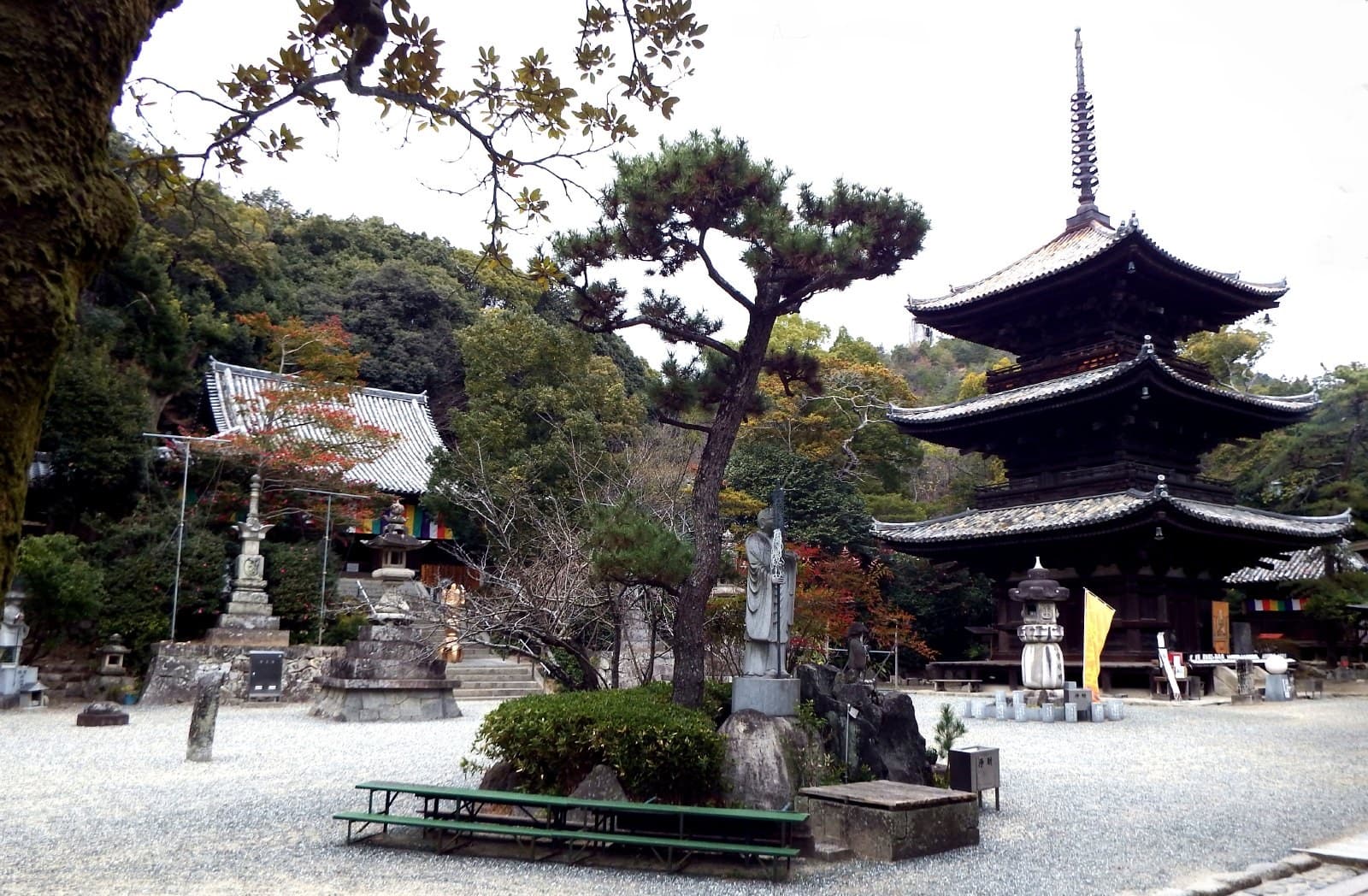
Image of Ishite-ji (石手寺). Image source · CC-BY-SA-4.0
Station 51 of 88
Shikoku 88 Temple PilgrimageVisit essentials
A quick read before you go
- Duration
- 60–90 minutes for a complete visit covering the Niōmon, the courtyard and pagoda, the Hondō and…
- Access
- Located at 33.8479° N, 132.7965° E in eastern Matsuyama.
Overview
Of all the Shikoku 88, no temple holds the route's origin myth as densely as Ishite-ji. The temple's old name was An'yō-ji; its current name — Stone Hand Temple — comes from the legend of Emon Saburō, the cruel landowner who refused alms to the wandering Kūkai eight times, broke the master's bowl, lost his eight children in succession, and walked Shikoku more than twenty times in pursuit of forgiveness.
Collapsing near Temple 12, he was met by Kūkai, forgiven, and given a stone inscribed with his name. A child of the Kōno clan was later born clutching that stone in his fist. The temple was renamed Ishite-ji in 892. The legend is the henro's foundational story; the stone is preserved on display in the temple museum.
Architecturally, Ishite-ji is one of Shikoku's richest precincts. The Niōmon Gate, built in 1318, is a National Treasure. The Kamakura-period three-storied pagoda dominates the central courtyard. The Main Hall, belfry, and several Buddhist sculptures are designated Important Cultural Properties. The Mantra Cave passageway — a long underground tunnel lined with thousands of small statues — invites pilgrims into a meditative threshold experience that has no real equivalent on the route.
What distinguishes Ishite-ji from every other Shikoku temple, though, is its idiosyncratic atmosphere. The current abbot has cultivated a syncretic, ecumenical, anti-establishment register, populating the precinct with unusual statuary, contemporary social commentary, and references to global religions. Visitors describe the place as 'strange and beautiful,' often the most memorable temple of the route.
For the pilgrim, Ishite-ji asks more than other temples. It is busy, dense, and full of contradictions. It is also the legendary place where the Shikoku pilgrimage as we know it began — and where, walking through the Mantra Cave or pausing before the Emon Saburō stone, the long arc of cruelty, repentance, karma, and rebirth becomes hard to look away from.
Why this place is sacred
Ishite-ji's thinness is unusual among the 88: it is loud, dense, layered, and openly idiosyncratic rather than quiet. The precinct accumulates rather than empties.
The Emon Saburō stone, preserved on display in the temple museum, anchors the henro's foundational myth materially. To stand before it is to stand at the legendary inception point of the entire 1,200-kilometre route. Whether or not the stone's provenance is historically verifiable, its veneration predates modern records, and its narrative — cruelty unmade by exhaustion, atonement, forgiveness, and rebirth into a new family — has shaped how the pilgrimage understands itself.
The Mantra Cave deepens the precinct's threshold quality. Walking the long underground passageway lined with thousands of small Buddhist statues is a meditative experience structurally distinct from anything offered above ground. Pilgrims describe an interior shift over the few minutes it takes to traverse.
Layered atmosphere — the Kamakura pagoda above, the cave below, folk-religious objects, esoteric symbolism, contemporary art and social commentary added by recent abbots — gives the temple a density that demands engagement rather than reverent quiet. Some pilgrims find this overwhelming; others find it the route's most alive precinct.
Founded in 728 or 729 as An'yō-ji, a Hossō-school temple by the wandering monk Gyōki. Intended as a centre of state-sponsored Buddhist practice within the early Nara network.
Reorganized as a Shingon temple in 813 by Kūkai. Renamed Ishite-ji in 892 following the Emon Saburō legend and the birth of the Kōno-clan child clutching the inscribed stone. The Niōmon Gate, built in 1318, was later designated a National Treasure. The temple's three-storied pagoda dates to the Kamakura period. Affiliated with the Buzan-ha branch of Shingon. Recent decades have seen the abbot cultivate a syncretic and idiosyncratic precinct character. Today functions as Temple 51 of the Shikoku 88-temple pilgrimage.
Experience and orientation
Most pilgrims arrive at Ishite-ji from the Dōgo Onsen tram terminus, a 20-minute walk that follows a pilgrim-marked route past shops and small restaurants. The precinct announces itself before you reach it; the Niōmon Gate, a National Treasure built in 1318, rises against the surrounding city with the heaviness of medieval temple architecture done at full scale.
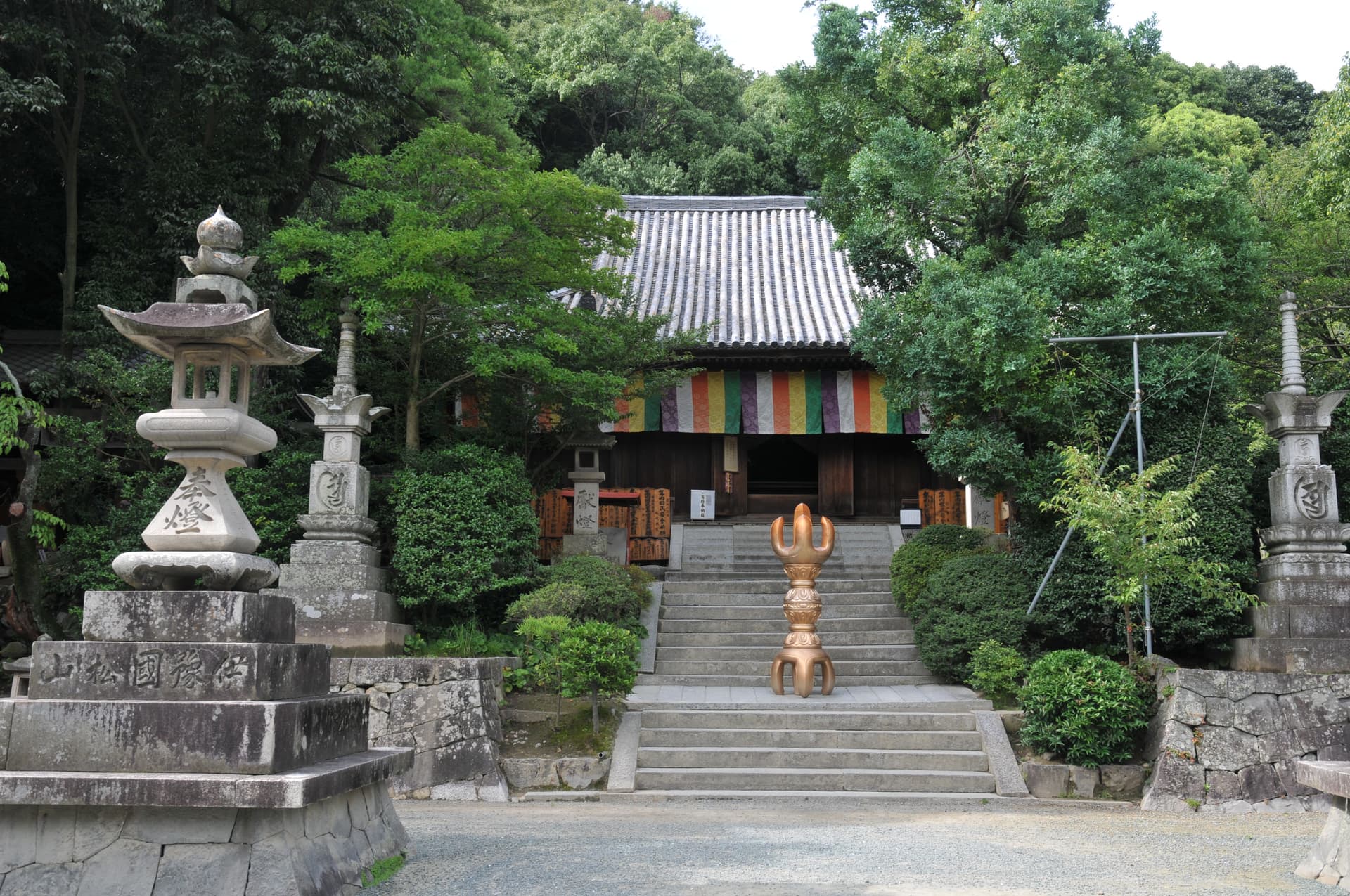
Pass under the gate. The first impression of the courtyard is overwhelming for many visitors. The three-storied Kamakura pagoda dominates the centre. To the sides, the Hondō, Daishi-dō, museum entrance, and the Mantra Cave's mouth all draw attention. Statuary — some traditional, some highly unusual contributions from the current abbot's syncretic vision — punctuates the grounds. The atmosphere is markedly different from the quieter henro temples; pilgrims stand alongside day tourists from Dōgo, school groups, and curious wanderers.
Standard henro liturgy at the Hondō and Daishi-dō follows the same form as elsewhere: candle, incense, sutra, name slip, stamp office. The principal image is Yakushi Nyorai. After the formal offerings, most pilgrims walk the Mantra Cave: a long underground passage lined with thousands of small statues, some lit faintly, others almost dark. The pace inside slows naturally. People emerge subdued.
The museum displays the Emon Saburō stone. Whatever historical scepticism a visitor brings, standing before this small object — said to have been clenched in a child's fist at birth, the bridge between a cruel man's eight dead children and his rebirth — is one of the henro's quietest registers. People often spend longer here than they expected.
The shop sells unusual amulets and printed materials shaped by the abbot's interests; many pilgrims take home something they would not find at any other temple on the route.
From central Matsuyama, take the Iyotetsu tram to Dōgo Onsen terminus, then walk approximately 20 minutes east along the henro-marked route. Walking pilgrims approach from Hanta-ji (Temple 50) about 2.7 km south. By car or taxi, park at the temple's designated lot.
The Niōmon faces south at the main entrance; pass through and find the Kamakura pagoda at the centre, the Hondō to the rear, the Daishi-dō and museum on the sides, and the Mantra Cave entrance off the main courtyard. Allow 60–90 minutes for a complete visit.
Context and lineage
By tradition, Gyōki founded the temple in 728 or 729 as An'yō-ji, a Hossō-school precinct on this site. In 813, Kūkai (Kōbō Daishi) reorganized it as a Shingon temple. The defining legend places it in the late ninth century: Emon Saburō, a wealthy and cruel landowner of the area, refused alms to the wandering Kūkai eight times. On the eighth refusal he broke the master's begging bowl. Soon after, his eight children died in succession.
Repenting, Emon Saburō set out to find Kūkai across Shikoku and walked the circuit more than twenty times in either direction without meeting him. Exhausted, he collapsed near Temple 12 Shōzan-ji. Kūkai appeared, heard the dying man's request to be reborn for the chance of doing better, and inscribed Emon Saburō's name on a stone, placing it in his hand.
Years later, a child was born to the Kōno clan with that very stone clenched in his fist; the child's hand would not open until a priest from An'yō-ji prayed over it. The temple was renamed Ishite-ji ('Stone Hand Temple') in 892 to mark this. The Niōmon Gate was built in 1318 and is now a National Treasure; the three-storied pagoda dates to the Kamakura period.
Shingon Buddhism, Buzan-ha branch. The temple's idiosyncratic contemporary atmosphere is shaped by recent abbots' interest in syncretism and ecumenical reference, while its core liturgy and pilgrim reception follow the standard Shikoku 88 pattern.
Gyōki
Founder
Kūkai (Kōbō Daishi)
Shingon refounder; protagonist of Emon Saburō legend
Emon Saburō
Legendary repentant pilgrim
Kōno clan
Patron family
Traditions and practice
Pilgrim sequence: bow at the National Treasure Niōmon, purify hands and mouth at the temizuya, offer one candle and three incense sticks at the Hondō, recite the Heart Sutra and the Shingon mantra, present an osamefuda, repeat at the Daishi-dō, receive the stamp at the nōkyōjo. Specific to Ishite-ji: walk the Mantra Cave passageway slowly and view the Emon Saburō stone in the museum.
All standard henro practices continue. The active museum and shop are part of contemporary engagement; many visitors who are not formally on pilgrimage participate in candle and incense offerings as a respectful gesture. The current abbot's idiosyncratic additions to the precinct invite a wider range of contemplative postures than elsewhere.
Walk the Mantra Cave slowly enough to register the change in pace and atmosphere; the cave does its work on the body if given time. Stand before the Emon Saburō stone for longer than feels usual and let the legend's themes — cruelty, exhaustion, repentance, the long arc of karma — surface. Notice which pieces of statuary in the precinct you would have skipped past in a quieter temple, and ask why this one keeps them.
Shingon Buddhism (Buzan-ha)
ActiveTemple 51 of the Shikoku 88-temple pilgrimage; one of the most architecturally significant on the route, with a National Treasure Niōmon Gate and a Kamakura-period three-storied pagoda.
Standard henro liturgy at Hondō and Daishi-dō; the Mantra Cave passageway is a distinctive contemplative practice particular to this temple.
Hossō (former)
HistoricalOriginally founded as An'yō-ji, a Hossō-school temple, before becoming Shingon under Kūkai in 813.
Historical only.
Folk-religious Emon Saburō devotion
ActiveIshite-ji is the legendary origin point of the Shikoku pilgrimage tradition through the Emon Saburō reincarnation legend. The inscribed stone is preserved in the temple museum.
Veneration of the Emon Saburō stone; the temple is itself a pilgrimage destination for those tracing the henro's mythic origin.
Perspectives and open questions
Ishite-ji is read in several registers — as a major medieval architectural site, as the mythic origin of the Shikoku pilgrimage, and as Shikoku's most idiosyncratic precinct shaped by recent abbots.
Scholarly perspective
Architectural historians regard the National Treasure Niōmon (1318) and the Kamakura-period three-storied pagoda as firm evidence of the temple's medieval prominence. The Emon Saburō legend itself is a defining narrative of Shikoku pilgrimage culture but is mythic in nature; its historical kernel is unverifiable. Recent scholarship on contemporary Japanese religion has noted Ishite-ji's distinctiveness within the standard 88-temple pattern, attributing it to abbatial vision more than institutional change.
Living and traditional perspectives
Within henro tradition, Ishite-ji is the symbolic origin of the entire pilgrimage. The Emon Saburō stone is the seed from which the henro is said to have sprouted. To pass through the Niōmon and view the stone is, devotionally, to touch the route's foundational story.
Alternative interpretations
The current abbot has cultivated a syncretic, anti-establishment, ecumenical atmosphere — bringing in references to global religions, contemporary social commentary, and outsider art distinct from most henro temples. Some readers see this as a return to Buddhist universalism; others as an idiosyncratic departure. Both readings have their adherents.
Open questions
The provenance and dating of the actual Emon Saburō stone is not historically verifiable; its veneration nonetheless predates modern records. The temple's exact pre-Kamakura history is incompletely documented.
Plan your visit
Access and arrival
Located at 33.8479° N, 132.7965° E in eastern Matsuyama. From central Matsuyama, take the Iyotetsu Jōnan Line tram to Dōgo Onsen terminus, then walk approximately 20 minutes east. By car or taxi from Matsuyama Station, allow 25–30 minutes. Walking pilgrims approach from Hanta-ji (Temple 50) about 2.7 km south.
No shukubō at Ishite-ji. The Dōgo Onsen district immediately west offers a wide range of ryokan and hotels, traditionally favoured by henro pilgrims for the bath's recovery effects after walking. Central Matsuyama also has abundant business hotels.
Respectful visit
Modest, comfortable clothing covering shoulders and knees. Traditional henro dress (white hakui, sedge hat, stole, kongōzue) welcomed. Sturdy footwear is helpful for the Mantra Cave's varied surface.
Permitted in the outdoor precinct, including the Niōmon Gate, pagoda, and statuary. Restricted inside the Hondō, the museum, and the Mantra Cave. No flash anywhere. Be courteous of other pilgrims engaged in liturgy.
One candle and three incense sticks at each of the Hondō and Daishi-dō. Small coin offerings customary at each box. Do not light from another pilgrim's flame.
Quiet behavior in halls and the Mantra Cave. Do not touch statuary, including the ones unusual to this precinct. Stay on paths in the cave passageway. No eating, drinking, or smoking on grounds. Respect cordoned areas around National Treasure structures.
Do not light your candle from another's flame. Do not touch statuary in the courtyard or the Mantra Cave. Stay on paths in the cave; some sections are dim. Photography is restricted inside the Hondō and the museum. The precinct is busy; expect crowds, particularly weekends and peak henro seasons (March–May, September–November).
Current practical details
Address
2-chōme-9-21 Ishite, Matsuyama, Ehime 790-0852, Japan
Phone
Hours
Hours, fees, and access can change — verify on the official source before you travel. Practical details last checked Jun 2026.
Location
Map loads as you approach this section.
Pilgrim reflections
A portrait of encounter, not a score
Pilgrims describe what they felt, how present they could become, and whether the place would shape a journey. There are no stars and no ranking of traditions.
No reviewed reflections yet
The first pilgrims can help describe the character of being here.
Share a reflection
Available after an account-backed “Been there.” Every reflection is reviewed before publication.
Watch deeper
Films, episodes, and recorded talks for visitors who want more context before or after a visit. Speculative and alternative-history entries are labelled as perspectives, not as sources for established claims.
Nearby sacred places
Explore other sacred places in the region. Proximity does not establish access or travel time; check each place’s guidance.


References
Sources consulted for this page. Source categories describe the publication, not a guarantee that every claim is verified. Traditional accounts and outside interpretations may differ.
- 01Ishite-ji Temple No.51 — Tourism Matsuyama — Tourism MatsuyamaofficialOfficial cultural property listing.
- 02Ishiteji Temple — Japan Guide — Japan GuideguideArchitectural and visitor details.
- 03Ishiteji – Henro.org — Henro.orgguidePilgrim guide; founding and renaming.
- 04Customs and Etiquette of the Shikoku Pilgrimage — Henro.orgguideEtiquette and hours.
- 05Ishite-ji — Wikipedia contributorsencyclopediaFounding history, architectural details, cultural property status.
- 06Ishite-ji – The Temple of the First Ohenro Pilgrim — Kanpai JapanguideDetailed Emon Saburō legend.
Pilgrim glossary
- Sutra
- A canonical Buddhist scripture, often chanted as part of practice.
- Mantra
- A sound, word, or phrase repeated as part of meditation or ritual.
- Shingon
- An esoteric Japanese Buddhist school emphasizing ritual, mantra, and mandala practice.
Share a photo
Help visitors recognize Ishite-ji. Every submission is reviewed before publication.