Ishiteji Temple, Matsuyama
Where a stone clutched in rebirth gave the Shikoku pilgrimage its founding legend
Understand sacred places, explore living traditions, and learn how to engage respectfully with Pilgrim Map.
Access has not been verified. Check current local guidance before planning a visit.
Matsuyama, Ehime Prefecture, Japan
Read the sources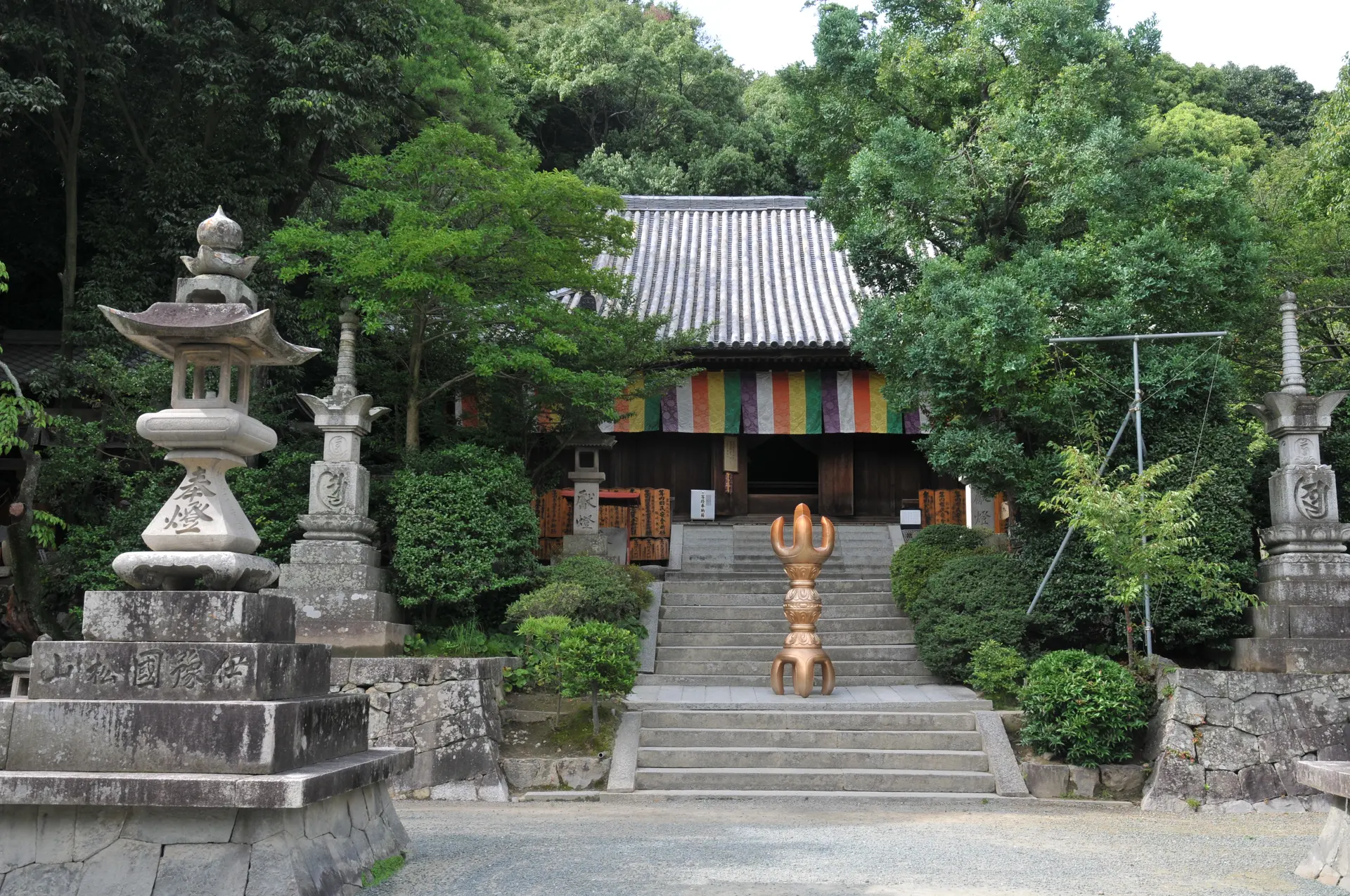
Visit essentials
A quick read before you go
- Duration
- 1-2 hours allows for exploring the temple grounds, traversing the underground passage, and…
- Etiquette
- Standard Japanese temple etiquette applies, with particular respect owed to pilgrims in…
Overview
The name Ishiteji means Stone Hand Temple, and in the treasure house lies the proof: a small stone inscribed with a name, clutched in the infant fist of a child who should not have known it. The legend speaks of Emon Saburo, a wealthy landowner who refused alms to a wandering monk eight times, breaking his begging bowl. His eight sons died one by one. Understanding his sin, Emon circled Shikoku twenty times seeking forgiveness.
On his deathbed, Kobo Daishi appeared and gave him a stone marked with his name. Emon was reborn into a noble family, the stone in his newborn hand—evidence of the cycle broken.
This story, whether historical fact or sacred myth, gave the Shikoku pilgrimage its emotional core: the possibility of transformation through devoted practice. Ishiteji preserves not just the stone but the promise.
Beyond the pilgrimage legend, the temple offers one of Japan's most unusual sacred experiences. A 200-meter underground passage, lined with Buddha statues and mantra inscriptions, leads through complete darkness to an inner sanctuary that visitors describe as entering another world entirely. The journey through darkness is itself the teaching.
Why this place is sacred
The concept of thin places requires unusual application at Ishiteji, where the boundary in question is not simply between visible and invisible worlds but between the cycles of existence themselves. The Emon Saburo legend speaks of karma breaking open—a selfish man undone by consequence, transformed through devotion, and reborn with physical evidence of his previous life in his infant hand.
Whether the stone is truly evidence of rebirth or a later creation hardly matters to the experience. What matters is the template it provides: the assurance that transformation is possible, that even great wrongs can be addressed through sincere practice, that the pilgrimage one walks has the power to change not just this life but future ones.
The underground passage extends this logic into direct experience. Pilgrims and visitors descend into complete darkness, surrounded by Buddha images they cannot see, walking forward on faith alone. The passage takes perhaps ten minutes, but for many it feels much longer. When light returns at the inner sanctuary, something has shifted. The darkness was not empty.
This combination of founding myth and immersive practice creates a site where the thinness is earned through participation. Ishiteji does not simply show pilgrims a sacred site; it invites them into the structure of transformation the legend describes.
The temple was originally founded in 728 CE as Anyoji after a wealthy man named Ochi Tamasumi had a vision of 25 bodhisattvas descending from the sky. The monk Gyoki carved the principal image of Yakushi Nyorai (Medicine Buddha). In 813, Kobo Daishi converted the temple to Shingon Buddhism. The temple was renamed Ishiteji in 892 after the Emon Saburo legend, reflecting its new identity as the repository of the pilgrimage's origin story.
Ishiteji has evolved from a site of personal vision to the symbolic heart of the Shikoku pilgrimage. The development of the underground passage, with its elaborate Buddha statues and mantra inscriptions, added an experiential dimension to pilgrimage that distinguishes Ishiteji from other temples on the route. Today the temple functions as both a major pilgrimage stop (among the most visited of the 88) and a destination for visitors drawn specifically to the cave experience.
The proximity to Dogo Onsen, one of Japan's oldest hot springs, creates a natural pairing of purification practices.
Experience and orientation
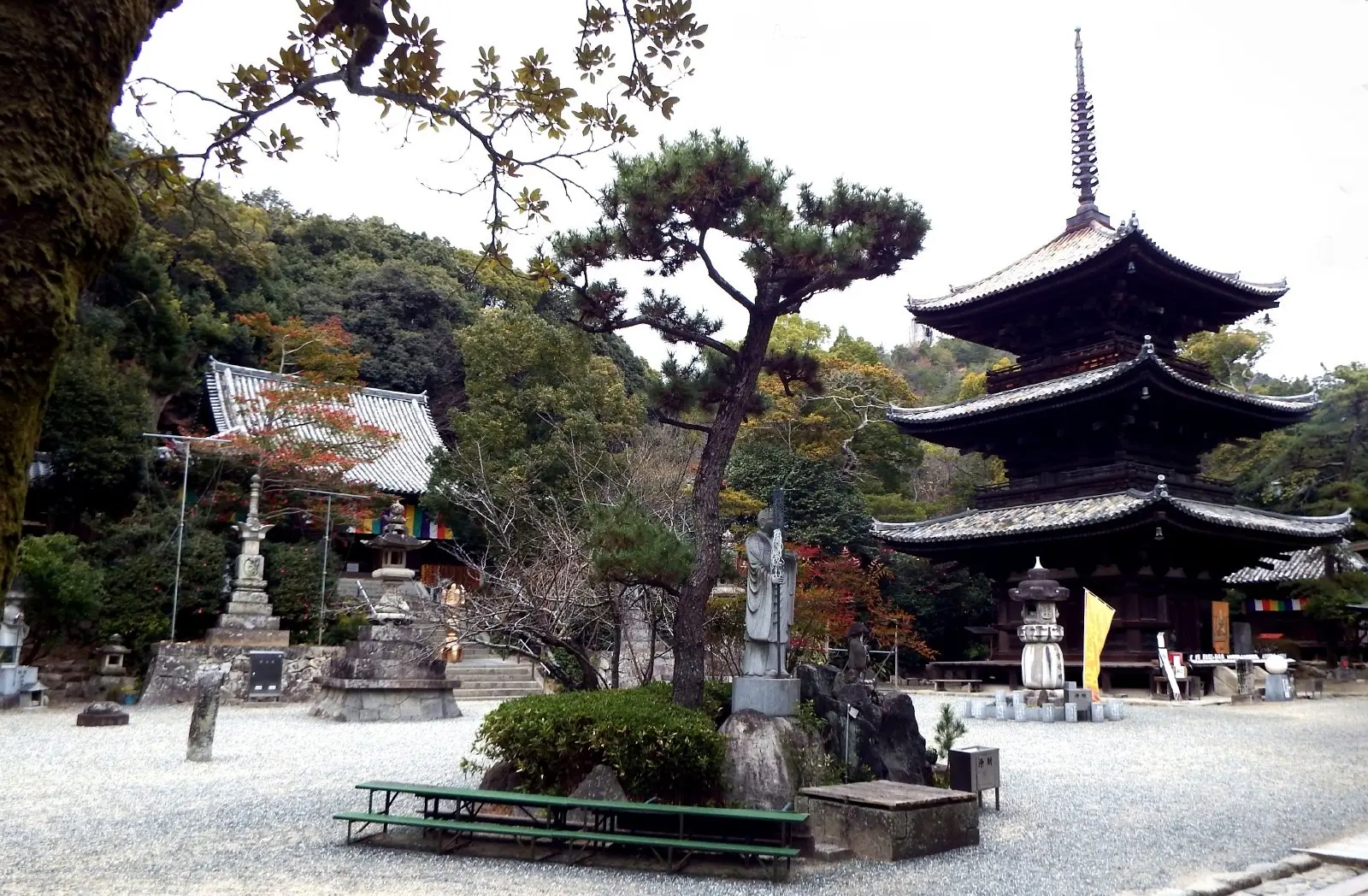
Approaching Ishiteji, the first encounter is with the Niomon Gate, a National Treasure dating to 1318. The two-story gate with its fierce guardian figures establishes that this is no ordinary temple. Within the grounds, visitors move through the typical elements of Japanese temple architecture: the purification fountain, the main hall, the pagoda. What is not typical is the quality—Ishiteji holds eight Important Cultural Properties in addition to the National Treasure gate.
The treasure museum houses the stone itself, small and unremarkable except for its inscription and its story. Seeing the object that a legend claims was carried between lives creates a curious sensation—neither belief nor disbelief quite applies. The stone exists. The story exists. The relationship between them resists simple resolution.
The underground passage begins near the main hall. Visitors descend into darkness. The passage is approximately 200 meters long, lined with Buddha statues and inscribed with mantras that cannot be read in the darkness. Some visitors find the experience unsettling; others report profound peace. What most share is the sense of having traveled somewhere—of emergence at the far end being qualitatively different from entrance.
The inner sanctuary beyond the cave is described variously as strange, beautiful, overwhelming, or slightly unsettling. It contains statues, sacred objects, and an atmosphere that visitors struggle to articulate. Many describe it as entering another world.
Throughout the temple, henro (pilgrims) in traditional white attire move through their practices: offering incense, reciting sutras, collecting temple stamps in their books. Their presence reminds visitors that this is not a museum but a living pilgrimage stop, one of 88 temples that form a 1,200-kilometer circle around Shikoku island.
Visitors typically enter through the Niomon Gate, explore the main temple grounds including the main hall and pagoda, and then face the choice of whether to descend into the underground passage. The passage takes approximately 10-15 minutes to traverse. The treasure museum requires a separate admission. The temple is located a short distance from Dogo Onsen and can easily be combined with a visit to the historic hot spring.
Context and lineage
The temple originated in 728 CE when the wealthy man Ochi Tamasumi had a vision of 25 bodhisattvas descending from the sky at this location. He commissioned the monk Gyoki to carve the principal image of Yakushi Nyorai and established Anyoji temple. In 813, Kobo Daishi visited and converted the temple to Shingon Buddhism. The more famous origin involves Emon Saburo: a wealthy, selfish man who refused alms to a traveling monk (Kobo Daishi) eight times, breaking his begging bowl.
His eight sons died. Recognizing his sin, Emon circled Shikoku 20 times seeking forgiveness. On his deathbed, Kobo Daishi appeared and gave him a stone with his name. Reborn into a noble family, the child clutched the stone in his fist. He grew to build this temple, renamed Ishiteji (Stone Hand Temple) in 892.
Ishiteji is a Shingon Buddhist temple affiliated with the Daigoji branch. It was originally of the Hosso sect before Kukai's conversion. The temple maintains traditional Shingon practices while serving as Temple 51 of the Shikoku 88 Temple Pilgrimage.
Ochi Tamasumi
Wealthy patron who had the founding vision and established the original temple in 728
Gyoki
Monk who carved the principal Yakushi Nyorai image in 729
Kobo Daishi (Kukai)
Converted the temple to Shingon Buddhism in 813; central figure in the Emon Saburo legend
Emon Saburo
Legendary figure whose rebirth story gave the temple its name and the Shikoku pilgrimage its origin
Traditions and practice
Pilgrims (henro) follow established protocols at each of the 88 temples: purifying hands at the fountain, ringing the bell, offering incense and coins, reciting the Heart Sutra and other texts, and receiving the temple stamp (goshuin) in their pilgrimage book. At Ishiteji, the underground passage is considered part of spiritual training, a descent into symbolic darkness and emergence renewed.
Modern pilgrims follow the same basic protocols as their historical predecessors, though most now complete the circuit by car rather than on foot. The Shikoku pilgrimage has experienced a revival of interest in recent decades, with walking pilgrims becoming more common again. Non-pilgrim visitors often explore the cave passage as a destination in itself.
Begin with the main temple grounds, appreciating the National Treasure gate and the Important Cultural Properties. If drawn to do so, enter the underground passage with openness to whatever the experience brings—some find darkness unsettling, others profound. The treasure museum holds the legendary stone. The nearby Dogo Onsen offers a natural complement: purification by water after transformation in darkness.
Shingon Buddhism
ActiveIshiteji is a Shingon temple serving as Temple 51 of the Shikoku 88 Temple Pilgrimage. The temple was converted to Shingon Buddhism by Kobo Daishi (Kukai) himself in 813 CE, making it one of many Shikoku temples with direct connection to the tradition's founder. As the repository of the Emon Saburo legend, Ishiteji holds unique significance in the symbolic structure of the pilgrimage.
The temple maintains Shingon Buddhist services and practices while serving pilgrims following the 88 temple circuit. The underground Mantra Path, lined with Buddha images and mantric inscriptions, serves as a distinctive practice element. Pilgrims recite sutras, make offerings, and receive temple stamps as part of their circuit completion.
Perspectives and open questions
Ishiteji invites contemplation from multiple angles: as a repository of founding legend, as a site of unusual physical experience, and as a living element of one of Japan's most important pilgrimage routes.
Scholarly perspective
Historians recognize the Emon Saburo legend as foundational folklore of the Shikoku pilgrimage, whether or not its details are historically accurate. The legend provides a template for understanding what pilgrimage offers: the possibility of karmic transformation through devoted practice. The temple's architectural heritage, including the National Treasure Niomon Gate, reflects the significant patronage Ishiteji received over centuries. Scholars also study the temple as evidence of the development of religious infrastructure along the Shikoku pilgrimage route.
Living and traditional perspectives
In Shingon Buddhist understanding, Kobo Daishi (Kukai) remains a living presence who accompanies all pilgrims on the Shikoku circuit—this is expressed in the phrase 'Dogyō Ninin' (Two traveling together). The Emon Saburo legend demonstrates the compassion of the Daishi who could forgive even grave transgressions when met with sincere repentance. The underground passage serves as a practice of symbolic death and rebirth, a descent into formlessness and emergence transformed.
Alternative interpretations
The underground passage and unusual inner sanctuary occasionally attract visitors interested in earth energies, ley lines, or paranormal phenomena. Some describe unusual experiences in the darkness that they interpret through esoteric or New Age frameworks.
Open questions
The full extent of the cave system has not been publicly documented. The historical accuracy of the Emon Saburo legend remains uncertain—it may preserve genuine memory, elaborate later invention, or elements of both. The original forms of sacred activity at the site before the temple's formal founding are unknown.
Plan your visit
Access and arrival
Dogo Onsen area offers numerous ryokan (traditional inns) and hotels, many with their own hot spring baths. Staying near Dogo Onsen allows for leisurely exploration of both the temple and the historic hot spring.
Respectful visit
Modest dress appropriate for a temple visit. Remove shoes when entering buildings. Pilgrims traditionally wear white clothing (ohenro-san), sedge hats, and carry walking sticks—visitors need not adopt this attire but should respect those who do.
Generally permitted in outdoor areas and the cave passage. Check restrictions before photographing in the main hall or treasure museum. Never photograph pilgrims without asking permission.
Small coins (5 yen coins are traditional in Japan) placed in offering boxes. Incense may be purchased and offered at the main hall.
{"Remove shoes before entering temple buildings","Bow when passing through the Niomon Gate","Purify hands at the water basin before approaching the main hall","Maintain quiet and respectful demeanor throughout","Do not disturb pilgrims in practice"}
The underground passage involves complete darkness for sustained periods. Those with severe claustrophobia or difficulty with enclosed spaces should consider carefully. The inner sanctuary beyond the cave has an unusual atmosphere that some visitors find overwhelming. The passage is not recommended for young children who might become frightened.
Current practical details
Address
2-chōme-9-21 Ishite, Matsuyama, Ehime 790-0852, Japan
Phone
Hours
Hours, fees, and access can change — verify on the official source before you travel. Practical details last checked Jun 2026.
Location
Map loads as you approach this section.
Pilgrim reflections
A portrait of encounter, not a score
Pilgrims describe what they felt, how present they could become, and whether the place would shape a journey. There are no stars and no ranking of traditions.
No reviewed reflections yet
The first pilgrims can help describe the character of being here.
Share a reflection
Available after an account-backed “Been there.” Every reflection is reviewed before publication.
Nearby sacred places
Explore other sacred places in the region. Proximity does not establish access or travel time; check each place’s guidance.



References
Sources consulted for this page. Source categories describe the publication, not a guarantee that every claim is verified. Traditional accounts and outside interpretations may differ.
- 01Ishiteji Temple - Matsuyama Travel — Japan GuideguideReliable travel information
- 02Ishiteji Temple - Japan National Tourism Organization — JNTOofficialOfficial tourism information
- 03Kumanozan Kokuzoin Ishiteji - Shikoku 88 Temple Pilgrimage — Shikoku 88 Temple PilgrimageguideOfficial pilgrimage information
- 04Temple 51, Ishiteji - Tourism SHIKOKU — Tourism ShikokuofficialRegional tourism authority
- 05Ishite-ji - Wikipedia — Wikipedia contributorsencyclopediaComprehensive overview of history and legend
- 06Ishite-ji Temple in Matsuyama — Japan TravelguideVisitor experience perspective
Pilgrim glossary
- Sutra
- A canonical Buddhist scripture, often chanted as part of practice.
- Mantra
- A sound, word, or phrase repeated as part of meditation or ritual.
- Shingon
- An esoteric Japanese Buddhist school emphasizing ritual, mantra, and mandala practice.
Share a photo
Help visitors recognize Ishiteji Temple, Matsuyama. Every submission is reviewed before publication.