Enmyō-ji
A Maria Kannon and the earliest carved word for henro
Understand sacred places, explore living traditions, and learn how to engage respectfully with Pilgrim Map.
Access has not been verified. Check current local guidance before planning a visit.
Matsuyama, Ehime Prefecture, Japan
Read the sources
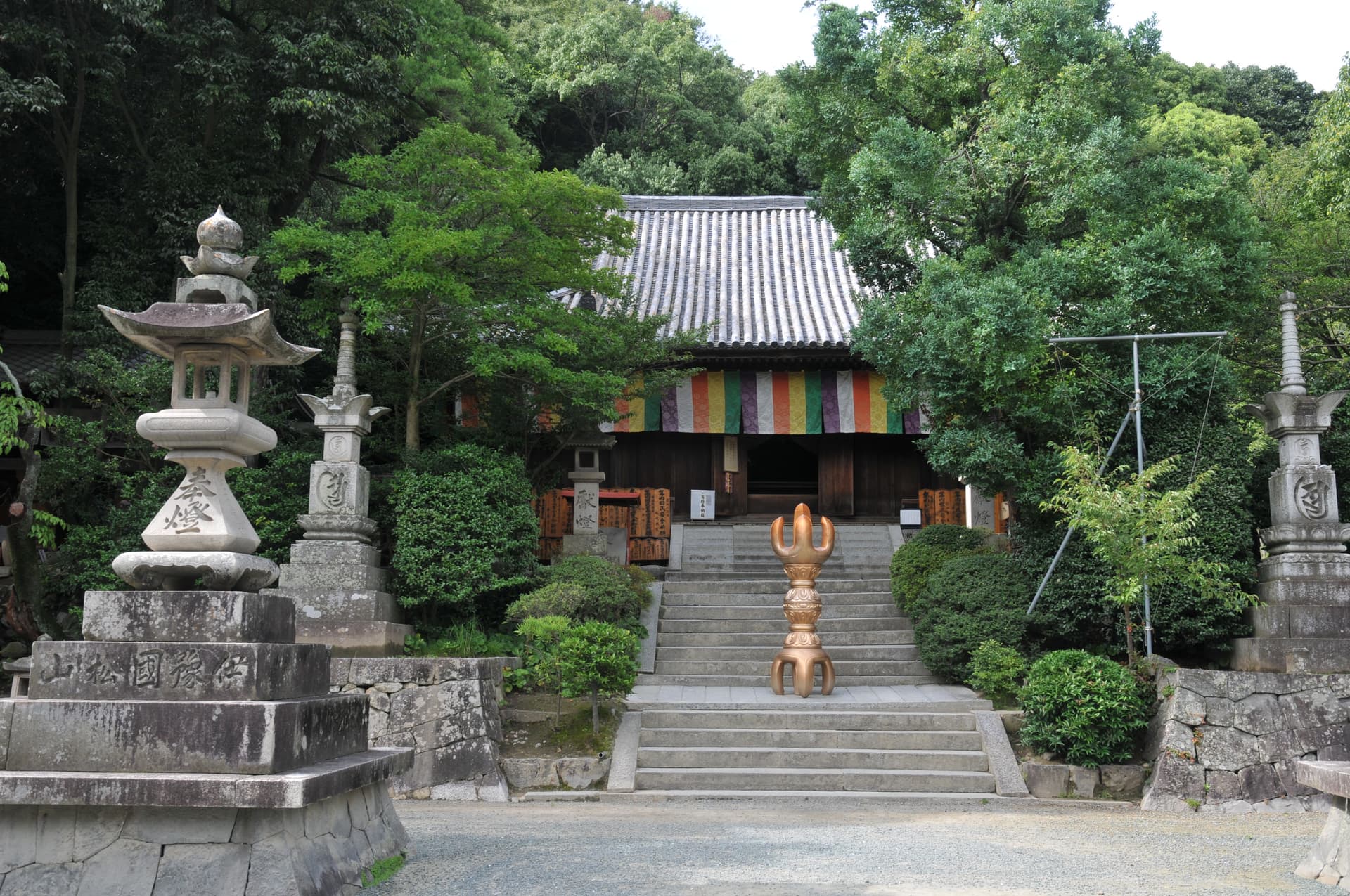
Image of Enmyō-ji (圓明寺). Image source · CC0
Station 53 of 88
Shikoku 88 Temple PilgrimageVisit essentials
A quick read before you go
- Duration
- 30–45 minutes including both halls and the stamp office.
- Access
- Located at 33.8918° N, 132.7397° E, north of central Matsuyama.
Overview
Enmyō-ji is one of the Matsuyama cluster's smaller temples, yet one of the route's densest religious palimpsests. Its Hondō houses Amida Nyorai, Buddha of the Western Pure Land—an unusual principal image for a Shingon temple. A second current is hidden Christian: the preserved “Maria Kannon” was secretly venerated as the Virgin Mary by Kakure Kirishitan during the Tokugawa ban on Christianity (1614–1873).
A third is documentary: in 1921, a University of Chicago professor on pilgrimage discovered a 1650 copper plate inscribed “henro” inside the Amida image's miniature shrine, believed to be the term's earliest epigraphic use.
The modest grounds and elaborate Hondō roof contrast with nearby Taisan-ji's National Treasure scale; pilgrims often linger once they understand the heritage. Enmyō-ji resists a single-tradition reading, encoding Buddhist resilience under Christian persecution, Christian survival under Buddhist administration, pilgrimage self-naming, and Pure Land devotion within Shingon. The Maria Kannon and plate stretch the route's religious self-understanding beyond what its official narrative always makes easy.
Why this place is sacred
Enmyō-ji's thinness is one of religious palimpsest. The same precinct holds three distinct devotional currents in unexpected combination: Shingon administration, Pure Land focus through the Amida principal image, and a hidden Christian object hidden in plain sight.
To stand before the Maria Kannon — a Buddhist statue of the bodhisattva of compassion that for two centuries doubled as a clandestine image of the Virgin Mary — is to encounter the porousness of devotional images at the practical level of survival under persecution.
The 1650 copper plate adds a different register: documentary thinness. The character for 'henro,' inscribed and buried in the miniature shrine of the Amida image, marks an early formal moment when the practice we now call the Shikoku pilgrimage had a name written down. To know that this word existed here, in metal, four centuries ago is to feel the route's continuity and the moment of its self-naming.
The temple's Pure Land–Shingon doubling is itself unusual. Amida is the Buddha of the Western Pure Land, the centre of Pure Land school devotion; finding him as the principal image of a Shingon-administered temple on the Shingon-anchored Shikoku circuit is the kind of cross-current that Japanese Buddhist categories accommodate but rarely advertise.
Founded in 749 as Kaiganzan Enmyō-mitsu-ji on the west mountain of Wakehama, an imperial-era foundation by Gyōki at the request of Emperor Shōmu, intended as a centre of Buddhist practice within the Nara provincial network.
Rebuilt by Kūkai during the Konin era (810–824) and reorganized as Shingon. Damaged by fires; relocated to its current site by warlord Suga Shigehisa in the Genna era (1615–1624). The Maria Kannon was secretly venerated here during the Tokugawa-era ban on Christianity (1614–1873). In 1650 the copper plate inscribed with 'henro' was placed in the miniature shrine of the Amida image; rediscovered in 1921. Functions today as Temple 53 of the Shikoku 88, affiliated with Shingon.
Experience and orientation
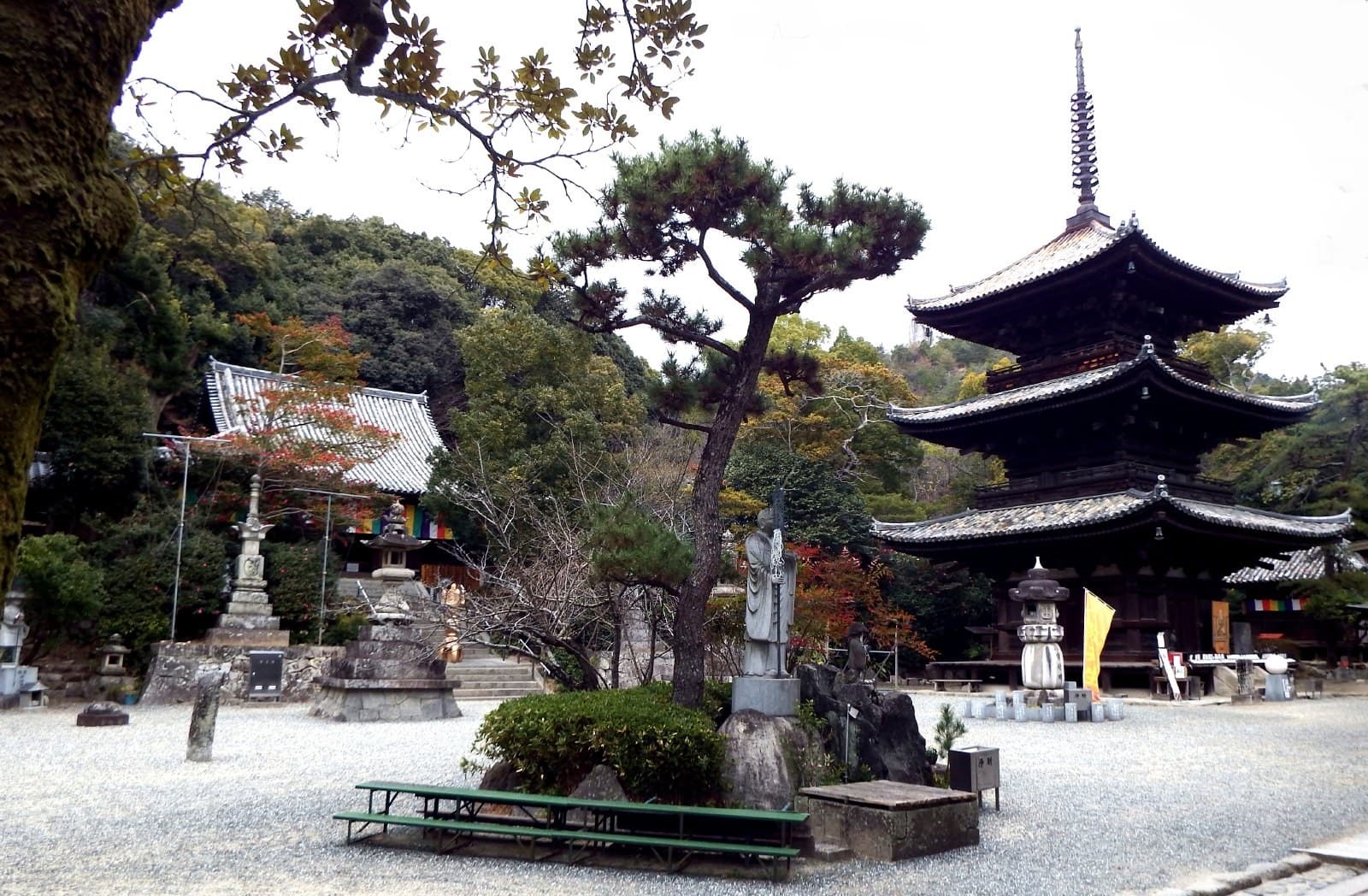
Enmyō-ji is reached after the long stretch from Taisan-ji, about 3 kilometres of road and footpath northeast. The temple announces itself less than its neighbours: a smaller precinct, a smaller gate, a smaller courtyard. The first thing that catches the eye is the elaborate roof decoration of the Hondō, with its layered carvings and unusual ornamental elements. After Taisan-ji's austere National Treasure scale, the impression is of something more decorative and intimate.
The Hondō houses Amida Nyorai. Standard henro liturgy applies: candle, three incense sticks, sutra recitation, name slip. Many pilgrims add the short Amida invocation (Namu Amida Butsu) at this hall in recognition of the unusual Pure Land focus. Inside the miniature shrine of this image, hidden for centuries until 1921, the 1650 copper plate carrying the character for 'henro' was found.
The Daishi-dō stands a few steps away. Standard offerings here also.
The Maria Kannon is the temple's quiet centrepiece for those who know to ask after it. The statue may or may not be readily viewable depending on temple schedules; the temple staff will direct interested pilgrims if it is on display. To stand before it — a Buddhist Kannon that for two centuries was secretly addressed as the Virgin Mary — is the closest most Shikoku temples bring the pilgrim to interfaith devotional history.
Most pilgrims spend 30 to 45 minutes here. The temple is rarely crowded. The walk continues from here either back into Matsuyama or northward on the long stretch toward Imabari, a route of approximately 34 kilometres before the Imabari temple cluster begins.
Located at 33.8918° N, 132.7397° E, north of central Matsuyama. From Taisan-ji (Temple 52), follow the henro trail approximately 3 km northeast. By bus from central Matsuyama, the Iyotetsu line stops near the temple. By taxi from Matsuyama Station, allow 30 minutes. The Niōmon is at the entrance; pass through and find the Hondō with its elaborate roof at the rear, the Daishi-dō to the side, and the stamp office adjacent.
The Maria Kannon is preserved on grounds; ask staff for current viewing arrangements. Allow 30–45 minutes.
Context and lineage
By tradition, Gyōki Bodhisattva founded the temple in 749 (the first year of the Tenpyō-shōhō era) at the request of Emperor Shōmu. The original location was the west mountain of Wakehama, with the name Kaiganzan Enmyō-mitsu-ji. In the Konin era (810–824), Kūkai (Kōbō Daishi) rebuilt and reorganized the temple under Shingon. Centuries later, after fires, the warlord Suga Shigehisa relocated the temple to its current site during the Genna era (1615–1624).
During the Tokugawa-era persecution of Christianity (1614–1873), a 'Maria Kannon' was preserved on temple grounds — a Kannon statue secretly venerated as the Virgin Mary by hidden Christian (Kakure Kirishitan) believers. In 1650, an inscribed copper plate bearing the character for 'henro' was placed inside the miniature shrine of the Amida principal image; this plate was rediscovered in 1921 by a University of Chicago professor on pilgrimage and is now the earliest known epigraphic record of the word.
Shingon Buddhism. The Pure Land focus through the Amida principal image and the hidden-Christian Maria Kannon both function as parallel devotional currents within the Shingon institutional frame.
Gyōki
Founder by tradition
Emperor Shōmu
Imperial founder-patron
Kūkai (Kōbō Daishi)
Shingon refounder
Suga Shigehisa
Edo-period relocator
Kakure Kirishitan (Hidden Christians)
Anonymous lay venerators
Traditions and practice
Pilgrim sequence: bow at the Niōmon, purify hands and mouth, offer one candle and three incense sticks at the Hondō, recite the Heart Sutra and the Amida Sutra (or simply the invocation Namu Amida Butsu), present an osamefuda, repeat at the Daishi-dō, receive the stamp at the nōkyōjo. The Pure Land focus of the principal image makes the Amida invocation natural at this temple, even within an otherwise Shingon-style liturgy.
The same sequence is followed by today's pilgrims. Many international visitors specifically request to view the Maria Kannon and the temple's heritage related to hidden Christianity and the 1650 'henro' inscription; staff accommodate where possible.
At the Hondō, consider including the Amida invocation alongside the Heart Sutra in recognition of the temple's unusual Pure Land focus. If the Maria Kannon is viewable, sit a moment with it; the statue carried two devotional traditions in secret for two centuries, and the layered presence is part of the temple's offering. Reflect on the 1650 inscription if visiting the Hondō with this knowledge — the word for the practice you are doing was first carved in metal, here.
Shingon Buddhism
ActiveTemple 53 of the Shikoku 88-temple pilgrimage; principal image is Amida Nyorai (Buddha of the Western Pure Land), unusual for a Shingon temple where Dainichi or other esoteric Buddhas are more common.
Pilgrim liturgy at Hondō and Daishi-dō; veneration of Amida often supplemented by the Pure Land invocation.
Hidden Christian (Kakure Kirishitan) heritage
HistoricalThe temple grounds preserve a 'Maria Kannon' — a Buddhist Kannon statue secretly venerated as the Virgin Mary by hidden Christians during the Tokugawa-era ban on Christianity (1614–1873).
Historical syncretic devotion; today preserved as cultural heritage rather than active liturgy.
Perspectives and open questions
Enmyō-ji is read variously as a small Shingon temple of unusual religious resilience, as a documentary site for the formalization of the pilgrimage, and as a quiet emblem of folk-level interfaith porousness.
Scholarly perspective
The 1650 copper plate is significant epigraphic evidence for the formalization of the Shikoku pilgrimage as 'henro' by the mid-seventeenth century, predating most documentary uses of the term. The Maria Kannon is one of many such crypto-Christian objects preserved across western Japan during and after the Tokugawa Christianity ban; specialists in Kakure Kirishitan history regard each surviving example as a small but important data point for understanding clandestine devotion. The temple's foundation legend follows the standard Gyōki/Emperor Shōmu pattern.
Living and traditional perspectives
Pilgrims regard the temple as a quietly profound stop — small in scale, dense in heritage. The Pure Land focus through the Amida principal image is welcomed by henro who carry Pure Land devotion alongside their participation in the Shingon-organized circuit.
Alternative interpretations
The Maria Kannon is sometimes read as evidence of pre-modern interfaith tolerance at the level of folk practice — a 'thin place' between Buddhism and Christianity preserved by the practical necessity of survival under persecution rather than by official theological accommodation. Whatever the historical mechanism, the object's continued presence here is a small reminder that devotional categories at the lay level are often more porous than at the institutional.
Open questions
Whether the temple's clergy in the Edo period knowingly sheltered the Maria Kannon, or whether it was placed quietly by lay believers without temple knowledge, is unclear. The exact circumstances of the 1650 copper plate's inscription and original placement are also incompletely documented.
Plan your visit
Access and arrival
Located at 33.8918° N, 132.7397° E, north of central Matsuyama. From Taisan-ji (Temple 52), 2.5–3 km northeast along the henro trail. By bus from central Matsuyama, Iyotetsu lines reach the area; alight near Wakehama and walk a short distance. By taxi, 30 minutes from Matsuyama Station.
No shukubō at Enmyō-ji. Pilgrims typically stay in central Matsuyama or Dōgo Onsen before the long walk north toward Imabari. Walking pilgrims often arrange minshuku stays along the long stretch to break up the 34 km to Enmei-ji.
Respectful visit
Modest, comfortable clothing covering shoulders and knees. Traditional henro dress (white hakui, sedge hat, stole, kongōzue) welcomed but not required.
Permitted in the outdoor precinct including the Niōmon and exterior of the Hondō (particularly the elaborate roof). Restraint is recommended inside halls and around the Maria Kannon. Ask staff before photographing the preserved heritage objects.
One candle and three incense sticks at each of the Hondō and Daishi-dō. Small coin offering at each box customary. Place an osamefuda in each hall's box. Do not light your candle from another's flame.
Quiet behavior. Respect concealed images and preserved heritage objects. No eating, drinking, or smoking on the precinct.
Do not light your candle from another's flame. Photograph with restraint inside halls and especially around the Maria Kannon — its history of concealment continues to inform respectful approach. Do not handle preserved devotional objects.
Current practical details
Address
1-chōme-182 Wakemachi, Matsuyama, Ehime 799-2656, Japan
Phone
Hours
Hours, fees, and access can change — verify on the official source before you travel. Practical details last checked Jun 2026.
Location
Map loads as you approach this section.
Pilgrim reflections
A portrait of encounter, not a score
Pilgrims describe what they felt, how present they could become, and whether the place would shape a journey. There are no stars and no ranking of traditions.
No reviewed reflections yet
The first pilgrims can help describe the character of being here.
Share a reflection
Available after an account-backed “Been there.” Every reflection is reviewed before publication.
Watch deeper
Films, episodes, and recorded talks for visitors who want more context before or after a visit. Speculative and alternative-history entries are labelled as perspectives, not as sources for established claims.
Nearby sacred places
Explore other sacred places in the region. Proximity does not establish access or travel time; check each place’s guidance.


References
Sources consulted for this page. Source categories describe the publication, not a guarantee that every claim is verified. Traditional accounts and outside interpretations may differ.
- 01Enmyoji Temple — Shikoku Pilgrimage News — Shikoku Pilgrimage NewsguideFounding by Gyōki, copper plate discovery.
- 02Enmyo-ji Temple — Tourism Matsuyama — Tourism MatsuyamaofficialOfficial cultural details.
- 03Customs and Etiquette of the Shikoku Pilgrimage — Henro.orgguideEtiquette and hours.
- 04Enmyō-ji — Wikipedia contributorsencyclopediaFoundation, relocation, Maria Kannon.
- 05Temple 53, Enmyō-ji — Shikoku Tours — Shikoku ToursguidePractical pilgrim info.
Pilgrim glossary
- Kannon
- The bodhisattva of compassion, central to many East Asian pilgrimage routes.
- Bodhisattva
- An enlightened being who postpones full nirvana to help others toward awakening.
- Sutra
- A canonical Buddhist scripture, often chanted as part of practice.
- Shingon
- An esoteric Japanese Buddhist school emphasizing ritual, mantra, and mandala practice.
- Pure Land
- A Buddhist tradition focused on rebirth in Amida Buddha's western paradise through devotional practice.
Share a photo
Help visitors recognize Enmyō-ji. Every submission is reviewed before publication.