Enmei-ji
Fudō's flame and Jizō's tenderness in the same precinct
Understand sacred places, explore living traditions, and learn how to engage respectfully with Pilgrim Map.
Access has not been verified. Check current local guidance before planning a visit.
Imabari, Ehime Prefecture, Japan
Read the sources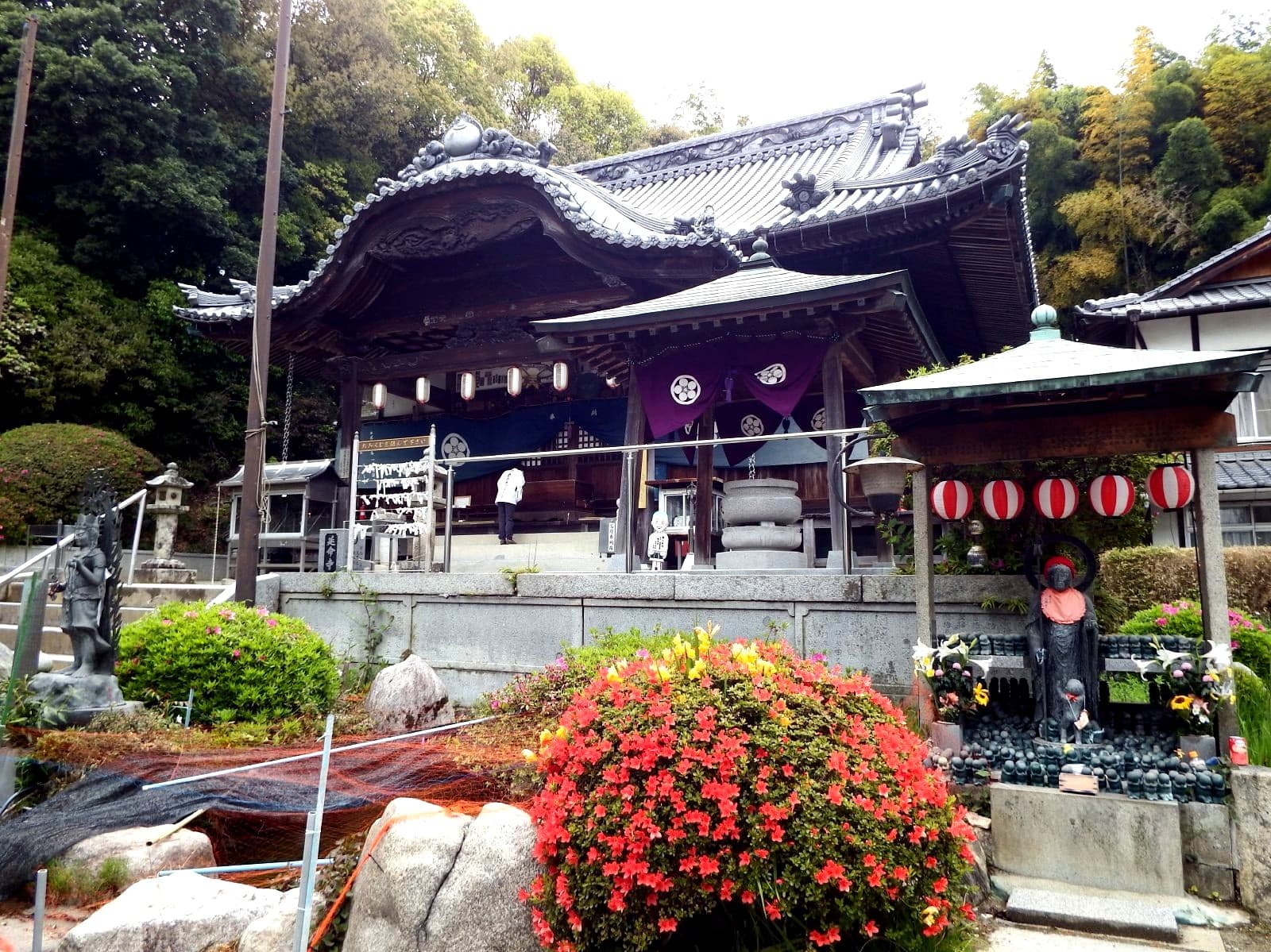
Image of Enmei-ji (延命寺). Image source · CC-BY-SA-4.0
Station 54 of 88
Shikoku 88 Temple PilgrimageVisit essentials
A quick read before you go
- Duration
- 30–45 minutes including both halls, the Jizō section, and the stamp office.
- Access
- Located at 34.0668° N, 132.9640° E just outside Imabari city.
Overview
After the long stretch north from Matsuyama — about 34 kilometres of road and trail through the Imabari plain — the henro arrives at Enmei-ji, the first temple in the dense Imabari cluster. The precinct is modest, leafy, peaceful in a way that feels earned after the walk. The principal image is Fudō Myōō, the wrathful esoteric protector understood in Shingon as a manifestation of Dainichi Nyorai. Tradition holds that Gyōki carved this Fudō at Mt.
Chikami in the eighth century, anchoring the temple's foundational sanctity to one of Japanese Buddhism's most influential bodhisattva-monks.
A distinctive architectural feature is the Hondō's roof ornament: a 'flaming turnip,' an unusual emblem read variously as a stylized cintāmaṇi (wish-fulfilling jewel) or as Fudō's blazing aureole. The flame-shape catches the eye against the temple's otherwise restrained appearance.
The temple is also a centre of mizuko-kuyō — memorial rites for unborn or lost children, including those lost through miscarriage, stillbirth, or abortion. Small statues of Jizō Bodhisattva, the bodhisattva who guides the souls of children through the underworld, line parts of the precinct. They are often draped with bibs, knit caps, and small toys left by grieving parents. Visitors arriving without preparation sometimes find these statues unexpectedly affecting.
Fudō's fierce protective fire and Jizō's tender care for the most vulnerable share the same grounds. The pairing is not accidental: in Japanese Buddhist iconography, Fudō cuts through delusion with his sword and Jizō receives the consequences with patience. Pilgrims passing through Enmei-ji often pause longer than expected, feeling the precinct's combination of structural protection and emotional care without quite naming it.
Founded in the Tenpyō era (729–749) by Gyōki on Mt. Chikami, rebuilt by Kūkai during the Konin era as 'Fudō-in Enmyō-ji,' relocated to its current lower-elevation site after fires, and renamed Enmei-ji after the Meiji Restoration to avoid confusion with Temple 53 Enmyō-ji, the temple has worn several names while retaining its devotional core.
Why this place is sacred
Three currents shape Enmei-ji: foundational sanctity rooted in the Gyōki-attributed Fudō image, active mizuko-kuyō memorial rites, and the flaming-turnip roof ornament spanning Buddhist iconography and folk visual sensibility.
Its location creates another threshold for walking henro. After some 34 km from Matsuyama, often divided over two days, Enmei-ji is the first return to dense temple clustering. Pilgrims often describe it as where the long walk's accumulated solitude settles.
Mizuko Jizō statues draped with bibs and small toys carry emotional weight beyond the precinct's modest scale, especially for visitors with histories of loss. Here Fudō's protective wrath and Jizō's tender attention share the same ground; their dual presence is the temple's quiet teaching.
Founded during the Tenpyō era (729–749) by Gyōki Bodhisattva on Mt. Chikami (748 m), with a Fudō Myōō image carved by Gyōki himself. Intended as a mountain training centre within the Nara state Buddhist network.
Rebuilt by Kūkai during the Konin era (810–824) by imperial order of Emperor Saga as 'Fudō-in Enmyō-ji,' becoming a centre for esoteric study and practice. After fires and decline, relocated from the mountain to the foot of Mt. Chikami at its current site. Renamed Enmei-ji ('Life-Prolonging Temple') after the Meiji Restoration to avoid confusion with Temple 53 Enmyō-ji in Matsuyama. Active mizuko-kuyō memorial practice has developed in modern times.
Functions today as Temple 54 of the Shikoku 88 within the Imabari cluster.
Experience and orientation
Most pilgrims arrive at Enmei-ji after the long stretch from Enmyō-ji (Temple 53), about 34 kilometres north through the Imabari plain. The precinct's first impression is of relief: leafy grounds, mature trees, a low scale that gathers rather than impresses. Walking pilgrims often pause at the entrance simply to set down packs.
The Hondō houses Fudō Myōō. Standard henro liturgy applies: candle, three incense sticks, sutra recitation, name slip, small coin in the box. The mantra of Fudō Myōō (Nōmaku samanda bazaradan senda makaroshada sowataya untarata kanman) is sometimes recited at this hall by pilgrims familiar with esoteric practice. Look up at the roof: the flaming-turnip ornament is unusual and immediately recognizable once noticed.
The Daishi-dō stands a short walk away. Standard offerings here also.
The mizuko Jizō statues are scattered through the precinct, often in a designated section. Each is small, stone, often with a red cloth bib tied around its neck or a knit cap on its head. Some have small toys, pinwheels, or fresh flowers placed at their bases by grieving parents. Visitors should not move or touch the offerings; the statues belong to specific families' grief work.
The stamp office sits beside the courtyard. Many pilgrims continue directly to Nankōbō (Temple 55), 3 kilometres further on — the Imabari cluster makes this stretch easy walking, with all six nearby temples reachable within a single day.
Located at 34.0668° N, 132.9640° E just outside Imabari city. From central Imabari, take a local bus or taxi (10–15 minutes); from Imabari Station, allow 15 minutes by car. Walking pilgrims approach from Enmyō-ji (Temple 53) approximately 34 km south or continue to Nankōbō (Temple 55) approximately 3 km southeast. The Niōmon faces the entrance; pass through and find the Hondō (with flaming-turnip roof) and Daishi-dō ahead, with the mizuko Jizō section to one side. Allow 30–45 minutes.
Context and lineage
By tradition, Gyōki Bodhisattva carved a statue of Fudō Myōō (an incarnation of Dainichi Nyorai) and built a mountain temple on Mt. Chikami in the eighth century, during the Tenpyō era (729–749). In the Konin era (810–824), Kūkai (Kōbō Daishi) reorganized the temple under imperial sponsorship from Emperor Saga as a centre for esoteric study and practice, naming it 'Fudō-in Enmyō-ji.'
After fires and warfare in subsequent centuries, the temple was relocated from the mountain summit to its current lower-elevation site at the foot of Mt. Chikami. Following the Meiji Restoration of 1868, when the government undertook administrative reorganization of Buddhist institutions, the temple was renamed Enmei-ji ('Life-Prolonging Temple') to avoid confusion with Temple 53 Enmyō-ji in Matsuyama. The flaming-turnip ornament on the Hondō roof is a distinctive sign read variously as a stylized cintāmaṇi or as Fudō's blazing aureole.
In modern times, the temple has developed a particular dedication to mizuko-kuyō — memorial rites for unborn and lost children — drawing grieving parents from the wider region.
Shingon Buddhism. The temple's mountain-Buddhist origins under Gyōki and its esoteric reorganization under Kūkai are the two foundational currents; the modern mizuko-kuyō practice draws on Jizō devotion within the Shingon frame.
Gyōki
Founder-sculptor by tradition
Emperor Saga
9th-century imperial patron
Kūkai (Kōbō Daishi)
Shingon refounder
Traditions and practice
Pilgrim sequence: bow at the Niōmon, purify hands and mouth, offer one candle and three incense sticks at the Hondō, recite the Heart Sutra and the Fudō mantra, present an osamefuda, repeat at the Daishi-dō, receive the stamp at the nōkyōjo. Periodic Fudō goma fire rituals are held on special occasions. Mizuko-kuyō memorial rituals can be arranged on request for those memorializing lost children.
Standard henro liturgy plus active mizuko memorial services. Many visitors who are not formally on pilgrimage come specifically for mizuko-kuyō. Pilgrims often spend a moment with the Jizō statues even without specific bereavement, in recognition of the precinct's care.
At the Hondō, consider including the Fudō mantra alongside the Heart Sutra; the wrathful protector is the temple's central figure and his mantra is part of the recommended liturgy here. Walk slowly past the Jizō section; the statues with their bibs, caps, and small toys belong to specific families' grief, and acknowledging them as such — without staring or photographing — is part of respectful presence.
If you carry your own loss, you are welcome to leave a small offering at one of the public Jizō figures.
Shingon Buddhism
ActiveTemple 54 of the Shikoku pilgrimage; principal image Fudō Myōō (Acala), the wrathful esoteric protector understood in Shingon as a manifestation of Dainichi Nyorai.
Pilgrim liturgy at Hondō and Daishi-dō; periodic Fudō goma fire rituals on special occasions.
Mizuko-kuyō (memorial for lost children)
ActiveThe temple has a special dedication to children lost through miscarriage, stillbirth, or abortion — an active devotional purpose drawing grieving parents from the wider region.
Memorial offerings, statues of Jizō Bodhisattva, prayers for the well-being of mizuko spirits.
Perspectives and open questions
Enmei-ji is read as a typical Nara-imperial foundation, as a centre of folk Jizō devotion, and — in some readings — as a quiet emblem of the Meiji-era administrative tidying that renamed it.
Scholarly perspective
Architectural and textual historians treat Enmei-ji as a standard Nara-period imperial-foundation legend with confirmed Shingon reorganization under Kūkai. The Meiji-era renaming illustrates the administrative tidying of duplicate temple names within a single province after 1868. Documentation of the temple's medieval history is sparse; the original Mt. Chikami site has not been excavated systematically.
Living and traditional perspectives
Locally, Enmei-ji is significant for healing and protection through Fudō Myōō, and as a place mothers and parents visit to console the spirits of unborn children. The Gyōki attribution of the Fudō image is honoured devotionally regardless of its archaeological verifiability.
Alternative interpretations
The flaming-turnip roof ornament is unusual in Buddhist symbolism — read variously as a stylized cintāmaṇi (wish-fulfilling jewel), Fudō's blazing aureole, or a folk-aesthetic flourish whose meaning has shifted over time. Some henro literature treats it as a small mystery emblematic of the precinct's combined austerity and tenderness.
Open questions
The original Mt. Chikami site has not been excavated systematically; the temple's medieval history is sparsely documented. The exact origin of the flaming-turnip ornament's symbolism is not definitively established.
Plan your visit
Access and arrival
Located at 34.0668° N, 132.9640° E just outside Imabari city. From central Imabari, 10–15 minutes by local bus or taxi. From Imabari Station, allow 15 minutes by car. Walking pilgrims approach from Enmyō-ji (Temple 53) approximately 34 km south or continue to Nankōbō (Temple 55) approximately 3 km southeast.
No shukubō at Enmei-ji. Pilgrims typically stay in central Imabari, where business hotels and ryokan are readily available. Walking pilgrims may arrange minshuku stays during the long Matsuyama-to-Imabari stretch.
Respectful visit
Modest, comfortable clothing covering shoulders and knees. Traditional henro dress (white hakui, sedge hat, stole, kongōzue) welcomed.
Permitted in the outdoor precinct, including the Niōmon and exterior of the Hondō (the flaming-turnip roof is a recognised photographic subject). Avoid photographing visitors making mizuko offerings. Avoid close-up photography of individual Jizō statues whose bibs, caps, and toys mark specific family memorials.
One candle and three incense sticks at each of the Hondō and Daishi-dō. Small coin offering at each box customary. Visitors leaving offerings at the Jizō statues may add small toys, bibs, or stones, particularly if memorializing a loss. Do not light from another's flame.
Respect the privacy of mourners. Do not move offerings on the Jizō statues. Quiet behavior throughout the precinct, particularly around the mizuko section. No eating, drinking, or smoking on grounds.
Do not light your candle from another's flame. Do not photograph visitors making mizuko offerings — bereaved parents are often present, and their privacy matters. Do not move offerings on the Jizō statues; toys, bibs, and small objects placed at their bases belong to specific memorial intentions. Quiet behaviour around the Jizō section is essential.
Current practical details
Address
Japan, 〒794-0081 Ehime, Imabari, Agata, 甲636
Phone
Hours
Hours, fees, and access can change — verify on the official source before you travel. Practical details last checked Jun 2026.
Location
Map loads as you approach this section.
Pilgrim reflections
A portrait of encounter, not a score
Pilgrims describe what they felt, how present they could become, and whether the place would shape a journey. There are no stars and no ranking of traditions.
No reviewed reflections yet
The first pilgrims can help describe the character of being here.
Share a reflection
Available after an account-backed “Been there.” Every reflection is reviewed before publication.
Watch deeper
Films, episodes, and recorded talks for visitors who want more context before or after a visit. Speculative and alternative-history entries are labelled as perspectives, not as sources for established claims.
Nearby sacred places
Explore other sacred places in the region. Proximity does not establish access or travel time; check each place’s guidance.


References
Sources consulted for this page. Source categories describe the publication, not a guarantee that every claim is verified. Traditional accounts and outside interpretations may differ.
- 01Enmei-ji Temple — Shikoku Pilgrimage News — Shikoku Pilgrimage NewsguideFounding by Gyōki, Kūkai's reorganization, name change history.
- 02Customs and Etiquette of the Shikoku Pilgrimage — Henro.orgguideEtiquette and hours.
- 03Enmei-ji – Japan Travel — Japan TravelguideAtmosphere, flaming-turnip roof ornament.
- 04Temple 54, Enmei-ji — Shikoku Tours — Shikoku ToursguidePractical pilgrim info.
Pilgrim glossary
- Bodhisattva
- An enlightened being who postpones full nirvana to help others toward awakening.
- Sutra
- A canonical Buddhist scripture, often chanted as part of practice.
- Mantra
- A sound, word, or phrase repeated as part of meditation or ritual.
- Shingon
- An esoteric Japanese Buddhist school emphasizing ritual, mantra, and mandala practice.
Share a photo
Help visitors recognize Enmei-ji. Every submission is reviewed before publication.