Taisan-ji
Where Kūkai built levees and saw a Jizō in the sky
Understand sacred places, explore living traditions, and learn how to engage respectfully with Pilgrim Map.
Access has not been verified. Check current local guidance before planning a visit.
Imabari, Ehime Prefecture, Japan
Read the sources
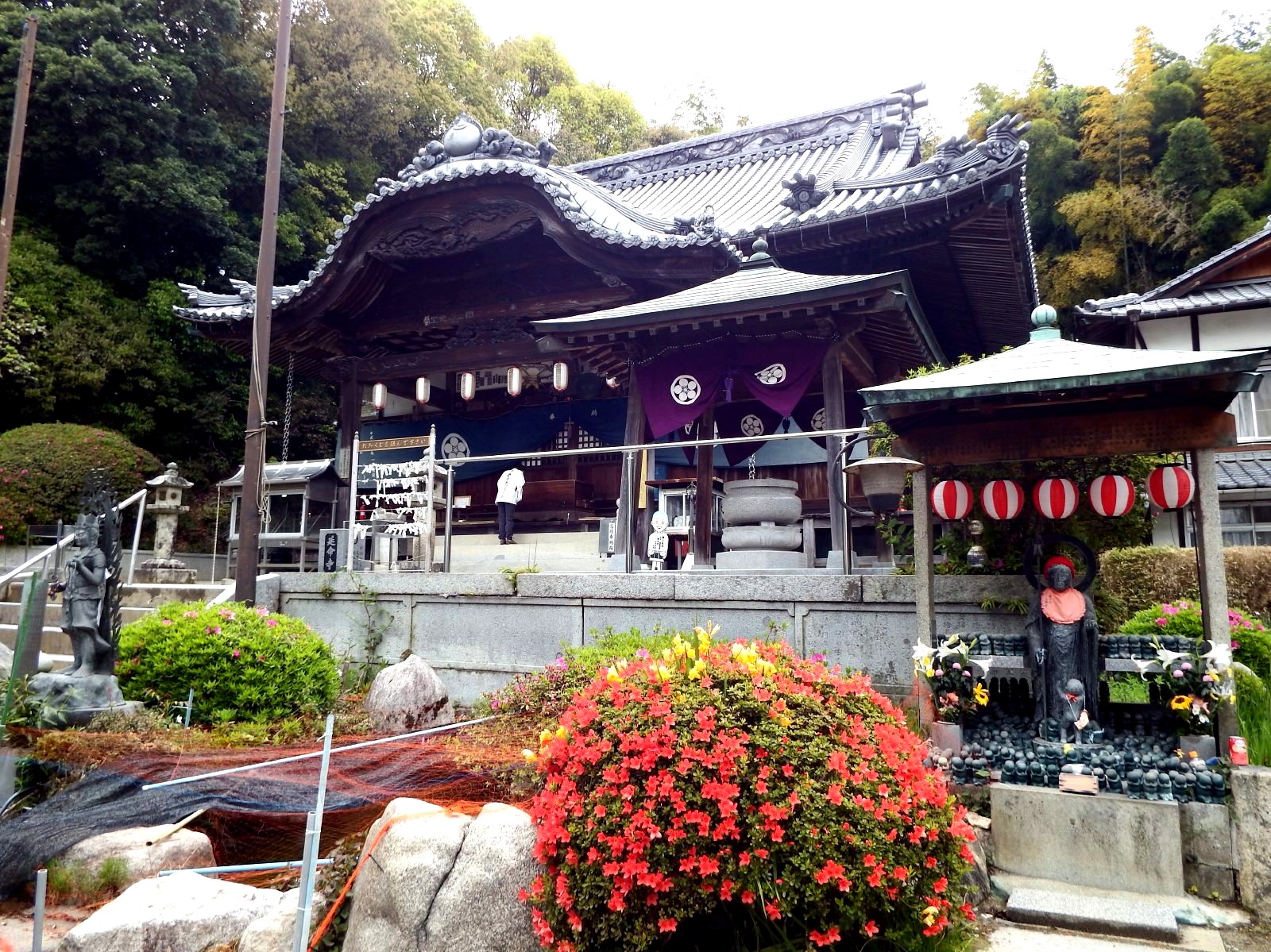
Image of Taisan-ji (泰山寺). Image source · CC-BY-SA-3.0
Station 56 of 88
Shikoku 88 Temple PilgrimageVisit essentials
A quick read before you go
- Duration
- 30–45 minutes including both halls and the stamp office.
- Access
- Located at 34.0501° N, 132.9746° E on the southern outskirts of Imabari.
Overview
Imabari's Taisan-ji — written 泰山寺 to distinguish it from the Matsuyama Taisan-ji 太山寺 (Temple 52) — sits on the city's southern outskirts on a distinctive elevated stone-platform foundation. The platform is part of the temple's atmosphere: solid, terraced, raising the precinct slightly above the surrounding land. The Sosha River runs nearby, and the temple's foundation legend belongs to it.
In 815, the Sosha — locally called 'Hitotori-gawa' ('Person-Taking River') because each rainy season it claimed lives — flooded catastrophically. Kūkai, then in his early forties and travelling Shikoku in the work that would become the 88-temple circuit, joined local villagers in building levees along the river. Alongside the practical engineering, he performed the secret 'earthen blessing' ritual (tsuchi-kuyō) at seven sites along the riverbank — a Shingon-esoteric configuration imposing cosmic order on the chaotic waters.
On the final day of the rite, Enmei Jizō Bodhisattva ('Life-Prolonging Jizō') appeared in the sky and declared the prayer fulfilled. Kūkai planted the 'Forgetful Pine' tree on the ritual site, carved a Jizō statue from his vision, and built the temple. In 824 it became an imperial temple under Emperor Junna.
The distinction matters: most of the 88 temples are reorganized by Kūkai or simply visited by him, but only a small number were personally founded. Taisan-ji (Imabari) is one. The foundation legend is also unusual in its concrete imagery: not just a vision but levees, not just prayer but engineering, not just contemplation but the practical work of saving lives. Pilgrims often note this — the example of compassion enacted as both labor and prayer at once.
The principal image is Enmei Jizō Bodhisattva — Jizō in his life-prolonging aspect, particularly invoked for protection of children and travellers. The temple's protective character extends to the long pilgrim road; Jizō's compassion has long been understood as a sheltering presence over those on the move. After the urban rhythm of Nankōbō, Taisan-ji's quieter elevated precinct offers a different register of presence in the same Imabari cluster.
Why this place is sacred
Imabari Taisan-ji's thinness is biographical and topographical. The temple's foundation is tied directly and concretely to Kūkai's actions on this specific stretch of land — engineering, ritual, vision. Where many Shikoku temples gain their pilgrimage significance through later Kūkai-attribution narratives, Taisan-ji's connection is more direct: this is one of the few temples Kūkai personally founded.
The Sosha River, formerly called the 'Person-Taking River' for its annual fatal flooding, runs near the temple. The foundation legend describes Kūkai working alongside villagers on levees during the day and performing tsuchi-kuyō ('earthen blessing') ritual at seven points along the riverbank.
The mandalic configuration of seven ritual sites along a chaotic waterway is a textbook Shingon esoteric pattern; the practical engineering alongside it is unusual in the broader Buddhist hagiographical record but consistent with Kūkai's documented engineering reputation (compare his role in Manno-ike reservoir reconstruction).
Enmei Jizō appearing in the sky is the closing image — the practical work and the ritual configuration culminating in a vision that becomes the principal devotional object. The carved statue is said to be Kūkai's own work from that vision.
The stone-platform foundation supporting the temple grounds is a distinctive architectural feature. Pilgrims approaching from the road climb a few steps onto the elevated precinct; the slight elevation matters atmospherically. The 'Forgetful Pine' Kūkai is said to have planted on the ritual site is part of the surrounding lore, though its exact location is no longer verifiable.
Founded in 815 by Kūkai (Kōbō Daishi) following his flood-control miracle and the appearance of Enmei Jizō, with a Jizō statue carved by Kūkai from the vision. Originally on the summit of Mt. Kanawa.
Designated an imperial temple under Emperor Junna in 824. Originally on the summit of Mt. Kanawa, later relocated to the foot of the mountain after fires and warfare. Functions today as Temple 56 of the Shikoku 88-temple pilgrimage. Its distinctive elevated stone-platform foundation supports the rebuilt precinct.
Experience and orientation
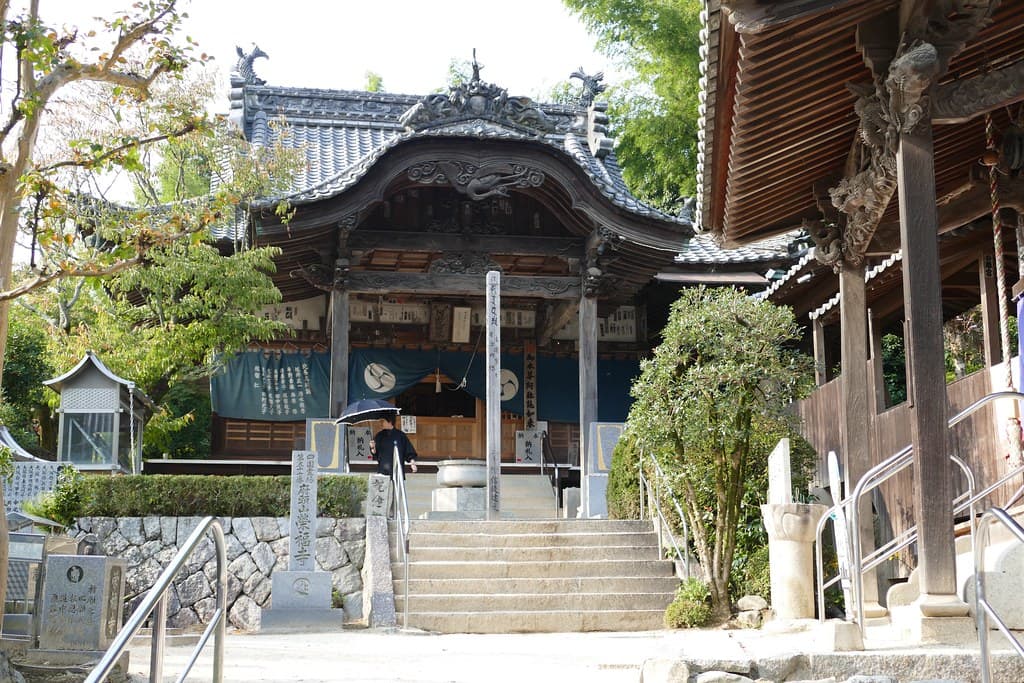
Most pilgrims arrive at Imabari Taisan-ji from Nankōbō (Temple 55), a 3-kilometre walk south through the city's outer edge. The temple announces itself with the elevated stone-platform foundation; even before reaching the gate, the visitor sees the precinct lifted slightly above road level, terraced into the landscape. Climb the steps to enter.
The Niōmon at the entrance is modest. Inside, the courtyard is quiet; this is one of the calmer Imabari temples, distinct from Nankōbō's central-city density. The Hondō houses Enmei Jizō Bodhisattva. Standard henro liturgy applies: candle, three incense sticks, sutra recitation, name slip, small coin in the box. Pilgrims sometimes add Jizō prayers explicitly for the protection of children, of travellers, or of those they have lost.
The Daishi-dō stands a short walk away. Standard offerings here also.
The temple's atmosphere benefits from knowing the foundation legend. Kūkai building levees alongside villagers; the seven ritual sites along the river; Enmei Jizō appearing in the sky on the closing day; the Forgetful Pine; the carved statue from the vision. The Sosha River nearby, now tame, was once 'Person-Taking.' Standing on the stone platform with this story in mind, the precinct's elevated solidity reads as part of the original protective gesture.
The stamp office sits beside the courtyard. Pilgrims continue from here to Eifuku-ji (Temple 57), about 3 kilometres further south, completing the next stage of the Imabari cluster.
Located at 34.0501° N, 132.9746° E on the southern outskirts of Imabari. From central Imabari or Nankōbō (Temple 55), 3 km south by road; reachable by car, taxi, or on foot via the henro trail. By taxi from Imabari Station, allow 15 minutes. The Niōmon is at the base of the stone-platform foundation; climb the steps to enter the elevated precinct, find the Hondō and Daishi-dō ahead, with the stamp office adjacent. Allow 30–45 minutes.
Context and lineage
In 815, the sixth year of the Konin era, the Sosha River — locally called the 'Hitotori-gawa' ('Person-Taking River') for the lives it claimed in seasonal floods — overflowed catastrophically. Kūkai (Kōbō Daishi), then travelling Shikoku in the work that would become the 88-temple circuit, joined the villagers in building levees along the riverbank.
Alongside the practical engineering, he performed the secret 'earthen blessing' ritual (tsuchi-kuyō) at seven sites along the river — a Shingon-esoteric mandalic configuration imposing cosmic order on the waters. On the closing day of the rite, Enmei Jizō Bodhisattva ('Life-Prolonging Jizō') appeared in the sky and declared the prayer fulfilled. Kūkai planted what came to be called the 'Forgetful Pine' tree on the ritual site, carved a statue of the Jizō he had seen, and built the temple.
In 824 the precinct became an imperial temple under Emperor Junna. Originally on the summit of Mt. Kanawa, the temple was later relocated to the foot of the mountain after fires and warfare. The current site is on a distinctive elevated stone-platform foundation.
Shingon Buddhism. The temple's foundation directly by Kūkai gives it a relatively unmediated connection to the Shingon esoteric tradition, with the Sosha River legend embodying the practical-and-ritual character of Kūkai's documented activity in his middle years.
Kūkai (Kōbō Daishi)
Founder, ritualist, sculptor
Emperor Junna
9th-century imperial patron
Traditions and practice
Pilgrim sequence: bow at the Niōmon, climb the stone-platform steps, purify hands and mouth, offer one candle and three incense sticks at the Hondō, recite the Heart Sutra and the Jizō mantra, present an osamefuda, repeat at the Daishi-dō, receive the stamp at the nōkyōjo. Pilgrims with concerns about children, travel safety, or longevity often direct prayers explicitly to Enmei Jizō at this hall.
The same sequence is followed by today's pilgrims. The temple's connection to Kūkai's foundation directly — rather than a later attribution — gives some pilgrims a particular sense of contact with the historical Kūkai at this site.
At the Hondō, take a moment with Enmei Jizō knowing the carved image is said to be Kūkai's own work from his vision after the flood-control rite. The dual register of practical labor (levees) and esoteric ritual (tsuchi-kuyō at seven sites) is the temple's specific teaching: compassion enacted simultaneously as work and prayer. If you have children or travel companions in your life, this is a natural place to extend the offering on their behalf.
Shingon Buddhism
ActiveTemple 56 of the Shikoku pilgrimage; principal image Enmei Jizō Bosatsu (Life-Prolonging Jizō), a manifestation of Jizō Bodhisattva venerated for protection of life and travellers. One of the few temples on the route Kūkai personally founded.
Pilgrim liturgy at Hondō and Daishi-dō; particular invocation of Jizō for protection, longevity, and the safety of children.
Perspectives and open questions
Imabari Taisan-ji is read as one of Kūkai's direct foundations, as a flood-control miracle site, and as a Jizō temple of practical protective character.
Scholarly perspective
Founding legends linking Kūkai to flood-control rituals are common across Japan and may reflect his actual engineering reputation; compare his documented role in the reconstruction of the Manno-ike reservoir in Sanuki. The historical kernel of the Sosha River legend is plausible in this context, though the specific details (seven ritual sites, the Forgetful Pine, the sky vision of Enmei Jizō) are part of devotional rather than archaeological record.
The temple's distinctive stone-platform foundation is a notable architectural feature though not a designated cultural property.
Living and traditional perspectives
Local devotion to Enmei Jizō continues for protection of life, especially for children and travellers; the temple is a familiar landmark of Imabari folk piety. The Kūkai-as-engineer-and-ritualist combination is honoured here as exemplary of the Daishi's documented work.
Alternative interpretations
Shingon esotericism interprets the 'earthen blessing' ritual at seven sites along the river as a mandalic configuration imposing cosmic order on chaotic waters — the river's fatal flooding being subdued not just by physical levees but by the ritual geometry that sanctifies the landscape. Read this way, the temple commemorates a moment when esoteric practice and civil engineering coincided.
Open questions
The exact location of Kūkai's original ritual sites and the 'Forgetful Pine' is unverifiable. How much of the existing structure dates to before the relocation from Mt. Kanawa is unclear; postwar and later rebuilds shape much of what is currently visible.
Plan your visit
Access and arrival
Located at 34.0501° N, 132.9746° E on the southern outskirts of Imabari. From Nankōbō (Temple 55), 3 km south by road on the henro trail. By taxi from Imabari Station, 15 minutes. Reachable by car, taxi, or on foot.
No shukubō at Imabari Taisan-ji. Pilgrims typically stay in central Imabari, where business hotels and ryokan are abundant within a short taxi ride. Walking pilgrims can also arrange minshuku stays in nearby villages.
Respectful visit
Modest, comfortable clothing covering shoulders and knees. Traditional henro dress (white hakui, sedge hat, stole, kongōzue) welcomed. Sturdy footwear is helpful for the stone steps onto the elevated precinct.
Permitted in the outdoor precinct, including the Niōmon, the stone-platform foundation, and exteriors of the halls. Standard restraint inside halls; do not photograph the principal image without permission.
One candle and three incense sticks at each of the Hondō and Daishi-dō. Small coin offering at each box customary. Place an osamefuda in each hall's box. Do not light from another's flame.
Quiet behavior. Do not touch or move offerings on Jizō statues. Do not climb on the stone-platform sides or sit on their edges. No eating, drinking, or smoking on grounds.
Do not light your candle from another pilgrim's flame. Do not touch or move offerings on the Jizō statues — particularly important here, as some are placed by parents memorializing children. Photograph with restraint inside halls. The stone-platform foundation has uneven steps in places; care for footing on entry.
Current practical details
Address
1-chōme-9-18 Koizumi, Imabari, Ehime 794-0064, Japan
Phone
Hours
Hours, fees, and access can change — verify on the official source before you travel. Practical details last checked Jun 2026.
Location
Map loads as you approach this section.
Pilgrim reflections
A portrait of encounter, not a score
Pilgrims describe what they felt, how present they could become, and whether the place would shape a journey. There are no stars and no ranking of traditions.
No reviewed reflections yet
The first pilgrims can help describe the character of being here.
Share a reflection
Available after an account-backed “Been there.” Every reflection is reviewed before publication.
Watch deeper
Films, episodes, and recorded talks for visitors who want more context before or after a visit. Speculative and alternative-history entries are labelled as perspectives, not as sources for established claims.
Nearby sacred places
Explore other sacred places in the region. Proximity does not establish access or travel time; check each place’s guidance.

References
Sources consulted for this page. Source categories describe the publication, not a guarantee that every claim is verified. Traditional accounts and outside interpretations may differ.
- 01Taisanji Temple — Shikoku Pilgrimage News — Shikoku Pilgrimage NewsguideDetailed founding legend (Kūkai's flood-control miracle).
- 02Taisanji – Henro.org — Henro.orgguidePilgrim guide entry.
- 03Kinrinzan Chokuoin Taisanji — Shikoku 88 — Shikoku 88guideOfficial Shikoku 88 description.
- 04Customs and Etiquette of the Shikoku Pilgrimage — Henro.orgguideEtiquette and hours.
- 05Taisan-ji — Japan Travel — Japan TravelguideStone-platform setting, atmosphere.
Pilgrim glossary
- Bodhisattva
- An enlightened being who postpones full nirvana to help others toward awakening.
- Sutra
- A canonical Buddhist scripture, often chanted as part of practice.
- Mantra
- A sound, word, or phrase repeated as part of meditation or ritual.
- Shingon
- An esoteric Japanese Buddhist school emphasizing ritual, mantra, and mandala practice.
Share a photo
Help visitors recognize Taisan-ji. Every submission is reviewed before publication.