Eifuku-ji
A sea-prayer temple where Amida is said to have drifted ashore after Kūkai's goma fire
Understand sacred places, explore living traditions, and learn how to engage respectfully with Pilgrim Map.
Access has not been verified. Check current local guidance before planning a visit.
Imabari, Ehime Prefecture, Japan
Read the sources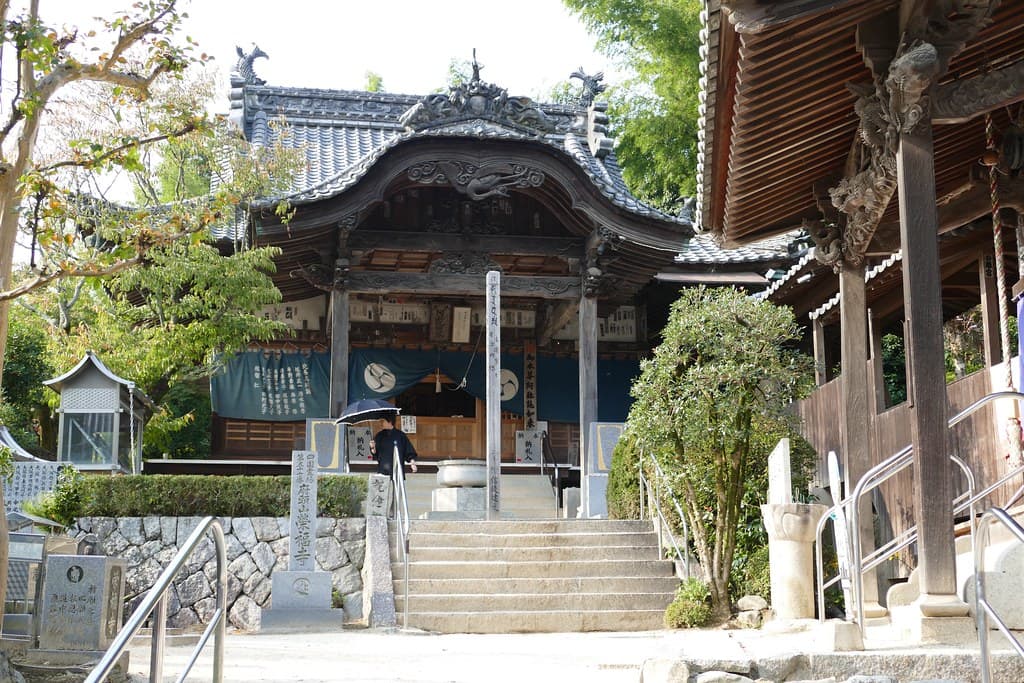
Image of Eifuku-ji (栄福寺). Image source
Station 57 of 88
Shikoku 88 Temple PilgrimageVisit essentials
A quick read before you go
- Duration
- 20–40 minutes for a complete ritual visit and stamp.
- Access
- Approximately 3 km southeast of central Imabari.
Overview
Eifuku-ji (T57) is the modest first of three Imabari-area temples often joined in one walking morning, before the climb to Senyū-ji and the crossing to Iyo Kokubun-ji. Its small precinct holds a Hondō, Daishi-dō, bell tower, and stamp office: a place for arriving, chanting, and continuing.
In the Konin era (814–824), Kūkai is said to have performed several days of goma fire ritual on nearby Mt. Futo to calm the Seto Inland Sea. When the water stilled, an image of Amida Nyorai was found on the shore and enshrined where the rite ended. Fishermen, ferry workers, and others dependent on the inland sea still pray here for safety.
After the 1868 shinbutsu-bunri separation of kami and Buddhist worship, Eifuku-ji split from its associated shrine and moved halfway up the mountain, simplifying an older ritual fabric.
Henro pass the sanmon, recite the Heart Sutra and Amida's shingon—On amirita teizei kara un—at the Hondō and again at the Daishi-dō, receive the stamp, bow, and leave. Bamboo-and-cedar stillness within bustling Imabari lets this well-kept, ordinary fudasho serve as a calibration of pilgrimage practice—three sutra recitations and three offerings—rather than spectacle.
Why this place is sacred
The thinness of Eifuku-ji is concentrated in two layers: the founding legend of Kūkai's goma ritual on Mt. Futo and the drifted-ashore Amida statue, and the long communal practice of sea prayer that grew from it. The site is not visually dramatic—it does not occupy a high peak or a famous shrine. Its sanctity is documentary as much as elemental: the mid-Edo handwritten sutra book inscribed 'Betto Eifukuji' confirms the temple's role as a stamp-issuing fudasho across centuries.
The precinct itself is a modest hill amid bamboo and cedar, with views toward the inland sea and toward the buildings of modern Imabari. Pilgrims describe a meditative hush distinct from the surrounding city—not silence, but the quality of attention that small wooded precincts above urban land tend to hold.
A site to mark Kūkai's sea-calming goma ritual and to enshrine the Amida Nyorai statue said to have drifted ashore after it. From the start the temple was tied to the safety of those who travelled the inland sea.
Pre-Edo records were lost in late Sengoku-era warfare; documentary continuity resumes in the mid-Edo period. The 1868 shinbutsu-bunri order separated the temple from its associated Inari shrine on Mt. Futo and prompted a move halfway up the mountain. The current Hondō and Daishi-dō, the bell tower, and the stamp office sit in this post-Meiji arrangement. The maritime devotional layer—prayers for safety at sea and on the road—has continued through every structural change.
Experience and orientation
Pilgrims arriving on foot reach Eifuku-ji after a stretch of approach roads through the suburbs of Imabari. The sanmon marks a clear threshold: street noise gives way to bamboo, cedar, and a slight gradient of stone steps. The Hondō stands modestly forward, the Daishi-dō to one side. There is no large hall, no museum, no extensive grounds to wander—just the two halls, a wash basin, the bell tower, and the small stamp office.
A typical visit follows the standard fudasho sequence: rinse hands and mouth at the basin, ring the bell on arrival (if at all; departure-ring is considered inauspicious), light a candle and three sticks of incense, offer an osamefuda slip, chant the Heart Sutra and the honzon shingon at the Hondō, then repeat at the Daishi-dō. The whole sequence runs 20–40 minutes.
Local devotees come specifically to pray for safe travel by sea and road; their presence threads through any morning visit, and ferry workers and fishermen are not unusual sights. Most walking pilgrims pair the visit with the climb up Mt. Sakurei to Senyū-ji (T58) immediately afterward—the two temples form a natural rhythm of plain and mountain in a single morning.
The temple sits roughly 3 km southeast of central Imabari, on a low hill at the foot of Mt. Futo. Walking pilgrims usually arrive from Tai-san-ji (T56) further north and continue south afterward to climb up to Senyū-ji. By car or local bus, a small parking lot is available at the base/up the hill, with a short walk to the sanmon.
Context and lineage
During the Konin era (814–824), Emperor Saga is said to have ordered Kūkai to climb Mt. Futo and perform a goma fire ritual to calm the storms of the Seto Inland Sea. Over several days the ritual was sustained, and on the final day the sea grew still. A statue of Amida Nyorai was discovered drifted onto the shore beneath the mountain, and Kūkai enshrined it at the site where the ritual had ended.
The temple has been a sea-protection center since.
Koyasan Shingon school—the largest of the Shingon sub-schools, headquartered at Mt. Kōya. Eifuku-ji is one of many Koyasan-affiliated fudasho on the Shikoku route. Liturgically the temple follows standard Koyasan Shingon practice: Heart Sutra, honzon shingon, Daishi gohōgo, with goma fire rituals on commemorative days.
Kūkai (Kōbō Daishi)
Founding priest of Eifuku-ji and originator of the sea-calming goma ritual on Mt. Futo.
Emperor Saga
Imperial patron who is said to have commissioned the ritual.
Traditions and practice
The core practice at Eifuku-ji is the standard pilgrim sequence: Heart Sutra recitation, honzon shingon for Amida Nyorai (On amirita teizei kara un), Kōbō Daishi gohōgo, an osamefuda offering, and candle and incense at both the Main Hall and the Daishi-dō. Goma fire rituals follow the Koyasan Shingon calendar on commemorative days. Local fishermen and ferry workers leave votive offerings asking protection from storms and accidents.
The temple operates as an active fudasho with a daily stamp office and full pilgrimage reception. Periodic memorial and goma services run per the standard Shingon calendar. Group bus tours pass through during morning hours; quiet individual prayer is the dominant rhythm at other times.
If unfamiliar with the full liturgy, a stripped-down practice still honors the form: rinse hands at the basin, light one candle and three sticks of incense, place an osamefuda, chant or read the Heart Sutra silently, and bow. Doing the same sequence at the Daishi-dō makes the visit complete. The maritime layer of the temple invites a moment to consider one's own crossings—bodies of water, transits, returns.
Shingon Buddhism (Koyasan school)
Active57th fudasho of the Shikoku 88-temple circuit; tied to Kōbō Daishi's legend involving the Seto Inland Sea.
Daily liturgy at Hondō and Daishi-dō, sutra recitation, goma fire ritual on commemorative days, distribution of nokyō-chō stamps.
Maritime folk veneration
ActiveLong associated with prayers for safety at sea and protection from storms on the inland sea.
Votive offerings from local fishermen and ferry workers; prayers for traffic safety and longevity.
Perspectives and open questions
Eifuku-ji is straightforward as a pilgrimage temple: a Konin-era Shingon foundation, post-Meiji rearrangement, active fudasho today. The interpretive layers concentrate around its founding legend and its long association with sea prayer.
Scholarly perspective
Documented as a working Shingon fudasho with verifiable Edo-period pilgrimage stamp records. The mid-Edo handwritten sutra book inscribed 'Betto Eifukuji' confirms the temple's long-standing role on the route. Pre-Edo records were lost in the late Sengoku wars, and the original location before the 1868 move is only partially documented.
Living and traditional perspectives
Local maritime communities continue to view Eifuku-ji as a kami-Buddha protector of the inland sea, even after the formal separation from the original shrine in 1868. The temple's role in fishermen's prayers and traffic-safety devotions is unbroken.
Alternative interpretations
In Shingon honji-suijaku readings, Amida Nyorai's drifting ashore is interpreted as the Buddha self-revealing at the site of the ritual rather than being placed there by human agency. The legend describes manifestation rather than installation.
Open questions
The full ritual fabric of the temple before its separation from the Mt. Futo shrine in 1868 is only partly recoverable; combined kami-Buddha liturgies that may have been performed at the original site survive in fragments rather than as continuous practice.
Plan your visit
Access and arrival
Approximately 3 km southeast of central Imabari. Reachable by car (small parking lot at the base/up the hill) or by local bus and a short walk. Walking henro typically arrive from Tai-san-ji (T56) and continue afterward up to Senyū-ji (T58).
No shukubo at Eifuku-ji. Senyū-ji (T58), the next temple, operates an active shukubo with shōjin ryōri and onsen. Imabari city has standard hotel and minshuku options.
Respectful visit
Modest clothing. Pilgrim white (hakui), the conical hat (sugegasa), and the walking staff (kongōzue) are common but not required. Hats are removed when chanting.
Permitted in the open precinct. Not permitted inside the Main Hall or directly at the honzon. Avoid photographing pilgrims who are praying.
Coin, candle, three sticks of incense, and an osamefuda slip at both the Hondō and the Daishi-dō.
Do not ring the bell on departure. Do not enter the inner sanctum. Stay on paved paths within the precinct.
Do not ring the bell on departure (considered inauspicious in henro practice). Do not photograph the interior of the Main Hall or the honzon. Avoid pointing cameras directly at praying pilgrims.
Current practical details
Address
甲200 Tamagawachō Yawata, Imabari, Ehime 794-0114, Japan
Phone
Hours
Hours, fees, and access can change — verify on the official source before you travel. Practical details last checked Jun 2026.
Location
Map loads as you approach this section.
Pilgrim reflections
A portrait of encounter, not a score
Pilgrims describe what they felt, how present they could become, and whether the place would shape a journey. There are no stars and no ranking of traditions.
No reviewed reflections yet
The first pilgrims can help describe the character of being here.
Share a reflection
Available after an account-backed “Been there.” Every reflection is reviewed before publication.
Watch deeper
Films, episodes, and recorded talks for visitors who want more context before or after a visit. Speculative and alternative-history entries are labelled as perspectives, not as sources for established claims.
Nearby sacred places
Explore other sacred places in the region. Proximity does not establish access or travel time; check each place’s guidance.


References
Sources consulted for this page. Source categories describe the publication, not a guarantee that every claim is verified. Traditional accounts and outside interpretations may differ.
- 01Eifukuji Temple, Temple No. 57 of the 88 Sacred Temples of Shikoku — Shikoku Pilgrimage NewsofficialDetailed history of founding, Kobo Daishi connection, and Meiji separation.
- 02Eifukuji – Imabari, Ehime Prefecture, Shikoku — Henro.orgguideStandard pilgrim reference with grounds layout and access notes.
- 03Temple 57, Eifukuji — Tourism ShikokuofficialTourism board summary with practical visit info.
- 04Customs and Etiquette of the Shikoku Pilgrimage — Henro.orgguidePilgrim etiquette and standard temple opening hours (7am–5pm).
Pilgrim glossary
- Honzon
- The principal Buddhist deity enshrined as a temple's central object of worship.
- Sutra
- A canonical Buddhist scripture, often chanted as part of practice.
- Shingon
- An esoteric Japanese Buddhist school emphasizing ritual, mantra, and mandala practice.
Share a photo
Help visitors recognize Eifuku-ji. Every submission is reviewed before publication.