Nankōbō
The only 'bō' among the eighty-eight
Understand sacred places, explore living traditions, and learn how to engage respectfully with Pilgrim Map.
Access has not been verified. Check current local guidance before planning a visit.
Imabari, Ehime Prefecture, Japan
Read the sources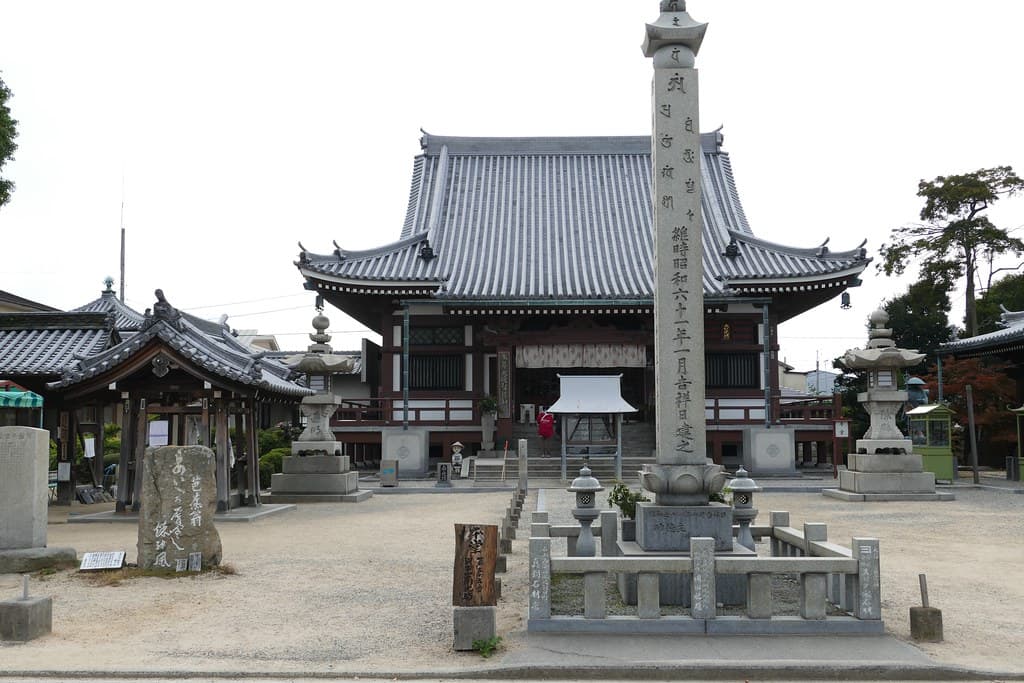
Image of Nankōbō (南光坊). Image source
Station 55 of 88
Shikoku 88 Temple PilgrimageVisit essentials
A quick read before you go
- Duration
- 30–45 minutes for the temple alone; allow 60–75 minutes if including the adjacent Bekku…
- Access
- Located at 34.0688° N, 132.9958° E in central Imabari.
Overview
Nankōbō stands in central Imabari, an architecturally substantial urban temple distinguishable from the route's mountain and forest sites. What distinguishes it most among the 88, though, is its name. 'Nankōbō' (南光坊) — the 'bō' (坊) means a priest's lodging — is the only temple on the entire pilgrimage whose name carries this character, a small linguistic relic of the temple's origin as a sub-temple within a larger religious complex.
That complex was Bekku Ōyamazumi Shrine, the mainland branch of Ōyamazumi Shrine on Ōmishima island, dedicated to Ōyamatsumi-no-Kami, the kami of mountains and seafaring. Eight 'bō' (priests' lodgings) once served Bekku Ōyamazumi; Nankōbō was one. Buddhist priests living in these lodgings conducted combined Buddhist–Shintō ritual on behalf of the shrine, in the long pre-Meiji pattern of shinbutsu-shūgō ('combined kami and Buddha worship').
When Kūkai organized the Shikoku circuit in the early ninth century, he designated Nankōbō as Temple 55, anchoring the lodging firmly into Shingon practice while leaving its shrine affiliation intact.
In 1868, the new Meiji government issued the shinbutsu-bunri edicts, forcibly separating Buddhist temples from Shintō shrines across Japan. Nankōbō was administratively detached from Bekku Ōyamazumi, ending more than a millennium of combined practice. The temple still faces the surviving Bekku Ōyamazumi Shrine across a short distance — close neighbours now formally distinct.
The principal image is Daitsū-chishō Buddha (Mahābhijñā-jñānābhibhū), described in the Lotus Sūtra as a Buddha countless aeons in the past. He is one of the rarest Buddhas in Japanese veneration; few other temples in Japan enshrine him as principal. Standing before this image is to invoke a cosmological depth — Buddha-time stretching across kalpas — that the temple's compact urban precinct contains without dramatizing.
Largely destroyed by US air raids on Imabari in 1945, the temple was rebuilt postwar. The grounds today preserve a sense of continuity through reconstruction. For the henro, Nankōbō is a stop where the route's deep historical entanglement with Shintō becomes visible at the level of a single character preserved in a temple name.
Why this place is sacred
Nankōbō's thinness is historical and linguistic rather than architectural. The temple's deepest significance lies in what its surviving name encodes: the centuries when Buddhist and Shintō practice were institutionally inseparable in Japan, and the abrupt 1868 separation that ended that pattern.
For most of Japanese history, Buddhist priests lived in 'bō' attached to major Shintō shrines, conducting joint liturgy that addressed kami and Buddhas as different facets of a single sacred field. The shinbutsu-bunri edicts of 1868 ended this with administrative force; many bō were destroyed, repurposed, or absorbed into one tradition or the other. Nankōbō survived because of its designation as a Shikoku 88 temple, but its name became a memorial to all that did not survive.
The principal image, Daitsū-chishō Buddha, adds cosmological depth. The Lotus Sūtra describes him as a Buddha who attained awakening incalculable kalpas in the past. Where most Buddhist veneration centres on relatively recent or accessible figures, Daitsū-chishō pulls the imagination across vast cosmic time. Standing before him at Nankōbō, the temple's accumulated history — Ōyamazumi origins in the sixth century, Kūkai's ninth-century designation, the 1868 separation, the 1945 bombing, the postwar rebuilding — recedes into a much longer perspective.
The surviving Bekku Ōyamazumi Shrine adjacent is part of the temple's thinness. Pilgrims can walk between them in minutes. The historical wound and the surviving reconciliation are simultaneously present.
One of eight 'bō' (priests' lodgings) attached to Bekku Ōyamazumi Shrine, the mainland branch of Ōyamazumi Shrine, conducting combined Buddhist–Shintō ritual on behalf of the shrine.
Designated Temple 55 of the Shikoku circuit by Kūkai in the early ninth century, anchoring it into Shingon practice while leaving the shrine affiliation intact. Continued in shinbutsu-shūgō practice for nearly a millennium. Forcibly separated from Bekku Ōyamazumi Shrine by the 1868 shinbutsu-bunri edicts. Largely destroyed by US air raids on Imabari in 1945; rebuilt postwar. Functions today as Temple 55, the only 'bō' among the 88 — a surviving linguistic relic of pre-Meiji unified practice.
Experience and orientation
Nankōbō is reached easily from Imabari Station — a short walk through central streets, with the temple announcing itself in the urban grid. After Enmei-ji's leafy seclusion, Nankōbō's setting feels distinctly different: traffic, neighbouring buildings, the rhythm of city life around the precinct walls. The grounds, when entered, are larger than expected for a city-centre temple; this is one of the more architecturally substantial temples in the Imabari cluster.
Postwar reconstruction shaped most of what is visible today. The temple was largely destroyed by US air raids on Imabari in 1945; the rebuilt halls preserve the layout but are inevitably newer than the medieval architecture seen at Ishite-ji or Taisan-ji. Standard henro liturgy applies. The Hondō (Yakushi-dō) houses Daitsū-chishō Buddha flanked by Miroku Bodhisattva and Kannon Bodhisattva. Candle, three incense sticks, sutra recitation, name slip, small coin in the box.
The Daishi-dō stands a short walk away. Standard offerings here also.
Many pilgrims walk on to Bekku Ōyamazumi Shrine, immediately adjacent. The shrine's torii faces close to the temple's grounds; visiting both gives a small but vivid demonstration of pre-Meiji religious geography. The shrine itself preserves a long history; the affiliated Ōyamazumi Shrine on Ōmishima island holds an enormous National Treasure collection of arms and armor, though that is a separate visit some distance away.
The stamp office sits beside the courtyard. Most pilgrims continue from here to Taisan-ji (Temple 56), about 3 kilometres south, or use Nankōbō's central location to overnight in Imabari before tackling the rest of the cluster.
Located at 34.0688° N, 132.9958° E in central Imabari, walking distance from Imabari Station. Walk approximately 10–15 minutes east from the station. Walking pilgrims approach from Enmei-ji (Temple 54) approximately 3 km north, or continue to Taisan-ji (Temple 56) approximately 3 km south. The Niōmon faces the entrance; pass through and find the Hondō (Yakushi-dō) ahead, with the Daishi-dō and stamp office adjacent. The Bekku Ōyamazumi Shrine is immediately adjacent; visiting both is recommended.
Allow 30–45 minutes for the temple, longer if including the shrine.
Context and lineage
Origins trace to the imperial-era founding of Ōyamazumi Shrine on Ōmishima in 594. The mainland branch shrine — Bekku Ōyamazumi — established a religious complex on what is now central Imabari, with eight 'bō' (priests' lodgings) serving the shrine through Buddhist–Shintō combined ritual. Nankōbō was one of these eight. Kūkai (Kōbō Daishi) in the early ninth century designated Nankōbō as Temple 55 of his Shikoku pilgrimage circuit, embedding it firmly within Shingon practice while leaving its shrine affiliation intact.
The temple's shinbutsu-shūgō pattern continued for nearly a millennium. In 1868, the new Meiji government's shinbutsu-bunri edicts forcibly separated Buddhist temples from Shintō shrines across Japan; Nankōbō was administratively detached from Bekku Ōyamazumi, though the two institutions remained physically adjacent. The temple was largely destroyed by US air raids on Imabari in August 1945 during the Pacific War.
Reconstruction in the postwar period rebuilt the halls and grounds while preserving the temple's identity as Temple 55 and as the only 'bō' on the 88-temple route. The principal image is Daitsū-chishō Buddha, a rare Buddha described in the Lotus Sūtra as having attained awakening countless aeons in the past, flanked at the Hondō by Miroku and Kannon.
Shingon Buddhism. The temple's pre-Meiji history sits within shinbutsu-shūgō (combined kami and Buddha worship); since 1868 the institutional affiliation has been Shingon alone, with the surviving Bekku Ōyamazumi Shrine adjacent as a separate institution.
Ōyamatsumi-no-Kami
Patron kami of mountains and seafaring
Kūkai (Kōbō Daishi)
Pilgrimage organizer
Traditions and practice
Pilgrim sequence: bow at the Niōmon, purify hands and mouth, offer one candle and three incense sticks at the Hondō, recite the Heart Sutra, present an osamefuda, repeat at the Daishi-dō, receive the stamp at the nōkyōjo. The Hondō houses Daitsū-chishō Buddha flanked by Miroku Bodhisattva and Kannon Bodhisattva.
The same sequence is followed by today's pilgrims. Visitors are encouraged also to visit Bekku Ōyamazumi Shrine adjacent, which preserves the shrine half of the pre-Meiji partnership. Some pilgrims explicitly do both as a gesture of acknowledgement to the temple's history.
At the Hondō, take a moment with Daitsū-chishō Buddha — one of the rarest Buddhas in Japanese veneration, described in the Lotus Sūtra as having attained awakening incalculable kalpas in the past. The cosmological scale of his presence is part of what the temple offers. After the formal liturgy, walk to Bekku Ōyamazumi Shrine adjacent; the short passage between temple and shrine traces a thousand years of joint practice severed in 1868. The pairing is part of Nankōbō's lived meaning.
Shingon Buddhism
ActiveTemple 55 of the Shikoku pilgrimage; the only one of the 88 with 'bō' (priest's lodging) in its name, indicating its origin as a sub-temple within a larger religious complex.
Pilgrim liturgy at Hondō and Daishi-dō.
Pre-Meiji shinbutsu-shūgō (combined Buddhist–Shintō practice with Ōyamazumi)
HistoricalUntil 1868, Nankōbō was administratively part of Bekku Ōyamazumi Shrine — a sub-temple (bekku, 'separate hall') of the great shrine to Ōyamatsumi-no-Kami, kami of mountains and seafaring. The Meiji shinbutsu-bunri edicts forcibly separated them.
Historical: combined Buddhist–Shintō liturgies; today preserved in temple memory and the surviving Bekku Ōyamazumi Shrine nearby.
Perspectives and open questions
Nankōbō is read as a textbook example of pre-Meiji jingūji (shrine-temple) practice and its disruption, as the linguistic exception among the 88, and as a reflection point on religious continuity through war and political upheaval.
Scholarly perspective
Nankōbō exemplifies the pre-Meiji jingūji ('shrine-temple') pattern in which Buddhist priests served kami enshrinements; its 1868 separation from Bekku Ōyamazumi Shrine is a textbook case of shinbutsu-bunri policy. The temple's survival as a Shikoku 88 site allowed it to retain its 'bō' name where many other lodgings of similar origin were dissolved, repurposed, or destroyed in the post-Meiji decades.
Living and traditional perspectives
Pilgrims regard Daitsū-chishō Butsu — said in the Lotus Sūtra to be a Buddha countless aeons in the past — as anchoring the temple in cosmic-scale time. The rarity of his enshrinement makes Nankōbō a particular object of devotion for those drawn to the Lotus Sūtra's vast temporal frames.
Alternative interpretations
Some henro literature treats Nankōbō's surviving 'bō' name as a memorial of all that was lost in shinbutsu-bunri — a small linguistic relic of unified practice. From this perspective, walking between the temple and the adjacent shrine is to traverse a wound that has not fully healed; the geography itself preserves the historical memory.
Open questions
The exact ritual relationship between the eight pre-Meiji bō and Bekku Ōyamazumi Shrine is incompletely documented; only Nankōbō survives as a recognisable continuation. Specific medieval temple history is sparse in available sources.
Plan your visit
Access and arrival
Located at 34.0688° N, 132.9958° E in central Imabari. Walking distance from Imabari Station — approximately 10–15 minutes east on foot. By car or taxi, very accessible. The temple is one of the easiest on the route to reach by public transport.
No shukubō at Nankōbō, but central Imabari has abundant business hotels and ryokan within walking distance. The temple's central location makes it convenient for pilgrims overnighting in the city before continuing to the rest of the Imabari cluster the following day.
Respectful visit
Modest, comfortable clothing covering shoulders and knees. Traditional henro dress (white hakui, sedge hat, stole, kongōzue) welcomed but not required. The walk between Imabari Station and the temple is short and easy.
Permitted in the outdoor precinct, including the Niōmon and exterior of the halls. Standard restraint inside halls; do not photograph the principal image without explicit permission. At the adjacent Bekku Ōyamazumi Shrine, follow Shintō shrine photography norms (typically permitted in outer grounds, restricted near the honden).
One candle and three incense sticks at each of the Hondō and Daishi-dō. Small coin offering at each box customary. Place an osamefuda in each hall's box. Do not light from another's flame.
Quiet behavior. Respect for both temple and adjacent shrine. No eating, drinking, or smoking on grounds. The urban setting means the precinct is closer to neighbouring residences than at most route temples; keep voices low when entering and leaving.
Do not light your candle from another pilgrim's flame. Photograph with restraint inside halls; the principal image of Daitsū-chishō is not generally photographed. Be respectful of the urban temple's neighbours; the precinct is in a residential area.
Current practical details
Address
3-chōme-1 Bekkuchō, Imabari, Ehime 794-0026, Japan
Phone
Hours
Hours, fees, and access can change — verify on the official source before you travel. Practical details last checked Jun 2026.
Location
Map loads as you approach this section.
Pilgrim reflections
A portrait of encounter, not a score
Pilgrims describe what they felt, how present they could become, and whether the place would shape a journey. There are no stars and no ranking of traditions.
No reviewed reflections yet
The first pilgrims can help describe the character of being here.
Share a reflection
Available after an account-backed “Been there.” Every reflection is reviewed before publication.
Watch deeper
Films, episodes, and recorded talks for visitors who want more context before or after a visit. Speculative and alternative-history entries are labelled as perspectives, not as sources for established claims.
Nearby sacred places
Explore other sacred places in the region. Proximity does not establish access or travel time; check each place’s guidance.

References
Sources consulted for this page. Source categories describe the publication, not a guarantee that every claim is verified. Traditional accounts and outside interpretations may differ.
- 01Temple 55, Nankōbō — Tourism Shikoku — Tourism ShikokuguideOfficial tourism description.
- 02Nankobo, Temple No. 55 — Shikoku Pilgrimage News — Shikoku Pilgrimage NewsguideOyamazumi connection, deity details.
- 03Bekkuzan Kongoin Nankobo — Shikoku 88 — Shikoku 88guideOfficial Shikoku 88 site; 1868 separation from Bekku Oyamazumi Shrine.
- 04Nankobo Temple — Japan Travel — Japan TravelguideAtmosphere; one of the largest temples on the route.
- 05Ōyamazumi Shrine — Wikipedia contributorsencyclopediaShrine context for Nankōbō's origins.
Pilgrim glossary
- Kannon
- The bodhisattva of compassion, central to many East Asian pilgrimage routes.
- Bodhisattva
- An enlightened being who postpones full nirvana to help others toward awakening.
- Sutra
- A canonical Buddhist scripture, often chanted as part of practice.
- Torii
- The traditional Japanese gate marking the entrance to a Shinto sacred area.
- Shingon
- An esoteric Japanese Buddhist school emphasizing ritual, mantra, and mandala practice.
Share a photo
Help visitors recognize Nankōbō. Every submission is reviewed before publication.