Ryōzen-ji
First gate of the Shikoku 88, where ordinary travelers become henro
Understand sacred places, explore living traditions, and learn how to engage respectfully with Pilgrim Map.
Access has not been verified. Check current local guidance before planning a visit.
Naruto, Tokushima Prefecture, Japan
Read the sources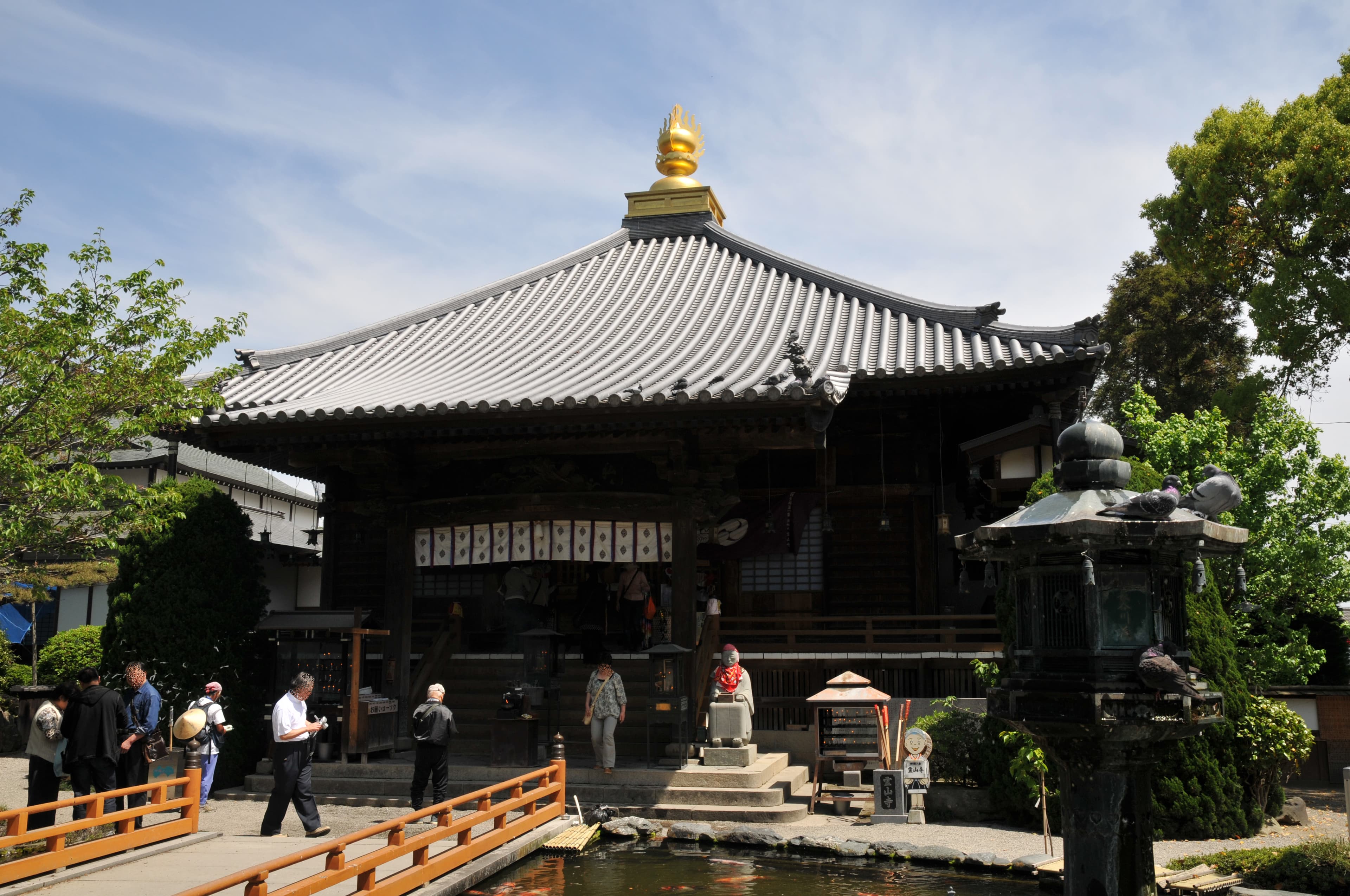
Image of Ryōzen-ji (霊山寺). Image source · CC-BY-SA-3.0
Station 1 of 88
Shikoku 88 Temple PilgrimageVisit essentials
A quick read before you go
- Duration
- 30-60 minutes for a thorough first visit including outfitting, ritual chanting, and the first…
- Access
- From JR Bandō Station (Kōtoku Line, about 25 minutes from Tokushima City): walk approximately…
Overview
Ryōzen-ji is the threshold where most walking pilgrims begin the Shikoku 88. At the outfitter outside the gate, travelers buy a white hakui jacket, conical sugegasa hat, wooden kongō-zue staff, stole, prayer beads, osamefuda slips, and the nōkyōchō stamp book that will accompany them around Shikoku. Putting on the robe outside the Niōmon is a small, deliberate transformation; afterward the journey is no longer touristic, but something harder to name.
Tradition says Kūkai, founder of Shingon Buddhism and posthumously Kōbō Daishi, retreated here in 815 and saw Shakyamuni Buddha preaching on Vulture Peak in India. He carved Shaka Nyorai and named Ryōzen-ji the Sacred Peak Temple, from which the canonical sequence of 88 fudasho radiates. Historians hold that the network crystallized later, in the late medieval and Edo periods, but pilgrims still experience this as the beginning.
The compact grounds contain a guardian-flanked Niōmon, pond, nearby Hondō and Daishi-dō whose chanting carries between them, and a stamp office whose staff have inscribed the first calligraphic page of millions of books. Mount Ōasa rises north, a pre-Buddhist mountain associated with Ame-no-hiwashi-no-mikoto; Vulture Peak layers new sacred meaning upon it rather than replacing it. Many henro look back at the road from the gate and quietly mark their beginning.
Why this place is sacred
Ryōzen-ji is a thin place not because anything dramatic happens in the precinct, but because of what happens to the people passing through it. Within Shingon's reading of the four prefectures of Shikoku as four stages of practice — Tokushima as the dōjō of awakening (hosshin), Kōchi as discipline (shugyō), Ehime as enlightenment (bodai), Kagawa as nirvāṇa (nehan) — Ryōzen-ji opens the first stage. The temple is where aspiration becomes commitment.
The mountain name Jikuwasan and the temple name Ryōzen-ji together evoke Vulture Peak, the site in India where Shakyamuni delivered the Lotus Sutra. Kūkai's recorded vision and his subsequent carving of the Shaka Nyorai image transferred that geography to Shikoku. Beneath this layering lies the older devotion to Mount Ōasa, where the Shintō kami Ame-no-hiwashi-no-mikoto has been venerated since antiquity. The temple's name does not erase the older mountain religion; it sits inside it.
Ryōzen-ji's earliest tradition places its founding in the 8th century by the priest Gyōki, who built temples across Japan at the order of Emperor Shōmu. Its refounding by Kūkai in 815 reframed the site as the explicit starting point of his proposed 88-temple circuit and as a Buddhist counterpart to the indigenous Mount Ōasa cult.
The medieval temple was destroyed during the 16th-century invasion of Shikoku by the warlord Chōsokabe Motochika, then rebuilt during the Edo period. As mass henro pilgrimage spread in the Edo era, Ryōzen-ji acquired its present role as outfitter and orientation point: the place where new pilgrims learn the ritual sequence they will repeat 87 more times. Today it is a parish temple of the Kōyasan Shingon school and the most heavily trafficked of the early temples on the route.
Experience and orientation
Most pilgrims arrive in the morning, having taken the local train to JR Bandō and walked the kilometer and a half. The pilgrim outfitter shop, Monzen-ichibangai, sits opposite the gate. New henro often spend an unhurried hour there: trying on the white hakui, choosing a sugegasa, weighing the kongō-zue staff that doubles as a walking stick and a stand-in for Kōbō Daishi himself, leafing through stamp books. Inside the gate the protocol begins.
At the chōzuya, water is taken in the right hand, then the left, then to the mouth and back. At the bonshō — the great bell — one slow ring marks arrival; departing pilgrims do not ring it again.
At the Hondō, a candle is lit from the temple's flame, never from another pilgrim's, then placed on the upper rows of the rōsokutate; three sticks of incense go into the kōro, one osamefuda slip is dropped into the box, a coin is dropped into the saisen, and the chanting begins — Heart Sutra, the Shaka Nyorai mantra, and the Mantra of Light. The same sequence repeats at the Daishi-dō.
Then the stamp office: three vertical lines of black ink and three red seals, the first inscription in a book that will fill over the coming weeks. The sound is muffled — wood, footsteps, the soft scratch of a brush, the occasional bell — and most pilgrims stand longer than they expected to.
Arrive at JR Bandō Station on the Kōtoku Line and walk about 1.5 kilometers north to the temple. From the parking lot, bow once at the Niōmon before passing under it. Visit the Monzen-ichibangai shop opposite the gate first if you intend to outfit yourself as a henro. Inside the precinct, do the chōzuya purification before approaching the halls. Hondō first, Daishi-dō second, stamp office last.
Plan thirty to sixty minutes for a thorough first visit, longer if you are buying full pilgrim gear.
Context and lineage
Tradition holds that during a retreat at this site in 815, Kūkai had a vision of Shakyamuni Buddha preaching the Lotus Sutra on Vulture Peak (Gridhrakuta) in India. He carved an image of Shaka Nyorai, named the temple Ryōzen-ji ('Sacred Peak Temple'), and inaugurated it as the first of the 88 fudasho on his proposed circumambulation of Shikoku. Earlier tradition attributes the temple's original founding to Gyōki at the order of Emperor Shōmu in the 8th century.
Whether Kūkai personally consecrated this exact site is undocumented outside Shingon tradition.
Ryōzen-ji is officially affiliated with the Kōyasan Shingon-shū, the largest branch of Japanese esoteric Buddhism, headquartered at Mount Kōya in Wakayama. Its position as fudasho-ichiban (Temple 1) of the Shikoku 88 places it at the symbolic and practical entrance to the Kūkai-centered henro tradition that has been continuously practiced — with periods of greater and lesser activity — for over a thousand years.
Kūkai (Kōbō Daishi)
Refounder of Ryōzen-ji and traditional inaugurator of the Shikoku 88
Gyōki
Traditional original founder
Emperor Shōmu
Imperial patron of Gyōki's temple-building program
Chōsokabe Motochika
16th-century destroyer
Traditions and practice
Historic henro practice prescribed a specific sequence at every fudasho. Approaching the gate, the pilgrim bows once. Water is taken at the chōzuya: right hand, left hand, mouth, then the ladle handle is rinsed. At the bonshō a single slow stroke is rung on arrival — not on departure, which is said to bring bad luck.
At the Hondō a candle is lit from the temple's permanent flame and placed on the upper rows of the candle stand; three incense sticks are placed in the kōro; an osamefuda slip bearing the pilgrim's name and prayer intention is dropped in the slip box; coins are offered in the saisen-bako.
The Heart Sutra (Hannya Shingyō) is chanted, followed by the honzon mantra — at Ryōzen-ji this is the Shaka Nyorai mantra ('Nōmaku samanda bodanan baku') — and the Mantra of Light (Kōmyō Shingon: 'On abokyabeiroshanō makabodara mani handoma jinbara harabaritaya un'). The full sequence is repeated at the Daishi-dō with the Kōbō Daishi mantra ('Namu Daishi henjō kongō') in place of the honzon mantra. Finally the nōkyōchō is presented at the stamp office for the first inscription.
Daily monastic services continue under the Kōyasan Shingon liturgy. The stamp office issues the first inscription for new henro and provides orientation for those uncertain of the sequence. The on-grounds and adjacent shops sell every standard item of pilgrim equipment, from osamefuda packs to white robes in graded ranks for those who have completed multiple circuits.
If this is your first temple, allow time. Do the chōzuya. Ring the bell once. Even if you do not intend to chant, stand at the Hondō for a full minute before moving on; the rhythm of the route depends on this kind of patience. If you are not Buddhist, ringing the bell once on arrival and offering a coin and a moment of attention is enough.
If you do choose to chant, ask the staff at the stamp office for a small Shikoku-88 sutra booklet — they are accustomed to first-day pilgrims.
Shingon Buddhism (Kōyasan branch)
ActiveRyōzen-ji is officially affiliated with the Kōyasan Shingon-shū and serves as fudasho-ichiban (Temple 1) of the 88-temple pilgrimage traditionally inaugurated by Kūkai (Kōbō Daishi). The temple is the symbolic gate of hosshin no dōjō — the place where pilgrims awaken the aspiration for enlightenment.
Daily sutra recitation in the Hondō and Daishi-dō; pilgrims chant the Heart Sutra (Hannya Shingyō) and the Mantra of Light (Kōmyō Shingon); osamefuda slips are deposited at each hall.
Pre-Buddhist mountain veneration (Mount Ōasa / Ame-no-hiwashi-no-mikoto)
ActiveMount Ōasa, about 2 km north of the temple, has been venerated since antiquity as the seat of the indigenous Shintō deity Ame-no-hiwashi-no-mikoto. Kūkai is said to have likened it to Vulture Peak in India when naming Ryōzen-ji, indicating Buddhist-Shintō layering rather than replacement.
Local Shintō observance continues at the Mount Ōasa shrine. The temple's name reflects this layering rather than active joint ritual; pilgrims sometimes visit both the temple and the mountain shrine in a single day.
Perspectives and open questions
Different communities tell the story of Ryōzen-ji differently. The historian, the Shingon priest, the folk-religious villager, and the secular henro all converge at the same gate but for different reasons.
Scholarly perspective
Historians treat the 88-temple network as something whose canonical sequence and Kūkai-centric narrative crystallized in the late medieval to early Edo period — 16th to 17th centuries — rather than during Kūkai's lifetime. Ryōzen-ji's founding by Gyōki in the 8th century and refounding by Kūkai in 815 are regarded as traditional history rather than independently documented fact. The current buildings are Edo-period and modern reconstructions following the 16th-century Chōsokabe destruction.
Living and traditional perspectives
Kōyasan Shingon doctrine treats Ryōzen-ji as the place where Kūkai personally inaugurated the 88-temple route in 815, after his vision of Shakyamuni's sermon on Vulture Peak. The carved Shaka Nyorai principal image is understood as a direct material consequence of that vision, and the temple as the literal seed-point from which the henro mandala radiates around Shikoku.
Alternative interpretations
Read through Shingon's mikkyō symbolism, the four prefectures of Shikoku correspond to four stages of Buddhist practice — hosshin (awakening aspiration), shugyō (discipline), bodai (enlightenment), and nehan (nirvāṇa). Ryōzen-ji opens the dōjō of hosshin and is therefore cosmologically the seed-point of the entire mandala-walk. Folk tradition adds the layer of Mount Ōasa, where the Shintō kami Ame-no-hiwashi-no-mikoto has been venerated since antiquity. The Buddhist Vulture Peak naming sits inside the older mountain religion rather than displacing it.
Open questions
Whether Kūkai himself ever consecrated this exact site is undocumented outside tradition. The relationship between the pre-Buddhist Mount Ōasa cult and the temple's Vulture Peak naming is suggestive but not historically reconstructed in detail. The exact year Kūkai vowed to open the 88-temple route is contested: 815 is most commonly cited, but earlier and later dates appear in sources.
Plan your visit
Access and arrival
From JR Bandō Station (Kōtoku Line, about 25 minutes from Tokushima City): walk approximately 1.5 km north (15-20 minutes). By car: about 10 minutes from the Bandō IC on the Tokushima Expressway. Free parking on site. Address: 126 Tsukahana, Bandō, Naruto, Tokushima Prefecture, 779-0230.
No shukubo at Ryōzen-ji itself. Hotels and minshuku are available in Naruto and Tokushima City. Many walking henro continue 16 km on Day 1 and stay at the shukubo of Anraku-ji (Temple 6), which has its own onsen.
Respectful visit
The traditional white pilgrim hakui (jacket), wagesa (stole), conical sugegasa hat, and kongō-zue staff are encouraged from Temple 1 onward but are not required. Modest casual clothing is acceptable. If you intend to walk the route in pilgrim whites, Ryōzen-ji is where most henro outfit themselves; the pilgrim shop opposite the gate carries every grade and size.
Generally permitted in the open precinct. Avoid flash inside the Hondō and Daishi-dō. Do not photograph other pilgrims at prayer. Tripods are discouraged in the inner halls. Photographs of altars and principal images are typically prohibited inside the halls themselves; signs in Japanese will indicate where.
At each hall: coins in the saisen-bako, three sticks of incense in the kōro, one candle on the rōsokutate (lit from the temple flame), and one osamefuda slip in the slip box. Osamefuda are graded by color according to how many times a pilgrim has completed the 88 — white for first-timers. Buying a pack of fifty before starting is conventional.
Do not light your candle from another pilgrim's flame. Do not ring the bell on departure. Do not enter behind the altar. Do not touch the principal image. Avoid loud conversation in the halls. The ladle at the chōzuya should not touch your lips directly — pour water from the ladle into your hand instead.
Do not light a candle from another pilgrim's flame; tradition holds that this transfers their negative karma to you. Do not ring the bell on departure. Do not photograph other pilgrims at prayer without permission. If you buy a kongō-zue staff, treat it as the embodied presence of Kōbō Daishi: never use it as a casual walking stick on tatami floors, and at lodgings wash and dry the tip before resting it indoors.
Current practical details
Address
Tsukahana-126 Ōasachō Bandō, Naruto, Tokushima 779-0230, Japan
Phone
Hours
Hours, fees, and access can change — verify on the official source before you travel. Practical details last checked Jun 2026.
Location
Map loads as you approach this section.
Pilgrim reflections
A portrait of encounter, not a score
Pilgrims describe what they felt, how present they could become, and whether the place would shape a journey. There are no stars and no ranking of traditions.
No reviewed reflections yet
The first pilgrims can help describe the character of being here.
Share a reflection
Available after an account-backed “Been there.” Every reflection is reviewed before publication.
Watch deeper
Films, episodes, and recorded talks for visitors who want more context before or after a visit. Speculative and alternative-history entries are labelled as perspectives, not as sources for established claims.
Nearby sacred places
Explore other sacred places in the region. Proximity does not establish access or travel time; check each place’s guidance.


References
Sources consulted for this page. Source categories describe the publication, not a guarantee that every claim is verified. Traditional accounts and outside interpretations may differ.
- 01Ryozenji – Naruto, Tokushima Prefecture, Shikoku — Henro.orgguideStandard reference for Shikoku 88 temple histories
- 02Jikuwazan Ichijyouin Ryozenji – Shikoku 88 Temple Pilgrimage — Shikoku 88 Temple Pilgrimage AssociationofficialOfficial temple association page
- 03Ryozenji Temple - Naruto Travel — Japan GuideguideMainstream English-language Japan travel resource
- 04Customs and Etiquette of the Shikoku Pilgrimage — Henro.orgofficialDetailed pilgrim etiquette
- 05Ryozenji Temple, the First Temple of the Shikoku Pilgrimage — Chugoku Shikoku Tokyo (JNTO)guideJNTO-affiliated tourism site
- 06Monzen-ichibangai Henro Shop — Henro.orgguidePilgrim outfitter directly outside Temple 1
Pilgrim glossary
- Honzon
- The principal Buddhist deity enshrined as a temple's central object of worship.
- Mandala
- A symbolic diagram of the cosmos used in meditation and ritual.
- Sutra
- A canonical Buddhist scripture, often chanted as part of practice.
- Mantra
- A sound, word, or phrase repeated as part of meditation or ritual.
- Shingon
- An esoteric Japanese Buddhist school emphasizing ritual, mantra, and mandala practice.
- Zen
- A Japanese Buddhist school emphasizing seated meditation and direct insight.
Share a photo
Help visitors recognize Ryōzen-ji. Every submission is reviewed before publication.