Dainichi-ji
Cosmic Buddha at the heart of the Shikoku 88's first quiet temple
Understand sacred places, explore living traditions, and learn how to engage respectfully with Pilgrim Map.
Access has not been verified. Check current local guidance before planning a visit.
Itano, Tokushima Prefecture, Japan
Read the sources
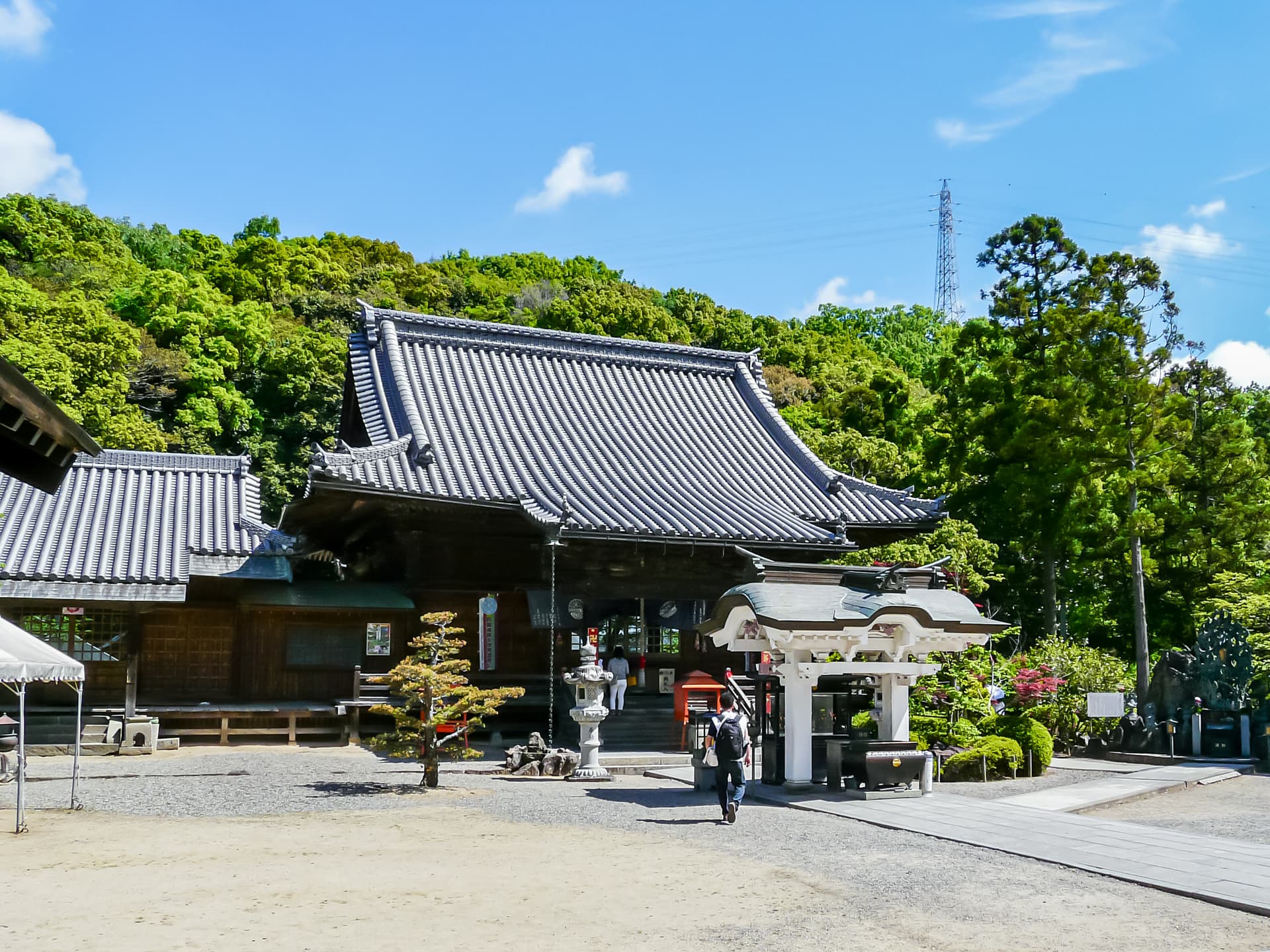
Image of Dainichi-ji (大日寺). Image source · CC-BY-SA-3.0
Station 4 of 88
Shikoku 88 Temple PilgrimageVisit essentials
A quick read before you go
- Duration
- 20-30 minutes for a standard visit including the corridor of 33 Kannon.
- Access
- About 5 km west of Konsen-ji on the standard henro route.
Overview
Five kilometers west of the Long Life Well, the henro path climbs through wooded country to Dainichi-ji, a small temple on a slope with a compact precinct, older wood, and lighter tour-bus traffic—the early circuit's first marked quiet. Its principal image is Dainichi Nyorai, Mahāvairocana, Shingon's central Buddha: not one Buddha among many but the dharmakāya from which all phenomena and Buddhas emanate.
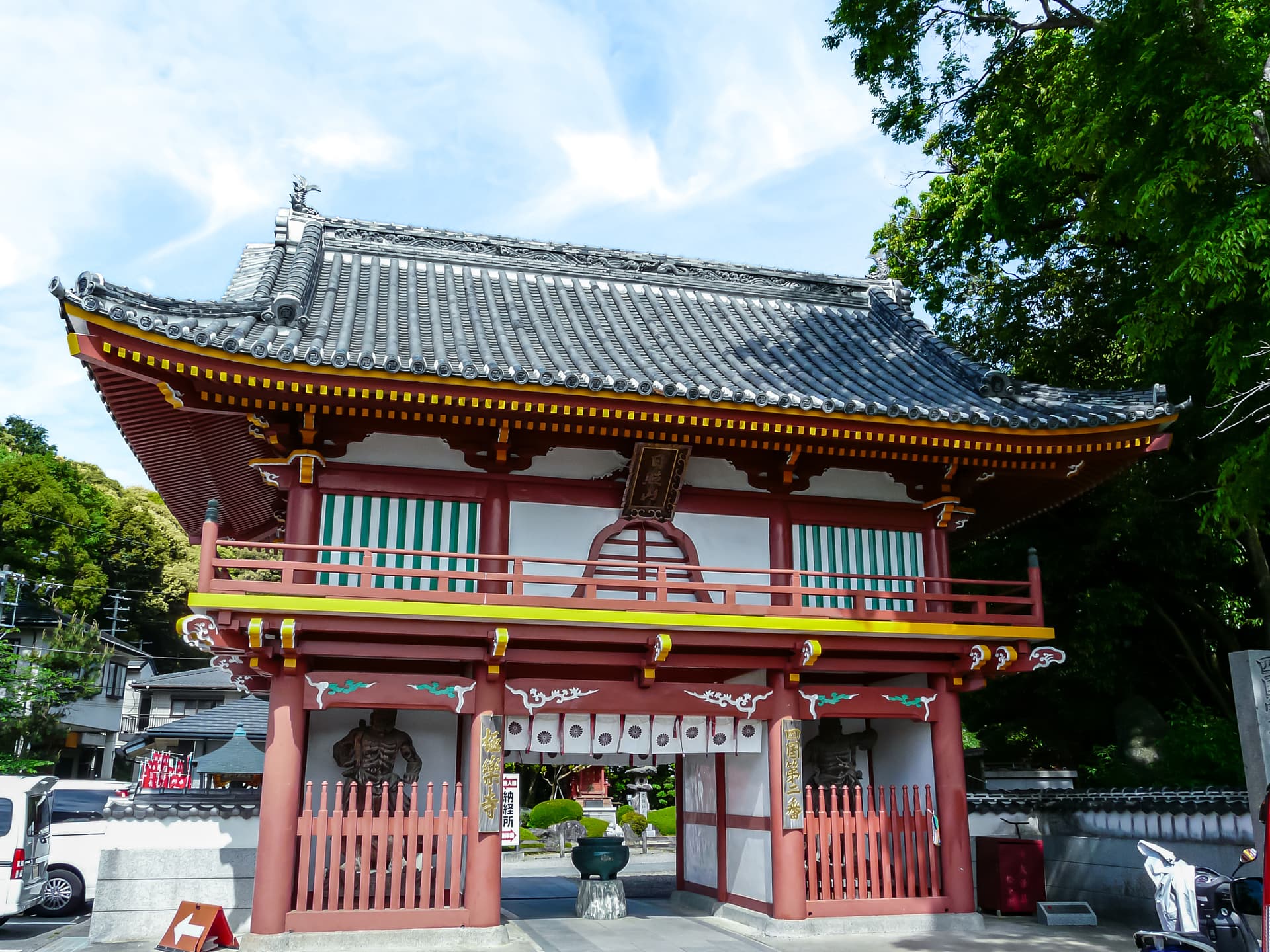
Tradition says Kūkai perceived Dainichi in a purple cloud here in 815, carved a 5.5-centimeter image, and founded the temple. The Hondō's present image is inscribed 1407; the traditional Heian image has not survived if it existed as described. The Hondō dates to 1649 and restoration in 1799. A two-story shōrō-mon bell-tower gate distinguishes the precinct, while a covered corridor lined with 33 Saigoku Kannon statues between Hondō and Daishi-dō compresses a western-Japan pilgrimage into minutes.
Pilgrims often report that this silence and Dainichi's doctrinal centrality deepen reflection after the busier first three temples.
Why this place is sacred
In Shingon teaching, every act of seeing a Dainichi image is also a participation in the cosmic Buddha's seeing of itself. The tradition's central practice — sokushin jōbutsu, becoming Buddha in this very body — depends on the practitioner's identification with Dainichi. Dainichi-ji is therefore one of the temples on the Shikoku 88 where the doctrinal background of the entire route surfaces explicitly.
The wooded slope and the smaller scale of the precinct produce a different quality of attention than the busier early temples. The corridor of 33 Saigoku Kannon between the two main halls miniaturizes another major pilgrimage: the Saigoku Kannon route of western Japan, which threads thirty-three Kannon temples from Wakayama to Gifu. Walking past the thirty-three statues in this corridor is, in folk-religious form, to make that pilgrimage in compressed time.
The double pilgrimage — the great henro and the embedded mini-Kannon route — is part of what gives Dainichi-ji its unusual density.
Tradition assigns the temple's founding to Kūkai in 815. The carving of a tiny 5.5-centimeter Dainichi image and the perception of the Buddha amid a purple cloud frame the temple as a place where the cosmic Buddha 'appeared' — making it doctrinally pivotal within the early Shikoku route.
The principal image now enshrined was carved in 1407, well after Kūkai. The current Hondō dates to 1649 with restoration in 1799. The corridor of 33 Saigoku Kannon was added later, reflecting the medieval and Edo-period habit of folding pilgrimage routes into one another. The temple was previously affiliated with the Shingon Sect Omuro-ha and became a branch temple of Tō-ji in Kyoto in 1887, where it remains today as a Tōji-ha Shingon temple.
Experience and orientation
Coming from Konsen-ji, the henro path follows narrow roads through a quiet hamlet called Kurotani — locally the temple is sometimes called Kurotanidera, the Black-Valley Temple, because of this. The shōrō-mon, the two-story bell-tower gate, marks the entry. The bell hangs in the upper story; pilgrims ring it on arrival from the path below. Inside, the precinct is wooded and slightly elevated, around 70 meters above the surrounding plain.
The chōzuya is to one side, the Hondō ahead, the Daishi-dō to the right. The covered corridor connects the two halls; the 33 Kannon statues line both walls, each with the name of its corresponding Saigoku temple. Walking the corridor slowly takes only a minute or two, but the gesture — the miniature pilgrimage — is part of the visit. At the Hondō, the standard ritual unfolds: candle, three incense sticks, osamefuda, coin, the Heart Sutra, and the Dainichi mantra.
The mantra varies according to which mandala-realm is invoked. For the Diamond Realm, 'On abiraunken bazara datoban'; for the Womb Realm, 'On abiraunken.' Most Shikoku 88 sutra books note both. The same protocol at the Daishi-dō. The stamp office is to the right. Pilgrims often spend less time at this temple than at louder ones; twenty to thirty minutes is typical. But the silence is part of what the temple offers.
From Konsen-ji walk west about 5 km along the henro markers; this section is partly road and partly small-village paths. By car, free parking is at the gate. The two-story shōrō-mon is the entry; the bell is in its upper level, accessible from the gate's interior staircase. Visit the Hondō first, then the corridor of 33 Kannon, then the Daishi-dō, then the stamp office.
Allow time for the corridor — the gesture of walking it slowly is part of the temple's character.
Context and lineage
In 815, during his return from Tang China and his establishment of the Shikoku 88 circuit, Kūkai is said to have perceived the presence of Dainichi Nyorai amid a purple cloud at this hillside. He carved a small Dainichi image — 5.5 centimeters — and founded the temple as the place where the cosmic Buddha 'appeared.' The act of perception, more than a separate event, is treated in Shingon as the temple's foundational moment.
Dainichi-ji has belonged to the Tōji-ha branch of Shingon since 1887, making it a branch temple of Tō-ji in Kyoto — the Heian-period imperial temple given to Kūkai in 823. Previously the temple was affiliated with the Shingon Sect Omuro-ha. The shift in 1887 placed Dainichi-ji within the lineage of one of the founding institutions of Japanese Shingon.
Kūkai (Kōbō Daishi)
Founder; traditional carver of the original 5.5 cm Dainichi image
Anonymous 1407 sculptor
Carver of the present principal Dainichi Nyorai image
Edo-period rebuilders
Builders of the present Hondō (1649) and 1799 restorers
Traditions and practice
At the Hondō and Daishi-dō, the standard sequence applies: chōzuya purification, one bell stroke on arrival, candle, three incense sticks, osamefuda, coin, sutra. The Dainichi Nyorai mantra is chanted at the Hondō — 'On abiraunken bazara datoban' for the Diamond Realm or 'On abiraunken' for the Womb Realm. The Heart Sutra precedes the mantra in standard practice. The Kōbō Daishi mantra is chanted at the Daishi-dō.
The corridor of 33 Saigoku Kannon, between the two halls, is walked slowly; some pilgrims pause at each statue, others walk through with a single bow at the entry and exit.
Daily Shingon liturgy continues. The stamp office issues the fourth inscription. The corridor of 33 Kannon is freely accessible.
Allow more time here than the small precinct seems to require. The silence is the offering. Complete the standard ritual at both halls. In the corridor of 33 Kannon, walk slowly. If you have an intention you want to carry through the henro, the corridor is a small place where it can be named to yourself.
If you are not chanting, the standard non-pilgrim gesture applies: bow at the gate, ring the bell once, light a candle, place a coin in the saisen, and stand a moment before each hall.
Shingon Buddhism (Tōji-ha branch)
ActiveBranch temple of Tō-ji in Kyoto since 1887; previously belonged to the Shingon Sect Omuro-ha. Mountain name Kokuganzan ('Black Rock Mountain'), hall name Henjōin. The central role of Dainichi Nyorai (Mahāvairocana) makes this temple doctrinally pivotal in Shingon.
Daily Shingon liturgy at the Hondō (Dainichi Nyorai) and Daishi-dō. Pilgrim chanting includes the Dainichi mantra in either Diamond Realm or Womb Realm form, the Heart Sutra, and the Kōbō Daishi mantra.
Saigoku Kannon route (folk-religious mini-pilgrimage)
ActiveA covered corridor lined with 33 Kannon statues, each representing one of the 33 temples of the Saigoku Kannon Pilgrimage of western Japan, allows pilgrims to walk a compressed version of that separate route within the precinct of Dainichi-ji.
Walking the corridor slowly, sometimes pausing at each statue or making a single offering at the entry. The practice is integrated with the Shikoku 88 ritual rather than separate from it.
Perspectives and open questions
Dainichi-ji's interpretive layers diverge sharply: the historian sees a 1407 image and an Edo-period building, the Shingon priest sees the cosmic Buddha appearing in a purple cloud, and the folk-religious pilgrim sees a corridor of 33 Kannon that compresses a separate pilgrimage into the henro.
Scholarly perspective
The Kūkai foundation in 815 is hagiographic rather than independently documented. The principal image as we have it today is dated by inscription to 1407, well after Kūkai. The current Hondō is 1649 with 1799 restoration. The temple's affiliation has shifted institutionally — Shingon Omuro-ha previously, Tōji-ha since 1887.
Living and traditional perspectives
Tōji-ha Shingon doctrine treats Dainichi-ji as the precise spot where Kūkai 'met' Dainichi Nyorai, making it a pilgrim's first explicit encounter with the cosmic Buddha on the Shikoku 88 route. The principal image is venerated as a continuation of Kūkai's original carving lineage, regardless of its 1407 date.
Alternative interpretations
Within mikkyō practice, every Dainichi-ji is functionally a portable mandala-axis. Chanting before the honzon is said to actualize the practitioner's identity with the cosmic Buddha — sokushin jōbutsu, becoming Buddha in this very body. The corridor of 33 Saigoku Kannon adds a folk-religious dimension: pilgrimage within pilgrimage, a hallmark of late-medieval Japanese devotion.
Open questions
The original Heian-period image, if it existed in the form tradition describes, has not survived. The relationship of the 1407 image to Kūkai's tradition remains a matter of devotional interpretation rather than documented continuity. The exact date the corridor of 33 Saigoku Kannon was added to the precinct is not clearly recorded.
Plan your visit
Access and arrival
About 5 km west of Konsen-ji on the standard henro route. From JR Itano Station, a longer walk (roughly an hour) or a short drive. Free parking on site. Address: Hinoura, Kurotani, Itano-chō, Itano-gun, Tokushima Prefecture.
No shukubo at Dainichi-ji. Hotels and minshuku in Itano. Most walking henro continue to the next temple within the same day; many continue further to the shukubo of Anraku-ji at Temple 6.
Respectful visit
Pilgrim whites are encouraged but not required. Modest casual dress is acceptable. The temple is on a slope and the corridor floor is sometimes uneven; appropriate footwear is helpful.
Permitted in the precinct. The shōrō-mon and the corridor of 33 Kannon are popular subjects. Avoid flash inside the halls. Do not photograph other pilgrims at prayer in the corridor without permission. Photographs of the principal image are typically prohibited; signs in Japanese mark where.
At each hall: coins, candle, three incense sticks, and an osamefuda. In the corridor of 33 Kannon, no formal offering is required, though some pilgrims drop a small coin into a single offering box at the entry to the corridor.
Do not touch the principal image or the 33 Kannon statues. Do not enter behind the altars. Do not climb the bell tower beyond the level designated for visitors. Photograph respectfully and observe any posted prohibitions.
Do not light your candle from another pilgrim's flame. Do not climb on or touch the 33 Kannon statues in the corridor. Do not enter behind the altars in either main hall. The bell on the upper level of the shōrō-mon is rung from a clearly designated rope; do not strike the bell directly with the hand or with anything other than the suspended striker.
Current practical details
Address
Iuchi-28番地 Kurodani, Itano, Itano District, Tokushima 779-0113, Japan
Phone
Hours
Hours, fees, and access can change — verify on the official source before you travel. Practical details last checked Jun 2026.
Location
Map loads as you approach this section.
Pilgrim reflections
A portrait of encounter, not a score
Pilgrims describe what they felt, how present they could become, and whether the place would shape a journey. There are no stars and no ranking of traditions.
No reviewed reflections yet
The first pilgrims can help describe the character of being here.
Share a reflection
Available after an account-backed “Been there.” Every reflection is reviewed before publication.
Watch deeper
Films, episodes, and recorded talks for visitors who want more context before or after a visit. Speculative and alternative-history entries are labelled as perspectives, not as sources for established claims.
Nearby sacred places
Explore other sacred places in the region. Proximity does not establish access or travel time; check each place’s guidance.


References
Sources consulted for this page. Source categories describe the publication, not a guarantee that every claim is verified. Traditional accounts and outside interpretations may differ.
- 01The history and origin — Dainichi-ji Temple official siteofficialTemple's own English history page
- 02Dainichiji – Itano, Tokushima Prefecture, Shikoku — Henro.orgguidePilgrimage reference
- 03Dainichi-ji Temple|The 4th temple of Shikoku 88 Temple Pilgrimage — Dainichi-ji TempleofficialOfficial temple homepage
- 04Temple 4, Dainichiji — Tourism ShikokuguideOfficial regional tourism portal
- 05Customs and Etiquette of the Shikoku Pilgrimage — Henro.orgguidePilgrim protocol
Pilgrim glossary
- Honzon
- The principal Buddhist deity enshrined as a temple's central object of worship.
- Kannon
- The bodhisattva of compassion, central to many East Asian pilgrimage routes.
- Mandala
- A symbolic diagram of the cosmos used in meditation and ritual.
- Sutra
- A canonical Buddhist scripture, often chanted as part of practice.
- Mantra
- A sound, word, or phrase repeated as part of meditation or ritual.
- Shingon
- An esoteric Japanese Buddhist school emphasizing ritual, mantra, and mandala practice.
Share a photo
Help visitors recognize Dainichi-ji. Every submission is reviewed before publication.