Gokuraku-ji
Temple 2 of the Shikoku 88, where pilgrims pray for safe birth and long life
Understand sacred places, explore living traditions, and learn how to engage respectfully with Pilgrim Map.
Access has not been verified. Check current local guidance before planning a visit.
Naruto, Tokushima Prefecture, Japan
Read the sources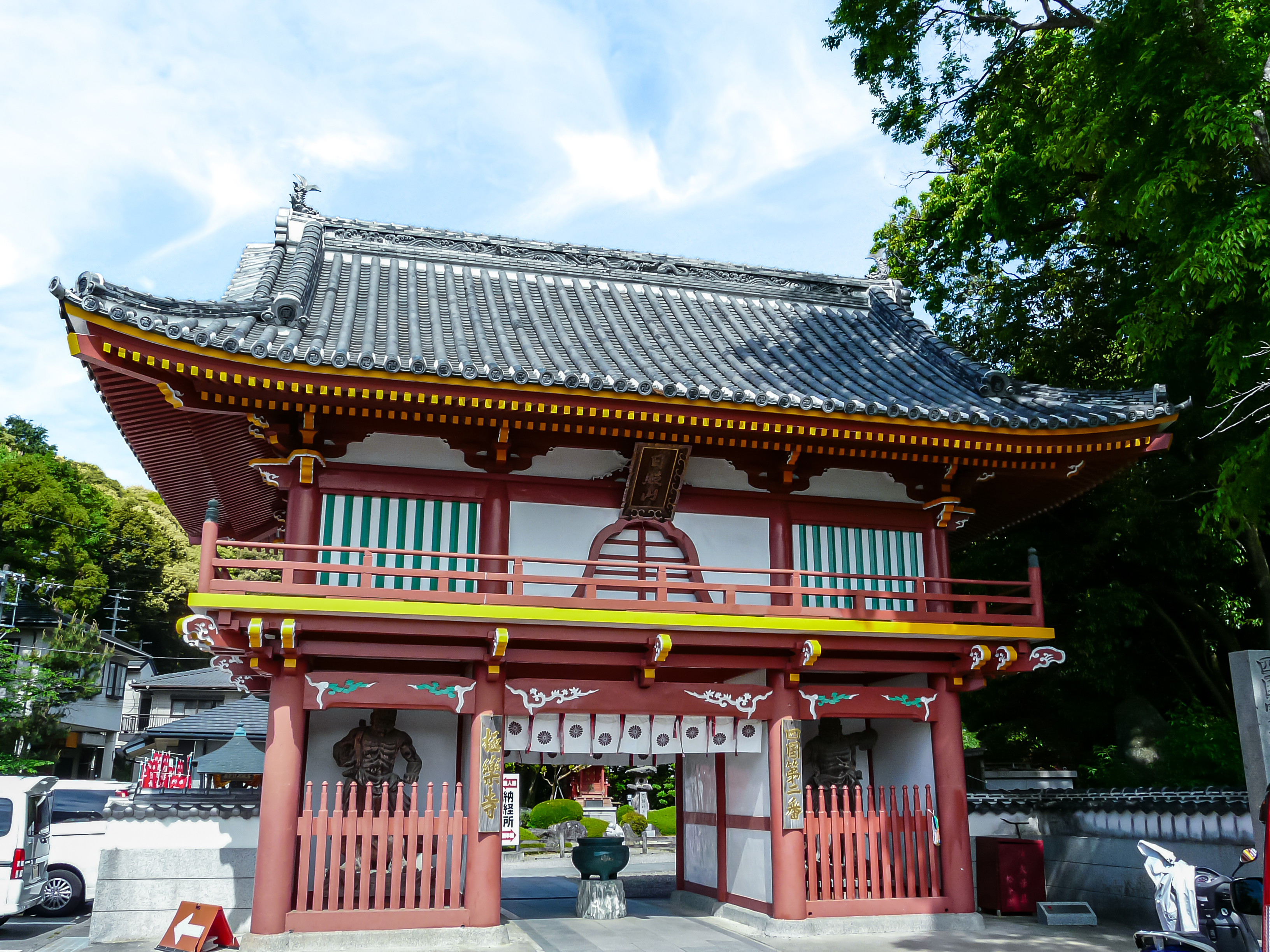
Station 2 of 88
Shikoku 88 Temple PilgrimageVisit essentials
A quick read before you go
- Duration
- 20-40 minutes for a standard visit including ritual at both halls and a pause at the cedar.
- Access
- About 1.4 km southwest of Ryōzen-ji on the standard henro route; easily walked in 20-25 minutes.
Overview
Twenty minutes southwest of Ryōzen-ji through rice fields and low houses, Gokuraku-ji's vermilion gate marks a small, unhurried temple. Its name, 'Temple of Paradise,' is a Pure Land term; its principal image is Amida Nyorai, Buddha of Sukhāvatī, the western paradise of birth without suffering. Tradition says Kūkai recited the Amitabha Sutra here for thirty-seven days, saw Amida, and carved the image.
Its radiance supposedly kept fishermen in Naruto Bay fifteen kilometers north from seeing fish, so they raised a mound before the Hondō to screen the light. This gave the temple its mountain name, Nisshōzan, 'Sun-Blocking Mountain.'
An old sugi in the precinct, designated a Tokushima Prefecture Natural Monument, is said to have been planted by Kūkai and is now roughly twelve centuries old; pilgrims often touch its trunk before continuing. A stone kosodate-Daishi, or 'child-rearing Daishi,' depicts Kōbō Daishi cradling a child. People petition it for safe childbirth, healthy infancy, and the difficulties of raising children, and expectant mothers often outnumber through-walking henro on weekday mornings.
The nearby Hondō and Daishi-dō, bell, and dominant cedar make Temple 2 quieter than Ryōzen-ji, though the pilgrimage and henro robe still feel new.
Why this place is sacred
The Amida tradition that organizes Gokuraku-ji's name and central rituals is normally associated with Pure Land Buddhism rather than Shingon, but esoteric Shingon long ago integrated nenbutsu devotion into its repertoire. Here the synthesis is concrete: an Amida Nyorai principal image at a Daishi-pilgrimage temple. The mountain name Nisshōzan and the hall name Muryōjuin ('Hall of Limitless Life') both gesture toward Amida's domain — the second name is a literal translation of Amitāyus, the Buddha of Boundless Life.
Pilgrims come not only for the standard ritual but for what the temple offers as supplementary intercessions: longevity prayers, safe-childbirth (anzan) blessings, and child-rearing (kosodate) petitions. The cedar tree functions as a tangible link to Kūkai. Standing under it, pilgrims often touch the trunk. The gesture is small, but the gap of twelve centuries between the present pilgrim's hand and Kūkai's planting hand is the precise distance the henro practice tries to collapse.
Tradition places the original founding in the Nara period under the priest Gyōki, with Kūkai refounding the temple in 815 after a thirty-seven-day Amida retreat. From the start, the temple's identity has been organized around the principal image and the Pure Land aspiration that image represents.
Like its neighbors, Gokuraku-ji was destroyed in the 16th-century Chōsokabe campaign and rebuilt during the Edo period. The kosodate-Daishi tradition appears to have intensified during the Edo period when the henro practice acquired its mass-pilgrimage form. The temple is today a Kōyasan Shingon parish temple, and the two principal devotional foci — the Amida Hondō and the kosodate-Daishi — coexist without tension.
Experience and orientation
Coming from Ryōzen-ji on foot, the approach to Gokuraku-ji is a residential walk through low Naruto suburbs — narrow lanes, rice paddies in season, the occasional henro sign nailed to a power pole. The vermilion sanmon gate is the first visual marker that you have arrived.
Inside, the precinct opens to the right: chōzuya near the gate, bell to the left, the Hondō facing the entrance with the artificial Nisshōzan mound rising behind it, the Daishi-dō at an angle, and the great cedar standing dominantly in the middle distance. The trunk is wrapped in a sacred shimenawa rope and surrounded by a low wooden barrier; many pilgrims bow toward it before approaching the halls.
At the Hondō, the candle goes onto the rōsokutate, the three incense sticks into the kōro, the osamefuda slip into the box, and the Heart Sutra and Amida mantra ('On amirita teizei kara un') are chanted. The same at the Daishi-dō. The kosodate-Daishi stands on a separate stone pedestal between the two halls; people bring small offerings of flowers, a coin, or a folded paper crane. The stamp office is to the right of the gate.
Most henro spend twenty to forty minutes here.
From Ryōzen-ji walk southwest about 1.4 km along the henro markers; the route is well-signed. By car, free parking is at the gate. Bow at the sanmon on entering. Visit the cedar before the halls if you wish to greet Kūkai's tree first; otherwise complete the chōzuya and standard ritual at the two halls before pausing there. The kosodate-Daishi statue does not require a formal sequence — a coin, a moment, and a quiet intention are sufficient.
Context and lineage
Kūkai is said to have undertaken a thirty-seven-day chanting of the Amitabha Sutra on this hilltop in 815. On the final day he beheld Amida Nyorai and carved the principal image. The radiance of the new statue, tradition adds, was so great that it dazzled fishermen working in Naruto Bay fifteen kilometers north — they could no longer see fish in the water and asked the temple to screen the light.
An artificial mound was raised in front of the Hondō, and the mountain name Nisshōzan ('Sun-Blocking Mountain') was given.
Gokuraku-ji is a parish temple of the Kōyasan Shingon-shū, headquartered at Mount Kōya. Its dedication to Amida Nyorai expresses Shingon's long-standing integration of Pure Land devotion (nenbutsu, faith in Amida's vow) with esoteric ritual practice — a synthesis that characterized late-Heian and medieval Buddhism on Shikoku.
Kūkai (Kōbō Daishi)
Refounder; traditional carver of the principal Amida Nyorai; planter of the precinct's great cedar
Gyōki
Traditional original founder
Chōsokabe Motochika
16th-century destroyer
Traditions and practice
Historic henro practice at Gokuraku-ji follows the standard fudasho sequence — chōzuya purification, one bell stroke on arrival, candle, three incense sticks, osamefuda, coin, sutra at both Hondō and Daishi-dō. The mantra at the Hondō is the Amida Nyorai mantra ('On amirita teizei kara un'), and the Pure Land aspiration of the temple is sometimes carried into nenbutsu chanting ('Namu Amida Butsu').
Beyond the standard ritual, the temple has long been a destination for safe-birth and child-rearing prayers, particularly through the kosodate-Daishi statue. Edo-period and Meiji-era pilgrim accounts mention both the cedar and the child-protection practices already as established features.
The temple offers formal kitō (prayer-request) services for anzan and kosodate; expectant mothers and families with infants commonly visit specifically for these. The Hondō hosts daily sutra recitation. The nōkyō stamp office is to the right of the gate.
If you are walking the route, complete the standard sequence at both halls. If you are not chanting, ring the bell once on arrival, light a candle from the temple flame at the Hondō, and stand quietly. The cedar is worth a slow approach: many pilgrims bow before stepping into the rope-marked area and place a hand on the trunk in silence.
The kosodate-Daishi welcomes intentions on behalf of children, family, or anyone you are accompanying through their first months in the world.
Shingon Buddhism (Kōyasan branch)
ActiveTemple 2 of the Shikoku Pilgrimage. The mountain name Nisshōzan ('Sun-Blocking Mountain') and the hall name Muryōjuin ('Hall of Limitless Life') derive from the Amida-centered legend of Kūkai's carving and place the temple within Shingon's Pure Land synthesis.
Daily Shingon liturgy at the Hondō and Daishi-dō; pilgrim chanting of the Amida Nyorai mantra ('On amirita teizei kara un') and the Heart Sutra; kitō prayer-requests for safe childbirth (anzan) and child-rearing (kosodate) before the kosodate-Daishi statue.
Perspectives and open questions
Gokuraku-ji holds two interpretive layers — the Pure Land theology of Amida and the devotional materialism of the Kūkai-cedar — that different observers weight differently.
Scholarly perspective
The Kūkai carving narrative is hagiographic; the ascription is traditional rather than archaeologically demonstrated. The temple's documented architectural history is post-Chōsokabe Edo-period reconstruction. The age of the cedar is plausible at approximately 1,100-1,200 years and is officially recognized as a Tokushima Prefecture Natural Monument, but the attribution to Kūkai's planting hand is a tradition, not a documented fact.
Living and traditional perspectives
Shingon tradition treats the Amida principal image as a direct manifestation of Kūkai's vision — the Hondō as a true 'place where Amida appeared.' The cedar is treated as the planted hand of Kōbō Daishi himself, still living in the precinct twelve centuries later. Pilgrims who touch its trunk are understood to be in tactile contact with the founder.
Alternative interpretations
Within Shingon's Pure Land integration, an Amida principal image at a Daishi-pilgrimage temple shows the synthesis of esoteric practice with nenbutsu devotion that characterized late-Heian and medieval Shikoku Buddhism. The kosodate-Daishi tradition reflects Shikoku's broader folk-Buddhist welcoming of women and children into pilgrimage devotion — a feature that distinguishes the henro from older male-monastic mountain pilgrimages.
Open questions
Whether Kūkai personally carved the principal image is documented only in tradition. The artificial 'sun-blocking' mound's actual age and function — whether genuinely raised by fishermen as the legend says, or a later landscaping element — is not well documented. The cedar's exact age has not been independently dated.
Plan your visit
Access and arrival
About 1.4 km southwest of Ryōzen-ji on the standard henro route; easily walked in 20-25 minutes. By car, about 12 km from Naruto IC. Nearest JR station is Bandō (Kōtoku Line). Free parking on site. Address: Rakanji, Hayashi, Naruto, Tokushima Prefecture.
No shukubo at Gokuraku-ji. Hotels and minshuku are available in Naruto and Tokushima City. Walking henro typically continue further along the route — either staying in Itano or pushing on to the shukubo of Anraku-ji at Temple 6.
Respectful visit
Pilgrim whites are encouraged but not required. Modest casual dress is acceptable. Many expectant mothers visiting the kosodate-Daishi do so in ordinary clothes; that is entirely customary.
Permitted in the open precinct. The cedar and the bright vermilion gate are popular subjects. Avoid flash inside the halls. Some statues have signs forbidding close-up photography; observe them. Do not photograph other visitors at prayer without permission.
At each hall: coins, candle, three incense sticks, and an osamefuda. At the kosodate-Daishi, a coin and a brief intention are sufficient; small flower offerings are common. At the cedar, no formal offering is made — the gesture is the touch and the bow.
Do not enter behind the altars. Do not touch the principal Amida image. Do not pluck branches or leaves from the cedar. If you see a sign forbidding photography, observe it without exception.
Do not light your candle from another pilgrim's flame. Do not climb on the cedar's roots or remove bark, leaves, or twigs from the tree — it is a designated Natural Monument. Do not photograph the kosodate-Daishi up close while another visitor is praying.
Current practical details
Address
Dannoue-12 Ōasachōhinoki, Naruto, Tokushima 779-0225, Japan
Phone
Hours
Hours, fees, and access can change — verify on the official source before you travel. Practical details last checked Jun 2026.
Location
Map loads as you approach this section.
Pilgrim reflections
A portrait of encounter, not a score
Pilgrims describe what they felt, how present they could become, and whether the place would shape a journey. There are no stars and no ranking of traditions.
No reviewed reflections yet
The first pilgrims can help describe the character of being here.
Share a reflection
Available after an account-backed “Been there.” Every reflection is reviewed before publication.
Watch deeper
Films, episodes, and recorded talks for visitors who want more context before or after a visit. Speculative and alternative-history entries are labelled as perspectives, not as sources for established claims.
Nearby sacred places
Explore other sacred places in the region. Proximity does not establish access or travel time; check each place’s guidance.


References
Sources consulted for this page. Source categories describe the publication, not a guarantee that every claim is verified. Traditional accounts and outside interpretations may differ.
- 01Gokurakuji – Naruto, Tokushima Prefecture, Shikoku — Henro.orgguideStandard pilgrimage reference
- 02Nisshouzan Muryoujyuin Gokurakuji — Shikoku 88 Temple Pilgrimage AssociationofficialOfficial 88-temple association
- 03Customs and Etiquette of the Shikoku Pilgrimage — Henro.orgguidePilgrim ritual protocol
- 04Gokuraku-ji (Naruto) — WikipediaencyclopediaCross-checked against primary tradition sources
- 05Gokuraku-ji, Shikoku Pilgrimage's Second Temple — Setouchi ExplorerguideTravel-blog detail on architecture and grounds
Pilgrim glossary
- Sutra
- A canonical Buddhist scripture, often chanted as part of practice.
- Mantra
- A sound, word, or phrase repeated as part of meditation or ritual.
- Shimenawa
- A sacred straw rope marking the boundary of a Shinto holy place.
- Shingon
- An esoteric Japanese Buddhist school emphasizing ritual, mantra, and mandala practice.
- Pure Land
- A Buddhist tradition focused on rebirth in Amida Buddha's western paradise through devotional practice.
- Zen
- A Japanese Buddhist school emphasizing seated meditation and direct insight.
Share a photo
Help visitors recognize Gokuraku-ji. Every submission is reviewed before publication.