Jizō-ji
Two hundred arhats and an 800-year-old ginkgo at Temple 5
Understand sacred places, explore living traditions, and learn how to engage respectfully with Pilgrim Map.
Access has not been verified. Check current local guidance before planning a visit.
Itano, Tokushima Prefecture, Japan
Read the sources
Station 5 of 88
Shikoku 88 Temple PilgrimageVisit essentials
A quick read before you go
- Duration
- 45-60 minutes including the walk to the Rakandō.
- Access
- About 1.4 km south of Dainichi-ji on the henro route; from JR Itano Station, about a 25-minute…
Overview
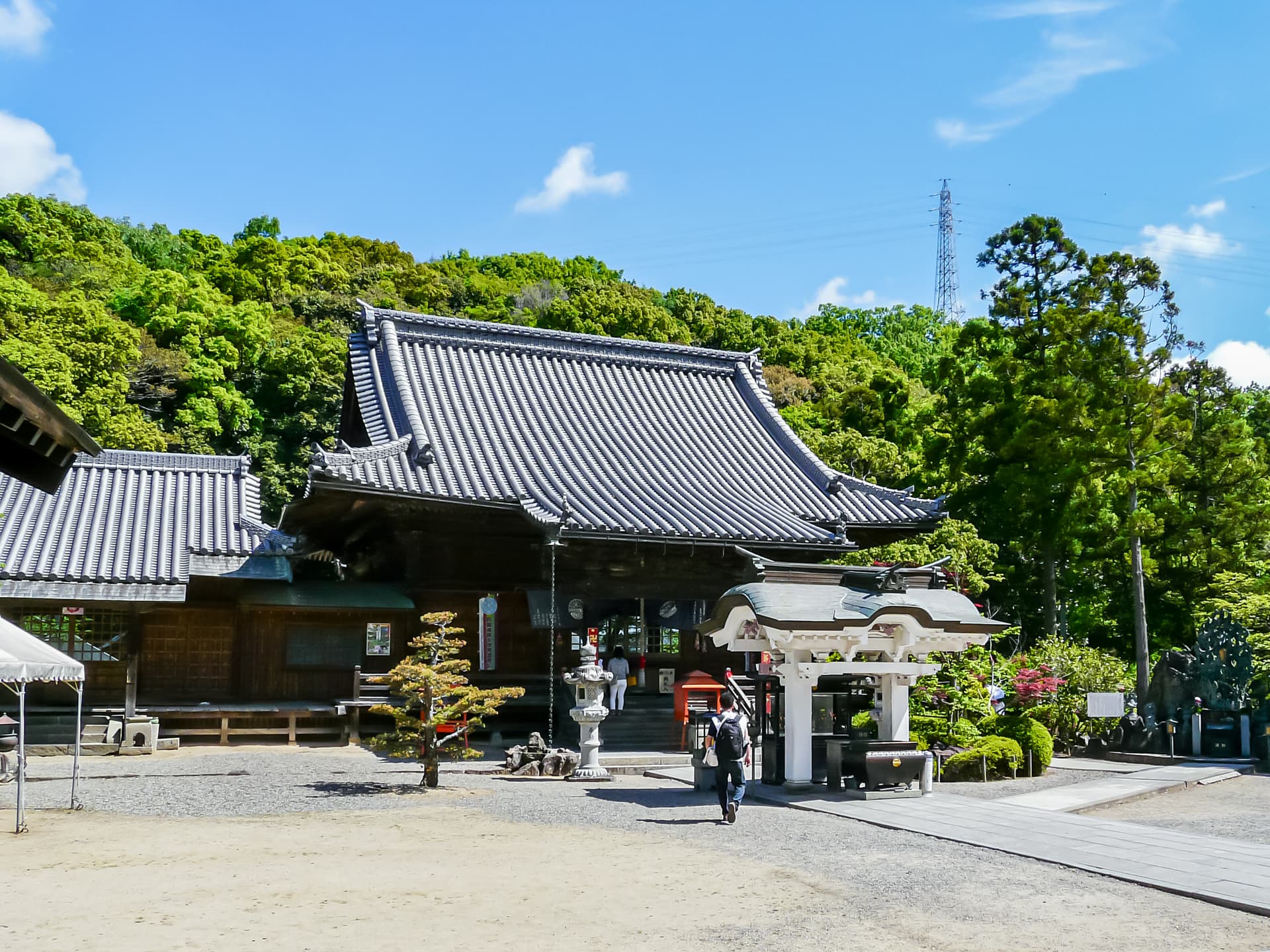
About a kilometer and a half south of Dainichi-ji, the road descends to Jizō-ji's parklike precinct behind a tile-roofed gate. This early-route temple carries layered patronage: founded in 821 by Kūkai at Emperor Saga's request, honored by three successive emperors, supported by Minamoto no Yoritomo and Yoshitsune, and rebuilt with help from Awa's Edo daimyō, the Hachisuka clan.
Its principal image is Enmei Jizō Bosatsu, the Long-Life Earth Treasury Bodhisattva. Inside its hollow torso rests a 5.5-centimeter Shōgun Jizō, the Victorious-Army Earth Treasury said to be Kūkai's carving—an image-within-image lineage, with a Buddha-relic at the larger statue's heart.
The precinct's emotional center is the separate Rakandō, a few minutes' walk away. Built in 1775 for 500 life-size arhats, Buddha's enlightened disciples, it lost most in a 1915 fire; the hall was rebuilt around about 200 survivors. Their different faces register joy, anger, sorrow, weariness, defiance, surprise, and peace. Pilgrims often pause beside the figure matching their mood, making this one of the early Tokushima route's most affecting encounters.
An 800-year-old ginkgo, a designated Tokushima Prefecture Natural Monument, turns brilliant yellow in mid-November and carpets the outer precinct with leaves.
Why this place is sacred
The image-within-image structure of the principal hall is a recurring esoteric Buddhist trope. The taizō-butsu — a Buddha-image enclosing another Buddha-image, often relics in the hair or in the chest cavity — expresses the relationship between the manifest body of the Buddha (nirmāṇakāya) and the cosmic dharma body (dharmakāya). Jizō-ji makes this material.
Pilgrims chanting before the Hondō are addressing not only the Enmei Jizō they can see but the smaller Shōgun Jizō hidden inside, said to be the founder's own hand. The Rakandō works on a different register entirely. Arhats in Mahāyāna iconography are not the perfected end-state — that role belongs to bodhisattvas — but they are recognizable. They have been monks. They have struggled. The faces in the hall register that struggle without sentimentalizing it.
Pilgrims often report identifying with one or another expression and then asking themselves what state of mind they are carrying into the journey ahead. The Rakandō functions as a mirror of the henro's interior weather.
Founded in 821 by Kūkai at the order of Emperor Saga, with the small Shōgun Jizō image originally enshrined as the principal. The temple was patronized in succession by Emperors Saga, Junna, and Nimmyō, establishing it early as one of the more historically embedded fudasho of the route.
Generations after the founding, the priest Jōkan Shōnin of Kumano Gongen carved the larger Enmei Jizō Bosatsu and placed Kūkai's small image inside it. Later patronage from Minamoto no Yoritomo, Yoshitsune, and the Hachisuka clan extended the temple's patronage stratum from imperial to warrior to daimyō. The Rakandō was built in 1775 with 500 arhat statues; a 1915 fire destroyed most, and the hall was rebuilt around the surviving roughly 200 statues.
The 800-year-old ginkgo predates the Rakandō by several centuries.
Experience and orientation
The approach from Dainichi-ji descends into the hamlet of Hayashi. The Niōmon is large and tile-roofed, the courtyard wide and open. The ginkgo dominates the inner precinct; in mid-November it is impossible to miss. The Hondō stands ahead, the Daishi-dō at an angle, the bell tower to one side. The chōzuya is near the gate.
At the Hondō the standard ritual unfolds — candle, three incense sticks, osamefuda, coin, the Heart Sutra, and the Jizō Bosatsu mantra ('On kakaka bisanmaei sowaka'). The same at the Daishi-dō. Then most pilgrims walk to the Rakandō. It is a five-minute walk from the Hondō or a two-minute drive. The hall is wide and dim; the arhats are arranged in tiered rows, each life-size, each carved with a face. Some are seated, some standing, a few in motion.
Walking past them slowly takes a long time. Pilgrims often stop without choosing to. The expressions accumulate. Eventually one of them — the one that resembles the mood you walked in with, or the one you have been hiding — registers, and that is when many pilgrims sit down on the bench provided. A small admission may apply. Photography rules vary by hall and signage. Outside, the ginkgo waits.
From Dainichi-ji walk south about 1.4 km along the henro markers; from JR Itano Station, about a 25-minute walk. By car, free parking is at the gate. Visit the Hondō and Daishi-dō first, then walk or drive the short distance to the Rakandō. The arhat hall is sometimes signposted as a separate stop within the temple's complex; ask at the stamp office for current opening hours.
Allow longer here than at most early temples — forty-five to sixty minutes is a more honest estimate.
Context and lineage
Kūkai is said to have carved the small Shōgun Jizō Bosatsu — Victorious-Army Earth Treasury — in 821 and entrusted it to the temple. Generations later, Jōkan Shōnin, a high priest of Kumano Gongen in Kishū, carved a larger Enmei Jizō from a sacred tree and placed Kūkai's image inside its hollow torso. Three successive emperors — Saga, Junna, and Nimmyō — became devotees.
In the medieval period the warriors Minamoto no Yoritomo and Yoshitsune are said to have donated; in the Edo period the Hachisuka clan, daimyō of Awa, extended that patronage.
Jizō-ji is a parish temple of the Shingon school. Its imperial Heian patronage, medieval Genpei-era warrior associations, and Edo-period Hachisuka donations layer the temple into broader Japanese political and religious history more substantively than most early-route fudasho. The Rakandō tradition belongs to a wider East Asian devotion to the 500 arhats, with parallels in Chinese and Korean Buddhism.
Kūkai (Kōbō Daishi)
Founder; traditional carver of the small Shōgun Jizō image enshrined inside the principal Enmei Jizō
Emperor Saga
Imperial patron at the temple's founding in 821
Jōkan Shōnin
Carver of the larger Enmei Jizō Bosatsu containing Kūkai's image
Minamoto no Yoritomo
Genpei-era warrior patron
Hachisuka clan
Edo-period daimyō patrons
Traditions and practice
At each main hall, the standard ritual: chōzuya purification, one bell stroke on arrival, candle from the temple flame, three incense sticks, osamefuda, coin, sutra recitation. The Jizō mantra ('On kakaka bisanmaei sowaka') is chanted at the Hondō; the Kōbō Daishi mantra at the Daishi-dō.
Long-life and child-protection prayers are traditional at this temple, and warriors traditionally petitioned the Shōgun Jizō tradition for victory in battle — a practice no longer relevant in literal form but echoed in modern petitions for resolve in difficulty. The visit to the Rakandō is older than written henro records and continues unchanged: a slow walk through the hall, pausing before any statue whose expression matches one's interior weather.
Daily Shingon liturgy continues. The Rakandō is open to pilgrims for a small admission. Long-life prayers are offered formally on request. The stamp office issues the fifth inscription.
Allow more time here than the standard early-temple visit. After the formal ritual at the Hondō and Daishi-dō, walk to the Rakandō without an agenda. Do not try to catalog all the arhats. Walk slowly, let the faces accumulate, and sit down when one of them stops you. If you have been carrying a feeling you have not named, this is a good place to name it to yourself.
The ginkgo is worth approaching afterward; in autumn it offers a different kind of attention.
Shingon Buddhism
ActiveTemple 5 of the Shikoku Pilgrimage. Mountain name Mujinzan ('Inexhaustible Mountain'), hall name Shōgon'in. Imperial patronage during the early Heian era and warrior-class patronage in later centuries make this one of the most historically embedded temples on the early route.
Daily Shingon liturgy at the Hondō (Enmei Jizō Bosatsu) and Daishi-dō. Pilgrim chanting includes the Heart Sutra, the Jizō mantra ('On kakaka bisanmaei sowaka'), and the Kōbō Daishi mantra. Long-life and child-protection prayers are traditional.
Five Hundred Arhats devotion (folk Buddhist)
ActiveThe Rakandō, built 1775 and rebuilt after a 1915 fire, holds about 200 life-size arhat statues representing Buddha's enlightened disciples. The hall belongs to a wider East Asian devotion to the 500 arhats, found also in Chinese and Korean Buddhism.
Pilgrims walk slowly through the hall, often pausing before the arhat whose facial expression matches their own interior state. The practice has no fixed liturgy and is approached individually.
Perspectives and open questions
Jizō-ji can be read three ways simultaneously, and the readings do not conflict — they layer. The historian sees imperial and warrior patronage. The Shingon priest sees a sealed Kūkai lineage in the principal image. The pilgrim in the Rakandō sees themselves.
Scholarly perspective
Imperial patronage of Jizō-ji is documented in temple records and is more historically substantive than the typical Kūkai-foundation story. Warrior-class donations from the Genpei era through the Edo period are also relatively well attested. The Rakandō fire of 1915 and its reconstruction with about 200 surviving statues from an original 500 are documented architectural fact.
Living and traditional perspectives
Shingon tradition reads the Enmei Jizō and Shōgun Jizō nesting as a sealed lineage from Kūkai, accessed through the medium of the Heian-medieval sculptural tradition. Pilgrims chanting before the Hondō are addressing both the visible image and the small founder-carved image enclosed within.
Alternative interpretations
The image-within-image structure — taizō-butsu — is a recurring esoteric Buddhist trope expressing the relationship between manifest body and dharma body. Jizō-ji makes this material. The Rakandō belongs to a wider East Asian devotion to the 500 arhats, found also in Chinese temples; here the surviving 200 are read both as historical accident (the 1915 fire) and as pedagogical opportunity — fewer statues, more time with each.
Open questions
The original Kūkai-attributed Shōgun Jizō has not been publicly verified; its existence rests on tradition. The number, identity, and original sponsors of the 500 Edo-era arhat statues are imperfectly documented. Whether the 800-year-old ginkgo is exactly that age, or somewhat older or younger, has not been independently dated.
Plan your visit
Access and arrival
About 1.4 km south of Dainichi-ji on the henro route; from JR Itano Station, about a 25-minute walk. By car, free parking on site. Address: Bandō, Hayashi, Itano-chō, Itano-gun, Tokushima Prefecture.
No shukubo at Jizō-ji. Hotels and minshuku in Itano. Most walking henro continue to the shukubo of Anraku-ji at Temple 6 for the first night.
Respectful visit
Pilgrim whites are encouraged but not required. Modest casual dress is acceptable. The walk between the Hondō and the Rakandō is short but partly outdoors; weather-appropriate footwear helps in autumn ginkgo-fall season, when the leaves can be slippery underfoot.
Generally permitted in the open precinct. The ginkgo is heavily photographed in mid-November. Signs in the Rakandō should be observed; some halls forbid flash entirely, and a few prohibit photography of certain statues. Do not photograph the arhats with a wide flash that disturbs other pilgrims standing in the dim hall.
At each main hall: coins, candle, three incense sticks, and an osamefuda. A small admission donation is customary on entering the Rakandō; this is separate from the main hall offerings. Flower offerings are sometimes left at certain arhat statues; observe local convention.
Do not touch the arhat statues. Do not enter behind the altars. Do not climb on the ginkgo or remove fallen leaves as souvenirs in large quantity (a few are tolerated; bagsful are not). Some halls forbid food, drink, and pets; observe posted signage.
Do not light your candle from another pilgrim's flame. Do not touch the arhat statues; they are old, fragile, and irreplaceable. Do not bring food, drink, or pets into the Rakandō. Do not photograph the Rakandō in ways that disturb other pilgrims; some sections may forbid flash, and signs should be observed. Do not pluck leaves or branches from the ginkgo.
Current practical details
Address
Hayashihigashi-5 Rakan, Itano, Itano District, Tokushima 779-0114, Japan
Phone
Hours
Hours, fees, and access can change — verify on the official source before you travel. Practical details last checked Jun 2026.
Location
Map loads as you approach this section.
Pilgrim reflections
A portrait of encounter, not a score
Pilgrims describe what they felt, how present they could become, and whether the place would shape a journey. There are no stars and no ranking of traditions.
No reviewed reflections yet
The first pilgrims can help describe the character of being here.
Share a reflection
Available after an account-backed “Been there.” Every reflection is reviewed before publication.
Watch deeper
Films, episodes, and recorded talks for visitors who want more context before or after a visit. Speculative and alternative-history entries are labelled as perspectives, not as sources for established claims.
Nearby sacred places
Explore other sacred places in the region. Proximity does not establish access or travel time; check each place’s guidance.



References
Sources consulted for this page. Source categories describe the publication, not a guarantee that every claim is verified. Traditional accounts and outside interpretations may differ.
- 01Temple 5 – Jizoji — Henro.orgguideStandard pilgrimage reference
- 02Temple 5, Jizoji — Tourism ShikokuguideOfficial regional tourism portal
- 03Mujinzan Shougonin Jizoji — Shikoku 88 Temple Pilgrimage AssociationofficialOfficial 88-temple association
- 04Customs and Etiquette of the Shikoku Pilgrimage — Henro.orgguidePilgrim protocol
- 05Jizō-ji (Itano) — WikipediaencyclopediaImperial patronage and history
Pilgrim glossary
- Bodhisattva
- An enlightened being who postpones full nirvana to help others toward awakening.
- Sutra
- A canonical Buddhist scripture, often chanted as part of practice.
- Mantra
- A sound, word, or phrase repeated as part of meditation or ritual.
- Dharma
- The teachings of the Buddha; also the universal law underlying them.
- Shingon
- An esoteric Japanese Buddhist school emphasizing ritual, mantra, and mandala practice.
Share a photo
Help visitors recognize Jizō-ji. Every submission is reviewed before publication.