Old Smyrna
Where Ionian civilisation began: the mound that may have been Homer's city
Understand sacred places, explore living traditions, and learn how to engage respectfully with Pilgrim Map.
Access has not been verified. Check current local guidance before planning a visit.
İzmir, Turkey
Read the sources
Station 2 of 7
Seven Churches of RevelationVisit essentials
A quick read before you go
- Duration
- 1–2 hours for the mound itself; allow an additional 1–2 hours for the İzmir Archaeology Museum,…
- Access
- Tepekule neighbourhood, Bayraklı district, İzmir.
Overview
The Tepekule mound in Bayraklı places deep antiquity inside an ordinary İzmir neighbourhood, with apartments around it and a metro station nearby. Its ten-metre height holds a record beginning in the third millennium BC. Old Smyrna was Smyrna before the city moved: an Aeolian Greek settlement that became Ionia's prototype through planned streets, civic institutions, and an Athena sanctuary, among the earliest Athena temples in Anatolia, rebuilt from about 725 BC across six centuries.
A bronze votive bar confirms the dedication and the repeated claim that Athena protected this ground.
Ancient tradition made Smyrna one of several claimed birthplaces of Homer. Evidence remains inconclusive, but a hero-shrine endured into the Roman period. Whatever the biography, the mound carries an originating image of Western poetry: Achilles' anger and Odysseus's longing for home.
Why this place is sacred
Tepekule's sanctity is depth rather than dramatic landscape: no mountain, sacred spring, or panoramic sea view, but Lelegian pre-Greek occupation, Aeolian Greek settlement, Ionian cultural flowering, and Hellenistic decline compressed into ten metres of earth inside a modern city. The Athena temple sequence renewed one ground's consecration across generations, expressing a sacred topography in which recognition persists even as its form changes.
The Homer tradition adds what archaeology can neither confirm nor deny. If the first Greek poet was formed here, the Iliad and Odyssey bear something of the harbour views, Aegean climate, and cosmopolitan port. Whether historically true or not, the tradition holds that places shape people, who may then give those places to the world.
Harbour settlement and fortified city of Aeolian Greek colonists (c. 1000 BC); spiritual centre of the community through the Athena sanctuary; seat of the political institutions of early Ionian civic life.
Occupied from at least 3000 BC by Lelegian and other pre-Greek peoples; refounded as an Aeolian Greek city c. 1000 BC; Athena temple sequence begins c. 725 BC; absorbed into the Ionian cultural sphere; largely abandoned in the Hellenistic period when Smyrna relocated to its current position under Lysimachus; mound excavated from 1927/1930 onward; ongoing excavation continues.
Experience and orientation
The Tepekule neighbourhood in Bayraklı is reached easily enough from central İzmir by metro (Bayraklı station) or bus. The mound itself is harder to locate without preparation: it sits within a residential area, its approaches marked by street signs rather than grand entrances. Carry a map or navigation app.
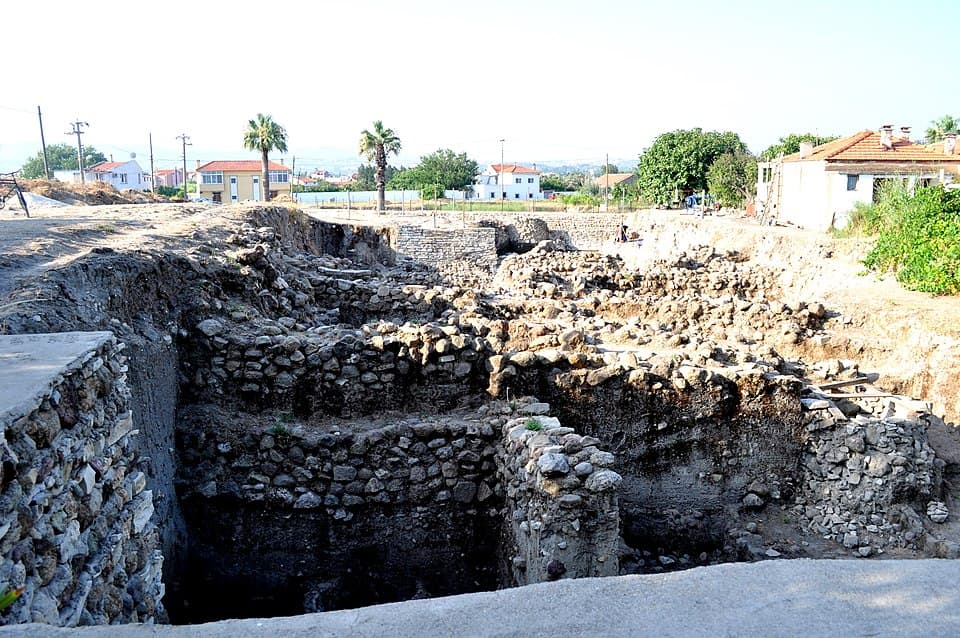
Once at the mound, the shift in temporal register is immediate. The height itself — ten metres of accumulated human settlement — is visible from the surrounding streets as something slightly displaced from the present. Active excavation trenches reveal stratigraphy spanning thousands of years in a single wall of earth: Bronze Age, Iron Age, Archaic, Classical layers stacked vertically. This is not the cleaned-up presentation of a major heritage site; it is the working face of archaeological time.
The remains of the Athena temple sequence are the most legible sacred feature. The plan of successive temples, each built on the foundations of the previous one, conveys the core logic of sacred topography: the same ground, consecrated repeatedly, across six centuries. Walking the footprint of the earliest temple — among the oldest confirmed Athena temples in Ionia — is a specifically intimate act available here and almost nowhere else.
The site lacks formal visitor amenities; nearby cafes and the metro connection make logistics manageable. Allow more time than the site's modest visible footprint might suggest.
The Tepekule mound is in the Bayraklı district, accessible from the Bayraklı metro station. Visitor access may be restricted during active excavation seasons. The İzmir Archaeology Museum (city centre) holds important finds from the site and provides essential context; visiting the museum before the mound is recommended.
Context and lineage
The mound at Tepekule had been inhabited long before the Greeks arrived. The Leleges — a pre-Greek Aegean people about whom little is known — occupied the site during the Bronze Age; their remains form the lowest excavated layers. When Aeolian Greek colonists arrived around 1000 BC, they did not build on empty land but on a site already carrying millennia of human habitation.
The Aeolian settlement was a planned city. From an early date it had defined street blocks, houses of standardised form, and a community organised around civic institutions. The Athena temple — built around 725 BC, at a period when most Greek religious architecture was still in timber — was the centre of this civic life. The bronze votive bar recovered in excavation, dedicating the space to Athena, is the oldest confirmed material evidence of Athena worship in Ionia.
The Homer tradition belongs to a later self-understanding. By the classical period, the city of Smyrna claimed the poet as its own and maintained a shrine to him. Whether this claim reflects a genuine memory or civic pride in an adopted cultural icon, the tradition is ancient and persistent.
Old Smyrna's role as a significant port city in the early archaic period — cosmopolitan, linguistically rich, at the confluence of Aeolian and Ionian cultural currents — is the kind of environment from which the poems' particular breadth of reference could plausibly have emerged.
Lelegian Bronze Age settlement (c. 3000 BC+) → Aeolian Greek colonisation (c. 1000 BC) → Athena sanctuary sequence (c. 725 BC onward) → Ionian cultural integration → Hellenistic depopulation → Ottoman and modern neighbourhood development → ongoing archaeological excavation (1927/1930–present)
Homer
Poet (traditionally)
Franz Miltner
Excavator
John Manuel Cook and Ekrem Akurgal
Excavators
Traditions and practice
The Athena sanctuary at Old Smyrna was the focus of civic religious life: animal sacrifice, votive offerings (the thousands of small figurines and metal objects recovered in excavation), processions and seasonal festivals. A Homer heroon (hero shrine) was maintained in the Roman period, suggesting a cult of the poet — worship of a human figure elevated to near-divine status through his cultural significance.
Egyptian religious objects recovered at the site indicate the cosmopolitan character of the port: Isis and Osiris worship alongside the principal Greek traditions.
No active religious ceremonies. Archaeological excavation continues in seasonal campaigns by Turkish university teams. The İzmir Archaeology Museum curates and displays finds from the site.
Begin at the İzmir Archaeology Museum before visiting the mound: the artefacts recovered from Old Smyrna — the votive objects, architectural fragments, Egyptian-influenced items — give the stratigraphic layers of the mound human scale and meaning. At the mound, focus on the excavation trenches where they are accessible: stand at the edge and read the layers.
Identify, if you can, the transition between the Bronze Age occupation and the Aeolian Greek settlement — a line of earth that represents a cultural horizon, the moment when a new people arrived and began building differently.
At the Athena temple footprint, consider what it meant to the community that first built here: not a major regional sanctuary with famous oracle, but the communal acknowledgement that their city stood under divine protection. This is the foundational form of sacred topography — the claim that this specific ground is consecrated, and that the community is therefore home.
Ancient Greek religion — Athena Polias worship
HistoricalThe principal deity of Old Smyrna; the sequence of Athena temples beginning c. 725 BC is among the earliest confirmed Athena sanctuary series in Ionia. A bronze votive bar confirmed the dedication. The temples were rebuilt six times, each rebuilding a renewal of the community's foundational claim.
Animal sacrifice, votive offerings, civic processions and festivals
Egyptian religious cults
HistoricalArtefacts showing Egyptian religious influence have been recovered at Old Smyrna, suggesting accommodation of Isis and Osiris worship in a cosmopolitan port city
Worship of Egyptian deities, likely associated with trade community presence
Archaeological and scholarly heritage
ActiveOne of the longest-excavated sites in Turkey (systematic work since 1927–1930); fundamental to understanding early Greek urbanisation and religious life in Ionia
Annual excavation seasons; Bronze and Iron Age stratigraphic research; museum curation of finds
Perspectives and open questions
Old Smyrna has been interpreted primarily through archaeological and literary-historical lenses — the site of the earliest Ionian urban planning, the possible home of Homer, and a prototype for Greek civic religious life in Asia Minor.
Scholarly perspective
Old Smyrna holds a foundational position in the archaeology of early Greek Asia Minor. The sequence of Athena temples (beginning c. 725 BC) is among the oldest documented in Ionia; the settlement plan reveals sophisticated urban organisation at a period when most Greek communities were still living in unplanned clusters. Systematic excavation since 1927 has produced evidence spanning Bronze Age through Hellenistic occupation, making Old Smyrna one of the most continuously documented sites for early Greek cultural development in Anatolia.
The site is not on the UNESCO World Heritage List.
Living and traditional perspectives
Ancient tradition identified Smyrna as one of Homer's birthplaces — and the city maintained a heroon to him, suggesting that the claim was taken seriously as a community identity rather than merely as tourist promotion. The tradition of the Homer heroon persisting into the Roman period speaks to the enduring cultural importance of this identification: a city that considered itself the origin point of Western poetry.
For students of classical culture, this is a tradition worth sitting with even without biographical certainty.
Alternative interpretations
Some who work in the tradition of Homeric sacred geography place Old Smyrna within a network of sites associated with the poems' geographical imagination — the Aegean coastline, the islands, the harbours that the Odyssey's landscapes draw upon. Whether or not Homer was literally here, the tradition connects the mound to the mythic and poetic foundations of the Mediterranean world.
Open questions
Whether Homer was genuinely born at Smyrna; the precise relationship between the Bronze Age Lelegian settlement and the later Greek city; the full extent of the Athena temple complex; the nature of the Egyptian religious practices documented at the site.
Plan your visit
Access and arrival
Tepekule neighbourhood, Bayraklı district, İzmir. Accessible by İzmir Metro (Bayraklı station, approximately 700 m from the mound) and city buses. No formal entrance structure; visitor access is via the neighbourhood streets. Formal visitor facilities are limited — no dedicated parking, café, or interpretive panels. Contact the İzmir Archaeology Museum (Bahri Baba Park, Konak) for current excavation season dates and access arrangements. Mobile phone signal is available throughout the area.
İzmir has extensive accommodation in all categories. Bayraklı has local options; the Alsancak and Konak neighbourhoods (central İzmir) offer more choice and are 30–40 minutes from the site by metro.
Respectful visit
No specific requirements.
Generally permitted. Respect any signage during active excavation areas.
Not applicable.
Do not disturb excavation trenches or remove any material. Do not climb on or disturb exposed archaeological features.
Visitor access may be restricted during active excavation seasons without prior arrangement. The site has no formal visitor infrastructure. Contact the İzmir Archaeology Museum or check with local tourism offices for current access conditions before visiting.
Location
Map loads as you approach this section.
Pilgrim reflections
A portrait of encounter, not a score
Pilgrims describe what they felt, how present they could become, and whether the place would shape a journey. There are no stars and no ranking of traditions.
No reviewed reflections yet
The first pilgrims can help describe the character of being here.
Share a reflection
Available after an account-backed “Been there.” Every reflection is reviewed before publication.
Nearby sacred places
Explore other sacred places in the region. Proximity does not establish access or travel time; check each place’s guidance.


References
Sources consulted for this page. Source categories describe the publication, not a guarantee that every claim is verified. Traditional accounts and outside interpretations may differ.
- 01Old Smyrna - Wikipedia — Wikipedia contributorsencyclopediaComprehensive archaeological and historical overview
- 02Smyrna - Wikipedia — Wikipedia contributorsencyclopediaBroader city history including the Old Smyrna period
- 03Old Smyrna Excavations: The Temples of Athena – Bryn Mawr Classical Review — Bryn Mawr Classical ReviewacademicReview of the definitive publication on the Old Smyrna Athena temples
- 04Old Smyrna - Bayraklı Höyük — Visit İzmirofficialOfficial İzmir tourism portal entry
- 05Protohistoric Excavations in Bayraklı-Tepekule Mound (Old Smyrna) – The European Archaeologist — Academia.eduacademicAcademic paper on protohistoric (Bronze and Iron Age) layers at the site
- 06Archaeological excavations continue at 5,000-year-old Smyrna Mound in Izmir — Türkiye TodaySource contextRecent (2022+) excavation news
- 07Ancient Smyrna – Drive Thru History — Drive Thru HistoryguideCultural and religious context including Homer connection and early Christian significance
- 08Artifacts with Egyptian influence in Smyrna — Hurriyet Daily NewsSource contextEgyptian religious artifacts found at the site
Share a photo
Help visitors recognize Old Smyrna. Every submission is reviewed before publication.