Karabel Relief
The last Hittite monument in western Anatolia, carved to sanctify a mountain pass between worlds
Understand sacred places, explore living traditions, and learn how to engage respectfully with Pilgrim Map.
Access has not been verified. Check current local guidance before planning a visit.
İzmir, Turkey
Read the sources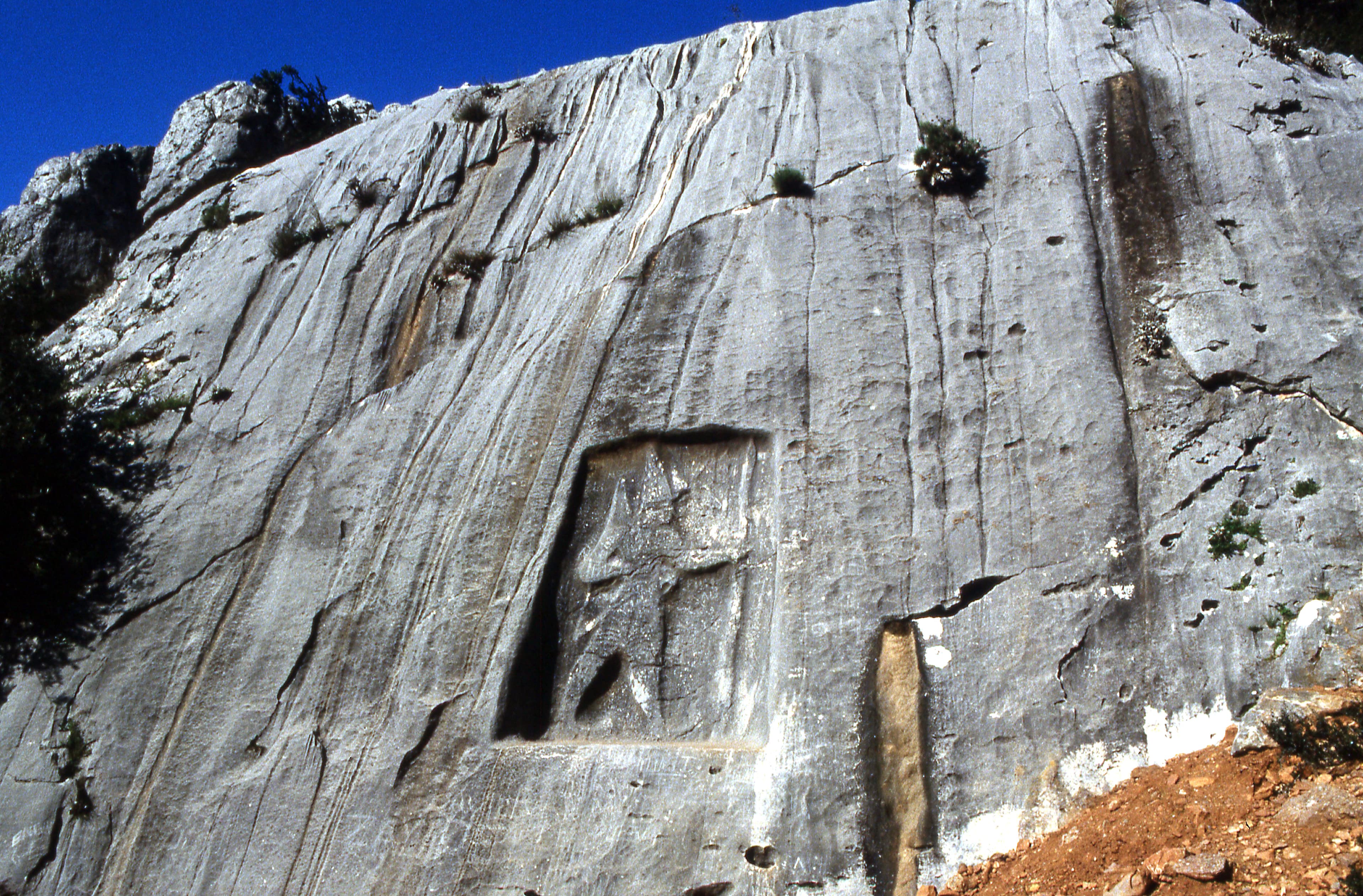
Image of Karabel Relief. Image source
Visit essentials
A quick read before you go
- Duration
- 1–2 hours at the site including travel within the pass area.
- Access
- Located in the Karabel Pass between Torbalı and Kemalpaşa, approximately 20 km southeast of…
Overview
At Karabel Pass between the Aegean coast and Anatolian interior, a cliff bears the three-thousand-year-old image of Tarkasnawa, king of Mira and Hittite vassal. Carved in Hittite civilization's final decades, he stands in a conical hat with bow and spear, his name beside him in Luwian hieroglyphics. The pass divided coast from highland and Greek world from deep interior; for Hittites, such liminal zones demanded potent divine protection.
The inscription helped decipher Luwian and anchor Hittite civilization in Anatolia rather than Syria, correcting Herodotus's centuries-old identification of the figure as Egyptian. This Bronze Age king asserted sovereignty at a world's edge within a generation of its collapse. Road construction blasted away three of four components in 1977–1982. Worn but intact Karabel A alone preserves the vanished civilization's westernmost reach.
Why this place is sacred
Hittite mountain passes were charged thresholds between territories, lowland and highland, familiar and unknown. A king's image there was political statement and religious act at once: it protected travelers, claimed the passage, and fixed royal presence where authority was most needed.
Karabel marks the Aegean world's felt boundary with Anatolia and the westernmost Hittite reach, carved shortly before the empire collapsed around 1180 BCE. One surviving figure against three destroyed companions, itself needing rescue, carries that vanished reach forward. Tarkasnawa's conical hat—canonical headgear of Hittite gods—aligns him with divine authority: he invokes an order of which he is part where heaven and earth negotiate.
Territorial and religious legitimation: to assert Tarkasnawa's authority over the Karabel Pass as a Hittite vassal, invoke divine protection for those passing through, and mark the boundary of Hittite influence at its westernmost reach.
The monument's meaning has shifted dramatically over millennia. For Herodotus and classical antiquity it was inexplicable — assumed Egyptian. For Ottoman and early modern scholarship it was mysterious. For 19th and 20th century archaeologists it became a key to deciphering Luwian hieroglyphics and locating Hittite civilization. Today it stands as a conservation concern: the sole survivor of a four-part monument, exposed to weathering and road traffic, awaiting formal protection.
Experience and orientation
Karabel Pass is a low hill saddle between Torbalı and Kemalpaşa, not a dramatic gorge. A road used in changing forms for at least three millennia passes a cliff carving easy to miss from a vehicle. Roughly 1.5 meters wide and 2.5 meters high, the lone figure stands in weathered rock without signs, facilities, or companions.
Approach on foot from the roadside at roughly eye level. Patience and angled light reveal the conical hat, bow, spear, and right-hand hieroglyphs; morning light articulates the northwest-facing low relief. The surrounding space is a graveyard of carving: road construction destroyed three companion sections between 1977 and 1982, leaving Karabel A by proximity or chance. The Hittite Empire itself collapsed within a generation of the carving, making this the edge of a world unaware it was ending.
The relief is carved into a cliff face in the Karabel Pass between Torbalı and Kemalpaşa, approximately 20 km southeast of İzmir city center, beside the D550/E87 road. It faces northwest. No signage or formal parking. The best approach is by car with a cautious roadside stop, followed by a short walk to the rock face.
Context and lineage
In the late 13th century BCE — approximately 1220–1180 BCE — the Hittite Empire was at the height of its reach but within a generation of catastrophic collapse. Tarkasnawa, king of Mira, ruled a vassal state in western Anatolia under the Hittite Great King. The Karabel Pass, linking the Aegean coastal plain with the Anatolian interior, was a vital corridor for trade, military movement, and administrative contact between western Anatolia and the Hittite heartland.
Hittite practice held that mountain pass entrances should be consecrated with royal or divine imagery — a combination of territorial claim and religious act. Tarkasnawa had himself carved at Karabel in the canonical style: a standing figure in a conical cap (symbol of divine authority), holding bow and spear (symbols of military power), with his name and titles rendered in Luwian hieroglyphics on the adjacent rock face.
Originally, the monument comprised four components: Karabel A (the standing figure), Karabel B, and two inscription panels C1 and C2. Together they created a monumental gateway to western Anatolia under Hittite vassal authority.
Within a generation of the carving, the Hittite Empire collapsed — around 1180 BCE — as part of the broader Bronze Age collapse that destroyed multiple Eastern Mediterranean civilizations simultaneously. Tarkasnawa's world ended. The reliefs remained, witnessed by travelers for three thousand years, until modern road construction destroyed three of the four components between 1977 and 1982.
The relief belongs to a broader Hittite tradition of rock carving at mountain passes — a tradition documented from western Anatolia (Karabel) through the Taurus Mountains (Fıraktın, İmamkullu, Hanyeri, Taşçı) to the Hittite heartland. The practice was not purely political but carried religious weight: the carved figure invoked divine protection over the pass and its travelers.
Tarkasnawa
King of Mira, Hittite vassal ruler who commissioned and is depicted in the relief
Herodotus
Ancient Greek historian who recorded the figure as Egyptian in his travels through the region — a misidentification that influenced scholarship for centuries
Traditions and practice
In Hittite religious practice, mountain pass reliefs were acts of consecration as much as territorial assertion. The carved king's image — wearing the conical cap that aligned the ruler symbolically with divinity — invoked the gods' protection over the pass and its travelers. The act of carving was itself a ritual: the king's presence, rendered permanent in stone, ensured ongoing divine sanction of the route.
No specific ceremonies at Karabel are recorded, but the broader Hittite practice at comparable sites included libations, invocations, and royal ritual enactment at the carved surfaces.
No active practices. The site receives occasional visits from archaeologists, students of Hittite civilization, and heritage tourists, but no organized program of any kind.
Arrive on foot from the road, moving slowly toward the cliff face. Allow the relief to become legible gradually rather than searching for detail from a distance. Face the carved figure at its own level — the conical hat, the held weapon, the inscription at its side — and consider that this was the westernmost carving of a civilization's official self-presentation.
The hieroglyphic inscription beside the figure was one of the texts that unlocked the Luwian script: these marks translated a lost language back into history.
Turn and look outward from the relief, as Tarkasnawa's image has looked for three thousand years: northwest toward the Aegean plain, the coastal world, the edge of the empire. Then consider what is not visible — the three companion sections of this monument, destroyed in living memory. The empty rock on either side of the surviving figure is not blank: it is a record of loss.
Holding that awareness — the monument's survival and its mutilation, both — gives the encounter its full weight.
Hittite Royal Cult / Luwian Heritage
HistoricalThe relief was carved to assert royal authority and divine favor of Tarkasnawa, king of the Hittite vassal state of Mira, in a strategically vital mountain pass connecting inland Anatolia with the Aegean coast. It served as a monumental marker of royal presence and legitimacy along a major trade and military route.
Carving rock reliefs at pass entrances was a Hittite practice to declare territorial control and invoke divine protection for the pass and its travelers.
Archaeological / Scholarly
ActiveThe Luwian hieroglyphic inscription was pivotal in deciphering the script and establishing that Hittite civilization was centered in Anatolia rather than Syria. The relief remains a primary reference point for Hittite studies in western Anatolia.
Site visits by epigraphers and archaeologists; casts held at İzmir museum and referenced in international publications.
Perspectives and open questions
The Karabel relief is read differently depending on what kind of presence one is bringing to the encounter: epigraphic evidence, political history, the felt weight of deep time, or the question of what survives and what doesn't.
Scholarly perspective
The scholarly consensus places the relief in the late 13th century BCE, carved by Tarkasnawa of Mira, a Hittite vassal kingdom in western Anatolia. The Luwian hieroglyphic inscription was crucial in establishing both Tarkasnawa's identity and the decipherment of Luwian script itself. The relief also confirmed that Hittite civilization extended well into western Anatolia — correcting earlier assumptions, influenced by Herodotus' misidentification, that Hittite territory was limited to central and eastern Anatolia.
Peer-reviewed scholarship (Cambridge Archaeological Journal, European Journal of Archaeology) has examined the monument's changing cultural significance and its role in Orientalist historiography of the 19th and 20th centuries.
Living and traditional perspectives
No living tradition is directly associated with the site. The region is part of the Turkish-speaking world, and the monument sits within a landscape of contemporary agricultural and road infrastructure. No Hittite descendant community maintains the site.
Alternative interpretations
From a liminal landscape perspective, the Karabel Pass can be understood as a persistent threshold — a place where different worlds have met, merged, and separated across several millennia. The Hittite practice of carving a king at a pass entrance acknowledges what passes actually are: thresholds where the familiar ends and the unknown begins, where divine protection is most needed.
The relief's survival — one figure from four, at the edge of a collapsed empire — can be read as a kind of stubborn presence, the carved stone outlasting the civilization that made it by three thousand years.
Open questions
The full political relationship between Tarkasnawa and the late Hittite Great King remains uncertain. Questions persist about whether additional reliefs existed in the broader Karabel corridor beyond the four documented components, and about the religious program — if any — enacted at the carved surface during the Hittite period.
Plan your visit
Access and arrival
Located in the Karabel Pass between Torbalı and Kemalpaşa, approximately 20 km southeast of İzmir city center, beside the D550/E87 road. Approach by private vehicle — there is no public transport to the relief itself. Roadside parking is informal. GPS: approximately 38.3706°N, 27.4561°E. No visitor facilities, no signage, no admission fee.
İzmir city center (20 km northwest) offers a full range of accommodation. No facilities near the pass itself.
Respectful visit
No specific requirements. Practical clothing for outdoor walking on rocky terrain beside a road.
Photography permitted and encouraged for documentation. The northwest-facing surface is best photographed in morning light or on overcast days when shadows are reduced.
None appropriate. This is an archaeological site with no active religious practice.
Do not touch or mark the carved surface. Do not attempt to climb the cliff face. Exercise caution beside the road.
Do not touch the carved surface. The relief is exposed to weathering and requires careful management. Road traffic is ongoing beside the site — be cautious when stopping. There are no visitor facilities.
Location
Map loads as you approach this section.
Pilgrim reflections
A portrait of encounter, not a score
Pilgrims describe what they felt, how present they could become, and whether the place would shape a journey. There are no stars and no ranking of traditions.
No reviewed reflections yet
The first pilgrims can help describe the character of being here.
Share a reflection
Available after an account-backed “Been there.” Every reflection is reviewed before publication.
Nearby sacred places
Explore other sacred places in the region. Proximity does not establish access or travel time; check each place’s guidance.



References
Sources consulted for this page. Source categories describe the publication, not a guarantee that every claim is verified. Traditional accounts and outside interpretations may differ.
- 01Metamorphoses of a Monument: The Materializations of the Karabel Relief (Turkey) — Cambridge Core / European Journal of ArchaeologyacademicPeer-reviewed study on the monument's changing cultural significance over time
- 02Vandalizing Father Hittite: Karabel, Orientalism and Historiographies — Cambridge Archaeological JournalacademicScholarly examination of the monument's role in Hittite historiography and Orientalist framing
- 03Karabel relief - Wikipedia — Wikipedia contributorsencyclopediaComprehensive overview of history, iconography, and destruction of related reliefs
- 04Alone Against Time: The 3,000-Year-Old Last Hittite Monument of Western Anatolia Awaits Rescue — ArkeonewsacademicDocuments current conservation concerns and damage from road construction
- 05Forgotten Hittite Legacy in İzmir: Karabel Rock Monument Cries for Help — Anatolian ArchaeologyguideDetails on current state and conservation needs
- 06Herodotus' Error: Misreading the Hittite 'Karabel Rock Relief' as Egyptian — The ArchaeologistguideExplains how Herodotus misidentified the monument as Egyptian and the long-running scholarly confusion
- 07Karabel Relief | Archiqoo — ArchiqooguideLocation data and general site description
Share a photo
Help visitors recognize Karabel Relief. Every submission is reviewed before publication.