Mount Sipylus and the Manisa relief
A mountain carved for the mother of gods, where grief turned to stone still weeps
Understand sacred places, explore living traditions, and learn how to engage respectfully with Pilgrim Map.
Access has not been verified. Check current local guidance before planning a visit.
Manisa, Turkey
Read the sources
Visit essentials
A quick read before you go
- Duration
- Half day combining the Weeping Rock, relief viewpoint, and a walk in the national park.
- Access
- Akpınar relief is approximately 5 km east of Manisa city centre on the D300 road toward Salihli,…
Overview
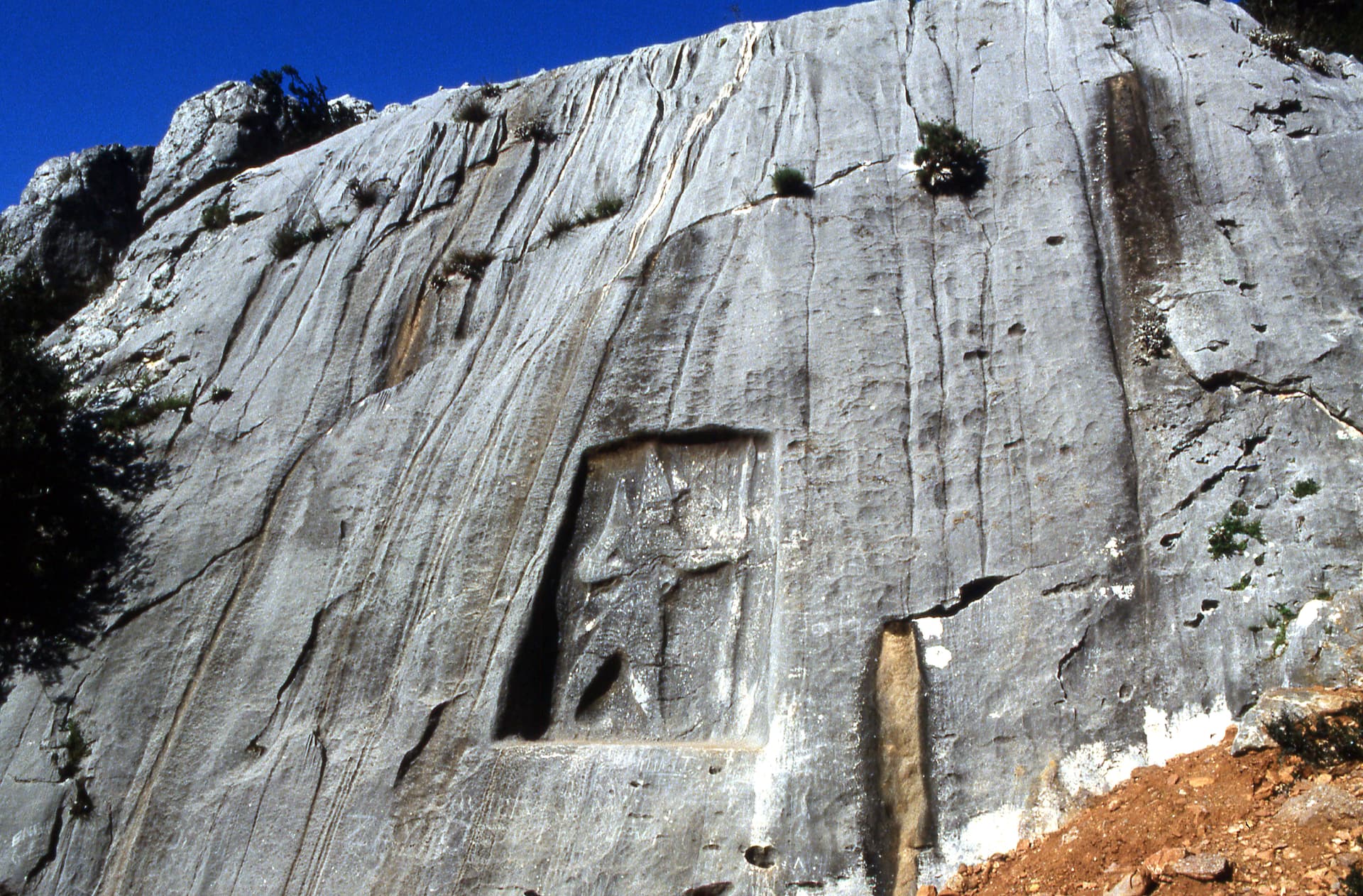
Mount Sipylus above Manisa in western Anatolia has accumulated sacred meaning across three thousand years and several civilizations. A cliff relief carved around 1300 BCE by Hittite or Luwian craftsmen was identified by later Greek and Roman viewers as an ancient image of Cybele, Anatolia's mother of the gods, older than the Olympians—an interpretation distinct from its unresolved original identity.
A naturally eroded limestone formation became Niobe, the grieving mother turned to stone after her children died, still seeming to weep when moisture seeps down its face; tradition also placed Tantalus's tomb on these slopes.
Together, the relief, rock, and tomb traditions inscribe grief, devotion, transgression, and longing into the landscape. Visiting within Spil Dağı National Park still makes this ancient sacred geography available while its meanings continue to accrue.
Why this place is sacred
The thinness of Mount Sipylus is geological as much as spiritual: the mountain's steep cliff faces and the formations they produce — the carved relief, the Weeping Rock — are not symbols of divine presence but, in the traditions centred here, expressions of it.
When Pausanias, the 2nd-century CE geographer, stood before the Akpınar relief and called it 'the most ancient of all images of the Mother of the Gods,' he was describing something that had been receiving veneration for at least fourteen centuries before his own time.
The continuity is remarkable: Hittite craftsmen carve a divine figure into the cliff around 1300 BCE; Lydian worshippers in the 6th and 5th centuries BCE venerate the same image as Cybele; Greek visitors integrate the carving into myths of Broteas, the god-neglecting sculptor son of Tantalus; Roman pilgrims come to see both the carving and the Weeping Rock.
Each civilisation that passed through this mountain valley left a layer of interpretation, and those layers did not cancel each other — they compounded. The Weeping Rock is remarkable in its own right: a limestone formation shaped by centuries of water and erosion into a face-like surface from which moisture genuinely seeps, producing what can read as tears.
Whether or not one holds to the Niobe narrative, standing before this formation at the right season — when snowmelt feeds the rock's moisture — and watching water move down what resembles a stricken face produces a visceral response that explains why the myth found its home here rather than anywhere else.
The Akpınar relief was carved c. 1300 BCE as part of Hittite frontier sacred marking — a practice of inscribing mountain cliffs with divine images to claim and consecrate territory. The mountain itself was likely venerated before the carving, as a natural sacred high place.
Hittite/Luwian sacred monument (c. 1300 BCE) → Lydian Cybele sanctuary (c. 700–550 BCE onward) → Greek mythological landmark (Niobe, Tantalus, Broteas traditions) → Roman period mother goddess cult and literary pilgrimage → Byzantine period loss of formal veneration → modern national park with informal goddess-spirituality pilgrimage and heritage tourism.
Experience and orientation
The approach to the Akpınar relief is itself part of the experience: the road east from Manisa city centre passes through increasingly rocky terrain before the limestone cliffs of Mount Sipylus come into full view, their scale dwarfing the valley below. The carved relief sits 100–120 meters up the cliff face — a height that requires binoculars or a telephoto lens for full detail, but that can also be appreciated at a distance as an act of intentional placement.
This is not an image that invites casual inspection; it demands that you look up, sustain attention, and come to it. The figure's ambiguity is part of the experience: even after three thousand years of scholarly attention, there is genuine disagreement about whether this is a goddess (Cybele), a king, or a Hittite storm deity. The rock will not settle the question for you.
The Weeping Rock, encountered on the road toward the Akpınar area, is more immediately legible — the weathered limestone surface that ancient visitors and modern ones alike read as a human face, the moisture that can be present especially in spring and after rain. This is where the Niobe myth lives in the landscape: in the actual visual and tactile qualities of the stone, in the coincidence of natural form and narrative need.
The wider mountain — Spil Dağı National Park — offers forest walking at higher elevations, views across the Gediz valley and toward İzmir on clear days, and the particular quality of altitude silence that high sacred places have preserved across cultures.
The Akpınar relief viewpoint is approximately 5 km east of Manisa city centre on the road toward Salihli (D300), above an amusement park area. The Weeping Rock is encountered before the relief on the same road. Manisa is 45 km north of İzmir, served by regular bus and dolmuş. A car is recommended for the mountain road. Spil Dağı National Park entrance is at Akpınar.
Context and lineage
In Greek mythological tradition, Mount Sipylus was the domain of Tantalus, king of the region, who was punished by the gods for a transgression so severe it became the archetype of divine punishment: eternally hungry and thirsty, surrounded by food and water that retreat when reached. His daughter Niobe, famous for her fourteen children, claimed superiority over the goddess Leto, who had only Apollo and Artemis. The two divine siblings destroyed all fourteen of Niobe's children in a single day.
Niobe, broken by grief, returned to her father's mountain and was there transformed into the weeping rock that still, in moist seasons, appears to shed tears. The earlier tradition attributed the cliff carving to Broteas, Tantalus's son, who carved the image of Cybele while despising all other gods — and was eventually driven mad for his hubris and leapt into fire. The Hittite historical reality of the carving (dated archaeologically to c.
1300 BCE) was later absorbed entirely into this mythological frame.
The site represents an unbroken thread of sacred attention from the Late Bronze Age (Hittite period, c. 1300 BCE) through the Iron Age (Lydian period, c. 700–550 BCE), Archaic and Classical Greek, Hellenistic, Roman, and into the modern period — now as a national park that preserves both the physical monument and the mountain's sacred character.
Traditions and practice
Lydian devotees brought offerings and conducted ceremonies at the relief site, venerating the carved figure as Cybele, the mountain mother of the gods. These practices may have included processions up the mountain road, offerings of grain and flowers at the cliff face, and ceremonies tied to the spring agricultural calendar — consistent with Cybele worship more broadly, which centred on renewal, fertility, and the earth's regenerative power.
Greek visitors came as literary pilgrims rather than religious ones, seeking the monuments of Niobe and Tantalus as confirmation of mythological geography; Pausanias describes his visit in matter-of-fact terms that suggest he was one of many. In the Roman period, the mountain and its images were incorporated into the broader cult of the Magna Mater (Great Mother).
The site is visited by heritage tourists, by those interested in Anatolian mythology, and by women and groups within contemporary goddess-spirituality traditions who treat it as one of the oldest accessible Cybele sites in the world. No formal ceremony is conducted; informal acts of attention — flowers left at the cliff base, contemplative time at the Weeping Rock — are occasionally reported. Archaeological and epigraphic study of the relief continues.
Approach the Weeping Rock first, before the carved relief, as a preparation. Spend time with it at whatever season you arrive — note whether moisture is present, observe how the light falls on the stone surface, notice what the face-like weathering produces in you without forcing a narrative onto it. Then continue to the relief viewpoint.
If you have binoculars, use them: the figure's physical qualities — the stance, the scale, the surface texture — only become available at that distance. Then turn and look outward across the Gediz valley and toward the sea. This mountain has been a place from which people watched the world for three thousand years. Stand in that watching for a moment before descending.
Hittite/Luwian Sacred Carving
HistoricalThe Akpınar relief (c. 1300 BCE) is one of the westernmost Hittite rock monuments and represents the practice of inscribing mountain cliffs with divine or royal images to consecrate frontier territory. Luwian hieroglyphic inscriptions accompany the figure.
Rock carving; accompanying votive offerings; Luwian hieroglyphic inscription — a formal act of divine naming
Cybele / Great Mother Worship
HistoricalFrom the Lydian period onward, the mountain and its carved figure were venerated as the domain of Cybele, the Anatolian mother goddess whose cult was eventually adopted across the Hellenistic and Roman worlds. Mount Sipylus was described by ancient writers as one of Cybele's favoured habitations. Pausanias recorded the relief as the oldest image of the mother goddess in existence.
Ceremonies and offerings at the relief site; processions up the mountain; possible connection to the Cybele mysteries transmitted westward through Greek and Roman religious channels
Greek Mythology — Niobe and Tantalus
HistoricalMount Sipylus was the mythological home of Tantalus and the site of Niobe's transformation into the Weeping Rock. These stories made the mountain a landmark of divine justice and tragic grief in the Greek imagination — a place where the consequences of hubris were visible in the landscape itself.
No formal religious practices documented; literary pilgrimage by ancient writers and geographers; the Weeping Rock as a site of wonder and philosophical meditation
Anatolian Goddess Pilgrimage
ActiveContemporary visitors engaged with pre-Greek Anatolian spirituality treat the site as one of the oldest accessible Cybele sanctuaries in the world, making it a destination for personal devotion and connection to the ancient mother goddess tradition.
Informal pilgrimage visits; contemplative time at the cliff face and Weeping Rock; occasional offerings of flowers or small tokens
Perspectives and open questions
Mount Sipylus can be approached as an archaeological monument, a site of mythological geography, a living anchor of the Anatolian goddess tradition, or simply as a mountain that has gathered human sacred attention across an unusually long span of time.
Scholarly perspective
The Akpınar relief is dated to c. 1300 BCE by Hittite Monuments Project scholars and is one of the westernmost known Hittite rock monuments. The two accompanying Luwian hieroglyphic inscriptions have been partially deciphered. Scholarly debate continues on whether the central figure is female (Cybele or a Hittite goddess) or male (a king or storm deity) — the identification with Cybele is a later Greek/Lydian interpretive layer that cannot be read back into the original Hittite iconographic program.
The Weeping Rock is a documented natural limestone formation whose moisture seepage creates the appearance described by ancient and modern visitors.
Living and traditional perspectives
Local Manisa tradition maintains the Niobe identification for the Weeping Rock; local guides point it out as 'Niobe's tears.' The mountain is a source of civic and cultural pride. The figure in the relief is called 'Cybele' in local tourism materials, reflecting the long-established interpretive tradition that Pausanias codified.
Alternative interpretations
New Age and goddess-spirituality practitioners regard the site as one of the oldest accessible Cybele sites anywhere in the world — a place where the pre-Greek Anatolian mother goddess tradition can be encountered in its original landscape. The unresolved identity of the carved figure is not, for these visitors, a problem but a feature: an opening for direct encounter with a mystery that scholarship has not closed.
Open questions
The identity of the carved figure remains genuinely unresolved. The full extent of Bronze Age cult activity on the mountain — whether there was a sanctuary complex associated with the relief, what offerings were made and where — has not been archaeologically investigated. The relationship between the carving and any earlier Neolithic or Chalcolithic sacred use of the mountain is unknown. Whether the Weeping Rock was venerated before the carving was made, or independently of it, is unclear.
Plan your visit
Access and arrival
Akpınar relief is approximately 5 km east of Manisa city centre on the D300 road toward Salihli, above an amusement park. Manisa is served by regular buses and dolmuş from İzmir (c. 45 km south, 1 hour). A car or taxi is recommended for the mountain road from the city centre to the relief viewpoint. The amusement park area is the practical access point.
Manisa city centre (5 km west) offers the nearest accommodation — modest hotels serving business travellers and domestic tourists. İzmir (45 km south) has the full range of options and is a practical base for visiting multiple sites in the region.
Respectful visit
No dress requirements. Practical clothing and footwear for potential walking in the national park. Bring layers — the mountain can be significantly cooler than the valley below.
Permitted throughout the national park and at the relief viewpoint.
Not formally practiced at the site. Some visitors leave small tokens or flowers at the cliff base informally; this is a personal choice and leaves no lasting mark.
Do not attempt to climb the cliff face. National park regulations apply — no fires, no removal of plants or rocks. Stay on marked paths in the park's higher reaches.
Do not attempt to climb the cliff face to reach the relief — it is protected and the ascent is dangerous. National park regulations apply throughout; follow all marked trails. The amusement park at the access point below the relief creates an incongruous atmosphere that requires some reorientation; move through it and up toward the cliff for the full experience.
Location
Map loads as you approach this section.
Pilgrim reflections
A portrait of encounter, not a score
Pilgrims describe what they felt, how present they could become, and whether the place would shape a journey. There are no stars and no ranking of traditions.
No reviewed reflections yet
The first pilgrims can help describe the character of being here.
Share a reflection
Available after an account-backed “Been there.” Every reflection is reviewed before publication.
Nearby sacred places
Explore other sacred places in the region. Proximity does not establish access or travel time; check each place’s guidance.


References
Sources consulted for this page. Source categories describe the publication, not a guarantee that every claim is verified. Traditional accounts and outside interpretations may differ.
- 01Hittite Monuments – Akpınar — Hittite Monuments ProjectacademicSpecialist database of Hittite rock monuments; authoritative on dating and iconography
- 02Akpınar (Sipylos-Monument) - Manisa Relief - Vici.org — Vici.org contributorsacademicGeographic and bibliographic entry for the monument
- 03Manisa relief - Wikipedia — Wikipedia contributorsencyclopediaComprehensive article covering dating, iconography, and scholarly debate
- 04Mount Sipylus - Wikipedia — Wikipedia contributorsencyclopediaOverview of the mountain's mythology and geography
- 05The monumental rock relief excavated by the Hittites on Mount Sipylus more than 3,000 years ago — La Brújula VerdeSource contextAccessible scholarly summary of the relief's Hittite context
- 06Mount Sipylus: Birthplace of myths — Daily SabahSource contextJournalistic overview of mythological associations
- 07Mount Sipylus – Hellenica World — Hellenica WorldencyclopediaAggregated encyclopaedic entry on the mountain
- 08The Cybele Conundrum — Andrew GoughSource contextExplores the Cybele identification tradition and its spiritual legacy
Share a photo
Help visitors recognize Mount Sipylus and the Manisa relief. Every submission is reviewed before publication.