Red Basilica
A Hadrianic mystery temple turned church turned mosque — nearly two thousand years of unbroken sacred use in one set of walls
Understand sacred places, explore living traditions, and learn how to engage respectfully with Pilgrim Map.
Access has not been verified. Check current local guidance before planning a visit.
İzmir, Turkey
Read the sources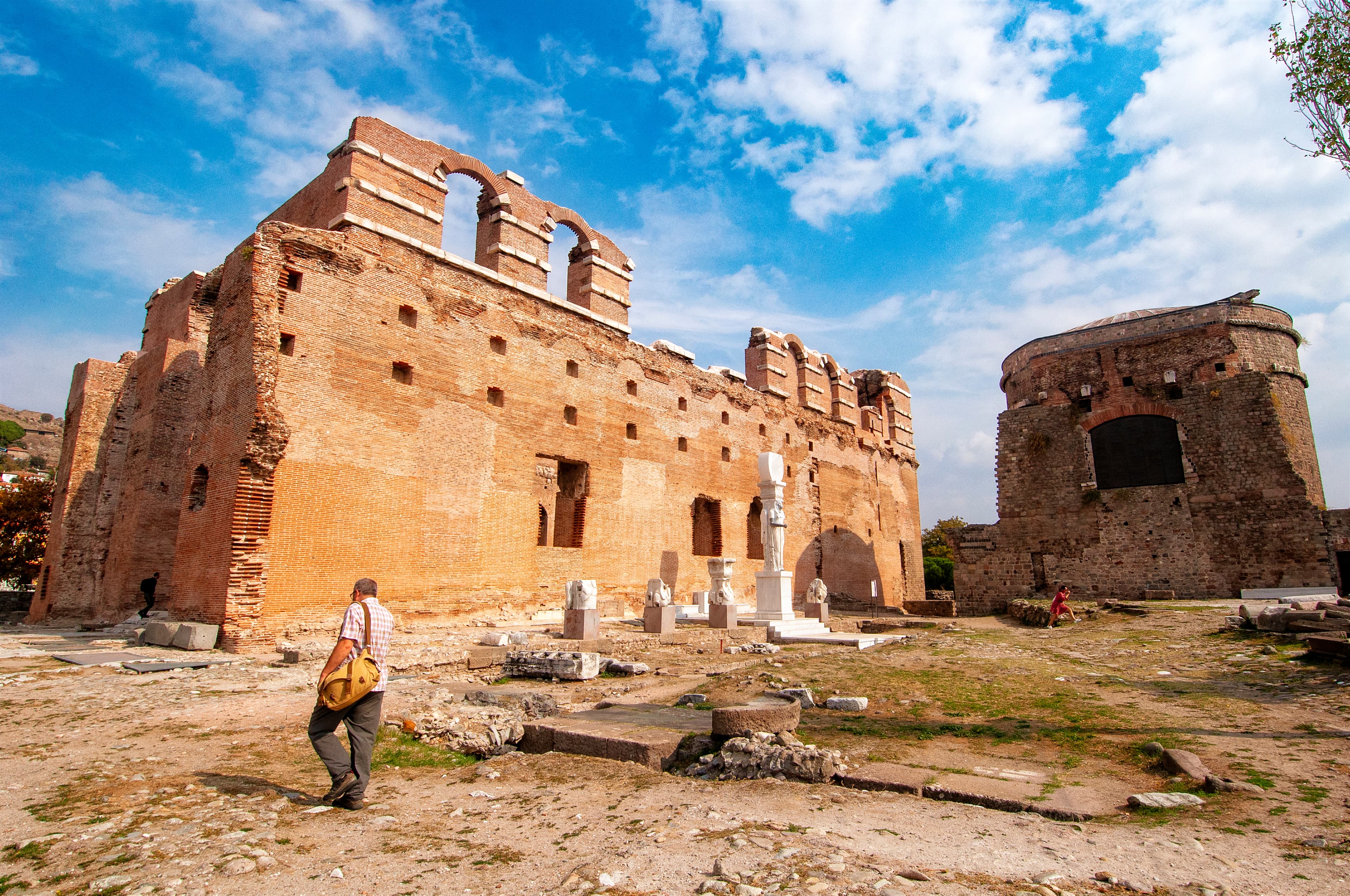
Image of Red Basilica. Image source
Station 3 of 7
Seven Churches of RevelationVisit essentials
A quick read before you go
- Duration
- 1–2 hours for the Red Basilica alone.
- Access
- Located in Bergama (İzmir Province), approximately 100 km north of İzmir city center.
Overview
The Red Basilica rises from the center of modern Bergama in a way that demands explanation. Its walls — enormous, built from fired brick in a region where marble and stone were the architectural norm — tower over the surrounding streets with a scale that implies imperial ambition rather than local pride. The building is 60 meters long and 26 meters wide. Its two circular rotunda towers stand 18 meters tall.
The temenos that once surrounded it measured 100 by 270 meters. A river ran beneath the floor.
Hadrian commissioned this vast sanctuary for the Egyptian mystery gods Serapis, Isis, Osiris, and Harpocrates.
The building that stands today is a ruin with an active interior. One rotunda tower has been the Kurtuluş Mosque since the early 20th century, with daily prayers called from within. The main basilica ruins are undergoing major restoration and are expected to reopen in 2026. Their layers remain literally visible: Roman brick, Christian remodeling, Islamic appropriation, and the open sky through the absent roof.
Why this place is sacred
Most sacred sites carry one tradition's imprint and bear later uses as disruptions or overlays. The Red Basilica is different. Each tradition that inhabited this space recognized the same quality in the location and chose to continue it rather than erase it. The Egyptian mystery cultists built here because Pergamon was the capital of a kingdom with deep religious ambitions.
The Christians converted the building because converting the city's most powerful pagan sanctuary was itself a theological act — sacred geography transferred rather than abandoned. The Muslim community built the Kurtuluş Mosque in the rotunda because a space that had always been a place of prayer continued to be one.
What the building encodes across all three uses is a theology of divine presence in a specific place. For the Egyptian cult, Serapis was present in this sanctuary in a way that required ritual maintenance — water channels for bathing, a vast courtyard for processions, enclosed chapels in the rotundas for the inner mysteries.
For early Christians in Pergamon, the Book of Revelation (2:12-17) addressed their community as living 'where Satan's throne is' — whether this referred to the Red Basilica, the Altar of Zeus, or the imperial cult generally, the implication was that the city was a site of intense spiritual contest, a place where the sacred and the adversarial were in immediate contact. For the mosque congregation, the same physical space continues to be where the divine is approached through structured prayer.
The water channels cut into the temenos floor during the Egyptian cult period are still visible. They carried water from the River Selinos — channeled beneath the entire complex — for the ritual purification that was central to Isis worship. The river still runs underground beneath the modern street. The water still moves beneath the prayers.
This quality of continuous sacred use is not common in the ancient world. Most pagan temples were converted, stripped, and rebuilt. The Red Basilica was converted, reused, and expanded — each new tradition adding to the sacred accumulation rather than subtracting from it.
Imperial Roman sanctuary for the Egyptian mystery cult of Serapis, Isis, Osiris, and Harpocrates, emphasizing salvation, ritual purification, and mystery initiation.
Built under Hadrian (c. 117–138 CE), the sanctuary served the Egyptian mystery cult through the Roman imperial period. In Late Antiquity it was converted to a Christian basilica — one of the largest in Asia Minor. This church was addressed in the Book of Revelation, making Pergamon one of the Seven Churches of Asia. After the Byzantine period, the building passed through Ottoman stewardship.
In the early Turkish Republican period, one rotunda was converted to the Kurtuluş Mosque, which remains active. The main basilica ruins are currently under restoration (2025–2026).
Experience and orientation
Bergama is a market town, and the Red Basilica sits in its middle without transition. The street turns a corner and the Roman brick walls are simply there — enormous, ungated, rising above the surrounding shops and houses with a scale that belongs to a different world.
Before entering, stand on the street for a moment and try to register what you are seeing: a building 60 meters long, its walls still largely intact after 1,900 years, built from fired brick in a region where every other major structure used marble and local stone. Hadrian imported the materials and the architects along with the theology.
The active mosque occupies the north rotunda. Its entrance is through the ancient doorway; the circular interior, which once housed a mystery cult chapel, has been whitewashed and fitted with carpet and a mihrab. Daily prayers are called here. When you stand outside the rotunda and hear the adhan, you are hearing the most recent chapter of the building's continuous sacred use. This is not a conflict between past and present — it is the same pattern, continued.
The main basilica hall, roofless and in the process of major restoration, reads as a landscape as much as a building. The walls contain the space; the sky fills what the roof once held. Walk to the center and look up. The brick vaulting along the walls retains its original form. The proportions of the space — 26 meters wide, 60 meters long — are still fully present.
The water channels in the courtyard floor are still visible, their paths traced from the original river inlet to the ritual bathing areas.
The temenos courtyard, the vast open enclosure surrounding the main building, gives a sense of the scale of the original sanctuary. Processions, public rituals, and the crowds of mystery cult worshippers filled this space. Today it is partially excavated, partially overgrown, and mostly quiet.
The Red Basilica is in Bergama town center, walkable from the main square and from most local accommodation. Allow 1–2 hours for the basilica and temenos area. Bergama itself rewards a full day: the Acropolis (with the Altar of Zeus terrace and Temple of Trajan) is 3 km uphill, the Asclepieion is 2 km from town, and all three together represent one of the most significant concentrations of ancient religious and healing sites in western Turkey.
Check current access status before visiting due to ongoing restoration.
Context and lineage
The Egyptian mystery cults of Serapis and Isis arrived in the Mediterranean world with the expansion of Ptolemaic Egypt and the opening of trade routes across the Hellenistic world. By the Roman imperial period they were among the most widely practiced mystery religions in the empire — not ethnic cults but genuinely universal offers of divine protection, healing, and afterlife assurance.
Hadrian, emperor from 117 to 138 CE and known for his personal religious eclecticism, built the Pergamon sanctuary as an imperial-scale integration of Egyptian religion into the Roman sacred landscape of Asia Minor. The choice of Pergamon — already the cultural and political capital of the eastern Roman provinces, home to the Asclepieion and the great Library — was not accidental. Hadrian was creating a center of religious gravity.
The building's unusual construction in fired brick — rare in Roman Asia Minor — gave it the reddish-orange color that produced both its modern Turkish name (Kızıl Avlu, 'Red Courtyard') and its popular English designation. The River Selinos was channeled beneath the entire complex, emerging in the water features of the temenos and the ritual bathing channels. Water and purification were central to Isis worship; the river architecture is theology made hydraulic.
The transition to Christianity was the usual late antique pattern — conversion of the city's largest pagan sacred space into the city's largest church — but the scale of what was converted was not usual. The resulting Christian basilica was enormous, and it was directly in the Book of Revelation's crosshairs.
Pergamon was the third of the Seven Churches addressed in Revelation 2–3, described as the place 'where Satan's throne is' — a phrase that most scholars attribute to the nearby Altar of Zeus, though some argue it referred specifically to the massive Egyptian sanctuary.
The Red Basilica sits within the broader sacred landscape of Pergamon: a city that served as the Attalid kingdom's capital, built the first imperial cult temple to Augustus and Rome in Asia, hosted the Asclepieion where Galen trained, and maintained one of the ancient world's great libraries. The religious ambition visible in the Red Basilica is of a piece with the city's investment in sacred architecture at the highest scale across five centuries.
Hadrian
Roman emperor (117–138 CE) who commissioned the sanctuary; known for his syncretistic religious interests and deep engagement with Egyptian theology
John of Patmos
Author of the Book of Revelation, who addressed the church at Pergamon in Revelation 2:12-17; his text established Pergamon as one of the Seven Churches of Asia and gave the site its enduring Christian theological significance
Traditions and practice
The Egyptian mystery cult of Serapis and Isis centered on purification, initiation, and the relationship between devotee and deity. Water played a central role: the ritual bathing channels fed by the underground river were not decorative but functional, used for the ceremonial purification that preceded participation in the mysteries. The vast temenos courtyard, 100 by 270 meters, accommodated large-scale festival processions and public ceremonies.
The rotunda chapels housed the inner mysteries — the specific rites of initiation, probably involving symbolic death and rebirth, that gave members of the cult their particular assurance of divine protection and afterlife. The exact character of these rites, like most mystery cult practices, was protected by silence and not written down.
Daily Islamic prayer and Friday congregational worship take place in the Kurtuluş Mosque in the north rotunda. The call to prayer is sounded from the ancient rotunda doorway. Christian pilgrims, typically as part of organized Seven Churches of Revelation tours, visit the main basilica ruins and often gather for prayer or Bible reading in the temenos area. The site's UNESCO World Heritage status makes it a significant heritage tourism destination alongside its living religious functions.
Begin in the temenos courtyard rather than the main basilica hall. Stand at the center of the open space and estimate its dimensions: 100 meters by 270 meters. This courtyard was filled with worshippers during the great Isis festivals — processions with priests, sacred images, initiates, and curious onlookers among the most elaborate public religious ceremonies in the Roman world. The emptiness you stand in now held crowds.
Then move to the water channels cut into the courtyard floor. Follow one to its termination. The channel still connects, through the underground course of the River Selinos, to the moving water beneath the modern street. The river that Hadrian channeled beneath this sanctuary in the 2nd century CE has not stopped flowing.
For those on the Seven Churches pilgrimage: Revelation 2:12-17 addresses the church at Pergamon with the words 'I know where you live — where Satan's throne is.' Stand in the ruins of the main basilica hall and read those words in context. You are inside one of the buildings at the center of that early Christian community's most difficult theological confrontation with imperial religious power.
For all visitors: wait for the adhan from the north rotunda. When the call comes from within those ancient walls, listen to what it means that this particular space — built for Isis, converted for Christ, reclaimed for Allah — continues to produce a call to prayer.
Egyptian Mystery Cult (Serapis / Isis)
HistoricalBuilt under Hadrian as one of the largest Serapea in Asia Minor, the sanctuary served the mystery religion of the Egyptian gods Serapis, Isis, Osiris, and Harpocrates — a cult that offered personal salvation, divine protection, and mystery initiation, theological concerns the emerging Christian community in the same city also addressed.
Mystery initiations; ritual bathing in the temenos water channels; festival ceremonies and processions in the vast courtyard; offerings to Serapis and Isis; priestly rites in the main hall and rotunda chapels
Early Christianity
HistoricalPergamon is the third of the Seven Churches addressed in the Book of Revelation (2:12-17). The letter describes the church as living 'where Satan's throne is.' The conversion of the massive pagan sanctuary to a church made the Red Basilica one of the largest Christian places of worship in Asia Minor.
Christian liturgy in the converted basilica; ongoing significance of Pergamon as one of the Seven Churches of Asia
Islam
ActiveThe Kurtuluş Mosque in the north rotunda continues daily Islamic worship on the same site that has hosted religious practice since the 2nd century CE — an unbroken chain of sacred use across Egyptian, Christian, and Islamic traditions.
Daily Islamic prayer; Friday congregational worship; the adhan called from the ancient rotunda doorway
Christian Pilgrimage (Seven Churches)
ActivePergamon is the third of the Seven Churches addressed in the Book of Revelation. Christian pilgrims visit as part of the Seven Churches of Asia circuit connecting Ephesus, Smyrna, Pergamon, Thyatira, Sardis, Philadelphia, and Laodicea — all sites in western Turkey directly addressed in Revelation 2–3.
Pilgrimage visits; prayer and Bible reading in the ruins; organized Seven Churches tours from İzmir or Ephesus
Archaeological / Heritage
ActivePart of UNESCO World Heritage Site 'Pergamon and its Multi-Layered Cultural Heritage' (2014). Currently undergoing major restoration under Turkey's Ministry of Culture. The site's exceptional multi-layered history makes it an important case study in the continuity of sacred space across traditions.
Heritage conservation and restoration (2025–2026); archaeological research; public heritage interpretation
Perspectives and open questions
The Red Basilica is simultaneously an archaeological monument, a site of Christian pilgrimage, and an active mosque. These three relationships — scholarly, devotional, and liturgical — sit alongside each other within the same walls, each reading the same brick and stone through a distinct framework.
Scholarly perspective
The Red Basilica is one of the largest and best-preserved examples of Roman sanctuary architecture in the eastern Mediterranean. Its exceptional record of continuous religious use across Egyptian, Christian, and Islamic traditions makes it a landmark in the comparative history of religions. The water channels and hydraulic infrastructure confirm the centrality of purification rites to the Egyptian cult at this site.
The use of fired brick — unusual for monumental construction in Asia Minor — and the channeling of the River Selinos beneath the building suggest that hydraulic engineering and symbolic theology were integrated from the initial design. It is part of Pergamon's UNESCO World Heritage inscription (2014), which recognizes the city's exceptional multi-layered cultural heritage.
Living and traditional perspectives
For the Christian community at Pergamon, addressed in the Book of Revelation as living 'where Satan's throne is,' the massive pagan sanctuary in their city's center was not a neutral monument but a live theological contest. Early Christian self-understanding in Pergamon was shaped by the contrast between their own community — small, vulnerable — and the imperial religious apparatus represented by sanctuaries like this one.
That the building was eventually converted to a church represented, in Christian theological terms, a decisive resolution of that contest. For the Muslim community maintaining the Kurtuluş Mosque in the north rotunda, the continuation of prayer in this space is an extension of the site's sacred character across the transition between traditions.
Alternative interpretations
The identification of the Red Basilica specifically as the 'throne of Satan' in Revelation 2:13 — rather than the Altar of Zeus — has attracted esoteric interest. The Egyptian mystery cult character of the site, with its emphasis on secret initiation rites, hidden knowledge, and symbolic death and rebirth, maps onto certain esoteric interpretive traditions in ways the more obviously political Altar of Zeus does not. Neither attribution is scholarly consensus.
Open questions
The precise nature of the mystery initiations performed at the Serapeum is not documented — no initiate wrote down the specific content of the rites, because the mystery was protected by the prohibition on disclosure. The relationship between the building's water architecture and the specific choreography of Isis worship at this site is not fully understood. Whether the building's orientation or proportions encode additional symbolic or astronomical meaning has not been formally studied.
The date of conversion from pagan sanctuary to Christian church is not precisely established.
Plan your visit
Access and arrival
Located in Bergama (İzmir Province), approximately 100 km north of İzmir city center. Regular buses connect İzmir's Otogar to Bergama throughout the day (approximately 2 hours). The Red Basilica is in Bergama town center, walkable from the main square and from local accommodation. The site was closed for major restoration from early 2025 under Turkey's Ministry of Culture 'Heritage for the Future' program; expected to reopen in 2026 with a new visitor center, restored pathways, and night lighting.
When open: daily 08:00–19:00 (summer), 08:30–17:30 (winter); entrance fee approximately 3 EUR pre-restoration — confirm current fee on reopening. Mobile phone signal is reliable throughout Bergama town. Prayer times for the Kurtuluş Mosque vary seasonally; check locally for the current schedule.
Bergama town offers several small hotels and pensions within walking distance of the Red Basilica. İzmir (100 km south) provides the widest range of accommodation options for day visitors.
Respectful visit
Modest dress is required to enter the Kurtuluş Mosque: shoulders and knees covered, shoes removed at the entrance. Standard respectful dress is appropriate for the main basilica ruins and temenos.
Photography is permitted in the ruins and temenos area. Photography inside the active mosque may be restricted, particularly during prayer times; seek permission before photographing the mosque interior.
Not applicable for non-Muslim visitors in the heritage areas.
Do not enter the mosque during prayer times. Do not disturb worship in the north rotunda when the mosque is open. During restoration, access to the main basilica may be limited; follow any site signage or staff guidance.
The north rotunda is an active mosque. Do not enter during prayer times. The main basilica was closed for restoration from early 2025; confirm current access status before planning your visit. Prayer times vary seasonally — ask locally.
Location
Map loads as you approach this section.
Pilgrim reflections
A portrait of encounter, not a score
Pilgrims describe what they felt, how present they could become, and whether the place would shape a journey. There are no stars and no ranking of traditions.
No reviewed reflections yet
The first pilgrims can help describe the character of being here.
Share a reflection
Available after an account-backed “Been there.” Every reflection is reviewed before publication.
Nearby sacred places
Explore other sacred places in the region. Proximity does not establish access or travel time; check each place’s guidance.



References
Sources consulted for this page. Source categories describe the publication, not a guarantee that every claim is verified. Traditional accounts and outside interpretations may differ.
- 01The 'Red Basilica' (Kızıl Avlu): The Monumental Ruined Temple in the heart of Bergama city — The ArchaeologistacademicDetailed architectural and historical analysis
- 02Pergamon's Red Basilica Set to Reopen in 2026 After Extensive Restoration — Anatolian ArchaeologyacademicCurrent restoration status as of 2025-2026
- 03Serapeum/The Red Basilica, Pergamum - Architecture and Asceticism — University of ExeteracademicAcademic study of the site's religious architectural context
- 04Red Basilica - Wikipedia — Wikipedia contributorsencyclopediaComprehensive overview of construction, religious use, and architectural details
- 05Red Basilica, Bergama (Pergamum), Turkey — Turkey Travel PlannerguidePractical visitor guide with historical context
- 06Pergamon's Red Basilica to reopen after restoration — Hurriyet Daily NewsSource contextTurkish media coverage of the restoration and reopening timeline
- 07Red Basilica — Grokipedia — GrokipediaencyclopediaOverview with architectural details
- 08The Seven Churches of Revelation: Pergamum — Eyes to See the RevelationspiritualSpiritual and biblical significance of Pergamon in Christian tradition
Share a photo
Help visitors recognize Red Basilica. Every submission is reviewed before publication.