Nago-ji
The kechigan-jo where the Bandō circuit closes — a Mt. Potalaka temple above Tateyama Bay
Understand sacred places, explore living traditions, and learn how to engage respectfully with Pilgrim Map.
Access has not been verified. Check current local guidance before planning a visit.
Tateyama, Chiba Prefecture, Japan
Read the sources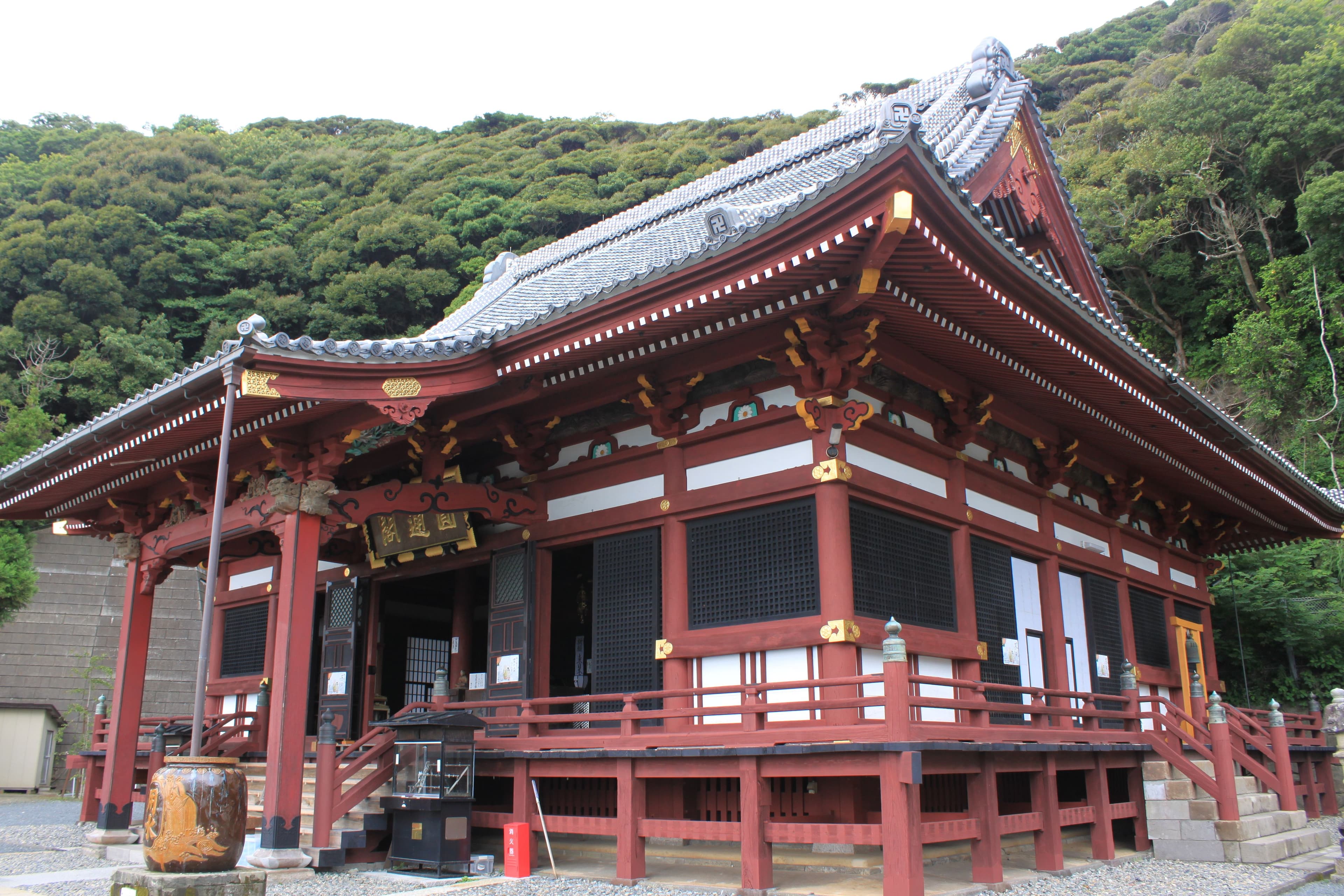
Station 33 of 33
Bandō Sanjūsankasho PilgrimageVisit essentials
A quick read before you go
- Duration
- 60–90 minutes for a focused visit including the Hondō, Senjū Kannon veneration, the Tahōtō…
- Access
- By car: roughly 5–10 minutes from central Tateyama.
Overview
Nago-ji stands on wooded Mt. Nago above Tateyama Bay and the Pacific at the Bōsō Peninsula's southern tip. Its mountain name, Fudaraku-san, renders Mt. Potalaka, Kannon's mythic ocean-side mountain; the setting is read as an earthly enactment of the bodhisattva's home.
Temple tradition dates its founding to 717 CE (Yōrō 1), when Gyōki (668–749), guided by an old man's divine message, carved driftwood into Senjū Kannon and prayed for Empress Genshō (680–748). No contemporary documentation survives. Minamoto no Yoritomo is later said to have prayed here for safety and victory after his 1180 defeat at Ishibashiyama, before defeating the Heike and founding the Kamakura shogunate.
After the 1703 Genroku earthquake and fire, Iseya Jinemon led an Awa-wide mid-18th-century rebuilding that produced the Hondō (1759) and Tahōtō (1761). The principal Kamakura-period bronze Senjū Kannon—about 105 cm tall with 42 hands—is a National Important Cultural Property. Nago-ji completes the 33-station Bandō circuit after the route from Sugimoto-dera in Kamakura and issues kechigan certification. It is also station #1 of the regional 34-temple Awa-no-kuni Fudasho Kannon Pilgrimage.
Why this place is sacred
Nago-ji's thinness has three registers. First is Fudaraku-san, Mt. Potalaka, Kannon's ocean-side abode in Mahayana cosmology. A forested mountain above Tateyama Bay and the Pacific enacts that mythic geography; the sea reportedly reached the Kannon-dō's foot in the Edo period, so arrival reads iconographically as reaching the bodhisattva's home.
Second is kechigan, where a 1,300+ km Bandō journey from Sugimoto-dera in Kamakura through seven eastern prefectures ends. Pilgrims present their nōkyō-chō for the final #33 stamp and, where applicable, completion certification. This structural climax reliably produces a pronounced sense of arrival, and many time it for an unhurried late-afternoon close.
Third is layered patronage: the Nara-period Gyōki and Empress Genshō tradition; Minamoto no Yoritomo's Kamakura-period vow before his campaign against the Heike; Iseya Jinemon and Awa villages rebuilding after 1703; and the Kamakura-period National Important Cultural Property bronze Senjū Kannon. The 1759 Hondō and 1761 Tahōtō embody community vow-making after disaster, joining Yoritomo's decisive prayer to pilgrims' journeys across years.
Experience and orientation
From JR Tateyama Station, a local bus or taxi reaches Nago-ji in about 5–10 minutes; central Tateyama is similarly close by car, while travel from greater Tokyo takes roughly 2 hours. Many Bandō pilgrims approach in late afternoon for an unhurried kechigan stamping.
A forest path climbs Mt. Nago through deciduous and broadleaf woods to the 1759 Hondō. Its Kamakura-period bronze Senjū Kannon—about 105 cm tall, with 42 hands and National Important Cultural Property status—rewards quiet attention to its age and patina. Pilgrims offer incense and saisen, then recite or hear the Hannya Shingyō, Senju-darani, or Kannon-kyō; close altar photography is generally restricted.
Above stands the 1761 Tahōtō. The grounds open south over Tateyama Bay and the Pacific, with Mt. Fuji visible west on clear winter days. The office issues the Bandō #33 stamp and, where applicable, full-completion certification; it also starts the 34-temple Awa-no-kuni Fudasho circuit at #1. Office hours are commonly 8:00–17:00; confirm before travel.
From JR Tateyama Station on the JR Uchibō Line, take a short bus or taxi to the temple (about 5–10 minutes). Walk up the forested approach to the Hondō. Light incense, offer at the saisen box, and recite or quietly listen to the Hannya Shingyō or the Senju-darani before the bronze Senjū Kannon. Continue up to the Tahōtō pagoda and the ocean-view grounds.
Bandō pilgrims should bring their nōkyō-chō to the temple office for the #33 stamp and, where applicable, the kechigan certification of full completion. Pilgrims continuing onto the Awa-no-kuni Fudasho circuit can begin it here as #1.
Context and lineage
By temple tradition, in 717 CE (Yōrō 1) — early in the Nara period — the wandering monk Gyōki (668–749) received a divine message from an old man, took sacred wood that had drifted ashore from the sea, and from it carved a Senjū Kannon image. He prayed for the recovery of Empress Genshō (680–748) from illness. With imperial decree, a temple was established on Mt. Nago.
No contemporary documentation of this founding survives, and the temple itself acknowledges the account as tradition.
Through the medieval period, samurai patronage shaped Nago-ji's standing. Minamoto no Yoritomo (1147–1199), fleeing into Awa Province after his 1180 defeat at the Battle of Ishibashiyama, is said to have prayed at Nago-ji for safety and victory in his coming campaign against the Heike. His subsequent triumph and founding of the Kamakura shogunate cemented the temple's reputation as a place where Kannon answers vow-making prayer. Successive samurai clans through the medieval centuries continued the patronage.
The 1703 Genroku earthquake and ensuing fire destroyed most of the precincts. After the disaster, the Awa merchant Iseya Jinemon — from Higashimachi — became the lead benefactor in 1757 and gathered offerings totaling more than 398 ryō from villages across Awa. The surviving Hondō (1759) and the Tahōtō pagoda (1761) are products of this Edo-period popular reconstruction effort.
The Kamakura-period bronze standing Senjū Kannon honzon — about 105 cm tall, with 42 hands — was designated a National Important Cultural Property. The Hondō, Tahōtō, and other temple structures are recognized cultural assets at prefectural and municipal levels.
Nago-ji is a parish temple of the Chizan-ha branch of Shingon Buddhism (mother temple Chishaku-in, Kyoto) — one of the major esoteric Buddhist schools in Japan. The Senjū Kannon devotion at the heart of the temple is older than the surviving structures; it traces, in tradition, to Gyōki's 717 CE carving from sea-borne sacred wood, and is concentrated today in the Kamakura-period bronze standing Senjū Kannon Bosatsu.
Gyōki (668–749)
Traditional founder
Nara-period itinerant monk later venerated as a bodhisattva. Per temple tradition, in 717 CE he received a divine message, took sacred wood that drifted ashore from the sea, and carved the original Senjū Kannon image, founding Nago-ji to pray for the recovery of Empress Genshō from illness.
Empress Genshō (680–748)
Imperial patron in the founding legend
Eighth-century empress whose illness, by temple tradition, prompted Gyōki's foundational prayer at the site; her imperial decree authorized construction of the temple complex on Mt. Nago.
Minamoto no Yoritomo (1147–1199)
Medieval samurai patron
First shogun of the Kamakura shogunate. By tradition, after his 1180 defeat at the Battle of Ishibashiyama and flight into Awa Province, he prayed at Nago-ji before his successful campaign against the Heike — a vow-making narrative that has shaped the temple's medieval and later reputation.
Iseya Jinemon
Edo-period lead benefactor
Awa merchant from Higashimachi who, in 1757, became the lead benefactor of the post-1703 reconstruction. He gathered more than 398 ryō from villages across Awa, funding the surviving Hondō (1759) and Tahōtō pagoda (1761).
Resident Shingon-shū Chizan-ha clergy
Contemporary stewards
The continuing community responsible for daily Shingon esoteric liturgy, the certification of Bandō completion, the care of the Kamakura-period bronze Senjū Kannon (National Important Cultural Property) and the cultural-property structures, and the reception of pilgrims completing the 1,300+ km circuit.
Traditions and practice
The temple's liturgy follows Shingon Chizan-ha esoteric forms — recitation of the Hannya Shingyō, the Senju-darani (the Thousand-armed Kannon dharani), and the Kannon-kyō at the bronze Senjū Kannon honzon. Shingon prayer rituals (kitō) for healing and aspiration are offered, drawing on the temple's long association with Empress Genshō's healing prayer and Yoritomo's vow-making. Veneration of the bronze Senjū Kannon (Important Cultural Property) and the wooden Amida Buddha image are central to the traditional ritual life of the precinct.
Bandō pilgrims arrive year-round for the #33 nōkyō and the kechigan certification, which is the structural climax of the circuit. The temple office issues both the final stamp and, where applicable, certification of full completion of all 33 stations. Pilgrims continuing onto the regional Awa-no-kuni Fudasho Kannon Pilgrimage (34 temples) can begin that circuit here at #1. Memorial and votive prayer services are offered on request, and the temple maintains ongoing care of cultural-property structures and the bronze honzon.
Bandō pilgrimage office hours commonly 8:00–17:00; confirm with the temple before traveling.
Allow 60 to 90 minutes for the Hondō, Senjū Kannon, Tahōtō, and ocean-view grounds; Bandō completers may stay longer. If possible, receive the kechigan stamp in late afternoon for an unhurried close. Pause inside the Hondō so the bronze image's age, 42-armed form, and patina register, then use the ocean view as the route's visual conclusion.
Buddhism
ActiveNago-ji is an active Shingon (Chizan-branch) temple at the southern tip of the Bōsō Peninsula, with mother temple Chishaku-in in Kyoto. Per temple tradition, founded in 717 CE by the wandering Nara-period monk Gyōki to pray for the recovery from illness of Empress Genshō; the Senjū Kannon was carved from sacred wood that drifted ashore from the sea. The honzon is a Kamakura-period bronze standing Senjū Kannon (~105 cm, 42 hands) — designated a National Important Cultural Property. As Bandō #33 and the final station of the 1,300+ km pilgrimage from Sugimoto-dera in Kamakura, Nago-ji is the kechigan-jo where pilgrims complete their circuit and have it certified at the temple office. The mountain name 'Fudaraku-san' (補陀洛山) explicitly identifies the site with Mt. Potalaka, Kannon's mythic ocean-side mountain in Mahayana cosmology. The temple is also #1 of the Awa-no-kuni Fudasho Kannon Pilgrimage — a 34-temple regional Bōsō circuit — marking it as a node where pan-eastern and local-Bōsō pilgrimage geographies overlap. The Hondō (1759) and Tahōtō pagoda (1761), products of the Iseya Jinemon-led Edo-period popular reconstruction after the 1703 Genroku earthquake, survive at the precinct.
Bandō Sanjūsankasho Pilgrimage
Active33rd and final station — the kechigan-jo, the completion station — of the 1,300+ km Bandō Kannon pilgrimage that begins at Sugimoto-dera in Kamakura and traverses seven prefectures of eastern Japan. The temple office certifies completion of all 33 stations.
Awa-no-kuni Fudasho Kannon Pilgrimage
Active1st station of a regional 34-temple Kannon pilgrimage on the southern Bōsō Peninsula. Pilgrims continuing onto the Awa circuit begin it here, immediately after completing the Bandō — a pairing that makes Nago-ji a doubly significant pilgrimage node.
Perspectives and open questions
Nago-ji is a temple where mythic geography, the structural climax of the Bandō circuit, and centuries of layered patronage converge on a single forested mountain above Tateyama Bay. Holding all three open is the most honest way to read the precinct.
Scholarly perspective
The 717 CE founding date and Gyōki attribution are temple tradition without independent contemporary documentation. What is securely documented is: the Kamakura-period (12th–14th c.) bronze standing Senjū Kannon honzon, recognized as a National Important Cultural Property; the 1703 Genroku earthquake and ensuing fire that destroyed most of the precincts; and the surviving Edo-period reconstruction (Hondō 1759, Tahōtō pagoda 1761), funded by the Iseya Jinemon-led popular effort beginning in 1757 with offerings totaling more than 398 ryō from villages across Awa.
The temple's role as the kechigan-jo of the Bandō Sanjūsankasho pilgrimage is well-attested from the medieval period onward.
Living and traditional perspectives
Temple tradition integrates the Mt. Potalaka identification (Fudaraku-san), the Gyōki founding legend, the Empress Genshō healing prayer, and the Yoritomo vow narrative into a single sacred biography of the site. Completion of the Bandō circuit at Nago-ji is the central ritual event in this tradition: the kechigan moment when 1,300+ km of pilgrimage close.
Within Shingon-shū Chizan-ha esoteric reading, the bronze Senjū Kannon embodies Kannon's compassion at full active reach — 1,000-armed, here represented as 42 in a standard iconographic compression — and the mountain-and-sea setting reads as a manifestation of Mt. Potalaka, Kannon's mythic abode at the meeting of land and ocean.
Alternative interpretations
Some readings emphasize the layered patronage as itself the spiritual lesson: a Nara-period monk's founding legend, a Kamakura-period samurai's vow, an Edo-period popular reconstruction — every major era has left its mark, and the visitor who arrives is the latest in a long line of vow-makers. Others focus on the ocean horizon: in the Edo period the sea reportedly reached the foot of the Kannon-dō, and the temple's identification as Mt.
Potalaka is grounded in the daily fact of looking south over Tateyama Bay and the Pacific.
Open questions
{"Historicity of Gyōki's founding, of the Yoritomo prayer, and of the original 8th-century structure are unverifiable from contemporary documentation","The Kamakura-period bronze Senjū Kannon's specific commissioning circumstances and craftsmen are not securely recorded","Specific present-day annual festival schedule beyond standard pilgrimage practice not exhaustively retrieved","Seasonal cherry-blossom and migratory bird timing in the temple grove not retrieved in detail"}
Plan your visit
Access and arrival
By car: roughly 5–10 minutes from central Tateyama. Public transport: short bus or taxi from JR Tateyama Station (JR Uchibō Line); the temple is well-served by local bus routes. From greater Tokyo, Tateyama is reachable in roughly 2 hours by limited express train or by Aqua-Line + drive. The Bōsō Peninsula's southern tip makes Tateyama and Nago-ji a natural overnight or two-day trip from Tokyo. Bandō pilgrimage office hours commonly 8:00–17:00; confirm with the temple before traveling.
Mobile phone signal is reliable on all major Japanese carriers in Tateyama and on Mt. Nago, though some forest pockets may have weaker reception.
Tateyama and the surrounding southern Bōsō coast offer a range of accommodations, from beach-area inns to mid-range hotels. The Bōsō Peninsula's southern tip makes Tateyama and Nago-ji a natural overnight or two-day trip from Tokyo; many pilgrims completing the Bandō plan an unhurried final stay.
Respectful visit
Modest, comfortable clothing; sturdy footwear for the climb. Pilgrim attire — hakui, sugegasa, kongō-zue — welcome.
Permitted in the precincts and from the grounds; interior altar photography is generally restricted, especially close-up shots of the bronze Senjū Kannon. Ask before photographing inside any hall.
Saisen, incense, candles. Stamp and kechigan certification fees at the office.
Remove shoes when entering wooden hall interiors | Do not climb on the Tahōtō pagoda (1761) or other historic structures | Speak quietly during others' prayers — many pilgrims are completing a long journey | Interior altar photography is generally restricted, particularly close-up shots of the bronze Senjū Kannon
The bronze Senjū Kannon is a National Important Cultural Property; interior altar photography is generally restricted, especially close-up shots of the statue. The Tahōtō pagoda (1761) and Hondō (1759) are historic structures; do not climb on them. Speak quietly during others' prayers — many pilgrims here are completing a long journey, and the precinct's atmosphere reflects that. Avoid heavy summer typhoon weather (August–September) when Bōsō coastal access can close.
Current practical details
Address
1125 Nago, Tateyama, Chiba 294-0055, Japan
Phone
Hours
Hours, fees, and access can change — verify on the official source before you travel. Practical details last checked Jun 2026.
Location
Map loads as you approach this section.
Pilgrim reflections
A portrait of encounter, not a score
Pilgrims describe what they felt, how present they could become, and whether the place would shape a journey. There are no stars and no ranking of traditions.
No reviewed reflections yet
The first pilgrims can help describe the character of being here.
Share a reflection
Available after an account-backed “Been there.” Every reflection is reviewed before publication.
Nearby sacred places
Explore other sacred places in the region. Proximity does not establish access or travel time; check each place’s guidance.


References
Sources consulted for this page. Source categories describe the publication, not a guarantee that every claim is verified. Traditional accounts and outside interpretations may differ.
- 01那古寺公式ホームページ — 千葉県館山市の坂東33番結願所 — Nago-ji templeofficialOfficial temple website; confirms Bandō #33 結願所 (kechigan-jo, 'completion station') status.
- 02那古寺について — 那古寺公式ホームページ — Nago-ji templeofficialTemple's own historical and institutional description.
- 03境内を見る — 那古寺公式ホームページ — Nago-ji templeofficialTemple's own grounds description.
- 04Nago-ji — Tateyama City Tourist Information Office — Tateyama CityofficialOfficial municipal tourism site for the temple.
- 05Temples and Shrines | Tateyama City — Tateyama CityofficialMunicipal heritage page.
- 06那古寺観音堂/千葉県 — Chiba Prefecture Board of EducationofficialPrefectural cultural-property record for the Kannon-dō.
- 07Nago-ji — Wikipedia — Wikipedia contributorsofficialConfirms Shingon-shū Chizan-ha sect, Senjū Kannon honzon, 717 CE legendary founding by Gyōki, 1703 Genroku earthquake fire, and surviving Hondō (1759) and Tahōtō pagoda (1761).
- 08那古寺 — Wikipedia (Japanese) — Wikipedia contributorsofficialJapanese Wikipedia article.
- 09第一番 那古寺 — ちば南房総「安房国札観音霊場巡り」 — Awa-no-kuni Fudasho Kannon Pilgrimage AssociationguideNote: Nago-ji is also #1 of the Awa-no-kuni Fudasho Kannon Pilgrimage (a regional 34-temple Bōsō circuit), in addition to being Bandō #33.
- 10The Temple Guy: The Bando 33 Kannon Route — James Baquet (The Temple Guy)guideLong-form English-language pilgrim's account; confirms 33rd / final station status.
Pilgrim glossary
- Honzon
- The principal Buddhist deity enshrined as a temple's central object of worship.
- Kannon
- The bodhisattva of compassion, central to many East Asian pilgrimage routes.
- Bodhisattva
- An enlightened being who postpones full nirvana to help others toward awakening.
- Sutra
- A canonical Buddhist scripture, often chanted as part of practice.
- Shingon
- An esoteric Japanese Buddhist school emphasizing ritual, mantra, and mandala practice.
Share a photo
Help visitors recognize Nago-ji. Every submission is reviewed before publication.