Kiyomizu-dera
A Tendai Kannon temple of Saichō and Ennin tradition on Otowa-yama in southern Bōsō
Understand sacred places, explore living traditions, and learn how to engage respectfully with Pilgrim Map.
Access has not been verified. Check current local guidance before planning a visit.
Isumi, Chiba Prefecture, Japan
Read the sources
Station 32 of 33
Bandō Sanjūsankasho PilgrimageVisit essentials
A quick read before you go
- Duration
- 45–75 minutes for a focused visit; longer for pilgrims combining sutra-chanting and an…
- Access
- Address: Kamone 1270, Minamisato area, Isumi City, Chiba.
Overview
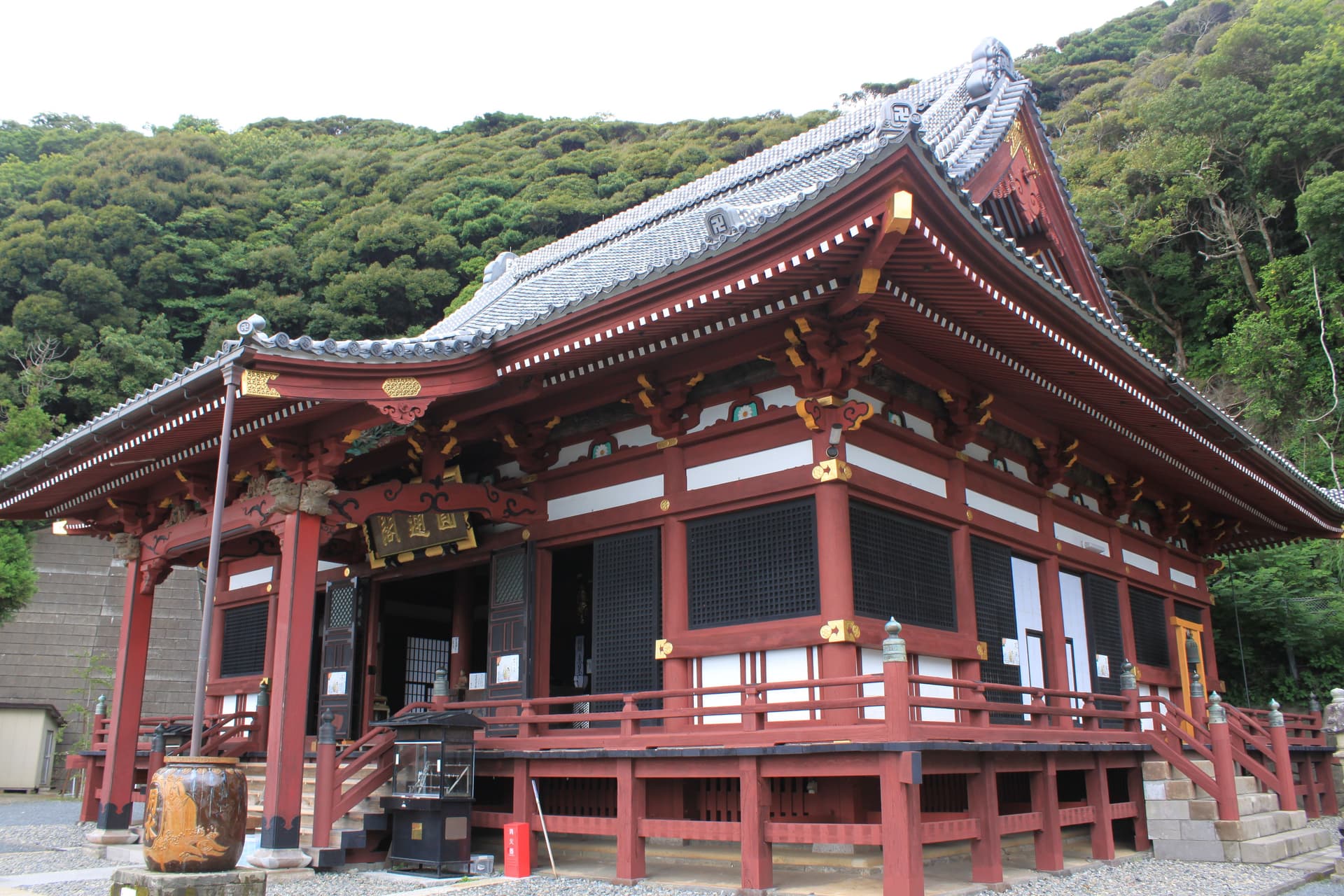
Otowasan Kiyomizu-dera stands on Otowa-yama in the forested hills of Isumi, Chiba. Its full name is Otowa-yama Senjū-in Seisui-ji (音羽山 千手院 清水寺), usually shortened to Kiyomizu-dera or Kiyomizu Kannon. It shares the Kiyomizu (清水, 'pure water') name and Tendai-founder or Sakanoue no Tamuramaro traditions with temples in Higashiyama, Kyoto, and Katō, Hyōgo, but all three are separate institutions with distinct lineages; their occasional grouping in travel writing is unofficial. This page concerns only the Isumi temple.
Temple tradition says Saichō (Dengyō Daishi, 767–822) founded a hermitage here during the Enryaku era (782–806) and carved a Jūichimen Kannon. In 807 CE (Daidō 2), his disciple Ennin (Jikaku Daishi, 794–864) is said to have carved a larger Senjū Kannon and rebuilt the temple. Tradition credits Sakanoue no Tamuramaro (758–811), also linked to Kyoto's Kiyomizu-dera, with sponsoring the original Hondō. The present Main Hall dates to 1688–1703 (Genroku era).
This is Bandō #32, second-to-last on the circuit of more than 1,300 km, following Kasamori-ji (#31), Japan's only shihō-kakezukuri hall. Its public Senjū Kannon and inner-sanctuary Eleven-faced Kannon give the quiet precinct a layered esoteric character. Locally it is a 'power spot' for healing, vitality, and renewal. Even where springs are modest, the pure-water name carries purification imagery, while the Thousand-armed Kannon's active reach and Eleven-faced Kannon's all-seeing perception express Kannon's compassion.
Why this place is sacred
Founder lineage, dual-Kannon iconography, and remoteness meet at Otowasan Kiyomizu-dera. Tradition places Saichō's eastward journey and hermitage here in the Enryaku era, Ennin's Senjū Kannon in 807, and Otowa-yama within early Tendai geography far from Mount Hiei. These claims are both audacious and characteristic of eastern Japanese Tendai foundation legends.
The Hondō's public Senjū Kannon and inner-sanctuary Jūichimen Kannon, both Chiba Prefecture cultural properties, form a mandala-like structure in Tendai esoteric reading: thousand arms reaching outward in active compassion and eleven faces seeing inwardly in every direction.
Rice paddies, low forested hills, and green stillness shape the rural Isumi setting. Visitors describe it as restorative; locally the temple is a 'power spot' for healing, vitality, and renewal. Kiyomizu (清水, 'pure water') threads through the experience even where springs are modest. For pilgrims nearing the Bandō circuit's end, the long Isumi approach and temple quiet become the structure of arrival.
Experience and orientation
The temple is easiest to reach by car, about 25–35 minutes from the JR Sotobō coast around Ōhara or Isumi. Buses from JR Ōhara and nearby stations are limited, so pilgrims often combine them with a taxi or rental car. The drive crosses low forested hills and rice country to Kamone 1270, Minamisato, Isumi City.
A quiet forest path and stairs lead to the Hondō, through greenery, low forest sounds, and birdsong. Reconstructed in 1688–1703, the Genroku-era hall is deliberately modest beside grander Edo-period temples. Its public altar holds the Senjū Kannon honzon, one of the temple's two principal Kannon images and a Chiba Prefecture cultural property. The Jūichimen Kannon occupies the regulated inner sanctuary; ask the temple office whether viewing is available.
Visitors light incense, offer saisen, and chant or listen quietly. The office issues the Bandō #32 nōkyō. Reported hours are 8:00–17:00, but verify before travel, especially in winter. Local visitors seek healing and renewed energy at this 'power spot' and often sit quietly before leaving. Bandō pilgrims may pause longer before continuing to Nago-ji (#33) at the peninsula's southern tip.
By car, drive 25–35 minutes from JR Ōhara or nearby Sotobō coast stations. By public transport, take the JR Sotobō Line to Ōhara and connect to a bus or taxi to the temple — confirm timetables before traveling. From greater Tokyo, the Aqua-Line + drive route or the JR Sotobō Line both work. At the temple, walk through the forested approach to the Hondō, light incense, offer at the saisen box, and chant or quietly listen before the Senjū Kannon.
Inquire at the temple office about inner-sanctuary access for viewing the Jūichimen Kannon. Bandō pilgrims should bring their nōkyō-chō to the office for the #32 stamp.
Context and lineage
Three figures dominate the temple's founding tradition. During the Enryaku era (782–806 CE), Saichō (Dengyō Daishi, 767–822) — soon to be founder of Japanese Tendai Buddhism — is said to have traveled into eastern Japan, come upon the Otowa-yama site in what is now Isumi, founded a hermitage, and enshrined a Jūichimen Kannon (Eleven-faced Kannon) image of his own carving.
In 807 CE (Daidō 2), his principal disciple Ennin (Jikaku Daishi, 794–864) — who would later become the third patriarch of Japanese Tendai and consolidator of its esoteric ritual — is traditionally credited with visiting the site, carving a larger Senjū Kannon (Thousand-armed Kannon), and rebuilding the temple to house it. The general and courtier Sakanoue no Tamuramaro (758–811), the same warrior linked in tradition to Kyoto's Kiyomizu-dera, is credited with sponsoring construction of the original Hondō.
The historicity of these accounts is, like most Heian-period Tendai foundation legends in eastern Japan, not securely documentable from contemporary records. What is reliably documented is the present Hondō, reconstructed between 1688 and 1703 (Genroku era), and the prefectural-level cultural property status of the principal Senjū Kannon and the inner-sanctuary Jūichimen Kannon images.
This Kiyomizu-dera is institutionally distinct from the Hossō / North Hossō Kiyomizu-dera in Higashiyama, Kyoto, and from the Banshū Kiyomizu-dera in Katō, Hyōgo. All three share the 'Kiyomizu' name and traditions involving Tendai founders and/or Sakanoue no Tamuramaro patronage, but they are separate institutions with separate lineages. Some travel writing groups them as 'three great Kiyomizu-dera,' but this is a traditional grouping rather than an official designation.
Otowasan Kiyomizu-dera is a parish temple of the Tendai school, anchored in the foundational lineage of Saichō and Ennin and the headquarters at Mount Hiei. The dual Senjū- and Jūichimen-Kannon devotion at the heart of the temple traces, in tradition, to the layered carvings of Saichō and Ennin at the same site.
Saichō / Dengyō Daishi (767–822)
Traditional founder
Founder of Japanese Tendai Buddhism, who established the headquarters at Mount Hiei after travel and study in Tang China. Per temple tradition, he founded a hermitage on Otowa-yama during the Enryaku era and enshrined an Eleven-faced Kannon of his own carving.
Ennin / Jikaku Daishi (794–864)
Carver of the Senjū Kannon honzon
Saichō's principal disciple and later third patriarch of Japanese Tendai. By temple tradition, in 807 CE Ennin carved a larger Senjū Kannon at the Otowa-yama site and rebuilt the temple to house it.
Sakanoue no Tamuramaro (758–811)
Traditional sponsor of the original Hondō
Heian-period general and courtier, also linked to Kyoto's Kiyomizu-dera in tradition. Credited with sponsoring construction of the original Main Hall at the Isumi site.
Genroku-era (1688–1703) carpenters
Builders of the surviving Hondō
The carpenters whose work, dated to between 1688 and 1703, produced the present Main Hall — the temple's surviving substantive structure.
Resident Tendai clergy
Contemporary stewards
The continuing community responsible for daily Tendai liturgy, the issuance of Bandō #32 goshuin, the care of the Senjū Kannon and inner-sanctuary Jūichimen Kannon, and reception of pilgrims and lay 'power-spot' visitors.
Traditions and practice
The temple's liturgy follows Tendai practice — recitation of the Kannon-kyō, the Hannya Shingyō, and the appropriate Kannon mantras at the Senjū Kannon honzon. Tendai liturgical observances are held on annual festival days. Visits to the inner-sanctuary Jūichimen Kannon, when access is permitted, deepen the esoteric structure of the visit.
Bandō pilgrims arrive year-round for the #32 nōkyō, often combining the visit with Kasamori-ji (#31) earlier the same day or the day before, and Nago-ji (#33) later the same day or the next. The temple receives goshuin requests at the office and conducts memorial services on request. Local 'power-spot' visits — for healing, vitality, and renewal — bring a steady flow of regional visitors as well. The temple reports standard opening hours of 8:00–17:00; verify before traveling, especially in winter.
Allow 45 to 75 minutes for a focused visit, longer for pilgrims combining sutra-chanting with an inner-sanctuary visit if available. Walk slowly through the forested approach, take the stairs at a steady pace, and pause at the Hondō's threshold before entering. Inside, light incense, offer at the saisen box, and chant or quietly listen before the Senjū Kannon. If you wish to view the inner-sanctuary Jūichimen Kannon, ask the temple office whether access is currently available.
Bandō pilgrims should bring their nōkyō-chō for the #32 stamp.
Buddhism
ActiveOtowasan Kiyomizu-dera is a Tendai temple in the Isumi region of southern Bōsō Peninsula, institutionally distinct from the Kyoto and Hyōgo (Banshū) Kiyomizu-dera. Per temple tradition, Saichō (Dengyō Daishi, 767–822) — founder of Japanese Tendai — visited the area during the Enryaku era (782–806), founded a hermitage, and enshrined a Jūichimen Kannon (Eleven-faced Kannon). His disciple Ennin (Jikaku Daishi, 794–864) is then said to have carved a larger Senjū Kannon (Thousand-armed Kannon) and rebuilt the temple to house it in 807 CE, with the Main Hall traditionally credited to the warrior Sakanoue no Tamuramaro. As Bandō #32, the temple is the second-to-last station of the 1,300+ km circuit. Both principal Kannon images — the public Senjū Kannon and the inner-sanctuary Jūichimen Kannon — are designated Chiba Prefecture cultural properties.
Bandō Sanjūsankasho Pilgrimage
Active32nd station of the 1,300+ km Bandō Kannon pilgrimage; the second-to-last station before the kechigan-jo at Nago-ji (#33).
Perspectives and open questions
Otowasan Kiyomizu-dera is a temple where Tendai foundation tradition, dual-Kannon iconography, and a long contemporary 'power-spot' practice meet on a single forested hillside. The visit rewards holding all three open at once, while keeping clear that this is the Isumi temple — institutionally distinct from the famous Kyoto and Hyōgo Kiyomizu-dera.
Scholarly perspective
Modern scholarship treats the Isumi (Chiba) Kiyomizu-dera as a Tendai temple at Otowa-san on the southeastern Bōsō Peninsula — institutionally and historically distinct from (a) the Kiyomizu-dera in Higashiyama, Kyoto, and (b) the Banshū Kiyomizu-dera in Katō, Hyōgo. All three share the 'Kiyomizu' name and traditions involving Tendai founders and/or Sakanoue no Tamuramaro patronage, but they are separate institutions.
The historicity of the Saichō and Ennin founding accounts at the Isumi site, like most Heian-period Tendai foundation legends in eastern Japan, is not securely documentable from contemporary records. The original 9th-century structure is unknown. What is reliably documented is the Genroku-era Main Hall (1688–1703) and the prefectural-level cultural property status of the two principal Kannon images.
Living and traditional perspectives
Temple tradition narrates a chain of patronage — Saichō, Ennin, Sakanoue no Tamuramaro — that integrates the site with the Heian-period diffusion of Tendai eastward from Mount Hiei into the Kantō and Bōsō regions. Within Tendai esoteric reading, the dual enshrinement of the public Senjū Kannon and the inner Jūichimen Kannon images a mandala-like structure of compassion: outwardly active (thousand arms reaching), inwardly all-seeing (eleven faces).
The 'pure water' name evokes the Tendai meditative theme of the Buddha-mind as a clear spring.
Alternative interpretations
Locally, Otowasan Kiyomizu-dera is regarded as a 'power spot' — a Japanese usage that means a place of concentrated healing, vitality, or renewal. Many visitors arrive specifically with this register in mind, and report a settling, restorative atmosphere consistent with the Tendai-founder lineage and the dual Kannon enshrinement. The water/spring symbolism implicit in 'Kiyomizu' threads through the visit even where physical springs are modest.
Open questions
{"The historicity of the Saichō and Ennin founding accounts is not securely documentable from contemporary records","The original 9th-century structure is unknown — what survives is the Genroku-era Main Hall (1688–1703)","Specific annual festival calendar not exhaustively retrieved beyond regular Bandō practice","Exact present opening hours per official site reported as 8:00–17:00 — confirm seasonally, especially in winter"}
Plan your visit
Access and arrival
Address: Kamone 1270, Minamisato area, Isumi City, Chiba. By car: roughly 25–35 minutes from the JR Sotobō coast (Ōhara / Isumi area). Public transport: bus from JR Ōhara or nearby stations is limited; many pilgrims use rental car or taxi from the train. Reported opening hours per temple: 8:00–17:00 — verify before traveling, especially in winter. Mobile phone signal is generally available on major Japanese carriers, though some forest pockets may have weaker reception.
Isumi and the surrounding southern Bōsō coast offer modest local lodging, including small inns and minshuku. Many Bandō pilgrims base themselves in Tateyama (closer to Nago-ji) or Mobara and visit Otowasan Kiyomizu-dera as a focused half-day stop.
Respectful visit
Modest, comfortable clothing; sturdy walking shoes for the stairs and grounds. Optional pilgrim attire includes white robes (hakui), a sedge hat (sugegasa), and a walking stick (kongō-zue).
Permitted in the precincts and grounds; interior altar photography is generally restricted.
Saisen, incense, and candle offerings are standard; goshuin fee at the office.
Remove shoes when entering wooden hall interiors | Keep noise low while others are praying | Respect the inner-sanctuary access boundary | Interior altar photography generally restricted
Forest paths can be slippery after heavy rain, and access roads occasionally close in the immediate aftermath of summer typhoon weather (August–September). Keep noise low while others are praying — the temple's quiet character is part of the visit. Respect the inner-sanctuary access boundary.
Current practical details
Address
1270 Misakichōkamone, Isumi, Chiba 299-4624, Japan
Phone
Hours
Hours, fees, and access can change — verify on the official source before you travel. Practical details last checked Jun 2026.
Location
Map loads as you approach this section.
Pilgrim reflections
A portrait of encounter, not a score
Pilgrims describe what they felt, how present they could become, and whether the place would shape a journey. There are no stars and no ranking of traditions.
No reviewed reflections yet
The first pilgrims can help describe the character of being here.
Share a reflection
Available after an account-backed “Been there.” Every reflection is reviewed before publication.
Nearby sacred places
Explore other sacred places in the region. Proximity does not establish access or travel time; check each place’s guidance.


References
Sources consulted for this page. Source categories describe the publication, not a guarantee that every claim is verified. Traditional accounts and outside interpretations may differ.
- 01清水寺 — 公式サイト (Otowasan Kiyomizu-dera, Isumi) — Kiyomizu-dera (Isumi) templeofficialOfficial temple website; confirms Otowa-yama mountain name, Tendai affiliation, Senjū Kannon honzon, Bandō #32 status, and founding narrative weaving Saichō, Ennin, and Sakanoue no Tamuramaro.
- 02清水寺のご紹介 — Kiyomizu-dera (Isumi) templeofficialTemple's own historical account.
- 03音羽山 清水寺(清水観音)| 坂東三十三観音 公式サイト — Bandō Sanjūsankasho Official Pilgrimage AssociationofficialOfficial pilgrimage association page for temple #32.
- 04Kiyomizu-dera (Isumi, Chiba) — Wikipedia — Wikipedia contributorsofficialEnglish Wikipedia article specifically on the Isumi (Chiba) Kiyomizu-dera — explicitly distinct from the Kyoto and Hyōgo temples of the same name. Confirms full name Otowa-yama Senjū-in Seisui-ji and Bandō #32 status.
- 05清水寺 (いすみ市) — Wikipedia (Japanese) — Wikipedia contributorsofficialJapanese Wikipedia article specifically on the Isumi temple, distinct from Kyoto Kiyomizu-dera and Banshū (Hyōgo) Kiyomizu-dera.
- 06清水寺 — ちば観光ナビ — Chiba Prefecture Official Tourism SiteofficialPrefectural tourism portal listing.
- 07いすみのパワースポット「清水寺」で癒やしと活力を体いっぱいに感じよう — Tabirai — Tabirai Travel InformationguideVisitor-focused article; details power-spot reputation and visiting experience.
- 08第32番札所 音羽山 清水寺(清水観音)— 坂東三十三観音霊場を歩く — Kasajizō (pilgrimage walking guide)guideDetailed Japanese pilgrimage guide site.
- 09The Temple Guy: The Bando 33 Kannon Route — James Baquet (The Temple Guy)guideLong-form English-language pilgrim's account of the full Bandō route.
Pilgrim glossary
- Honzon
- The principal Buddhist deity enshrined as a temple's central object of worship.
- Kannon
- The bodhisattva of compassion, central to many East Asian pilgrimage routes.
- Mandala
- A symbolic diagram of the cosmos used in meditation and ritual.
- Sutra
- A canonical Buddhist scripture, often chanted as part of practice.
- Tendai
- A Japanese Buddhist school based on the Lotus Sutra, foundational to many later traditions.
Share a photo
Help visitors recognize Kiyomizu-dera. Every submission is reviewed before publication.