Sugimoto-dera
Kamakura's oldest temple and the threshold of the Bandō Kannon circuit
Understand sacred places, explore living traditions, and learn how to engage respectfully with Pilgrim Map.
Access has not been verified. Check current local guidance before planning a visit.
Kamakura, Kanagawa Prefecture, Japan
Read the sources
Station 1 of 33
Bandō Sanjūsankasho PilgrimageVisit essentials
A quick read before you go
- Duration
- 30–45 minutes for a contemplative visit; 60+ minutes if attending the Goma ritual or starting a…
- Access
- From JR Kamakura Station east exit, take the Keikyū or Tōkyū bus toward Kanazawa-Hakkei or…
Overview
In a wooded valley east of Kamakura, Sugimoto-dera is reached by a steep mossed stone staircase older than the city's samurai capital. Tradition assigns its 734 CE founding to Empress Kōmyō and the priest Gyōki, making it Kamakura's oldest continuously active Buddhist temple. As the first Bandō Sanjūsankasho station—the eastern counterpart to the Saigoku 33—it is the threshold into pilgrimage.
Its Sanzon Doden enshrinement places three Jūichimen Kannon (Eleven-Headed Kannon) statues on one altar, traditionally attributed to Gyōki, Ennin, and Genshin across three successive centuries. Modern art history dates the surviving images to the late Heian period rather than the eighth century without diminishing their devotional significance. Each face marks a phase of compassionate response. The hall opens only on each month's 1st and 18th for the Goma fire ritual, when smoke rises before all three Kannon.
Sugimoto Kannon—Kannon under the cedar—recalls the night in 1189 when head priest Jōdai-bō entered a temple fire and sheltered the statues beneath a great cryptomeria. Geba Kannon, Dismount Kannon, recalls mounted samurai who tried to ride past and were said to be thrown from their horses and generations dismounting before the gate. The mossy entrance staircase is now closed to walking for preservation, but a parallel path lets pilgrims see what they may not step on.
Why this place is sacred
What gives Sugimoto-dera its quality of thinness is less any single dramatic feature than the way many small intensities have been compressed into one small precinct. The stone steps are not the steepest in Kamakura, but they have absorbed the weight of pilgrims' feet for so long that they hold their own kind of darkness.
The Kannon-dō is not the largest hall in the city, but it shelters three Kannon statues simultaneously — a Sanzon Doden enshrinement that is unusually rare in Japan, layering Heian-period devotion onto a single object of worship.
For those walking the Bandō circuit, the thinness is also relational. Sugimoto-dera is not merely a beautiful old temple. It is the place where the eastern Kannon journey begins. Receiving the first goshuin in a fresh nōkyō-chō stamp book here changes the temple from a destination into a starting line, and pilgrims often describe the climb up the stone steps as a deliberate crossing from secular to sacred time.
The fire of 1189, the moss restored across many decades, the cedar tree that gave the temple its name — these accumulate into a place where the ordinary acts of climbing, bowing, and lighting incense feel weighted by what has already been done here.
Founded by tradition in 734 CE under imperial sponsorship from Empress Kōmyō and the priest Gyōki, the temple was established as a Tendai-school Kannon hall in the eastern Kantō region. By the late 12th century, after the establishment of the Kamakura shogunate, it had become the first station of the Bandō Sanjūsankasho — the eastern Kannon pilgrimage promoted by Minamoto no Yoritomo and his son Sanetomo as a counterpart to the imperial-court Saigoku circuit.
The temple has burned and been rebuilt more than once; the most consequential fire came in 1189, when the head priest carried the three Kannon statues out of the flames and sheltered them under a cryptomeria — the origin of the temple's everyday name, Sugimoto Kannon. Through the Kamakura, Edo, and modern periods the hall has been continuously active.
Today it is one of only two Tendai temples in Kamakura, and its Goma fire rituals on the 1st and 18th of each month preserve a continuous esoteric liturgical tradition.
Experience and orientation
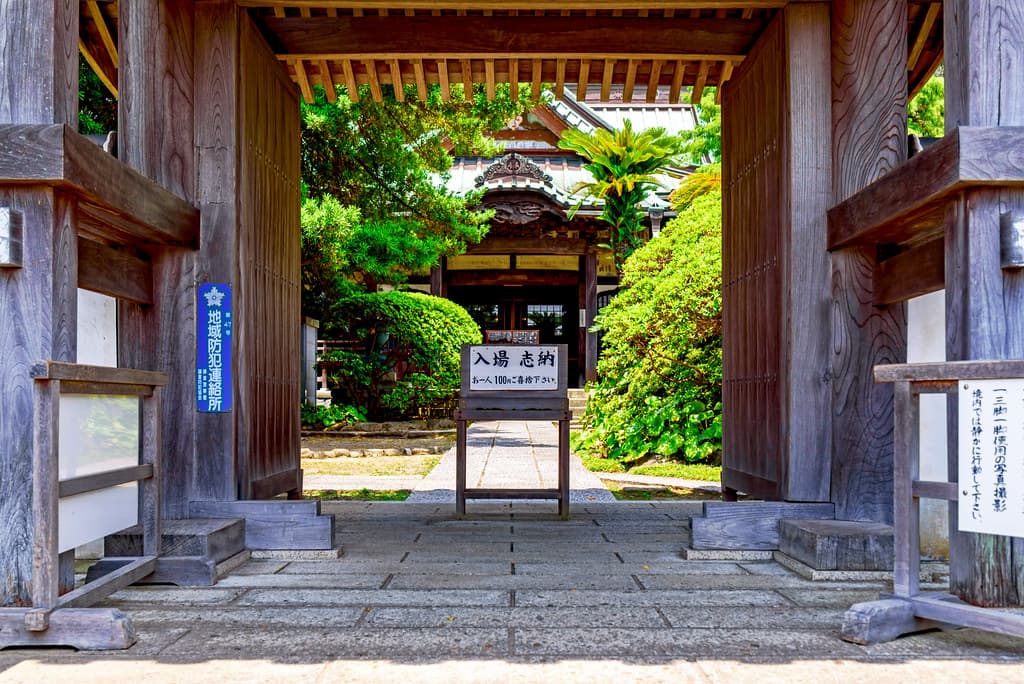
The walk in matters. From the main road through the Nikaidō valley, a Niōmon gate flanked by guardian figures opens onto two sets of stairs: the original moss-covered stone staircase, now closed to walking traffic to preserve its centuries of moss, and a parallel staircase for current visitors.
The two paths run almost beside each other, so the act of climbing the new staircase is also an act of looking sideways at the old one — at what the temple was, at what could not be sustained.
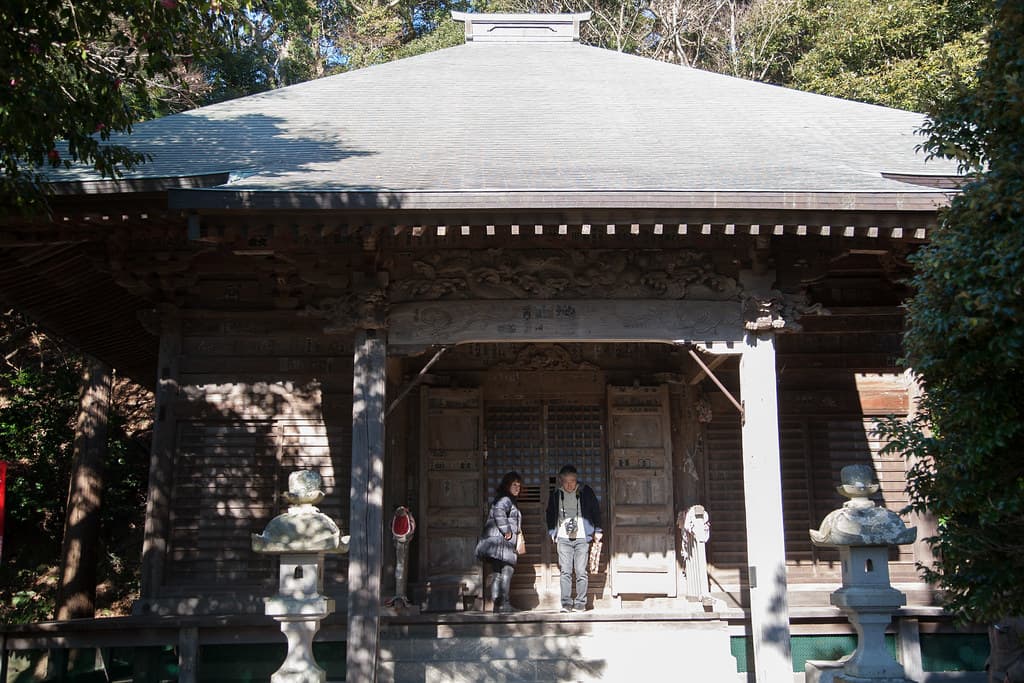
At the top, the precinct is small. A central Kannon-dō, a smaller subsidiary hall, the office where pilgrim stamps are issued. The sound of the road below disappears quickly. Visitors who arrive on the 1st or 18th of the month at 13:30 may witness the Goma fire ritual, when smoke rises and the three Eleven-Headed Kannon statues are unveiled together.
On other days the doors are closed but the hall is open enough for incense, a coin offering, and a quiet bow.
The atmosphere is most distinctive in early-summer rain, when the moss along the stairway turns saturated green, and in early morning shortly after the 08:00 opening, when the cedars filter cool light across the steps. The most photographed view of the temple is the moss staircase itself, but the deeper experience is interior: standing in the dark hall while three Heian-period Kannon stand back.
Approach via the bus from Kamakura Station to the 'Sugimoto Kannon' stop, then walk one minute to the gate. Pay the small admission at the entrance, climb the right-hand (current) staircase, pause at the Niō guardian figures, and continue up to the precinct. Visit the Kannon-dō first; the office and stamp window are to its side. If you are walking the Bandō circuit, this is where you receive your first goshuin — bring your nōkyō-chō or pilgrim's book.
Context and lineage
Tradition places the founding in 734 CE. Gyōki, traveling through the Kantō, looked down from Mount Taizō, saw what is now Kamakura, and was moved to carve a Kannon image and enshrine it on the hillside — the seed of the temple. Empress Kōmyō and Emperor Shōmu provided imperial sponsorship; Fujiwara no Fusasaki served as court patron.
In 851, the Tendai master Ennin is said to have carved a second Eleven-Headed Kannon for the same hall; in 985, the priest Genshin (Eshin Sōzu), at the order of cloistered Emperor Kazan, carved a third. These attributions are devotional rather than art-historical — the surviving images appear to date from the late Heian period — but the layering of three masters across three centuries is the ground of the Sanzon Doden enshrinement.
The most consequential narrative break came in 1189, when fire consumed the temple. The head priest, Jōdai-bō, ran into the flames and rescued the three Kannon statues, sheltering them beneath a giant cryptomeria. From that night the temple's everyday name became Sugimoto Kannon — Kannon under the cedar.
A second nickname, Geba Kannon ('Dismount Kannon'), grew from the legend that mounted samurai who tried to ride past the temple were thrown from their horses, an admonition to dismount before sacred ground.
Sugimoto-dera belongs to the Tendai school of Japanese Buddhism, founded on Mount Hiei by Saichō (767–822) and shaped in its early Kantō expansion by Ennin's missionary work. The temple is one of only two Tendai temples in Kamakura — a city otherwise dominated by Zen, Pure Land, and Nichiren institutions — and preserves a Tendai esoteric (taimitsu) liturgical layer through its monthly Goma rituals.
Gyōki (668–749)
Traditional founder
Nara-period Buddhist priest credited by temple tradition with siting the original Kannon hall and carving the first Eleven-Headed Kannon image.
Empress Kōmyō (701–760)
Imperial sponsor
Consort of Emperor Shōmu and devout patron of Buddhism, traditionally credited with sponsoring the temple's founding.
Ennin (794–864)
Heian-period Tendai master
Tendai patriarch traditionally credited with carving the second Eleven-Headed Kannon at Sugimoto-dera in 851.
Genshin / Eshin Sōzu (942–1017)
Heian-period Pure Land–Tendai scholar
Priest traditionally credited with carving the third Eleven-Headed Kannon in 985, on the order of cloistered Emperor Kazan.
Jōdai-bō
Head priest, 1189
Bettō (head priest) who carried the three Kannon statues out of the fire of 1189 and sheltered them under a cryptomeria, giving the temple its name.
Minamoto no Yoritomo and Minamoto no Sanetomo
Kamakura-shogunate patrons
Founder of the Kamakura shogunate and his son who established and supported the Bandō Sanjūsankasho, with Sugimoto-dera as Temple #1.
Traditions and practice
Daily sutra recitation in the Kannon-dō continues the Tendai liturgical pattern. Twice a month — on the 1st and 18th, the lunar dates traditionally associated with Kannon devotion — the resident clergy perform a Goma (護摩) fire offering at 13:30. Wooden prayer-sticks (gomagi) inscribed with intentions are added to the flames. During this ritual the doors of the Sanzon Doden are opened and the three Heian-period Eleven-Headed Kannon are visible together. Members of the public may attend.
The temple receives Bandō pilgrims year-round, issuing goshuin (temple stamps) and accepting nōkyō (transcribed sutras) at its office. Lay visitors light incense before the Kannon-dō, pray for compassion, healing, and protection, and frequently begin or close a Bandō circuit here. The Tendai school's broader interest in shōji ichinyō — the unity of birth, death, and Kannon's reach — is woven into routine devotional language at the temple.
If you can plan it, arrive on the 1st or 18th in time for the 13:30 Goma ritual. Bring a small offering of incense or a coin for the saisen-bako; pause at the Niōmon guardian gate before climbing; walk the new staircase slowly enough to take in the moss along the original. Inside the Kannon-dō, allow some quiet before leaving.
If you are starting the Bandō circuit, ask at the office for a nōkyō-chō; the staff can explain the practice of sutra-copying and the use of the pilgrim's book.
Buddhism
ActiveSugimoto-dera is one of only two Tendai temples in Kamakura and the city's oldest temple. As the first station of the Bandō Sanjūsankasho, it is the threshold where pilgrims enter the eastern Kannon circuit. Its three enshrined Eleven-Headed Kannon statues — attributed by tradition to Gyōki, Ennin, and Genshin — embody three successive layers of Tendai Kannon devotion stretching from the Nara through the Heian periods.
Perspectives and open questions
Sugimoto-dera is a place where temple tradition, art history, and lay devotion sit beside each other without resolving. The traditional founding story, the late-Heian carving dates, and the contemporary pilgrimage practice each describe a different temple in the same precinct.
Scholarly perspective
Sugimoto-dera is among the oldest verifiably continuous temple sites in Kamakura. Although the temple's annals attribute the three Eleven-Headed Kannon to Gyōki (8th c.), Ennin (9th c.), and Genshin (10th c.), modern art-historical analysis dates the surviving statues to the late Heian period (11th–12th c.); the attributions are devotional and legendary rather than verified. Two of the three statues are designated Important Cultural Properties of Japan. The 1189 fire and the temple's recovery are documented in Kamakura-period records.
Living and traditional perspectives
In Tendai devotional understanding, the Sanzon Doden enshrinement is a rare blessing: three living Kannon presences in one hall, each face on each statue representing a phase of compassionate response. The Bandō pilgrimage is framed as a way of meeting Kannon's thirty-three transformations across the eastern landscape, beginning at Kamakura's oldest seat. Sugimoto-dera, as Temple #1, holds the threshold position — both gate and starting point.
Alternative interpretations
Some folk-Buddhist traditions hold that the three statues are imbued with cumulative miraculous power because they survived the 1189 fire under the cedar tree; touching the prayer beads or receiving the goshuin from this temple is therefore considered especially auspicious for travelers and for those embarking on long undertakings.
Open questions
{"Exact original siting of the temple before the 1189 fire and rebuild","Identity of the carvers of the three surviving late-Heian statues","Earliest physical phase of the cryptomeria associated with the 1189 rescue legend"}
Plan your visit
Access and arrival
From JR Kamakura Station east exit, take the Keikyū or Tōkyū bus toward Kanazawa-Hakkei or Yokohama and alight at the 'Sugimoto Kannon' stop; the temple is a one-minute walk. Address: 903 Nikaidō, Kamakura, Kanagawa 248-0002. Phone: 0467-22-3463. Open 08:00–16:30 daily; admission 200 JPY adults, 100 JPY children. Mobile phone signal in this part of Kamakura is reliable on all major Japanese carriers.
Kamakura has a wide range of ryokan, hotels, and guest houses near the station, including options in the Hase neighborhood. For a multi-day Bandō pilgrimage, basing yourself in central Kamakura allows efficient travel between stations 1, 3, and 4.
Respectful visit
Modest, comfortable clothing. No formal dress required. Pilgrims often wear a white hakui (pilgrim coat) and carry a pilgrim staff (kongō-zue) and a sedge hat (sugegasa).
Permitted in the precincts and along the path; not permitted inside the Kannon-dō for the principal statues — follow posted signs. The original moss staircase may not be walked on but may be photographed from beside.
Customary offerings: incense at the burner before the Kannon-dō, a small coin in the saisen-bako, candles where provided. Pilgrims also deposit a transcribed nōkyō (sutra-copy) and receive a goshuin at the office in exchange for the small fee.
Original moss-covered staircase closed to foot traffic — use the parallel staircase | Quiet behavior inside and around the Kannon-dō | Remove hats inside the main hall | No photography of principal statues inside the Kannon-dō
The original moss staircase is closed to walking traffic; do not step on it under any circumstance — the moss is fragile and centuries old. Photography of the principal Kannon statues inside the hall is generally not permitted; follow posted signs. Remove hats inside the main hall and keep voices low.
Current practical details
Address
903 Nikaidō, Kamakura, Kanagawa 248-0002, Japan
Phone
Hours
Hours, fees, and access can change — verify on the official source before you travel. Practical details last checked Jun 2026.
Location
Map loads as you approach this section.
Pilgrim reflections
A portrait of encounter, not a score
Pilgrims describe what they felt, how present they could become, and whether the place would shape a journey. There are no stars and no ranking of traditions.
No reviewed reflections yet
The first pilgrims can help describe the character of being here.
Share a reflection
Available after an account-backed “Been there.” Every reflection is reviewed before publication.
Nearby sacred places
Explore other sacred places in the region. Proximity does not establish access or travel time; check each place’s guidance.

References
Sources consulted for this page. Source categories describe the publication, not a guarantee that every claim is verified. Traditional accounts and outside interpretations may differ.
- 01Sugimoto-dera — Wikipedia contributorsacademicComprehensive overview of founding, three Kannon statues, fire of 1189, and Bandō #1 status; cross-references academic sources.
- 02Bandō Sanjūsankasho — Wikipedia contributorsacademicConfirms Sugimoto-dera as Bandō #1 and provides circuit context.
- 03Sugimoto-dera Temple — Mossy Steps and Sacred Stone Stairs — Kamakura GuideguideLocal Kamakura visitor site; details Sanzon Doden enshrinement, monthly unveiling on the 1st and 18th, Goma fire ritual, moss staircase access restrictions.
- 04What is the Bando 33 Kannon Pilgrimage? — Temple NotesguideExplains role of Yoritomo and Sanetomo in establishing the Bandō circuit and Sugimoto-dera as starting point.
- 05Sugimotodera | Kamakura's Oldest Temple & Mossy Stone Steps — Visit Kamakura / Kamakura GuideguideConfirms 'Geba Kannon' (Dismount Kannon) nickname legend and Niōmon entrance.
- 06The oldest temple in Kamakura — Sugimoto-dera — VOYAPONguideVisitor experience details: stone steps, Niō guardians, atmosphere.
- 07Sugimoto-dera (Kamakura | Temples) — LIVE JAPANguidePractical visitor info — opening hours 08:00–16:30, admission 200 JPY adult / 100 JPY child, address, phone, bus access.
- 08KAMAKURA: Sugimoto-dera Temple's legend about 3-kannon statues that escaped from a fire — Japan TravelguideNarrative retelling of the 1189 fire and the cedar-tree origin of the temple's name.
Pilgrim glossary
- Kannon
- The bodhisattva of compassion, central to many East Asian pilgrimage routes.
- Sutra
- A canonical Buddhist scripture, often chanted as part of practice.
- Tendai
- A Japanese Buddhist school based on the Lotus Sutra, foundational to many later traditions.
- Pure Land
- A Buddhist tradition focused on rebirth in Amida Buddha's western paradise through devotional practice.
- Zen
- A Japanese Buddhist school emphasizing seated meditation and direct insight.
Share a photo
Help visitors recognize Sugimoto-dera. Every submission is reviewed before publication.