An'yō-in
Hōjō Masako's memorial temple and the home of the Tashiro Kannon
Understand sacred places, explore living traditions, and learn how to engage respectfully with Pilgrim Map.
Access has not been verified. Check current local guidance before planning a visit.
Kamakura, Kanagawa Prefecture, Japan
Read the sources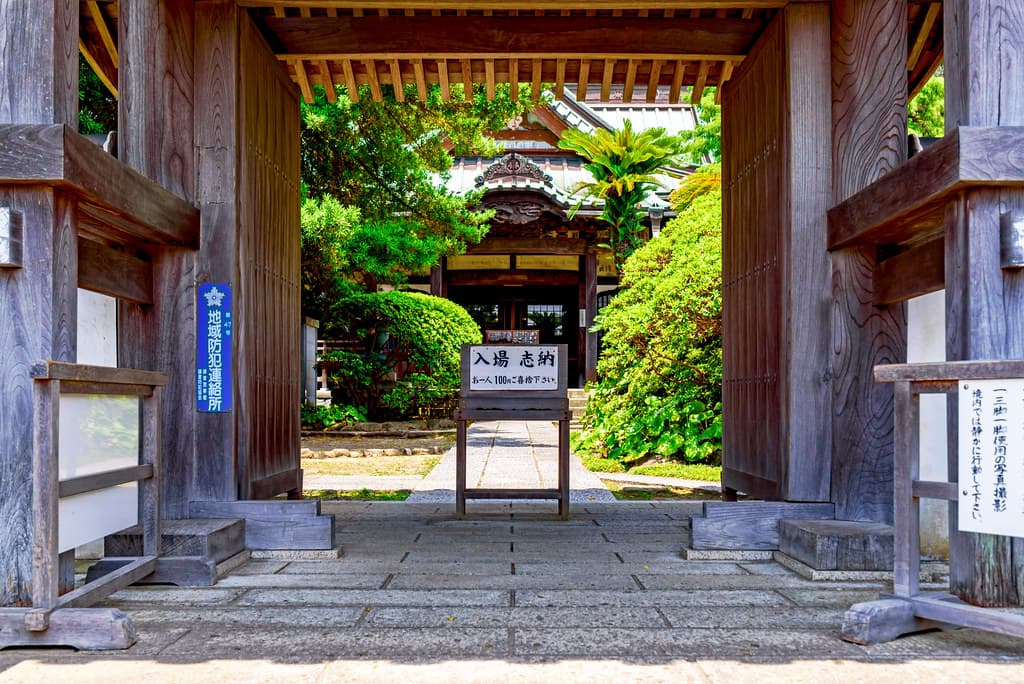
Image of An'yō-in (安養院). Image source
Station 3 of 33
Bandō Sanjūsankasho PilgrimageVisit essentials
A quick read before you go
- Duration
- 30–45 minutes for a contemplative visit including time at Masako's tomb stupa.
- Access
- About a 10-minute walk from the east exit of JR Kamakura Station (also accessible from the…
Overview
An'yō-in stands a short walk southeast of Kamakura Station, in the quieter Ōmachi neighborhood. Behind a small entrance gate, the precinct opens onto a Jōdo-shū main hall, an old hōkyōintō (jeweled-casket pagoda) traditionally identified as Hōjō Masako's tomb, and the centuries-old Obake Tsutsuji — 'ghost azaleas' — that flower in May into the temple's most photographed feature. The institution that today bears the name An'yō-in is the result of an Edo-period fusion of three earlier temples: Chōraku-ji, Zendō-ji, and Tashiro-ji.
The oldest devotional layer comes from Tashiro-ji. In 1192 the samurai Tashiro Nobutsuna — retainer of Yoritomo and Yoshitsune — enshrined a Senju Kannon (Thousand-Armed Kannon) in Hikigayatsu, and that image, known as the Tashiro Kannon, is now the principal pilgrimage honzon for Bandō #3. The institutional core comes from Chōraku-ji. In 1225, Hōjō Masako — Yoritomo's widow and the most powerful woman of the early Kamakura shogunate — founded the temple in Sasame-ga-yatsu to pray for her husband's repose.
After her own death, a chapel within its grounds was named An'yō-in after her posthumous name. Fires destroyed the original sites; the surviving institutions were merged on Zendō-ji's plot, the Tashiro Kannon was integrated, and the temple has carried all three histories since.
The three histories cohere in a particular way. The Senju Kannon's thousand reaching arms — Sahasrabhuja Avalokiteśvara in the Sanskrit name — meet a widow's grief; nembutsu chant for a dead husband meets samurai-warrior devotion to a bodhisattva who protects and brings worldly blessings. The temple's Tashiro Kannon is locally famous for prayers concerning relationships and family well-being, and the great azaleas that bloom each May feel like material witnesses to centuries of those prayers.
Behind the main hall, the simple stone hōkyōintō pagoda — the oldest of its kind in Kamakura — is the still center of all of this.
Why this place is sacred
An'yō-in's quality of thinness comes from convergence. Three earlier temples have been folded into one site without losing their distinct emotional registers, and the resulting precinct holds them in a tight space.
The first register is grief. Hōjō Masako founded the predecessor Chōraku-ji as a memorial for Yoritomo; her own posthumous name became the name of the place; the oldest hōkyōintō in Kamakura — said to be her tomb — stands behind the main hall. The second register is warrior devotion. Tashiro Nobutsuna, a samurai who served Yoritomo and Yoshitsune, enshrined the Senju Kannon that would later become this temple's pilgrimage image. The third register is bodhisattva compassion at scale.
The Senju Kannon's thousand arms reach, in classical iconography, toward all who suffer; the temple's local fame as a kannon for relationships, marriage, and family channels that universal reach into ordinary human hopes.
The Obake Tsutsuji — the giant azaleas, sometimes taller than visitors — bloom in May and intensify the precinct's sense of layered time. Many visitors describe the bloom as a physical reminder that prayers offered here have outlasted those who first prayed.
The predecessor Chōraku-ji was founded in 1225 by Hōjō Masako as a memorial temple to pray for the repose of Minamoto no Yoritomo's soul. The predecessor Tashiro-ji was founded in 1192 by the samurai Tashiro Nobutsuna to enshrine a Senju Kannon image. The Edo-period fusion produced the present An'yō-in, which since then has functioned as a Jōdo-shū temple, a Kannon pilgrimage station, and a memorial to Hōjō Masako.
Through the late medieval and Edo periods the three earlier temples were progressively merged: Chōraku-ji and Zendō-ji were destroyed by fire and consolidated, then in the Edo period the Tashiro Kannon was integrated from the surviving Tashiro-ji. The current main hall dates to a rebuilding after a 1680 fire. In modern times the temple has continued as an active Jōdo-shū institution and as Bandō #3, Kamakura 33 #3, and Kamakura 24 Jizō #24.
Experience and orientation
From Kamakura Station the walk passes through the Ōmachi neighborhood — quieter than the main station road, with side streets that sit at a slower pace. The temple gate is small and easy to miss. Inside the precinct, the path leads first to the main hall, where the Amida Nyorai (the temple's main honzon) is enshrined alongside the Senju Kannon and a restored statue of Hōjō Masako herself.
Behind the hall, set among older stones, stands the simple hōkyōintō pagoda traditionally identified as Masako's tomb.
The most distinctive seasonal experience is the early-to-mid-May bloom of the Obake Tsutsuji. These centuries-old azaleas grow taller than ordinary tsutsuji bushes, and the precinct in May is filled with deep colour pressed close around the paths. Outside azalea season the temple is much quieter — late March cherries, early-summer green, autumn maples — but the precinct retains its layered atmosphere year-round.
Weekday mornings are the calmest time. The temple is small enough that ten or fifteen minutes is sometimes all another visitor needs to pass through, and a longer pause near the tomb stupa or before the main hall opens up the temple's quieter character.
Walk about ten minutes southeast from the east exit of JR Kamakura Station, through the Ōmachi neighborhood. Pay the small admission at the entrance, visit the main hall first, then walk behind the hall to the hōkyōintō tomb stupa. Bandō pilgrims should bring their nōkyō-chō to the office for the Bandō #3, Kamakura 33 #3, and Kamakura 24 Jizō goshuin. There is no parking and no public restroom on-site.
Context and lineage
Tashiro Nobutsuna, a retainer of Minamoto no Yoritomo and his half-brother Yoshitsune, founded Tashiro-ji in Hikigayatsu in 1192 and enshrined a Senju Kannon image — the Tashiro Kannon. In 1225, Hōjō Masako, Yoritomo's widow and the de facto regent of the early Kamakura shogunate, founded Chōraku-ji in Sasame-ga-yatsu to pray for the repose of her husband's soul.
After Masako's own death, a chapel within Chōraku-ji's grounds was named An'yō-in — her posthumous Buddhist name — and the temple became as much a memorial for her as for Yoritomo.
Fires across the late medieval period destroyed the original Chōraku-ji and the nearby Zendō-ji. The surviving institutions were merged on Zendō-ji's plot and renamed An'yō-in. In the Edo period the principal image of Tashiro-ji — the Senju Kannon — was integrated into An'yō-in, completing a three-temple fusion that the present site continues to embody. The current main hall dates to a rebuilding after a 1680 fire.
An'yō-in is a Jōdo-shū (Pure Land) temple, in the lineage founded in Japan by Hōnen in the 12th century. The school's central practice is the recitation of Namu Amida Butsu (the nembutsu), with aspiration toward birth in Amida's western pure land. The Senju Kannon — Avalokiteśvara as compassionate companion to Amida — fits naturally into this devotional landscape. The predecessor Chōraku-ji was originally a Ritsu-sect temple; the move to Jōdo-shū came after the rebuild on Zendō-ji's site.
Hōjō Masako (1156–1225)
Founder of predecessor Chōraku-ji
Widow of Minamoto no Yoritomo and de facto regent of the early Kamakura shogunate; founded the predecessor temple Chōraku-ji as a memorial to her husband, and the present temple is named for her posthumous Buddhist name.
Minamoto no Yoritomo (1147–1199)
Subject of the original memorial
Founder of the Kamakura shogunate; the predecessor Chōraku-ji was founded by his widow to pray for the repose of his soul.
Tashiro Nobutsuna
Founder of predecessor Tashiro-ji
Samurai retainer of Yoritomo and Yoshitsune; founded Tashiro-ji in Hikigayatsu in 1192 and enshrined the Senju Kannon image now known as the Tashiro Kannon.
Sonjō
Founding priest of predecessor Tashiro-ji
Priest who consecrated the original Tashiro-ji and enshrined the Senju Kannon image at Tashiro Nobutsuna's request.
Hōnen (1133–1212)
Lineage founder
Founder of the Jōdo-shū (Pure Land) school of Japanese Buddhism, whose teaching of Namu Amida Butsu chanting underlies the temple's daily liturgy.
Traditions and practice
The resident clergy maintain the Jōdo-shū liturgical pattern, including recitation of Namu Amida Butsu (nembutsu) and the school's daily sutras. Memorial services (hōyō) for Hōjō Masako are observed annually. Daily devotions are offered before the Amida Nyorai (the temple's main honzon) and the Senju Kannon (the Bandō pilgrimage image).
Bandō pilgrims arrive at the temple office for the Bandō #3 stamp, often accompanied by stamps for the Kamakura 33 (#3) and the Kamakura 24 Jizō circuits. The Tashiro Kannon is invoked locally for prayers concerning love, marriage, family harmony, and fertility — a particular folk-Buddhist devotional layer that is well-known in the Kamakura area. During the May azalea season the precinct also functions as a flower-viewing temple, drawing visitors who may not otherwise be on the pilgrimage circuit.
Visit the main hall first, light incense, and offer a coin at the saisen-bako before going behind the hall to Hōjō Masako's tomb stupa. The tomb is the still center of the precinct; allow a quiet moment there. If you have come during azalea season, walk the path slowly and stay on it — the bushes are old and easily damaged.
If you are walking the Bandō circuit, the office can issue all three of An'yō-in's pilgrimage goshuin in one visit.
Buddhism
ActiveAn'yō-in is the result of the late medieval and Edo-period fusion of three earlier temples — Chōraku-ji (founded 1225 by Hōjō Masako), Zendō-ji, and Tashiro-ji (founded 1192 by Tashiro Nobutsuna). The temple takes its name from Masako's posthumous Buddhist name. Today's Jōdo-shū temple enshrines an Amida Nyorai together with the Senju Kannon known as Tashiro Kannon — the principal pilgrimage image for Bandō #3 — and a restored statue of Hōjō Masako. Behind the main hall stands a stone hōkyōintō traditionally identified as Masako's tomb, and recognized as the oldest such monument in Kamakura.
Perspectives and open questions
An'yō-in is best understood as a layered institution rather than a single temple. Each of its three predecessor histories — warrior, widow, monastic — shapes the way the present site is read.
Scholarly perspective
An'yō-in's institutional history is well-documented through medieval temple records and the Azuma Kagami chronicle. Modern scholarship treats the site as a fusion of three earlier temples consolidated across the late medieval and Edo periods. The hōkyōintō traditionally identified as Hōjō Masako's tomb is recognized as among the oldest surviving in Kamakura, though direct attribution rests on temple tradition.
Living and traditional perspectives
In Jōdo-shū devotional understanding, Masako's foundation of Chōraku-ji is a model of widowed grief transmuted into Pure Land aspiration: nembutsu prayers for her husband's birth in Amida's western paradise. The Tashiro Kannon, by contrast, comes from a samurai-warrior context (Tashiro Nobutsuna) and represents Kannon's role as protector and bringer of worldly blessings — especially for relationships and family. The two registers — Pure Land aspiration and worldly Kannon protection — coexist on the same altar.
Alternative interpretations
Local devotion treats the Tashiro Kannon as particularly efficacious for prayers concerning love, marriage, and harmony; the great azaleas are sometimes spoken of as material witnesses to centuries of such prayers. The temple has acquired a reputation in Kamakura as a quiet place to bring relational hopes.
Open questions
{"Original physical location and exact date of the predecessor Chōraku-ji before its rebuild on Zendō-ji's site","Date of the original Senju Kannon image's carving","Exact dating of the present main hall after the 1680 fire"}
Plan your visit
Access and arrival
About a 10-minute walk from the east exit of JR Kamakura Station (also accessible from the Enoden Kamakura Station) southeast through the Ōmachi neighborhood. Opening hours roughly 08:00–16:30 with seasonal variation; confirm before visiting. Admission 100 JPY. No parking and no public restroom on-site. Mobile phone signal is reliable on all major Japanese carriers in this part of Kamakura.
Central Kamakura has a wide range of ryokan, hotels, and guest houses. Most Bandō pilgrims base themselves near Kamakura Station or in the Hase neighborhood, visiting An'yō-in as part of a half-day on foot covering the central Kamakura cluster.
Respectful visit
Modest, walking-comfortable clothing. Pilgrim coat (hakui) and staff appropriate for those on the Bandō circuit.
Permitted in the precincts and around the azaleas; refrain from photographing inside the main hall unless explicitly allowed.
Incense, candles, monetary saisen, transcribed sutra (nōkyō) for the pilgrimage office.
Quiet voices near Masako's tomb stupa | Stay on the marked paths through the azaleas to protect the old plants | No photography inside the main hall
Quiet voices are expected near Masako's tomb stupa. Stay on the marked paths through the azaleas, especially during peak bloom; the centuries-old plants are protected. Photography inside the main hall is not permitted unless explicitly allowed.
Current practical details
Address
3-chōme-1-22 Ōmachi, Kamakura, Kanagawa 248-0007, Japan
Phone
Hours
Hours, fees, and access can change — verify on the official source before you travel. Practical details last checked Jun 2026.
Location
Map loads as you approach this section.
Pilgrim reflections
A portrait of encounter, not a score
Pilgrims describe what they felt, how present they could become, and whether the place would shape a journey. There are no stars and no ranking of traditions.
No reviewed reflections yet
The first pilgrims can help describe the character of being here.
Share a reflection
Available after an account-backed “Been there.” Every reflection is reviewed before publication.
Nearby sacred places
Explore other sacred places in the region. Proximity does not establish access or travel time; check each place’s guidance.


References
Sources consulted for this page. Source categories describe the publication, not a guarantee that every claim is verified. Traditional accounts and outside interpretations may differ.
- 01An'yō-in (Kamakura) — Wikipedia contributorsacademicDetailed history of Chōraku-ji / Zendō-ji / Tashiro-ji fusion, Jōdo-shū affiliation, Amida Nyorai honzon, Hōjō Masako's memorial role.
- 02祇園山 安養院 田代寺(田代観音) — Bandō Sanjūsankasho official site (bandou.gr.jp)officialOfficial Bandō circuit page — confirms Gionzan mountain name, Tashiro-dera designation, Senju Kannon as pilgrimage honzon.
- 03Anyoin Temple — Japan National Tourism OrganizationofficialOfficial tourism site — opening hours, admission, location, azalea season.
- 04安養院 (鎌倉市) — ウィキペディアacademicJapanese encyclopedia entry: Hōjō Masako tomb stupa, oldest hōkyōintō in Kamakura, complete fusion history.
- 05Anyo-in Temple — A Serene Retreat in Kamakura with Giant Azaleas and Samurai-Era Legacy — Kamakura GuideguideDetailed visitor experience, azalea (Obake Tsutsuji) information, Senju Kannon and Hōjō Masako enshrinement.
- 06鎌倉 安養院〜田代観音〜 — yoritomo-japan.comguideTashiro Nobutsuna founding of Tashiro-ji (1192); detailed Japanese-language history of the three-temple fusion.
- 07Anyoin Temple — Visit KamakuraguidePractical visitor information; confirms tomb of Hōjō Masako behind the main hall.
Pilgrim glossary
- Honzon
- The principal Buddhist deity enshrined as a temple's central object of worship.
- Kannon
- The bodhisattva of compassion, central to many East Asian pilgrimage routes.
- Bodhisattva
- An enlightened being who postpones full nirvana to help others toward awakening.
- Stupa
- A dome-shaped Buddhist monument that holds relics or marks a sacred place.
- Pure Land
- A Buddhist tradition focused on rebirth in Amida Buddha's western paradise through devotional practice.
Share a photo
Help visitors recognize An'yō-in. Every submission is reviewed before publication.