Kōzō-ji
A 1526 raised-floor Main Hall on 88 pillars and the temple of Kamatari's miraculous birth
Understand sacred places, explore living traditions, and learn how to engage respectfully with Pilgrim Map.
Access has not been verified. Check current local guidance before planning a visit.
Kisarazu, Chiba Prefecture, Japan
Read the sources
Station 30 of 33
Bandō Sanjūsankasho PilgrimageVisit essentials
A quick read before you go
- Duration
- 30–60 minutes for an attentive visit including the Main Hall, prayer, and stamping.
- Access
- By car: roughly 15–20 minutes inland from central Kisarazu, Chiba.
Overview
Kōzō-ji stands on a low forested ridge inland from central Kisarazu, on the Bōsō Peninsula. Its full mountain-and-temple name is Heiyasan Kōzō-ji, but devotees know it primarily as Takakura Kannon — the 'high-storehouse Kannon' — a name that refers as much to the architecturally unusual raised-floor Main Hall as to the original storehouse meaning.
The Main Hall is what most visitors come to see. It is a takayuka — a double-eaved irimoya hall raised about 2.45 metres above the ground on 88 floor pillars, requiring a flight of steps to enter. The form is unusual in Japan, and the hall is a Kisarazu City designated cultural property. Inside, the principal Shō-Kannon (Āryāvalokiteśvara) is a 3.6 m wooden image carved from a single camphor tree — formerly a hibutsu, with viewing limited.
The site is now a center for en-musubi prayer (auspicious-connection prayers, especially for matchmaking, marriage, and fertility), in part because of the Kamatari-birth legend. Bandō pilgrims who arrive after the urban Chiba-dera (#29) and before the architectural climax at Kasamori-ji (#31) often describe the precincts as the contemplative middle of the southern Chiba leg.
Why this place is sacred
Kōzō-ji's quality of thinness rests on three layered registers. The first is the 1526 Main Hall itself — a takayuka structure raised 2.45 metres above the ground on 88 floor pillars, with double eaves over an irimoya hipped-and-gabled roof. The form is rare in Japan and locally cited as architecturally distinctive; entering it means climbing into a wooden volume on stilts, which produces an unmistakable bodily sense of being lifted off the forest floor.
The Main Hall is a Kisarazu City designated cultural property, and the wood beneath the visitor's feet is itself the architectural argument.
The second register is the Kamatari legend. The mother of Fujiwara no Kamatari is said to have prayed at this site for a son, received a vision instructing her to visit Kashima Shrine, and conceived Kamatari shortly afterward. Kamatari, founding ancestor of the Fujiwara clan, would shape Japanese court politics for centuries.
The temple is read in this tradition as a place where Kannon's compassion intersects with one of the foundational political-religious genealogies of premodern Japan, and the en-musubi prayer practices that have grown up around the legend continue to draw visitors today, particularly couples and those carrying intentions around partnership, marriage, and fertility.
The third register is the setting. Kōzō-ji sits on a low ridge in inland Kisarazu, surrounded by quiet forest. The site is unhurried and rarely crowded; many pilgrims describe it as the contemplative pause of the southern Bandō leg, between the urban Chiba-dera (#29) and the architectural climax at Kasamori-ji (#31).
The Shō-Kannon honzon — a 3.6 metre image carved from a single camphor tree — is the devotional center of the hall, formerly a hibutsu and still treated with reserve in interior viewing.
Founded by temple tradition in the brief reign of Emperor Yōmei (585–587 CE) by a priest named Tokugi after a vision of Kannon. Subsequent legendary rebuildings credit the Nara-period priest Gyōki (after a second Kannon vision) and Fujiwara no Kamatari (650 CE, in gratitude for his miraculous birth through his mother's Kannon prayer at the site).
None of these accounts is contemporaneously documented; the principal devotion has been to the Shō-Kannon and to en-musubi (auspicious-connection) prayer rooted in the Kamatari-birth legend.
The temple's surviving fabric is late Muromachi: the Main Hall dates to about 1526. Earlier structures are not preserved. Sectarian affiliation today is Shingon-shū Buzan-ha, with mother temple Hase-dera (Sakurai, Nara). The Niō-mon (gate) and bell tower were rebuilt in the Edo period. Beyond traditional Kannon devotion, the temple's contemporary identity has crystallized around en-musubi prayer practice, memorial services (including pet memorial), and Bandō pilgrimage reception.
Experience and orientation
The drive takes you off the main coast roads into low forested hills; the precinct opens at the end of a quiet approach.
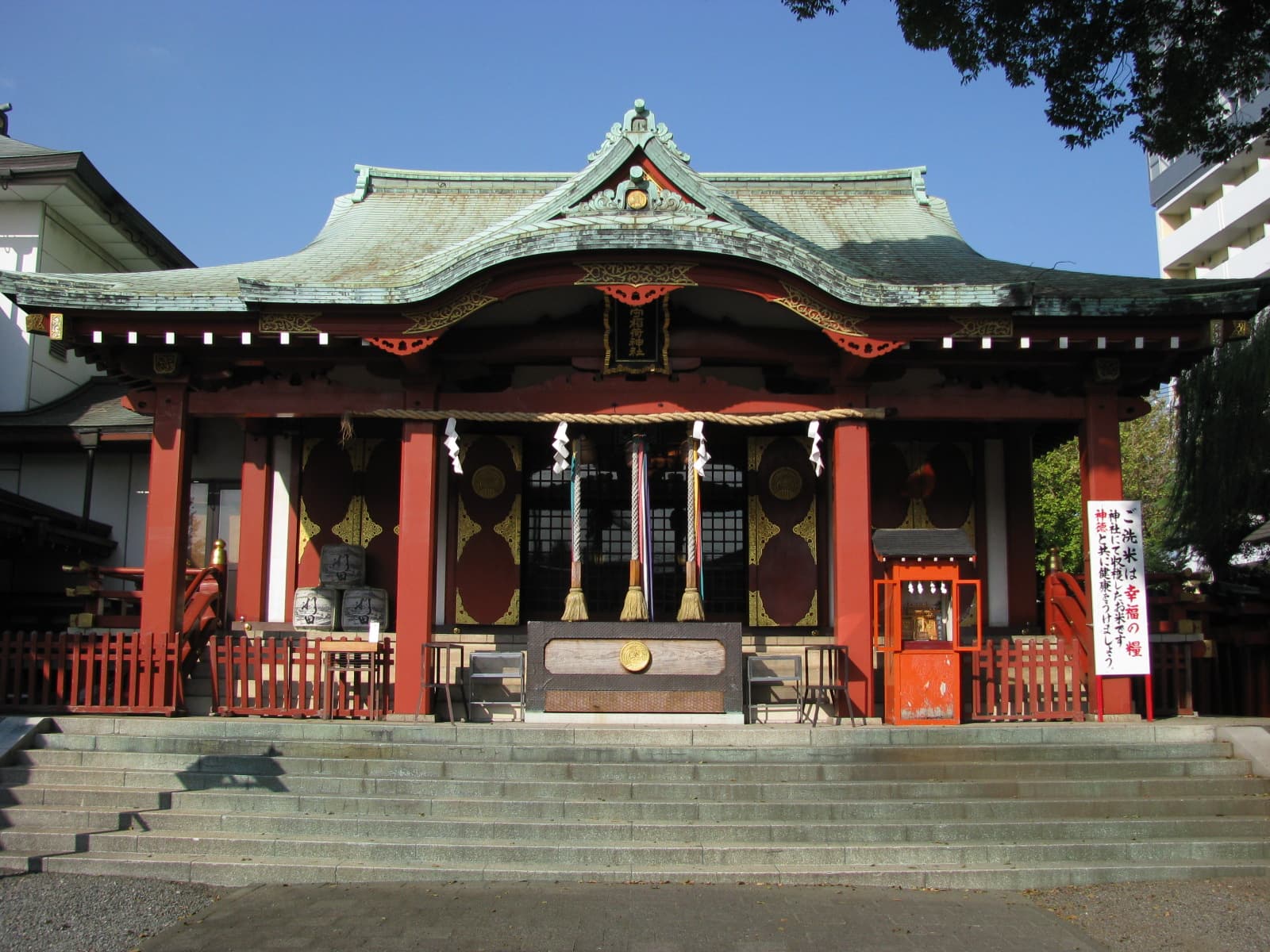
The Main Hall stands at the center. It is the temple's distinctive architectural feature and worth approaching slowly. Built about 1526, it is a takayuka — a 'high-floor' hall raised approximately 2.45 metres above the ground on 88 floor pillars, with double eaves over an irimoya hipped-and-gabled roof. A flight of steps brings you up onto the wooden platform; entering means stepping into a hall that sits on stilts above the earth.
The form is rare in Japan, and the experience of climbing into it is part of the visit.
By car, drive 15–20 minutes inland from central Kisarazu. By train and bus, take the JR Uchibō or Kururi Line to Kisarazu Station and connect to a local bus or taxi to the temple — confirm timetables with the temple or the Bandō pilgrimage association before traveling. From greater Tokyo, the Aqua-Line bridge from Kawasaki shortens the trip considerably.
At the temple, climb the steps onto the takayuka Main Hall, remove your shoes, light incense, and offer at the saisen box. Bandō pilgrims should bring their nōkyō-chō to the office for the #30 stamp.
Context and lineage
Three founding accounts overlap in the temple's tradition. The earliest places the foundation in the brief reign of Emperor Yōmei (585–587 CE) under a priest named Tokugi, who received an image or vision of Kannon at the site and built a hermitage. A second tradition attributes a rebuilding or dedication to the Nara-period itinerant priest Gyōki (668–749), again after a Kannon vision.
The third — the temple's most distinctive narrative — is the legend of Fujiwara no Kamatari (614–669), founding ancestor of the Fujiwara clan: his mother is said to have prayed here for a son, received a vision instructing her to make a pilgrimage to Kashima Shrine, and conceived Kamatari shortly afterward.
In 650 CE (Hakuchi era), in gratitude for his birth, Kamatari is said to have grandly rebuilt the temple with a seven-bay Main Hall, an Amida Hall, a three-story pagoda, and a bell tower.
None of these foundation accounts is contemporaneously documented. What is securely attested is the surviving Main Hall, dated to approximately 1526 (late Muromachi period) — a takayuka structure on 88 pillars that is recognized as architecturally distinctive in Japan and is a Kisarazu City designated cultural property. Niō-mon (gate) and bell tower were rebuilt in the Edo period. The relationship between the Tokugi and Gyōki foundation stories is not fully reconciled in the temple's records.
Kōzō-ji is currently a parish temple of the Buzan-ha branch of Shingon Buddhism, with mother temple Hase-dera (Sakurai, Nara) — one of the major esoteric Buddhist schools in Japan. Earlier sectarian affiliations are not securely documented; some sources note possibly Tendai-influenced earlier phases, consistent with the temple's broader trajectory of legendary founding and successive rebuildings.
Tokugi (徳義)
Legendary founding priest
By temple tradition, a priest of the brief reign of Emperor Yōmei (585–587 CE) who received a vision of Kannon at the Kōzō-ji site and established the original hermitage. His historicity is not independently corroborated.
Gyōki (668–749)
Legendary rebuilder
Nara-period itinerant monk later venerated as a bodhisattva. By a separate strand of temple tradition, Gyōki is credited with rebuilding or dedicating the temple after his own vision of Kannon.
Fujiwara no Kamatari (614–669)
Legendary grand rebuilder
Nara-period statesman and founding ancestor of the Fujiwara clan. By temple tradition, his mother prayed at Kōzō-ji for a son and conceived him after a Kannon vision; Kamatari is said to have grandly rebuilt the temple in 650 CE in gratitude.
Late-Muromachi-period carpenters
Builders of the surviving Main Hall
The carpenters responsible for the 1526 Main Hall — a takayuka double-eaved irimoya structure raised 2.45 m on 88 floor pillars, recognized today as architecturally rare in Japan.
Resident Shingon Buzan-ha clergy
Contemporary stewards
The continuing community responsible for daily liturgy, en-musubi prayer services, memorial and pet-memorial services, eternal-memorial (eitai-kuyō) burial arrangements, and Bandō pilgrim reception.
Traditions and practice
The temple's liturgy follows Shingon Buzan-ha esoteric forms — recitation of the Hannya Shingyō and Kannon-related sutras at the Shō-Kannon honzon, with mantras and hand-seals appropriate to the lineage. The en-musubi prayer practice is the temple's most distinctive contemporary devotional register: prayers for auspicious-connection, matchmaking, marriage, partnership, and conception are offered at the Main Hall and can be requested as formal services at the temple office.
Bandō pilgrims arrive year-round for the #30 nōkyō, often combining the visit with Chiba-dera (#29) earlier the same day and Kasamori-ji (#31) the next day. The temple advertises memorial services (kuyō) including pet memorial services, and offers eternal-memorial (eitai-kuyō) burial arrangements. Many visitors arrive specifically for en-musubi prayer rather than for the Bandō stamp. Bandō pilgrimage office hours are commonly 8:00–17:00 across the route — confirm directly with Kōzō-ji before traveling.
Allow 30 to 60 minutes for an attentive visit, longer if combining with the surrounding grounds and a slow forest walk. Approach the takayuka Main Hall on foot from the precinct gate and pause at the foot of the steps before climbing. Once on the platform, remove your shoes, light incense, and offer at the saisen box; the proportions of the hall register more clearly when you stand still inside it.
If you carry an intention around relationships, partnership, or family, this is the temple's traditional setting for those prayers; the Kamatari-birth legend gives the practice a long lineage. Bandō pilgrims should bring their nōkyō-chō for the #30 stamp.
Buddhism
ActiveKōzō-ji is a parish temple of the Buzan-ha branch of Shingon Buddhism, with mother temple Hase-dera in Sakurai, Nara. The honzon is Shō-Kannon (Āryāvalokiteśvara) — a 3.6 m wooden image carved from a single camphor tree, formerly a hibutsu. As Bandō #30, the temple is the contemplative middle of the southern Chiba leg, between the urban Chiba-dera (#29) and the architectural climax at Kasamori-ji (#31). The 1526 Main Hall — a takayuka structure on 88 floor pillars with a 2.45 m raised floor and a double-eaved irimoya roof — is a Kisarazu City designated cultural property and architecturally rare in Japan. Local devotion centers on en-musubi (auspicious-connection / matchmaking and conception) prayers, rooted in the temple's most distinctive legend: the mother of Fujiwara no Kamatari prayed here for a son and received a Kannon vision that led to his birth.
Bandō Sanjūsankasho Pilgrimage
Active30th station of the 1,300+ km Bandō Kannon pilgrimage; positioned between the urban Chiba-dera (#29) and the architectural climax at Kasamori-ji (#31) on the southern Chiba leg of the circuit.
Perspectives and open questions
Kōzō-ji is a temple where overlapping foundation legends, a securely documented late-Muromberg Main Hall, and a long en-musubi prayer practice converge. Holding all three open is the most honest way to read the precinct.
Scholarly perspective
Surviving fabric — Main Hall ca. 1526, with Edo-period gates and bell tower — is well documented. Pre-Muromachi history rests almost entirely on temple legend rather than independent records. The Tokugi (6th-century), Gyōki (Nara-period), and Fujiwara no Kamatari (650 CE) foundation traditions are not contemporaneously corroborated; their relationship to one another is not fully reconciled in retrieved sources. The unusual takayuka double-eaved irimoya structure is recognized as architecturally distinctive in Japan and is a Kisarazu City designated cultural property.
Available research notes the temple's records flag a medium-confidence reading on pre-Muromachi history.
Living and traditional perspectives
Temple tradition affirms a continuous Kannon presence at the site from the 6th century, grounded in the Tokugi-vision and Gyōki-vision narratives, and weaves the temple into the founding legend of the Fujiwara clan via Kamatari's mother. Within Shingon-shū Buzan-ha practice, the site is read as a power-place for Kannon's compassion as it manifests in human relationships — marriage, conception, lineage — a reading reinforced by the Kamatari narrative.
Alternative interpretations
Visitors arriving for en-musubi prayer often interpret the temple's quiet inland setting and the takayuka Main Hall as conducive to slow-paced prayer for partnership, family, or fertility. Some readings emphasize the symbolic resonance of climbing into a wooden hall on 88 pillars — taking each prayer up a step from the forest floor — as part of the precinct's appeal.
Open questions
{"The actual date and circumstances of the original temple's construction","The relationship between the Tokugi (6th-century) and Gyōki (Nara-period) founding stories","Historicity of the Fujiwara no Kamatari rebuilding tradition (650 CE)","Specific visiting hours during off-season (typically 8:00–17:00 per common Bandō practice; verify with the temple)","Detailed annual festival calendar beyond regular Bandō pilgrimage practice"}
Plan your visit
Access and arrival
By car: roughly 15–20 minutes inland from central Kisarazu, Chiba. Public transport: bus from JR Kisarazu Station on the JR Uchibō / Kururi Lines; routes and timetables are limited, so checking the temple's official site or the Bandō pilgrimage association is recommended. The Aqua-Line bridge from Kawasaki/Tokyo makes Kisarazu reachable as a day trip from greater Tokyo. Bandō pilgrimage office hours are commonly 8:00–17:00 across the route — confirm directly with the temple before traveling.
Mobile phone signal is reliable on all major Japanese carriers in inland Kisarazu, though some forest pockets may have weaker reception.
Central Kisarazu offers business hotels and city accommodations. Many pilgrims base themselves in Kisarazu and visit Kōzō-ji as a half-day excursion before continuing to Kasamori-ji and Kiyomizu-dera further south.
Respectful visit
Modest, comfortable clothing. Pilgrim attire (hakui, sugegasa, kongō-zue) welcome but not required.
Permitted in the precincts; interior photography of the honzon and altar areas is generally restricted — ask before photographing inside the Main Hall.
Saisen (small coin) at the offertory box; incense at the dedicated stand. Goshuin and en-musubi service fees paid at the temple office.
Remove shoes before entering wooden hall interiors | Do not climb on or lean against the historic raised-floor pillars (Kisarazu City designated cultural property) | Speak quietly during others' prayers, particularly during en-musubi or memorial services | Interior altar photography is generally restricted
The 1526 Main Hall is a Kisarazu City designated cultural property; do not lean on, climb on, or otherwise disturb the architectural elements. Interior altar photography is generally restricted — ask before photographing inside the Main Hall. Forest paths around the temple can be slippery after heavy rain, and approach roads occasionally close in the immediate aftermath of summer typhoon weather (August–September); check forecasts before traveling.
Current practical details
Address
1245 Yana, Kisarazu, Chiba 292-0812, Japan
Phone
Hours
Hours, fees, and access can change — verify on the official source before you travel. Practical details last checked Jun 2026.
Location
Map loads as you approach this section.
Pilgrim reflections
A portrait of encounter, not a score
Pilgrims describe what they felt, how present they could become, and whether the place would shape a journey. There are no stars and no ranking of traditions.
No reviewed reflections yet
The first pilgrims can help describe the character of being here.
Share a reflection
Available after an account-backed “Been there.” Every reflection is reviewed before publication.
Nearby sacred places
Explore other sacred places in the region. Proximity does not establish access or travel time; check each place’s guidance.



References
Sources consulted for this page. Source categories describe the publication, not a guarantee that every claim is verified. Traditional accounts and outside interpretations may differ.
- 01平野山 高蔵寺(高倉観音)| 坂東三十三観音 公式サイト — Bandō Sanjūsankasho Official Pilgrimage AssociationofficialOfficial pilgrimage association page for temple #30.
- 02千葉県木更津市の縁結びは高蔵寺 — Kōzō-ji (Takakura Kannon) templeofficialOfficial temple website; emphasizes en-musubi (matchmaking / good-relationship) prayers and Bandō #30 status.
- 03Kōzō-ji (Kisarazu, Chiba) — Wikipedia — Wikipedia contributorsofficialEncyclopedia-level summary; consistent with Japanese-language sources on sect, honzon, founding legend, and Main Hall date.
- 04高蔵寺 (木更津市) — Wikipedia (Japanese) — Wikipedia contributorsofficialJapanese Wikipedia; gives founding legend tied to Emperor Yōmei (585–587), Fujiwara no Kamatari rebuilding tradition (650 CE), and confirms 1526 main hall reconstruction.
- 05高倉観音(高蔵寺)— ちば観光ナビ — Chiba Prefecture Official Tourism SiteofficialPrefectural tourism portal listing for the temple.
- 06The Temple Guy: The Bando 33 Kannon Route — James Baquet (The Temple Guy)guideLong-form pilgrim's account of the full Bandō route by an experienced foreign pilgrim.
- 07第30番札所 平野山 高蔵寺(高倉観音)— 坂東三十三観音霊場を歩く — Kasajizō (pilgrimage walking guide site)guideDetailed Japanese pilgrimage guide site with temple-by-temple notes.
Pilgrim glossary
- Honzon
- The principal Buddhist deity enshrined as a temple's central object of worship.
- Kannon
- The bodhisattva of compassion, central to many East Asian pilgrimage routes.
- Sutra
- A canonical Buddhist scripture, often chanted as part of practice.
- Shingon
- An esoteric Japanese Buddhist school emphasizing ritual, mantra, and mandala practice.
- Tendai
- A Japanese Buddhist school based on the Lotus Sutra, foundational to many later traditions.
Share a photo
Help visitors recognize Kōzō-ji. Every submission is reviewed before publication.