Ganden-ji
A Sōtō Zen hilltop temple where Kannon was said to step from the rocks
Understand sacred places, explore living traditions, and learn how to engage respectfully with Pilgrim Map.
Access has not been verified. Check current local guidance before planning a visit.
Zushi, Kanagawa Prefecture, Japan
Read the sources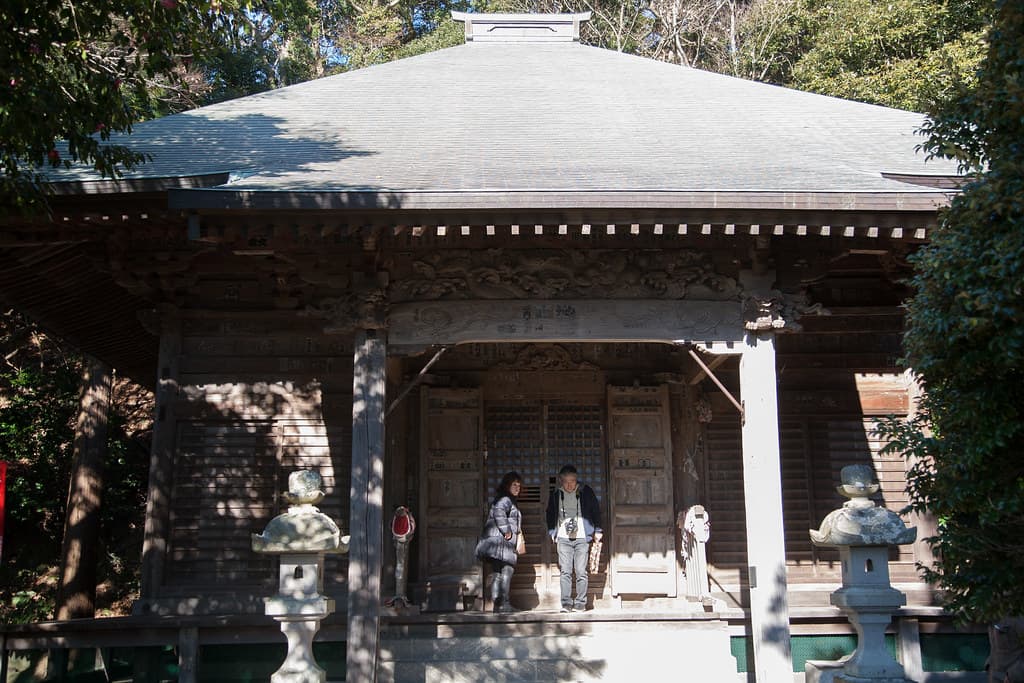
Image of Ganden-ji (岩殿寺). Image source
Station 2 of 33
Bandō Sanjūsankasho PilgrimageVisit essentials
A quick read before you go
- Duration
- 45–60 minutes for a contemplative visit including the climb to the hondō and the cliff-side cave…
- Access
- About a 17-minute walk from Zushi Station on the JR Yokosuka Line / Keikyū Zushi-Hayama.
Overview
On a wooded hill in Zushi's Hisagi neighborhood, near the station and sea, Ganden-ji centers on a cliff-side cave shrine and its small stone Kannon—the 'rock palace' behind the name Iwadono. Temple tradition dates its founding to Yōrō 5 (721 CE), when Tokudō followed auspicious light to a rocky outcrop, heard the Eleven-Headed Kannon mantra rise from the stones, and saw Kannon on the cliff.
An old man revealed as the local protective deity entrusted him to make this 'a good sacred place for all people'; Gyōki later carved the principal Kannon and consecrated the temple.
Now Sōtō Zen, Ganden-ji's Kannon devotion predates that affiliation. As Bandō Sanjūsankasho's second station, after Sugimoto-dera, it deepens the circuit in a wilder hillside setting. Emperor Kazan held services here in 990; Emperor Shirakawa designated Bandō #2 in 1174; and the Azuma Kagami records frequent visits by Minamoto no Yoritomo and his family. Novelist Izumi Kyōka later came to recover after his father's death, adding healing-after-loss to the temple's compassionate character.
Early-summer hydrangeas lining the path also make it an ajisai-dera, or 'hydrangea temple.'
Why this place is sacred
What gives Ganden-ji its quality is the layering of two registers — a mountain-cult substrate where rock and bodhisattva were experienced as a single revelation, and a later Sōtō Zen liturgical framework that holds the older devotion in place. The cliff-side cave is the geographic and devotional center of this layering.
Visitors who walk up to the cave find a small stone Kannon in a recess in the rock; the cave's quiet has the particular hush of a place where outside sound does not reach.
The site is also relational. As the second station of the Bandō circuit, Ganden-ji is where many pilgrims describe the journey shifting from sightseeing to embodied practice. The climb to the hilltop is short but real; the cave is reached by a further footpath.
Imperial patronage from Kazan and Shirakawa, samurai patronage from the Minamoto, Sōtō Zen liturgy in the medieval and modern periods, and the literary recovery of Izumi Kyōka in the early 20th century have all left their marks here without erasing one another.
Experience and orientation
From Zushi Station the approach passes through residential streets that gradually narrow and tilt upward. The temple gate sits at the foot of the hill; the climb to the hondō is short but enough to slow breath. At the top, the precinct opens onto a hilltop view across the rooftops of Zushi toward the wooded ridges to the west.
The main hall and Kannon-dō stand in the center; the cliff-side cave shrine, with its small stone Kannon image, is reached by a further footpath.
The atmosphere is most distinctive in early summer, when hydrangeas bloom along the hillside paths and the rainy-season light intensifies the green of moss and leaf. In autumn the maples in the precinct turn red against the cliff face. Weekday mornings are the quietest time — a window in which the cave-shrine and the small main hall can be visited without crowds, and the contrast with the busier Kamakura sights becomes most legible.
Walk from JR Zushi Station / Keikyū Zushi-Hayama (about 17 minutes) through the Hisagi neighborhood. Approach the temple gate, climb to the hondō, pause for prayer or incense, then take the further footpath to the cliff-side cave shrine. Bandō pilgrims should bring their nōkyō-chō to the temple office for the Bandō #2 stamp.
Context and lineage
The temple's founding legend describes Tokudō climbing toward auspicious clouds and a descending beam of light, hearing the Kannon mantra rise from the rocks, and seeing the figure of the Eleven-Headed Kannon appear on the cliff. The old man who entrusted the place to him is, in the temple's own narrative, the local protective deity — a kami–buddha syncretic motif (shinbutsu shūgō) typical of Japanese mountain Buddhism.
Gyōki, traveling in the Kantō, later carved the principal Kannon image and consecrated the site.
Emperor Kazan visited and performed Buddhist services here in 990. Emperor Shirakawa formally designated the temple as Bandō #2 in 1174. The Azuma Kagami chronicle records Minamoto no Yoritomo and members of his family as frequent visitors during the early Kamakura period; donations to the temple are documented in the same source. In later medieval and Edo periods the temple's affiliation became Sōtō Zen, although the date of this transition is uncertain.
Today's Ganden-ji is affiliated with the Sōtō school of Zen Buddhism, founded in Japan by Dōgen (1200–1253) and his successor Keizan. The temple is one of only two Sōtō temples on the Bandō circuit. Its earlier sectarian affiliation — likely Hossō or Tendai given the era of its founding — is not clearly documented; the site's deepest devotional layer is its Kannon worship, which predates and survives the school changes.
Tokudō (656–735)
Founding priest
Nara-period Buddhist priest credited by temple tradition with founding the site in 721 after his vision on the rocky outcrop.
Gyōki (668–749)
Consecrating priest
Traditionally credited with carving the principal Eleven-Headed Kannon image and consecrating the temple.
Emperor Kazan (968–1008)
Imperial patron
Cloistered emperor who visited and performed services at Ganden-ji in 990, part of his broader patronage of Kannon devotion in the eastern provinces.
Emperor Shirakawa (1053–1129)
Designator of Bandō #2
Cloistered emperor who in 1174 formally designated Ganden-ji as the second station of the Bandō Sanjūsankasho.
Minamoto no Yoritomo (1147–1199)
Kamakura-period patron
Founder of the Kamakura shogunate; recorded in the Azuma Kagami as a regular visitor and donor.
Izumi Kyōka (1873–1939)
Literary associate
Modern Japanese novelist who recovered at Ganden-ji after his father's death; the association links the temple to a broader cultural memory of healing-after-loss.
Traditions and practice
The resident Sōtō clergy maintain a regular liturgical schedule including zazen and the chanting of the school's daily sutras. Daily Kannon devotions before the Eleven-Headed Kannon honzon continue an older devotional layer. The cliff-side cave shrine, with its small stone Kannon image, receives offerings of incense and silent prayer.
Bandō pilgrims arrive at the office to offer their transcribed nōkyō (sutra-copy) and receive the Bandō #2 goshuin. Lay visitors come for prayers concerning compassion, healing, safe childbirth, and relief from suffering — drawing on the Eleven-Headed Kannon's classical role as the bodhisattva who turns toward those in need. In June, the hillside hydrangeas attract seasonal visitors as well as pilgrims.
Allow time for both the main hall and the cliff-side cave shrine; the cave is reached by a further short walk and is the temple's distinctive feature. Approach the cave quietly; the small enclosed space deepens any noise. If you are walking the Bandō circuit, ask at the temple office about the practice of sutra-copying and the use of the nōkyō-chō.
Confirm current opening hours and admission directly with the temple before visiting — English-language references do not consistently document them.
Buddhism
ActiveGanden-ji, traditionally founded in 721 by the priest Tokudō and consecrated by Gyōki, is the second station of the Bandō Sanjūsankasho. Although today a Sōtō Zen temple, its core devotion is to the Eleven-Headed Kannon — a continuity that long predates its Zen affiliation. The temple's hillside cave shrine with a stone Kannon image preserves the original mountain-cult character of Iwadono ('rock palace'), and the temple was patronized by Emperor Kazan, Emperor Shirakawa, and Minamoto no Yoritomo.
Perspectives and open questions
Ganden-ji's history sits at the junction of legendary mountain Buddhism, documented Kamakura-period patronage, and a later Sōtō Zen overlay. The site's deepest layer is the rock — the cliff-cave that gives the temple its name.
Scholarly perspective
Ganden-ji's traditional founding date of 721 CE is legendary; the site has clearly been a place of Kannon devotion for many centuries, with documentary evidence (Azuma Kagami) for Kamakura-period patronage by the Minamoto. The conversion to Sōtō Zen affiliation is later than the original devotional layer; the precise date of that transition is uncertain.
Living and traditional perspectives
In the temple's own narrative, the rock outcrop is a 'meditation cave' where Kannon revealed itself; the protective old-man deity who entrusted the place to Tokudō reflects a kami–buddha syncretic substrate (shinbutsu shūgō) typical of Japanese mountain Buddhism. The Bandō circuit framing places Ganden-ji as the temple where, after the threshold of Sugimoto-dera, the journey becomes interior.
Alternative interpretations
Local devotion treats the cliff-cave Kannon as especially efficacious for compassion-based prayers — for healing, safe childbirth, and relief from suffering — drawing on the Eleven-Headed Kannon's classical role as the bodhisattva who turns toward those in need.
Open questions
{"Original sectarian affiliation before Sōtō Zen","Date of the Sōtō school takeover and the names of its medieval restorers","Original carving date of the present principal Kannon image"}
Plan your visit
Access and arrival
About a 17-minute walk from Zushi Station on the JR Yokosuka Line / Keikyū Zushi-Hayama. Address: Hisagi neighborhood (久木), Zushi, Kanagawa. Mobile phone signal in this part of Zushi is reliable on all major Japanese carriers. Specific opening hours and admission fees were not consistently documented in English-language sources at time of writing; check the official Bandō Sanjūsankasho site (bandou.gr.jp) or contact the temple directly for current information.
Zushi has a small selection of business hotels and inns near the station. Many Bandō pilgrims base themselves in central Kamakura (a short train ride east) and visit Ganden-ji as a half-day side trip.
Respectful visit
Modest, walking-appropriate clothing. Closed-toe shoes recommended for the climb. Pilgrims often wear a hakui and carry a pilgrim staff.
Generally permitted in the precincts; avoid flash in the rock-cave area; refrain from photographing inside the Kannon-dō unless explicitly allowed.
Incense, candles, monetary saisen, transcribed sutra (nōkyō) for the pilgrimage office.
Quiet voices around the cave-shrine and main hall | Stay on marked paths during hilltop and cliff approaches | No flash photography near the rock-cave shrine
Stay on marked paths during the hilltop and cliff approaches. Use of flash is discouraged in the rock-cave area. During hydrangea season, paths can be slippery in rain.
Current practical details
Address
5-chōme-7-11 Hisagi, Zushi, Kanagawa 249-0001, Japan
Phone
Hours
Hours, fees, and access can change — verify on the official source before you travel. Practical details last checked Jun 2026.
Location
Map loads as you approach this section.
Pilgrim reflections
A portrait of encounter, not a score
Pilgrims describe what they felt, how present they could become, and whether the place would shape a journey. There are no stars and no ranking of traditions.
No reviewed reflections yet
The first pilgrims can help describe the character of being here.
Share a reflection
Available after an account-backed “Been there.” Every reflection is reviewed before publication.
Nearby sacred places
Explore other sacred places in the region. Proximity does not establish access or travel time; check each place’s guidance.


References
Sources consulted for this page. Source categories describe the publication, not a guarantee that every claim is verified. Traditional accounts and outside interpretations may differ.
- 01Ganden-ji — Wikipedia contributorsacademicConfirms Sōtō Zen affiliation, Jūichimen Kannon honzon, hilltop location, and cliff-side cave with stone Kannon image.
- 02岩殿寺 (逗子市) — ウィキペディアacademicJapanese-language encyclopedia entry — founding by Tokudō and Gyōki, Imperial visits by Kazan and Shirakawa, Yoritomo donations recorded in Azuma Kagami.
- 03第2番札所 海雲山 岩殿寺 曹洞宗 神奈川県逗子市 — Bandō 33 Kannon Pilgrimage (kasazizou.com)officialPilgrimage-circuit reference for Bandō #2 — confirms Kaiunzan mountain name, Sōtō sect, Eleven-Headed Kannon honzon.
- 04Bandō Sanjūsankasho — Wikipedia contributorsacademicBandō circuit context; Ganden-ji as Temple #2 and one of two Sōtō temples on the circuit.
- 05Zushi: Ganden-ji Temple has been a sacred, tranquil place for 1300 years — Japan Travelguide1,300-year continuity, hilltop atmosphere, founded 721, role in Bandō pilgrimage.
- 06A Spiritual Trek in Zushi — Visit Kanagawa / Tokyo Day TripguideVisitor-experience description; Izumi Kyōka literary association; access from Zushi Station.
- 07岩殿寺〜坂東三十三所第二番:逗子の岩殿観音〜 — yoritomo-japan.comguideDetailed Japanese-language history of Tokudō legend, Imperial patronage, and Yoritomo support.
- 08岩殿寺(岩殿観音) — Miura Hantō BiyoriguideHydrangea blooming season, Yoritomo and Izumi Kyōka literary connections.
Pilgrim glossary
- Honzon
- The principal Buddhist deity enshrined as a temple's central object of worship.
- Kannon
- The bodhisattva of compassion, central to many East Asian pilgrimage routes.
- Bodhisattva
- An enlightened being who postpones full nirvana to help others toward awakening.
- Sutra
- A canonical Buddhist scripture, often chanted as part of practice.
- Mantra
- A sound, word, or phrase repeated as part of meditation or ritual.
- Tendai
- A Japanese Buddhist school based on the Lotus Sutra, foundational to many later traditions.
- Zen
- A Japanese Buddhist school emphasizing seated meditation and direct insight.
Share a photo
Help visitors recognize Ganden-ji. Every submission is reviewed before publication.